The Truth About the Dodge Durango Hybrid
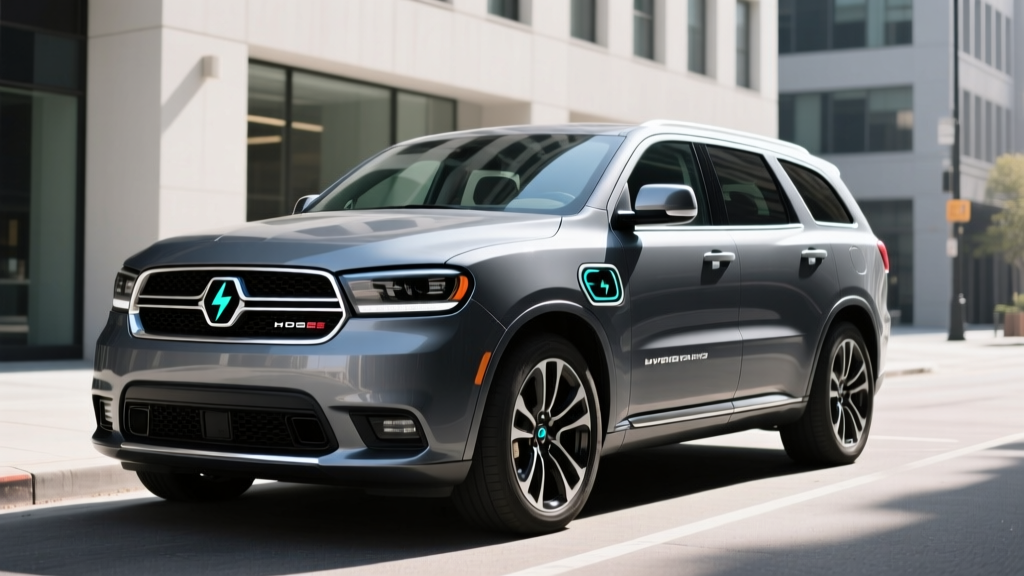
If you've been searching for a Durango hybrid, you've probably noticed something frustrating: as of early 2026, Dodge does not sell a hybrid version of its three-row SUV. The current-generation Durango remains a body-on-frame, V6-or-V8, gas-only vehicle — a holdover from an era when Stellantis prioritized horsepower over efficiency in its Dodge lineup.
That doesn't mean the search is pointless. Stellantis has confirmed electrified versions of future Dodge vehicles are in development, and industry reports suggest a next-generation Durango (expected for the 2027 model year) could debut with a plug-in hybrid (PHEV) or mild-hybrid powertrain. Until then, buyers seeking a hybrid three-row SUV from the Stellantis family — or from any automaker — need to look at what's actually available today.
This guide covers where the Durango hybrid stands, what powertrain options exist on the current model, which competing three-row hybrids make sense right now, and how to decide whether a conventional hybrid (HEV), plug-in hybrid (PHEV), or full battery-electric vehicle (BEV) fits your family.
Current Dodge Durango Powertrain Lineup (2026)
The 2026 Dodge Durango carries over the same powertrain options that have defined it for years. There is no hybrid, mild-hybrid, or plug-in variant in the current lineup.
| Engine | Horsepower | Torque (lb-ft) | EPA City/Hwy/Combined MPG | Drivetrain | Starting MSRP |
|---|---|---|---|---|---|
| 3.6L Pentastar V6 | 293 hp | 260 | 19 / 26 / 21 | RWD or AWD | ~$42,000 |
| 5.7L HEMI V8 | 360 hp | 390 | 14 / 22 / 17 | AWD | ~$52,000 |
| 6.4L HEMI V8 (SRT) | 475 hp | 470 | 13 / 19 / 15 | AWD | ~$72,000 |
For a midsize three-row SUV, the V6 Durango's 21 MPG combined is below competitors that offer hybrid powertrains. The Toyota Highlander Hybrid, for instance, returns up to 36 MPG combined — a 71% improvement — while offering similar seating capacity.
HEV vs. PHEV: What a Future Durango Hybrid Could Look Like
When (and if) Dodge introduces a Durango hybrid, it will likely fall into one of two categories. Understanding the distinction is essential before you shop any hybrid SUV.
Conventional Hybrid (HEV)
- How it works: A small battery (typically 1–2 kWh) and electric motor assist the gas engine. The battery recharges through regenerative braking and the engine — you never plug it in.
- Electric-only range: None or negligible (under 1 mile at low speeds).
- Efficiency gain: 25–40% better MPG than a gas-only equivalent, especially in city driving where the electric motor handles low-speed acceleration.
- Example: Toyota Highlander Hybrid (36 MPG combined).
Plug-In Hybrid (PHEV)
- How it works: A larger battery (typically 15–25 kWh) and more powerful electric motor allow genuine electric-only driving. You plug in to recharge (Level 1 or Level 2 AC charging). Once the battery depletes, it operates like a conventional hybrid.
- Electric-only range: Typically 25–45 miles on current PHEV SUVs.
- Efficiency gain: Massive for short commutes (zero gas if you stay within electric range). Combined gas MPG after battery depletion is similar to or slightly better than an HEV.
- Example: Jeep Grand Cherokee 4xe (25 miles electric, 56 MPGe combined).
Stellantis already produces the Jeep Grand Cherokee 4xe PHEV on a related platform, so the engineering groundwork for a plug-in Durango exists within the company. Whether Dodge chooses to badge it remains an open question as of 2026.
Best Three-Row Hybrid SUVs Available Now
If you need a hybrid three-row SUV today and can't wait for a potential Durango hybrid, here are the strongest alternatives with verified EPA data from fueleconomy.gov.
| Model | Type | EPA Combined MPG / MPGe | Electric-Only Range | Combined HP | Starting MSRP | Tax Credit Eligible? |
|---|---|---|---|---|---|---|
| Toyota Highlander Hybrid | HEV | 36 MPG | N/A | 243 hp | ~$43,000 | No |
| Toyota Grand Highlander Hybrid | HEV | 36 MPG | N/A | 245 hp | ~$47,000 | No |
| Toyota Grand Highlander Hybrid MAX | HEV | 27 MPG | N/A | 362 hp | ~$55,000 | No |
| Kia Sorento PHEV | PHEV | 79 MPGe / 34 MPG (gas) | 32 miles | 261 hp | ~$51,000 | Partial (§30D) |
| Jeep Grand Cherokee 4xe | PHEV | 56 MPGe / 23 MPG (gas) | 25 miles | 375 hp | ~$60,000 | Partial (§30D) |
| Mazda CX-90 PHEV | PHEV | 56 MPGe / 25 MPG (gas) | 26 miles | 323 hp | ~$52,000 | Partial (§30D) |
| Hyundai Santa Fe PHEV | PHEV | 76 MPGe / 33 MPG (gas) | 31 miles | 258 hp | ~$48,000 | Partial (§30D) |
Note that conventional hybrids (HEVs) like the Highlander Hybrid do not qualify for the federal §30D tax credit, which applies only to plug-in electric vehicles. Some PHEVs on this list may qualify for partial or full credits depending on battery sourcing, buyer income, and MSRP caps — details below.
Tax Credit Eligibility: What Hybrid Buyers Need to Know
Under current IRS §30D rules for 2026, only plug-in vehicles (BEVs and PHEVs) qualify for federal tax credits. Conventional hybrids (HEVs) are excluded entirely.
Federal §30D Credit Requirements for PHEVs
- Maximum credit: Up to $7,500 (split into $3,750 for battery components + $3,750 for critical minerals sourcing).
- Battery capacity: Minimum 7 kWh (most PHEV SUVs meet this).
- MSRP cap: SUVs must not exceed $80,000 MSRP.
- Buyer income cap: Modified AGI must not exceed $150,000 (single), $225,000 (head of household), or $300,000 (joint).
- Battery sourcing: Increasing percentages of battery components and critical minerals must be sourced from the U.S. or free-trade-agreement countries. These requirements tighten annually and disqualify several models that previously received the full credit.
- Point-of-sale transfer: As of 2024, eligible buyers can transfer the credit to the dealer at purchase, reducing the upfront price rather than waiting for a tax refund.
Because battery sourcing rules shift frequently, always verify current eligibility on IRS.gov before relying on the credit in your purchase decision. A tax professional can confirm whether your specific income and filing status qualify.
Hybrid Battery Longevity and Warranty
One of the most common concerns among first-time hybrid buyers is battery lifespan and replacement cost. Here's what the data shows:
Hybrid Battery Warranty Standards
Federal law mandates that hybrid and EV battery packs carry a minimum warranty of 8 years / 100,000 miles (10 years / 150,000 miles in California and states that follow CARB emissions standards). Most automakers match or exceed this baseline.
- Toyota: 10 years / 150,000 miles on hybrid batteries.
- Hyundai/Kia: 10 years / 100,000 miles.
- Stellantis (Jeep 4xe): 8 years / 100,000 miles.
Real-world longevity: Toyota's hybrid battery packs routinely last 150,000–200,000+ miles before significant degradation. PHEV batteries, which are larger and undergo deeper charge cycles, may show measurable capacity loss around 100,000–150,000 miles, though they remain functional with reduced electric range.
Replacement cost: Out-of-warranty hybrid battery replacement typically runs $2,000–$4,000 for an HEV and $5,000–$9,000 for a PHEV, depending on the model and whether you choose a new, refurbished, or reconditioned pack.
For context, a well-maintained Durango V6 engine and 8-speed transmission may also require $3,000–$5,000 in major service around the same mileage interval. The hybrid battery premium is real but not catastrophic when viewed against total vehicle maintenance over 150,000 miles.
Hybrid vs. PHEV vs. Full EV: Which Fits Your Family?
The right choice depends on your driving patterns, home charging access, and willingness to adapt your fueling routine.
Choose a Conventional Hybrid (HEV) If:
- You cannot install a home charger (apartment, street parking, landlord restrictions).
- You want maximum MPG with zero behavioral change — just fill up with gas as usual.
- Your annual mileage is high (15,000+ miles) and you want proven long-term reliability.
- You don't want to think about charging, range, or battery management.
Choose a Plug-In Hybrid (PHEV) If:
- You have reliable home Level 2 charging and a daily commute under 30–40 miles round trip.
- You want electric-only driving for daily errands but need gas-engine range for road trips.
- You want to reduce fuel consumption by 60–80% without range anxiety.
- You qualify for a partial federal or state tax credit to offset the higher MSRP.
Choose a Full EV (BEV) If:
- You have home charging and your typical trips stay within 250–300 miles.
- You want the lowest per-mile fuel cost (electricity at $0.12/kWh costs roughly $0.04/mile vs. $0.15/mile for a 25 MPG gas SUV).
- You want zero tailpipe emissions and minimal drivetrain maintenance (no oil changes, no transmission fluid).
- You can plan for DC fast charging on longer road trips (30-minute stops every 200–250 miles).
What We Know About a Next-Gen Durango Hybrid
Stellantis has not officially confirmed a hybrid or PHEV variant for the next-generation Dodge Durango. However, several signals point toward electrification:
- Platform sharing: The current Durango shares its underpinnings with the Jeep Grand Cherokee, which already offers the 4xe PHEV powertrain (2.0L turbo + electric motor, 375 combined hp, 25 miles electric range). Adapting this system to a redesigned Durango is technically feasible.
- Stellantis electrification commitments: The company has pledged electrified options across its brand portfolio by 2027–2028.
- Competitive pressure: With the Highlander Hybrid, Sorento PHEV, and CX-90 PHEV all capturing efficiency-minded family buyers, Dodge risks losing market share without an electrified three-row option.
If a Durango PHEV arrives for 2027 or 2028, expect a powertrain similar to the Grand Cherokee 4xe: a turbocharged four-cylinder engine paired with an electric motor integrated into the transmission, a 17–20 kWh battery pack, approximately 25–30 miles of electric-only range, and a combined output near 350–375 hp. Pricing would likely start in the $55,000–$60,000 range before incentives.
These figures are estimated and preliminary — Dodge has not published official specs for a next-generation Durango as of this writing.
Frequently Asked Questions
Does a Dodge Durango hybrid exist in 2026?
No. The 2026 Dodge Durango is available only with gas engines (3.6L V6, 5.7L V8, or 6.4L V8). Dodge has not announced an official hybrid or PHEV variant for the current generation. A next-generation Durango with a possible PHEV option is expected around the 2027–2028 timeframe.
How many MPG does the current Durango get?
The 2026 Durango V6 with RWD achieves an EPA-estimated 19 city / 26 highway / 21 combined MPG. The V8 models drop to 14–15 combined MPG. These figures are below most competitors — the Toyota Highlander Hybrid returns 36 MPG combined for comparison.
Does a hybrid SUV qualify for a tax credit?
Conventional hybrids (HEVs) like the Toyota Highlander Hybrid do not qualify for any federal tax credit. Plug-in hybrids (PHEVs) like the Kia Sorento PHEV or Jeep Grand Cherokee 4xe may qualify for up to $7,500 under IRS §30D, subject to battery sourcing requirements, buyer income caps, and MSRP limits. Always verify current eligibility on IRS.gov.
Are hybrid SUV batteries expensive to replace?
Out-of-warranty HEV battery replacement typically costs $2,000–$4,000; PHEV batteries run $5,000–$9,000. However, federal law requires at minimum an 8-year/100,000-mile hybrid battery warranty, and most automakers provide 10 years of coverage. Real-world data from Toyota and Hyundai shows hybrid batteries frequently lasting 150,000+ miles before significant degradation.
What's the best three-row hybrid SUV to buy right now?
For pure fuel efficiency, the Toyota Highlander Hybrid (36 MPG combined, ~$43,000) is the benchmark. For plug-in capability, the Kia Sorento PHEV (32 miles electric, ~$51,000) and Mazda CX-90 PHEV (26 miles electric, ~$52,000) offer strong value. The Jeep Grand Cherokee 4xe provides the most power (375 hp) but at a premium price and lower efficiency.
Should I wait for a Durango hybrid or buy now?
If you need a three-row SUV immediately and prioritize efficiency, buy a competing hybrid now — waiting 12–24 months for an unconfirmed Durango PHEV means continuing to pay premium fuel costs in the interim. If you're committed to the Dodge brand and can wait, monitor Stellantis announcements for the next-generation Durango reveal, expected in late 2026 or 2027.