Walk into any dealership in 2026 and you will find at least three vehicles wearing a "hybrid" badge — yet one never plugs in, another drives 40 miles on electricity alone, and a third simply uses a small motor to smooth out stop-start traffic. Understanding the different types of hybrids is the single most important step before you spend $30,000 to $55,000 on an electrified vehicle, because the powertrain you choose determines whether you save $400 or $1,800 a year on fuel.
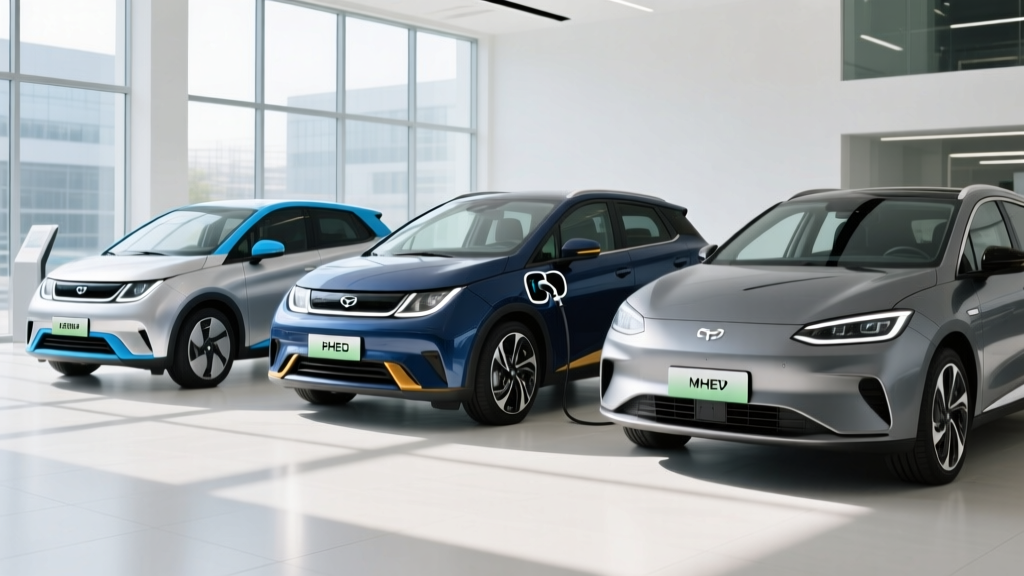
This guide breaks down the three hybrid architectures sold in the U.S. today — conventional hybrids (HEV), plug-in hybrids (PHEV), and mild hybrids (MHEV) — with exact EPA numbers, real-world expectations, battery warranties, and federal tax credit rules so you can match the right system to your driving pattern.
Conventional Hybrid (HEV): No Plug Required
A conventional hybrid pairs a gasoline engine with one or two electric motors and a small battery pack, typically 1.0 to 1.8 kWh. The battery recharges exclusively through regenerative braking and the engine — you never plug it in. The electric motor assists during acceleration, enables low-speed electric-only creeping, and allows the engine to shut off at stops, which is why HEVs dramatically outperform gas-only cars in city driving.
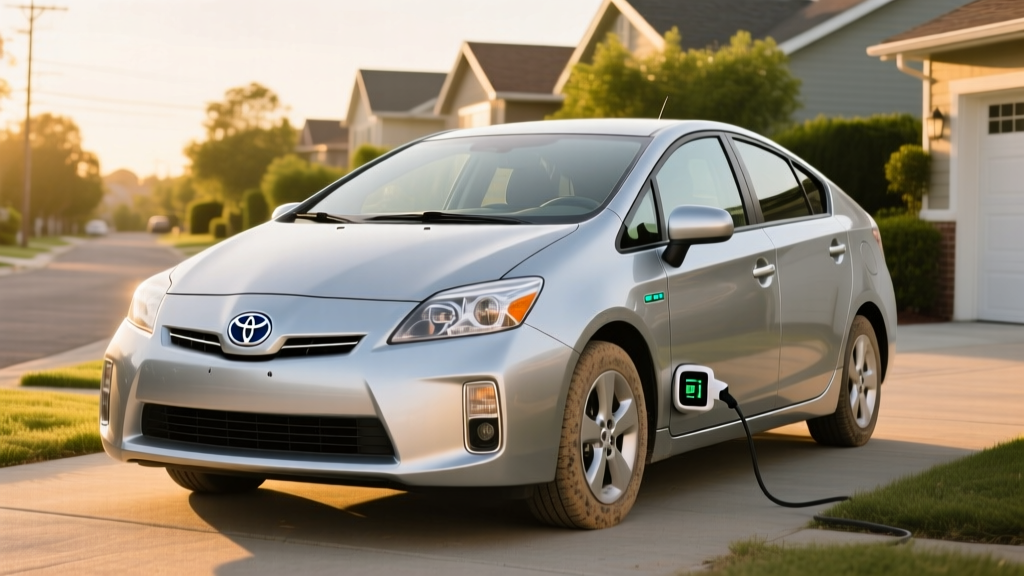
The benchmark 2026 Toyota Prius LE delivers an EPA-estimated 57 city / 56 highway / 57 combined MPG, according to fueleconomy.gov. Real-world owners frequently report 55–62 MPG in mixed suburban driving because HEVs recapture more energy in stop-and-go traffic than the EPA city cycle fully captures. On sustained highway cruising above 70 mph, expect numbers closer to 48–52 MPG as the aerodynamic drag advantage of the engine dominates.
| Model | City MPG | Highway MPG | Combined MPG | Combined HP |
|---|---|---|---|---|
| Toyota Prius LE | 57 | 56 | 57 | 194 |
| Honda Accord Hybrid | 51 | 44 | 48 | 204 |
| Hyundai Tucson Hybrid | 38 | 38 | 38 | 226 |
| Ford Maverick Hybrid | 42 | 33 | 37 | 191 |
| Toyota RAV4 Hybrid | 41 | 38 | 39 | 219 |
HEV battery packs are small, which keeps weight down and cost minimal. A replacement hybrid battery for a Prius runs $2,000–$3,500 at a dealership, though refurbished units from independent shops can be found for $1,000–$1,800. The good news: modern nickel-metal-hydride (NiMH) and lithium-ion HEV batteries routinely last 150,000–200,000 miles with minimal degradation because they operate within a narrow state-of-charge window — the car's computer never lets them fully charge or fully discharge.
Plug-In Hybrid (PHEV): Electric Commute, Gas Road Trips
A plug-in hybrid (PHEV) carries a substantially larger battery — typically 13 to 25 kWh usable — that you charge from a wall outlet or Level 2 charger. This enables 25 to 50 miles of electric-only driving before the gasoline engine engages. Once the battery depletes, the vehicle operates as a conventional hybrid, giving you a total combined range of 400–550 miles.
The 2026 Toyota RAV4 Prime, for example, provides an EPA-estimated 42 miles of electric-only range and a total range of approximately 600 miles. Its 18.1 kWh usable battery charges in about 2.5 hours on a 240V Level 2 circuit (3.3 kW onboard charger) or roughly 7.5 hours on a standard 120V household outlet. The RAV4 Prime does not support DC fast charging — a common limitation among PHEVs, because the relatively small battery cannot absorb high charge rates without thermal stress.
| Model | EV Range (mi) | Battery (kWh usable) | Level 2 Charge Time | Combined HP | MSRP |
|---|---|---|---|---|---|
| Toyota RAV4 Prime | 42 | 18.1 | ~2.5 hrs (3.3 kW) | 302 | $44,900 |
| Chrysler Pacifica PHEV | 32 | 16.0 | ~2.0 hrs (6.6 kW) | 260 | $51,095 |
| Hyundai Tucson PHEV | 33 | 13.8 | ~1.8 hrs (7.2 kW) | 261 | $39,750 |
| Jeep Wrangler 4xe | 22 | 17.3 | ~2.5 hrs (7.2 kW) | 375 | $52,995 |
| BMW X5 xDrive50e | 38 | 25.7 | ~3.5 hrs (7.4 kW) | 483 | $72,500 |
PHEVs shine for drivers with a predictable daily commute under 40 miles round-trip who also take road trips several times a year. Charge at home each night and you may burn zero gasoline for months. Let the battery deplete and you still get 27–35 MPG combined from the hybrid system — not as efficient as a dedicated HEV, but far better than a gas-only equivalent.
The critical trade-off: PHEVs are heavier than HEVs because they carry both a larger battery and a full gasoline powertrain. When the battery is depleted, that extra weight reduces fuel economy. A RAV4 Prime with a dead battery returns roughly 38 MPG combined versus 39–41 MPG for the standard RAV4 Hybrid — a small penalty, but one that compounds if you rarely plug in.
Mild Hybrid (MHEV): The Invisible Assist
Mild hybrids use a 48-volt integrated starter-generator and a tiny battery (0.5–1.0 kWh) that cannot propel the car on electricity alone. Instead, the system provides three functions: seamless engine stop-start, brief torque fill during acceleration, and coasting with the engine off. You will see MHEV systems on vehicles like the 2026 Ram 1500 with the 3.0L Hurricane inline-six and many European luxury models from Audi, Mercedes-Benz, and Volvo.
The fuel economy benefit of a mild hybrid is modest — typically 1 to 3 MPG improvement over a non-hybrid version of the same vehicle. A 2026 Ram 1500 with the 48V MHEV system achieves an EPA-estimated 20 city / 25 highway / 22 combined MPG, compared to approximately 19/24/21 for earlier non-hybrid versions. The real advantage is refinement: the stop-start system is nearly imperceptible, and the torque fill smooths out turbo lag.
MHEVs are not marketed as "hybrids" in the way consumers understand the term, and they do not qualify for any federal electrification tax credits. They exist primarily as an engineering solution for automakers to meet CAFE fuel-economy standards without redesigning the entire powertrain.
HEV vs PHEV vs EV: Which Powertrain Fits You?
Choosing between the different types of hybrids — or stepping up to a full battery-electric vehicle (BEV) — depends on three variables: your daily mileage, your access to charging, and your road-trip frequency.
| Factor | HEV | PHEV | BEV (Full EV) |
|---|---|---|---|
| Daily commute | Any distance | Under 40 mi ideal | Under 250 mi ideal |
| Home charging needed? | No | Yes (120V minimum) | Yes (240V strongly recommended) |
| Annual fuel cost (15k mi) | $1,200–$1,600 | $400–$1,100 | $500–$900 |
| Road trip flexibility | Excellent | Excellent | Requires DC fast-charging planning |
| Federal tax credit | None | Up to $7,500* | Up to $7,500* |
| Upfront price premium | +$1,000–$2,500 | +$4,000–$10,000 | +$5,000–$15,000 |
| Maintenance complexity | Low | Moderate | Lowest (no engine) |
*Subject to IRS §30D income caps, MSRP limits, and battery sourcing requirements. See irs.gov for current eligibility rules.
Choose an HEV if you lack home charging access, drive more than 50 miles daily in mixed conditions, and want maximum fuel savings with zero lifestyle change. The Prius, Accord Hybrid, and RAV4 Hybrid deliver 40–57 MPG without ever searching for a plug.
Choose a PHEV if you can install a Level 2 charger at home (or have access to one at work), your daily round-trip commute is under 40 miles, and you take 3+ road trips per year where you want zero range anxiety. The RAV4 Prime and Tucson PHEV let you commute on electricity while keeping a gas tank for weekend trips.
Choose a BEV if you have reliable home charging, your daily driving is under 250 miles, and you want the lowest operating cost and maintenance burden. Models like the Hyundai Ioniq 5 (318 miles EPA) or Tesla Model Y (320 miles EPA) eliminate gasoline entirely.
PHEV Tax Credits: The §30D Advantage
One significant financial advantage PHEVs hold over conventional HEVs: eligibility for the federal Clean Vehicle Credit under IRS §30D. A qualifying PHEV with a battery capacity of at least 7 kWh can earn up to $7,500 in federal tax credits — and as of 2024, that credit can be transferred to the dealer at the point of sale, reducing your purchase price directly rather than waiting until you file taxes.
However, eligibility is far from automatic. The 2026 rules impose several constraints:
- MSRP cap: SUVs, vans, and pickups must have an MSRP at or below $80,000; sedans and other vehicles must be at or below $55,000.
- Income cap: Modified adjusted gross income must not exceed $300,000 (joint), $225,000 (head of household), or $150,000 (single).
- Battery sourcing: A percentage of critical minerals and battery components must be sourced from the U.S. or free-trade-agreement countries — these thresholds increase annually and disqualify some models.
- Manufacturer cap: The 200,000-vehicle-per-manufacturer cap was eliminated, but the sourcing requirements effectively limit which trims qualify.
Conventional HEVs like the Prius and Accord Hybrid do not qualify for §30D because their batteries are too small and they lack plug-in capability. Some states offer additional rebates for PHEVs — California's CVRP program, for instance, has historically offered $1,000–$2,000 for eligible PHEVs, though funding varies. Check your state's energy office for current programs.
Battery Longevity and Replacement Costs
Battery degradation is the most common concern among hybrid buyers, and it is the area where the most misinformation circulates. Here is what the data shows.
Conventional HEV batteries experience minimal degradation because the vehicle's battery management system (BMS) keeps the state of charge between roughly 40% and 80% — a narrow window that dramatically reduces lithium-ion or NiMH wear. Taxi fleets running Toyota Camry Hybrids have documented 300,000+ miles on original battery packs. When failure does occur, it is typically a single bad cell module, which independent hybrid shops can replace for $300–$600 rather than replacing the entire pack.
PHEV batteries face more stress because they cycle through deeper charge-discharge ranges daily. Even so, modern PHEV packs from Toyota, Hyundai, and BMW are engineered with thermal management and buffer zones that limit usable capacity to roughly 85–90% of total cell capacity, preserving long-term health. Expect 8–12% degradation over 100,000 miles based on owner-reported data — meaning a PHEV rated for 42 miles of EV range may deliver 37–38 miles after a decade of use.
Hybrid Battery Pros
- Federal warranty: 8 yr / 100,000 mi minimum (10/150k in CARB states)
- HEV batteries often last 200,000+ miles without replacement
- Individual cell module repair available at independent shops
- Refurbished packs cost 40–60% less than new OEM replacements
Hybrid Battery Cons
- Full OEM pack replacement: $2,000–$4,500 (HEV), $8,000–$15,000 (PHEV)
- Extreme heat climates may accelerate degradation by 2–3% over 10 years
- PHEV EV range decreases gradually as battery ages
- Some older models (pre-2018) have limited refurbished pack availability
Real-World MPG: What the EPA Sticker Doesn't Tell You
The EPA's hybrid fuel-economy estimates are generally reliable, but they do not capture the full picture. Hybrids — especially HEVs — often exceed their EPA city ratings in real-world stop-and-go driving because regenerative braking recaptures more energy at lower speeds than the standardized test cycle assumes. Prius owners in dense urban areas like New York and San Francisco routinely report 60+ MPG in summer conditions.
Conversely, highway driving above 70 mph reduces hybrid advantages. At sustained high speeds, the electric motor contributes less and the gasoline engine bears the full aerodynamic and rolling-resistance load. Expect highway MPG to drop 5–10% below the EPA estimate at 75–80 mph, particularly in colder weather when the engine runs longer to heat the cabin.
For PHEVs, real-world electric range varies significantly with temperature. A RAV4 Prime rated for 42 miles of EV range may deliver 44–46 miles in mild 65°F weather with light acceleration, but only 32–36 miles in 25°F winter conditions when cabin heating and battery conditioning draw additional power. Preconditioning the cabin while still plugged in mitigates this loss.
Frequently Asked Questions
How many MPG does a conventional hybrid get?
Conventional hybrids (HEVs) range from 37 MPG combined (Ford Maverick Hybrid) to 57 MPG combined (Toyota Prius LE) based on EPA estimates. Real-world city driving often exceeds EPA ratings by 3–8 MPG, while highway driving at speeds above 70 mph typically returns 5–10% below the EPA highway figure.
How far can a PHEV go on electric only?
Current 2026 PHEVs offer 22 to 48 miles of EPA-estimated electric-only range, depending on battery size and vehicle weight. The Toyota RAV4 Prime leads mainstream models at 42 miles. Real-world EV range varies from roughly 32 miles in cold winter conditions to 46 miles in mild weather with conservative driving.
Do conventional hybrids need to be plugged in?
No. Conventional hybrids (HEVs) charge their batteries entirely through regenerative braking and the gasoline engine. You fuel them exactly like a standard gas car. Only plug-in hybrids (PHEVs) require or benefit from external charging.
Is a hybrid reliable and what does battery replacement cost?
Hybrids from Toyota, Honda, and Hyundai have demonstrated excellent long-term reliability, with HEV battery packs frequently lasting 150,000–200,000+ miles. Federal warranty coverage is 8 years / 100,000 miles (10/150k in CARB states). Full OEM battery replacement costs $2,000–$4,500 for HEVs and $8,000–$15,000 for PHEVs, though refurbished packs and individual cell repairs reduce this significantly.
Does a hybrid qualify for any tax credit?
Conventional hybrids (HEVs) do not qualify for the federal §30D Clean Vehicle Credit. Plug-in hybrids (PHEVs) with batteries of at least 7 kWh may qualify for up to $7,500, subject to MSRP caps ($80,000 for SUVs, $55,000 for sedans), buyer income limits, and battery component sourcing requirements. The credit can be applied at point of sale as of 2024. Consult IRS guidelines or a tax professional for your specific eligibility.
What is the difference between a mild hybrid and a full hybrid?
A mild hybrid (MHEV) uses a small 48V motor that cannot propel the vehicle on electricity alone — it only assists the engine with torque fill and smoother stop-start. A full hybrid (HEV) can drive short distances at low speeds on electric power alone and delivers substantially greater fuel savings, typically 35–57 MPG combined versus 1–3 MPG improvement for a mild hybrid.
Should I buy a hybrid or a full EV?
If you have home Level 2 charging, drive under 250 miles daily, and want the lowest operating cost, a BEV is the better long-term choice. If you lack home charging, frequently drive over 300 miles between stops, or live in an area with sparse DC fast-charging infrastructure, a PHEV or HEV eliminates range anxiety while still reducing fuel consumption by 30–60%.