If you're shopping for an electrified vehicle but aren't ready to commit to a full battery-electric car, you've probably encountered two acronyms: HEV (hybrid electric vehicle) and PHEV (plug-in hybrid electric vehicle). Both use a gasoline engine paired with an electric motor, but the difference between a plug-in hybrid and hybrid goes far beyond whether there's a charging port. It affects your daily fuel cost, your driving habits, your home electrical setup, and whether you qualify for federal tax incentives.
This guide breaks down exactly what separates these two powertrains in 2026, using real EPA data, current pricing, and ownership realities — not marketing brochures.
HEV vs PHEV: The Core Engineering Difference
A conventional hybrid (HEV) like the Toyota Prius or Honda CR-V Hybrid uses a small battery pack (typically 1.0–1.8 kWh) that charges exclusively through regenerative braking and the gasoline engine. You never plug it in. The electric motor assists the engine during acceleration and low-speed driving, but the car cannot travel meaningful distances on electricity alone.
A plug-in hybrid (PHEV) like the Toyota RAV4 Prime or Jeep Wrangler 4xe carries a much larger battery (typically 13–20 kWh usable) and a more powerful electric motor. You plug it into a wall outlet or Level 2 charger to fill that battery, giving you 25–50 miles of pure electric driving before the gasoline engine takes over. Once the battery depletes, a PHEV operates as a conventional hybrid.
HEV vs PHEV at a Glance
| Attribute | Conventional Hybrid (HEV) | Plug-In Hybrid (PHEV) |
|---|---|---|
| Battery size | 1.0–1.8 kWh | 13–20 kWh usable |
| Plug-in charging | No — self-charging | Yes — Level 1 or Level 2 |
| Electric-only range | ~1 mile or less | 25–50 miles (EPA) |
| DC fast charging | N/A | Rare; most are AC-only (a few exceptions like Mitsubishi Outlander PHEV) |
| Federal tax credit (§30D) | Not eligible | Up to $7,500 if battery sourcing, MSRP, and income rules are met |
| Typical price premium over gas model | $1,500–$3,000 | $5,000–$10,000 |
| Home electrical work needed | None | 120V outlet minimum; 240V Level 2 recommended |
Fuel Economy: Real-World MPG and MPGe Compared
Fuel economy is where the difference between a plug-in hybrid and hybrid gets nuanced, because PHEVs report two numbers: MPGe (miles per gallon equivalent, measuring efficiency while running on electricity) and charge-sustaining MPG (efficiency after the battery is depleted).
Here's how three popular 2026 models compare, using EPA data from fueleconomy.gov:
| Model | Type | EPA City MPG | EPA Hwy MPG | EPA Combined | EV Range (mi) | MPGe (electric mode) |
|---|---|---|---|---|---|---|
| Toyota Prius | HEV | 57 | 56 | 57 | N/A | N/A |
| Toyota Prius Prime | PHEV | 53 (gas) | 51 (gas) | 52 (gas) / 127 MPGe | 44 | 127 |
| Toyota RAV4 Hybrid | HEV | 41 | 38 | 39 | N/A | N/A |
| Toyota RAV4 Prime | PHEV | 40 (gas) | 36 (gas) | 38 (gas) / 94 MPGe | 42 | 94 |
| Honda CR-V Hybrid | HEV | 43 | 36 | 40 | N/A | N/A |
| Ford Escape PHEV | PHEV | 42 (gas) | 37 (gas) | 39 (gas) / 105 MPGe | 37 | 105 |
Real-world MPG note: Conventional hybrids routinely exceed their EPA city estimates in stop-and-go traffic because regenerative braking recaptures more energy at low speeds. Many Prius owners report 60+ MPG in urban driving. PHEVs are a different story: if you charge daily and drive under 30 miles, you may use almost zero gasoline for weeks. But if you never plug in, a PHEV's charge-sustaining MPG often trails a comparable HEV because it's hauling 300–500 extra pounds of battery.
Electric-Only Range and Charging: What PHEV Owners Need to Know
The electric-only range of a PHEV is the single biggest factor in whether the powertrain makes financial sense for you. Here are representative 2026 figures:
- Toyota Prius Prime: 44 miles EV range, 13.6 kWh battery
- Toyota RAV4 Prime: 42 miles EV range, 18.1 kWh battery
- Ford Escape PHEV: 37 miles EV range, 14.4 kWh battery
- Jeep Wrangler 4xe: 22 miles EV range, 17.3 kWh battery
- Hyundai Tucson PHEV: 33 miles EV range, 13.8 kWh battery
Total combined range (electric + gasoline) typically exceeds 450–550 miles for most PHEVs, eliminating any range anxiety on road trips.
Charging Times
Most PHEVs charge on AC power only — DC fast charging is rare in this segment:
- Level 1 (120V household outlet): 8–14 hours for a full charge. This works if you drive under 40 miles daily and park near an outlet overnight.
- Level 2 (240V, 16–32A): 2–4 hours for a full charge. A 240V outlet or dedicated home charger lets you top up between errands.
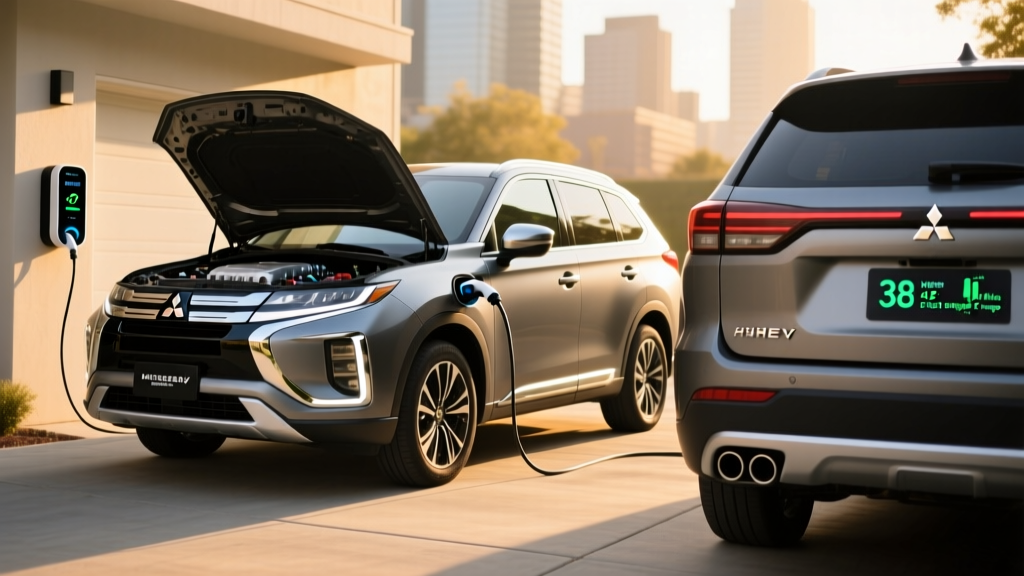
- DC fast charging: Only a handful of PHEVs support it. The Mitsubishi Outlander PHEV is a notable exception, accepting up to 22 kW DC (CHAdeMO), reaching 80% in roughly 38 minutes. Most PHEVs — including all Toyota, Ford, and Hyundai models — are AC-only.
kW vs kWh reminder: The battery capacity is measured in kWh (kilowatt-hours, the energy stored). The charge rate is measured in kW (kilowatts, the power flowing in). A 14 kWh battery charging at 3.3 kW takes about 4.2 hours from empty.
Powertrain Performance: Where the Electric Motor Shows Up
PHEVs generally deliver more combined horsepower than their HEV counterparts because they carry larger, more powerful electric motors. Here's a comparison:
| Model | Type | Engine | Combined HP | 0–60 mph |
|---|---|---|---|---|
| Toyota RAV4 Hybrid | HEV | 2.5L I4 + 2 motors | 219 | 7.4 sec |
| Toyota RAV4 Prime | PHEV | 2.5L I4 + 2 motors | 302 | 5.7 sec |
| Toyota Prius | HEV | 2.0L I4 + 1 motor | 194 | 7.2 sec |
| Toyota Prius Prime | PHEV | 2.0L I4 + 1 motor | 220 | 6.6 sec |
The RAV4 Prime's 302 hp makes it the quickest RAV4 Toyota sells — faster than the gas-only turbo model. That performance bump comes from the larger electric motor that a bigger battery can sustain. If acceleration matters to you, PHEVs often punch above their weight.
Pricing, Tax Credits, and Total Cost of Ownership
PHEVs carry a significant price premium over both HEVs and gas-only models, but federal incentives can narrow the gap. Here's how 2026 pricing looks:
| Model | Base MSRP (2026) | §30D Federal Credit | Effective Price |
|---|---|---|---|
| Toyota Prius (HEV) | ~$29,500 | $0 | ~$29,500 |
| Toyota Prius Prime (PHEV) | ~$34,000 | Up to $3,751* | ~$30,249 |
| Toyota RAV4 Hybrid (HEV) | ~$33,500 | $0 | ~$33,500 |
| Toyota RAV4 Prime (PHEV) | ~$44,500 | Up to $7,500* | ~$37,000 |
| Ford Escape PHEV | ~$40,500 | Up to $3,751* | ~$36,749 |
*Federal tax credit amounts under IRS §30D depend on battery critical-mineral sourcing, buyer income caps ($150K single / $300K joint), and MSRP limits ($55K for sedans, $80K for SUVs/trucks). Credit can be transferred to the dealer at point of sale. Always verify current eligibility with a tax professional — sourcing rules change annually.
Cost-per-mile reality: If your daily commute is under your PHEV's EV range and you charge at home at $0.14/kWh (national average), your effective fuel cost is roughly $0.04–$0.05/mile. A comparable HEV at 50 MPG and $3.30/gallon gasoline costs about $0.066/mile. Over 15,000 miles/year, that's roughly $240–$390 in annual savings — meaningful but not transformative. The real savings come if your utility offers off-peak rates under $0.10/kWh.
Battery Longevity, Warranty, and Replacement Costs
Battery Warranty Quick Reference
Federal law mandates that hybrid and PHEV batteries carry a minimum warranty of 8 years / 100,000 miles. In California Air Resources Board (CARB) states, that extends to 10 years / 150,000 miles.
- Toyota: 10 years / 150,000 miles on hybrid battery (all states, 2020+)
- Hyundai/Kia: 10 years / 100,000 miles
- Ford: 8 years / 100,000 miles
Warranties typically cover the battery if capacity drops below 70% of original. Read the fine print: some manufacturers prorate coverage after year 5.
Real-world degradation: Hybrid batteries degrade far more slowly than early skeptics feared. Toyota Prius batteries routinely exceed 200,000 miles with under 15% capacity loss. PHEV batteries, because they cycle deeper (full EV range drains), degrade slightly faster but are still expected to last 150,000+ miles with 80%+ capacity retention.
Replacement cost if out of warranty:
- HEV battery (1–2 kWh): $2,000–$4,000 installed
- PHEV battery (13–18 kWh): $6,000–$12,000 installed
Third-party refurbishment shops are increasingly available, offering rebuilt hybrid batteries for $1,000–$2,500. For most owners, the battery will outlast the vehicle's economic life.
Who Should Choose a Hybrid, a PHEV, or a Full EV?
The right choice depends on your driving pattern, charging access, and budget. Here's a decision framework:
Choose a Conventional Hybrid (HEV) If:
- You don't have reliable access to a plug at home or work
- You want maximum MPG with zero behavior change
- Your budget is under $35,000 and you want the lowest upfront cost
- You drive 30,000+ miles/year and want proven long-term reliability
- You frequently take long road trips and don't want to think about charging
Choose a Plug-In Hybrid (PHEV) If:
- You can install a Level 2 charger or have a 120V outlet near your parking spot
- Your daily commute is under 40 miles round-trip (so you drive mostly electric)
- You want EV-like daily driving but need gasoline flexibility for weekend road trips
- You qualify for the federal tax credit, narrowing the price gap
- You live in a cold climate where EV range loss is a concern — a PHEV's gas engine provides heat and unlimited range
Choose a Full EV (BEV) If:
- You have reliable home Level 2 charging
- Your daily driving is under 250 miles and you road-trip infrequently
- You want the lowest per-mile fuel and maintenance cost
- You qualify for the full $7,500 federal credit on an eligible model
- You're ready to plan charging stops on longer trips
Pros and Cons: HEV vs PHEV at a Glance
Conventional Hybrid (HEV) — Pros
- No plug needed — zero infrastructure cost
- Lower purchase price ($3K–$8K less than PHEV)
- Proven long-term reliability (20+ year track record)
- Best highway fuel economy of any non-plug-in vehicle
- Lighter weight = better charge-sustaining MPG
Conventional Hybrid (HEV) — Cons
- No electric-only driving — always burning gasoline
- No federal tax credit eligibility
- Less acceleration power from smaller electric motor
- Cannot pre-condition cabin on grid power
Plug-In Hybrid (PHEV) — Pros
- 25–50 miles of silent, zero-emission electric driving
- Federal tax credit up to $7,500 (model-dependent)
- Stronger acceleration from larger electric motor
- Gasoline backup eliminates range anxiety entirely
- Can pre-heat/cool cabin on grid power while plugged in
Plug-In Hybrid (PHEV) — Cons
- $5K–$10K price premium over HEV equivalent
- Requires home charging access to realize fuel savings
- Heavier — worse MPG when battery is depleted
- More complex powertrain (two full systems to maintain)
- Most cannot DC fast charge — road-trip charging is impractical
Frequently Asked Questions
Do I have to plug in a conventional hybrid?
No. A conventional hybrid (HEV) charges its small battery entirely through regenerative braking and the gasoline engine. There is no plug, no charging cable, and no change to how you fuel the car. You simply drive it like a normal gasoline vehicle and it delivers better MPG automatically.
What happens if I never plug in my PHEV?
A PHEV will operate as a conventional hybrid once the battery is depleted — but typically a less efficient one. Because PHEVs carry 300–500 extra pounds of battery and often use less aerodynamic tuning, charge-sustaining MPG can be 2–5 MPG worse than a dedicated HEV of the same model. You'll also miss out on the fuel-cost savings that justify the higher purchase price.
How long do hybrid batteries last?
Based on two decades of real-world data, modern hybrid batteries typically last 150,000–250,000 miles with gradual capacity loss. Toyota's hybrid battery warranty covers 10 years / 150,000 miles across all states. Out-of-warranty replacement runs $2,000–$4,000 for HEVs and $6,000–$12,000 for PHEVs. Many owners never need a replacement within the vehicle's useful life.
Is a PHEV better than a full EV?
It depends on your situation. A PHEV is better if you lack reliable home charging, regularly drive more than 300 miles in a day, or live in extreme cold where EV range drops 20–30%. A full EV is better if you have home Level 2 charging, drive under 250 miles daily, and want the lowest maintenance and per-mile fuel cost. PHEVs are a bridge technology — ideal for some, but a compromise for those who could go fully electric.
Does a plug-in hybrid qualify for the $7,500 federal tax credit?
Some do, but not all. Under IRS §30D rules, a PHEV must have a battery capacity of at least 7 kWh (most do), and the vehicle must meet critical-mineral sourcing, MSRP caps ($55K sedans, $80K SUVs), and buyer income limits ($150K single / $300K joint). Many PHEVs qualify for a partial credit of $3,751 (meeting one of two sourcing requirements). Check the fueleconomy.gov tax credit lookup for your specific model and consult a tax professional before purchasing.
Can I charge a PHEV on a regular household outlet?
Yes. Every PHEV ships with a Level 1 charging cord that plugs into a standard 120V outlet. At roughly 1.2–1.5 kW, a full charge takes 8–14 hours depending on battery size. For most PHEV owners with a sub-40-mile commute, overnight Level 1 charging is sufficient. A 240V Level 2 setup ($500–$1,500 installed, depending on your electrical panel) cuts charge time to 2–4 hours and is recommended if your daily driving exceeds your EV range.