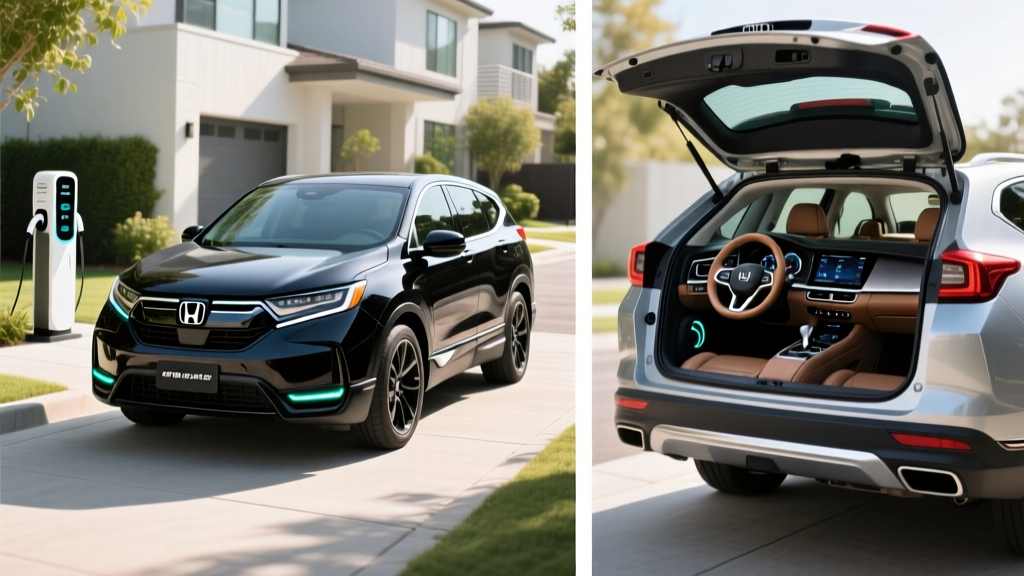
The Honda CR-V Hybrid Sport occupies a specific niche in the compact SUV market: it pairs a proven two-motor hybrid system with a sport-tuned appearance and a starting price that undercuts most rivals. For buyers who want EV-like efficiency in city driving without ever plugging in, the CR-V Hybrid Sport is a compelling option — but it's important to understand exactly what you're getting, what it costs to own long-term, and where a full EV or plug-in hybrid might serve you better.
This guide covers the 2026 Honda CR-V Hybrid Sport's powertrain specs, EPA and real-world fuel economy, battery longevity, pricing, and tax-credit eligibility — everything you need to make a data-driven purchase decision.
HEV vs. PHEV: What the CR-V Hybrid Sport Actually Is
Before diving into specs, let's clear up a common source of confusion. The Honda CR-V Hybrid Sport is a conventional hybrid electric vehicle (HEV), not a plug-in hybrid (PHEV). Here's what that means in practice:
| Feature | HEV (CR-V Hybrid Sport) | PHEV (e.g., Toyota RAV4 Prime) | BEV (e.g., Tesla Model Y) |
|---|---|---|---|
| Plugs in to charge? | No — charges via regenerative braking and engine | Yes — external charging required for EV range | Yes — external charging required |
| Electric-only range | ~1 mile at low speed | 35–42 miles typical | 250–330+ miles |
| Battery size | ~1.06 kWh (small buffer) | 18.1 kWh usable | 60–82 kWh usable |
| Home charger needed? | No | Yes (Level 2 recommended) | Yes (Level 2 essential) |
| Federal tax credit (§30D) | Not eligible | Up to $7,500 (if sourcing/income rules met) | Up to $7,500 (if sourcing/income rules met) |
The CR-V Hybrid Sport's battery is small by design. It captures energy during braking and deceleration, then deploys it to assist the gasoline engine during acceleration and to power low-speed electric-only driving. You never plug it in — it fuels exactly like a conventional gas car, but uses significantly less fuel.
Powertrain and Performance Specs
| Specification | 2026 Honda CR-V Hybrid Sport (AWD) |
|---|---|
| Powertrain | 2.0L Atkinson-cycle 4-cylinder + two electric motors |
| Combined horsepower | 204 hp |
| Combined torque | 247 lb-ft (electric motor torque) |
| Transmission | e-CVT (direct-drive, no traditional gears) |
| Drivetrain | Standard AWD (rear motor-driven) |
| 0–60 mph (est.) | ~7.6 seconds |
| Battery capacity | ~1.06 kWh lithium-ion |
| Towing capacity | 1,000 lbs |
Honda's fourth-generation two-motor hybrid system uses one motor primarily as a generator and the other as the drive motor. At highway cruising speeds, the gasoline engine can directly drive the front wheels through a lock-up clutch, bypassing the electric path for better efficiency. This is a series-parallel architecture — it switches seamlessly between EV drive, hybrid drive, and engine-direct drive depending on conditions.
The 204 combined horsepower and instant electric torque (247 lb-ft available from zero RPM) give the CR-V Hybrid Sport confident acceleration for merging and passing. It's not a performance SUV, but it's noticeably quicker off the line than the non-hybrid CR-V's 190-hp turbocharged engine.
Fuel Economy: EPA Ratings and Real-World MPG
| Driving Cycle | EPA Rating | Real-World Expectation |
|---|---|---|
| City | 43 MPG | 40–46 MPG (hybrids excel in stop-and-go) |
| Highway | 36 MPG | 33–37 MPG (less electric assist at sustained speed) |
| Combined | 40 MPG | 37–42 MPG depending on driving mix |
Source: EPA Fuel Economy
The CR-V Hybrid Sport's city MPG advantage is the key selling point. In stop-and-go traffic, the electric motor handles most low-speed propulsion while the engine shuts off entirely at stops. Regenerative braking recaptures energy that a conventional car wastes as heat. This is why the city rating (43 MPG) is higher than the highway rating (36 MPG) — the opposite of most gas-only vehicles.
Real-World Fuel Economy Notes:
- Cold weather (below 30°F): Expect a 5–10% MPG drop. The engine runs more frequently to provide cabin heat and warm the catalytic converter.
- Highway-heavy commutes: Drivers covering 80%+ highway miles will see combined figures closer to 35–37 MPG.
- City-heavy driving: Many owners report exceeding the 40 MPG combined EPA estimate with predominantly urban routes, sometimes hitting 44–46 MPG in warm weather.
- Total range: With a 14.0-gallon fuel tank and 40 MPG combined, expect roughly 520–560 miles per tank under normal conditions.
How the CR-V Hybrid Sport Compares to Rivals
| Model | Combined MPG | HP | AWD? | Starting MSRP |
|---|---|---|---|---|
| 2026 Honda CR-V Hybrid Sport | 40 MPG | 204 | Standard | ~$37,395 |
| 2026 Toyota RAV4 Hybrid XLE | 39 MPG | 219 | Standard | ~$34,595 |
| 2026 Hyundai Tucson Hybrid SEL | 38 MPG | 226 | Standard | ~$36,550 |
| 2026 Ford Escape Hybrid | 39 MPG (FWD) | 210 | Optional | ~$35,500 |
The CR-V Hybrid Sport leads in cargo space (36.3 cu ft behind rear seats) and interior refinement, while the RAV4 Hybrid edges it out on price and horsepower. The Tucson Hybrid offers the most power but trails slightly on fuel economy. All four are strong choices — the decision often comes down to which brand's dealer network, warranty, and driving feel you prefer.
Battery Longevity, Warranty, and Replacement Cost
Honda Hybrid Battery Warranty:
- Hybrid battery: 8 years / 100,000 miles (10 years / 150,000 miles in CARB states including CA, NY, MA, and others)
- Hybrid system components: 8 years / 100,000 miles
- Capacity retention threshold: Honda covers the battery if it fails or drops below functional specifications — there is no published percentage degradation threshold like BEV manufacturers use
Honda's hybrid battery track record is strong. The company has been producing two-motor hybrids since 2014 (and single-motor hybrids since 1999 with the original Insight). Real-world data from earlier Honda hybrid systems shows most batteries lasting well beyond 150,000 miles with minimal degradation. The small 1.06 kWh battery in the CR-V Hybrid operates within a narrow state-of-charge window (roughly 40–60% SoC), which significantly reduces stress and extends cell life.
Replacement cost if out of warranty: A new Honda hybrid battery pack currently costs between $2,000 and $4,000 including installation, depending on the dealer and region. Third-party refurbished packs are available for $1,200–$2,000. This is dramatically cheaper than BEV battery replacement ($8,000–$20,000+) because the pack is small.
Practical longevity insight: The hybrid battery is one of the least-worry components of the CR-V Hybrid. Unlike a BEV's large traction battery, the small buffer pack sees shallow charge cycles and is thermally managed by the cabin HVAC system. Failures before 150,000 miles are uncommon. The 12V auxiliary battery (a separate, conventional battery that powers electronics) is more likely to need replacement every 4–6 years at ~$200–$300.
Pricing, Trims, and Tax Credit Eligibility
The 2026 Honda CR-V Hybrid is available in multiple trims. The Sport and Sport Touring are the most popular hybrid configurations:
| Trim | MSRP (AWD) | Key Features |
|---|---|---|
| Hybrid Sport | ~$37,395 | Black 19" wheels, gloss black accents, heated front seats, 9" touchscreen, wireless Apple CarPlay/Android Auto |
| Hybrid Sport-L | ~$40,195 | Leather-trimmed seats, power tailgate, wireless phone charger, heated steering wheel |
| Hybrid Sport Touring | ~$42,195 | BOSE 12-speaker audio, navigation, heated rear seats, hands-free tailgate, front/rear parking sensors |
Federal Tax Credit (§30D) Status for the CR-V Hybrid Sport:
- ❌ Not eligible for the §30D New Clean Vehicle Credit — this credit applies only to plug-in electric vehicles (PHEVs and BEVs) with a battery capacity of at least 7 kWh. The CR-V Hybrid's ~1.06 kWh battery does not qualify.
- ❌ Not eligible for the §25E Used Clean Vehicle Credit — same plug-in requirement applies.
- ✅ Some state incentives may apply — a handful of states offer rebates or HOV-lane access for conventional hybrids. Check your state's energy office or AFDC state incentive database for current programs.
The lack of federal tax credit eligibility is the CR-V Hybrid Sport's primary financial disadvantage versus a PHEV like the Toyota RAV4 Prime (which qualifies for up to $7,500 under §30D if all sourcing, MSRP, and income requirements are met). However, the CR-V Hybrid Sport's lower purchase price — roughly $7,000–$10,000 less than a RAV4 Prime — largely offsets this difference for most buyers. Per IRS §30D guidelines, only vehicles with plug-in capability and sufficient battery capacity qualify.
Who Should Choose the CR-V Hybrid Sport vs. a PHEV or BEV?
Choose the CR-V Hybrid Sport (HEV) if:
- You cannot install a home Level 2 charger (apartment, street parking, condo restrictions)
- Your budget is under $40,000 and you want AWD standard
- You drive a balanced mix of city and highway and want consistent 37–42 MPG
- You want zero behavior change — just fuel up at any gas station
- You plan to keep the vehicle 8–12 years and want proven long-term reliability
Choose a PHEV (e.g., RAV4 Prime, CR-V e:PHEV where available) if:
- You have home Level 2 charging and a commute under 40 miles round-trip
- You want to drive mostly on electricity on weekdays but need gas flexibility for road trips
- You qualify for the full $7,500 §30D credit, making the effective price competitive
Choose a full BEV (e.g., Hyundai Ioniq 5, Tesla Model Y) if:
- You have reliable home charging and your daily driving is under 250 miles
- You want the lowest per-mile fuel cost ($0.03–$0.05/mile on home electricity vs. $0.12–$0.15/mile on gas at 40 MPG)
- You want near-zero maintenance (no oil changes, no engine, fewer moving parts)
- You qualify for federal and state EV incentives that bring the effective purchase price down
Ownership Costs: 5-Year Estimate
| Cost Category | CR-V Hybrid Sport (HEV) | Gas CR-V EX-L (AWD) | BEV (e.g., Model Y LR) |
|---|---|---|---|
| Purchase price (MSRP) | $40,195 | $38,795 | $46,630 |
| Federal tax credit | $0 | $0 | Up to $7,500* |
| Fuel/energy (5 yrs, 60k mi) | ~$6,300 (gas at $3.60/gal) | ~$8,400 (gas at $3.60/gal) | ~$2,400 (home electricity) |
| Maintenance (5 yrs) | ~$2,200 | ~$3,000 | ~$1,200 |
| Estimated insurance (5 yrs) | ~$8,500 | ~$8,000 | ~$10,000 |
| Total 5-yr cost (est.) | ~$57,195 | ~$58,195 | ~$52,730 |
* BEV tax credit subject to §30D eligibility including income caps ($150k single / $300k joint), MSRP caps ($55k for SUVs), and battery sourcing requirements. Verify at IRS.gov.
The CR-V Hybrid Sport saves roughly $1,000 over 5 years compared to the gas CR-V, primarily through fuel savings. Against a BEV, it costs more to operate but avoids the higher upfront price and charging-infrastructure dependency. Insurance for the hybrid is slightly higher than the gas version due to the more complex powertrain, but significantly lower than most BEVs.
Pros
- 40 MPG combined EPA; often exceeds in real-world city driving
- Standard AWD with no range penalty (unlike some competitors)
- No charging infrastructure needed — zero behavior change
- Strong battery warranty (8yr/100k mi; 10yr/150k mi in CARB states)
- Spacious cargo area (36.3 cu ft) and refined interior
- Proven Honda reliability and strong resale value
Cons
- No federal tax credit eligibility (HEV, not PHEV)
- Highway MPG (36) trails city (43) — less ideal for highway-heavy commuters
- 1,000-lb towing capacity limits utility vs. truck-based SUVs
- ~$1,400 premium over the gas CR-V LX AWD (though hybrid Sport includes more features)
- Infotainment system lacks the speed/responsiveness of some rivals
Frequently Asked Questions
How many MPG does the 2026 CR-V Hybrid Sport get?
The EPA rates the 2026 Honda CR-V Hybrid Sport AWD at 43 MPG city, 36 MPG highway, and 40 MPG combined. In real-world driving, city-heavy commuters often see 42–46 MPG, while highway-dominant driving yields 33–37 MPG. Cold weather reduces efficiency by roughly 5–10%.
Does the CR-V Hybrid Sport need to be plugged in?
No. The CR-V Hybrid Sport is a conventional hybrid (HEV), not a plug-in hybrid. Its small battery charges automatically through regenerative braking and the gasoline engine. You fuel it exactly like any gas car — at any gas station.
How far can the CR-V Hybrid Sport drive on electric power alone?
Only about 1 mile at very low speeds (under 25 mph). The electric motor primarily assists the gasoline engine rather than powering the vehicle independently for extended distances. If you want meaningful electric-only range (35–42 miles), you need a plug-in hybrid like the Toyota RAV4 Prime or a full BEV.
Is the CR-V Hybrid Sport reliable, and what does battery replacement cost?
Honda's hybrid system has a strong reliability record spanning two decades. The hybrid battery is covered for 8 years/100,000 miles (10 years/150,000 miles in CARB states). Real-world data shows most Honda hybrid batteries lasting 150,000+ miles. Out-of-warranty replacement costs $2,000–$4,000 at a dealer, or $1,200–$2,000 for a refurbished pack.
Does the CR-V Hybrid Sport qualify for any tax credit?
The CR-V Hybrid Sport does not qualify for the federal §30D New Clean Vehicle Credit, which requires plug-in capability and a minimum 7 kWh battery. Some states offer hybrid-specific rebates or incentives — check the Alternative Fuels Data Center for your state's current programs.
How does the CR-V Hybrid Sport compare to the CR-V e:PHEV?
As of the 2026 model year, Honda offers the CR-V e:PHEV (plug-in hybrid) in select international markets but not in the United States. US buyers choosing the CR-V Hybrid get the conventional HEV only. If Honda introduces the e:PHEV to the US market, it would offer roughly 30–35 miles of electric-only range with a larger battery, but at a significantly higher price point.
What is the total driving range of the CR-V Hybrid Sport?
With a 14.0-gallon fuel tank and 40 MPG combined EPA rating, the CR-V Hybrid Sport delivers approximately 520–560 miles of total range per tank under normal driving conditions. Highway-heavy trips will yield closer to 475–518 miles; city-dominant driving can extend to 580+ miles.
The 2026 Honda CR-V Hybrid Sport is a pragmatic choice for buyers who want SUV practicality, standard AWD, and 40 MPG without the complexity or cost of plug-in charging. It won't qualify for federal EV incentives and it won't drive 35 miles on electricity alone — but for the majority of American drivers who lack home charging access or simply want to fuel up and go, it delivers real, measurable fuel savings with Honda's proven hybrid reliability.