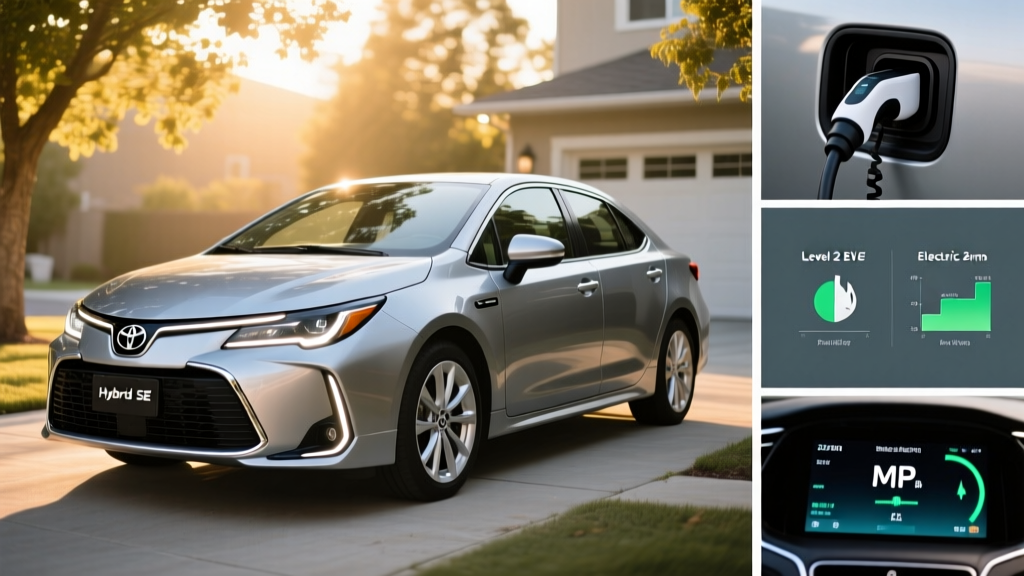
The Toyota Corolla has been America's default compact sedan for decades, but the hybrid variant is where the real engineering story lives. The Corolla Hybrid SE sits in a unique spot in Toyota's 2026 lineup: it pairs the fuel-sipping fifth-generation Toyota Hybrid System with sport-tuned suspension, a rear spoiler, and paddle shifters — all while undercutting most compact SUVs on price. If you're cross-shopping this against a RAV4 Hybrid or wondering whether a conventional hybrid still makes sense in a world of plug-ins and full EVs, this guide covers every number that matters.
Corolla Hybrid SE Quick Specs at a Glance
| Spec | Value |
|---|---|
| Powertrain | 1.8L 4-cyl + 2 electric motors (AWD-i) |
| Combined Horsepower | 138 hp |
| EPA MPG (City / Hwy / Combined) | 50 / 43 / 47 |
| Fuel Tank Capacity | 11.4 gallons |
| Total Driving Range | ~535 miles |
| 0–60 mph | ~8.1 seconds |
| Drivetrain | Electronic AWD (AWD-i) |
| Hybrid Battery | Lithium-ion, ~0.9 kWh (self-charging) |
| Starting MSRP (SE AWD) | $26,595 |
| Hybrid Battery Warranty | 10 years / 150,000 miles |
Source: EPA Fuel Economy, Toyota.
How Many MPG Does the Corolla Hybrid SE Actually Get?
The EPA rates the 2026 Corolla Hybrid SE at 50 city / 43 highway / 47 combined MPG. But as with any hybrid, the sticker number only tells part of the story.
| Driving Scenario | EPA Rating | Real-World Expectation |
|---|---|---|
| City (stop-and-go, under 40 mph) | 50 MPG | 50–55 MPG (hybrids excel here) |
| Highway (65–75 mph steady cruise) | 43 MPG | 40–44 MPG |
| Combined (mixed driving) | 47 MPG | 44–50 MPG |
| Cold weather (below 32°F, short trips) | — | 38–44 MPG |
Here's why hybrids often beat their EPA city rating in real driving: at low speeds, the electric motor handles most propulsion while the gas engine stays off or operates only as a generator. Every stop light becomes a regenerative braking opportunity, recapturing energy that a gas car would waste as heat. In warm-weather city driving with light traffic, owners regularly report 52–55 MPG on the Corolla Hybrid's trip computer.
Highway driving is the opposite. Above 65 mph, aerodynamic drag dominates, and the small 1.8L engine is doing most of the work with minimal electric assist. You'll see the MPG gauge dip on long interstate runs. In sub-freezing temperatures, expect a 10–15% drop across the board — the engine runs more often to heat the cabin, and battery efficiency decreases in the cold.
HEV vs PHEV vs EV: Where Does the Corolla Hybrid Fit?
The Corolla Hybrid SE is a conventional hybrid electric vehicle (HEV), not a plug-in hybrid. This distinction matters enormously for your daily routine, your budget, and your expectations.
HEV vs PHEV vs BEV — Key Differences
| Feature | HEV (Corolla Hybrid) | PHEV (e.g., Prius Prime) | BEV (e.g., Tesla Model 3) |
|---|---|---|---|
| Plug in to charge? | No — self-charging | Yes — Level 1 or Level 2 | Yes — Level 2 or DC fast |
| Electric-only range | ~1 mile at low speed | 25–44 miles | 250–400+ miles |
| Gas engine? | Yes | Yes | No |
| Home charger needed? | No | Recommended | Essential |
| Federal tax credit (§30D)? | No | Up to $7,500 (if eligible) | Up to $7,500 (if eligible) |
| Typical starting price | $24,000–$27,000 | $33,000–$40,000 | $38,000–$55,000 |
The Corolla Hybrid SE requires no behavior change from a gas car owner. You fill it at a gas station, never think about charging, and simply drive. The hybrid system manages energy flow automatically — the engine shuts off at stops, the electric motor assists during acceleration, and regenerative braking tops up the small lithium-ion battery. If you live in an apartment without charging access, or if your commute involves long highway stretches where PHEV electric range is quickly exhausted, the HEV simplicity is a genuine advantage.
However, if you have home Level 2 charging and a commute under 30 miles, a PHEV like the Toyota Prius Prime (44 miles electric-only) could let you drive most weekdays on electricity alone, with the gas engine available for road trips. The trade-off is a higher purchase price and the need for a charging setup.
Powertrain: What's Under the Hood
The 2026 Corolla Hybrid SE uses Toyota's fifth-generation hybrid system, which pairs a 1.8-liter Atkinson-cycle four-cylinder engine with a front-mounted electric motor and a second, independent electric motor powering the rear axle (AWD-i). Combined output is 138 horsepower.
The AWD-i system is not a mechanical all-wheel-drive setup with a driveshaft. Instead, the rear motor engages on demand — during acceleration from a stop, on slippery surfaces, or when the front wheels lose traction. Under steady highway cruising, only the front wheels are driven, which preserves fuel economy. The system adds roughly 100 lbs over the front-wheel-drive Corolla Hybrid LE but costs only about 1–2 MPG on the EPA cycle.
Performance is adequate but not thrilling. The 0–60 mph time of approximately 8.1 seconds puts it in line with competitors like the Honda Civic Hybrid but well behind sportier options. The SE trim's sport-tuned suspension and paddle shifters (which simulate six stepped gear ratios in the CVT) make it feel more engaged in corners than the LE, but the powertrain prioritizes efficiency over acceleration.
Pricing, Trims, and Tax Credit Eligibility
The 2026 Corolla Hybrid SE AWD starts at a MSRP of $26,595, including destination charge. That positions it roughly $2,000 above the Hybrid LE and about $4,000 below a comparably equipped RAV4 Hybrid.
Does the Corolla Hybrid Qualify for a Federal Tax Credit?
No. The federal §30D Clean Vehicle Credit applies only to plug-in electric vehicles (PHEVs and BEVs) with a battery capacity of at least 7 kWh. The Corolla Hybrid's battery is approximately 0.9 kWh — far below the threshold. It is classified as a conventional hybrid, which does not qualify for §30D or the point-of-sale transfer provision.
Some states offer their own hybrid incentives (for example, certain utility rebates for purchasing any electrified vehicle). Check with your state energy office or local utility for programs that may apply. For federal rules, see the IRS Clean Vehicle Credit page.
Without a tax credit, the Corolla Hybrid's value proposition rests entirely on fuel savings and a modest price premium over the gas Corolla. Here's the math: at 47 MPG combined versus the gas Corolla's 34 MPG combined, and assuming $3.40/gallon and 15,000 miles per year, the hybrid saves approximately $490 per year in fuel. Over five years, that's roughly $2,450 — enough to offset the hybrid premium and then some.
Battery Longevity, Warranty, and Replacement Cost
Hybrid battery anxiety is the single most common concern among first-time hybrid buyers. Here's what the data actually shows.
Corolla Hybrid Battery Warranty
Toyota covers the hybrid battery for 10 years or 150,000 miles (whichever comes first) on 2020 and newer models. This is among the longest hybrid battery warranties in the industry and applies nationwide regardless of state emissions laws.
The Corolla Hybrid uses a relatively small lithium-ion battery pack (~0.9 kWh). Unlike a full EV battery that undergoes deep charge-discharge cycles, the hybrid system keeps the battery in a narrow state-of-charge window (roughly 40–80%). This shallow cycling dramatically reduces degradation. Toyota's hybrid batteries in the Prius and Camry Hybrid have demonstrated 15–20 year lifespans in real-world taxi and fleet use.
If the battery does eventually need replacement outside of warranty, expect to pay between $2,000 and $3,500 for a new OEM pack at a Toyota dealership, or $1,000–$1,800 for a refurbished unit from an independent hybrid specialist. Given the 10-year/150,000-mile warranty and the proven longevity of Toyota's hybrid systems, battery replacement is statistically unlikely for most first and second owners.
Who Should Buy the Corolla Hybrid SE?
✓ Pros
- 47–50+ MPG with no plug-in required
- AWD standard on SE trim
- 10-year/150k-mile hybrid battery warranty
- Sport-tuned suspension adds driving engagement
- Low cost of ownership, proven Toyota reliability
- No charging infrastructure needed
✗ Cons
- 138 hp — modest acceleration
- No federal tax credit eligibility
- Rear seat space tighter than Civic or Elantra
- No plug-in option in the Corolla lineup
- Highway MPG drops at 75+ mph
- Infotainment is functional but dated vs competitors
Decision Framework
Choose the Corolla Hybrid SE if: You want maximum fuel economy with zero lifestyle change, you drive a mix of city and highway miles, you live where AWD is useful (snow, rain), and you want to keep your purchase under $28,000.
Consider a PHEV instead if: You have home Level 2 charging, your daily commute is under 35 miles, and you want to drive on electricity most days while keeping a gas engine for road trips. Look at the Prius Prime or RAV4 Prime.
Consider a full EV instead if: You have reliable home charging, your daily driving is under 250 miles, you want to eliminate gas entirely, and you qualify for the $7,500 federal credit (which can make an EV cheaper to own than a hybrid over 5 years).
Corolla Hybrid SE vs the Competition
| Spec | Toyota Corolla Hybrid SE | Honda Civic Hybrid Sport | Hyundai Elantra Hybrid Limited |
|---|---|---|---|
| EPA Combined MPG | 47 | 49 | 50 |
| Horsepower | 138 hp | 200 hp | 139 hp |
| AWD Available? | Yes (standard on SE) | No | No |
| 0–60 mph | ~8.1 sec | ~6.7 sec | ~8.6 sec |
| Starting MSRP | $26,595 | $29,995 | $29,150 |
| Hybrid Battery Warranty | 10 yr / 150k mi | 8 yr / 100k mi | 10 yr / 100k mi |
The Civic Hybrid wins on power and tech, but it's front-wheel-drive only and costs $3,400 more. The Elantra Hybrid edges out the Corolla on EPA MPG but lacks AWD and has a less proven hybrid track record. The Corolla Hybrid SE's combination of AWD, price, and Toyota's hybrid reliability record makes it the pragmatic pick — especially in northern states where winter traction matters.
Frequently Asked Questions
Does the Corolla Hybrid SE need to be plugged in?
No. The Corolla Hybrid SE is a conventional hybrid (HEV). It charges its small battery through regenerative braking and the gas engine. You never plug it in — just fill up at a gas station like any other car.
How far can the Corolla Hybrid SE drive on electric power alone?
Only about 1 mile at very low speeds (under 25 mph). The electric motor's role is to assist the gas engine during acceleration and to power the car at idle and low-speed creep — not to provide meaningful electric-only range. If you need 25–40 miles of electric-only driving, you need a PHEV like the Prius Prime.
Is the Corolla Hybrid SE reliable long-term?
Toyota's hybrid system is one of the most proven powertrains in the automotive industry, with over 25 years of real-world data since the 1997 Prius. The hybrid components (battery, inverter, motors) are covered for 10 years/150,000 miles. Consumer Reports and J.D. Power consistently rate the Corolla Hybrid at or near the top of its class for predicted reliability.
How much does it cost to replace the Corolla Hybrid battery?
A new OEM hybrid battery from Toyota costs approximately $2,000–$3,500 installed. Refurbished units from independent shops run $1,000–$1,800. However, with Toyota's 10-year/150,000-mile warranty and the proven longevity of the system (many Prius taxis exceed 300,000 miles on original batteries), most owners will never face this expense.
Is the Corolla Hybrid SE worth the premium over the gas Corolla?
The hybrid SE costs roughly $2,500–$3,000 more than a comparably equipped gas Corolla SE. At current fuel prices and typical annual mileage (15,000 miles), the hybrid saves approximately $490 per year in fuel. That means the hybrid premium pays for itself in about 5–6 years, after which every mile is pure savings — plus you get AWD, which the gas Corolla doesn't offer.
What's the difference between the Corolla Hybrid LE and SE?
The LE is front-wheel-drive with a comfort-tuned suspension and simpler interior trim, starting around $24,000. The SE adds electronic AWD (AWD-i), sport-tuned suspension, paddle shifters, a rear spoiler, and sport seats. The SE costs about $2,500 more but gains all-weather capability and a more engaging drive.