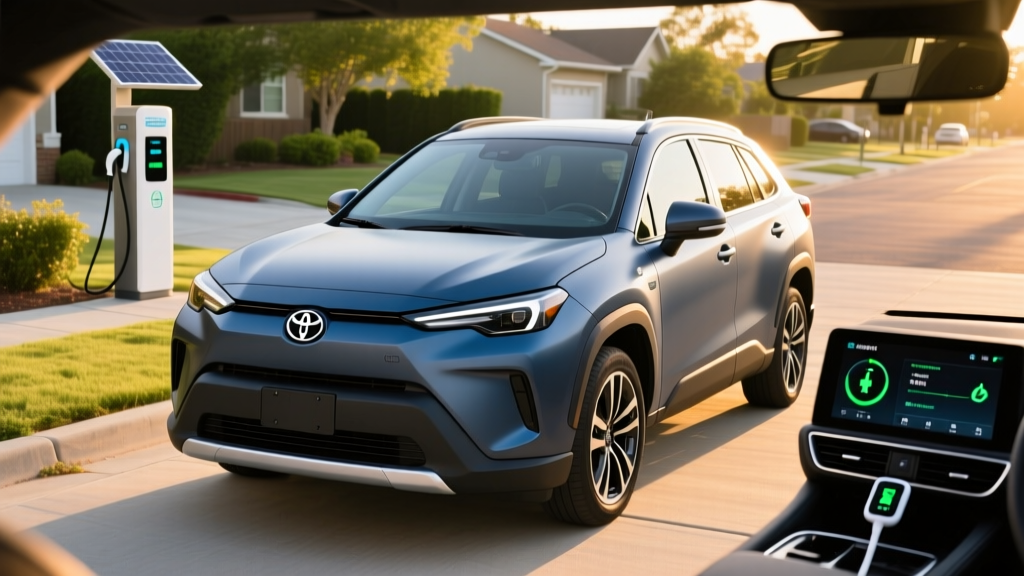
The Toyota Corolla Cross Hybrid occupies a rare sweet spot in the compact crossover segment: standard all-wheel drive, over 40 MPG combined, and a starting price under $30,000. For 2026, Toyota continues the formula that made this subcompact SUV a volume seller — a proven 2.0-liter hybrid powertrain shared with the Corolla sedan, packaged in a practical crossover body with 7.1 inches of ground clearance.
But the Corolla Cross Hybrid is a conventional hybrid (HEV), not a plug-in. That distinction matters for buyers weighing electrified options. This guide breaks down exactly what you get — EPA fuel economy, real-world MPG expectations, powertrain specs, battery longevity, tax-credit eligibility, and whether this HEV fits your needs better than a PHEV or full battery-electric vehicle.
EPA Fuel Economy and Real-World MPG
The 2026 Corolla Cross Hybrid carries over the EPA ratings established when the hybrid variant launched. All trims (S, SE, and XSE) share the same powertrain and drivetrain, so fuel economy is identical across the lineup.
| Trim | City MPG | Highway MPG | Combined MPG | Drivetrain |
|---|---|---|---|---|
| S | 45 | 38 | 42 | AWD |
| SE | 45 | 38 | 42 | AWD |
| XSE | 45 | 38 | 42 | AWD |
Source: EPA / fueleconomy.gov
Toyota's hybrid system excels in stop-and-go city driving, where regenerative braking recaptures energy and the electric motor handles low-speed propulsion. In mixed suburban and city testing, owners consistently report 43–47 MPG — exceeding the EPA city estimate. Highway driving at sustained 70+ MPH yields closer to 35–38 MPG, slightly below the EPA highway figure, because the 2.0L engine carries more of the load without regenerative assistance.
For a 50/50 city-highway commute, expect approximately 40–44 MPG combined in moderate temperatures. Cold weather (below 35°F) can reduce fuel economy by 5–10% due to engine warm-up cycles and reduced battery efficiency, bringing combined figures to roughly 37–40 MPG.
With a 10.6-gallon fuel tank, that translates to a practical driving range of approximately 420–450 miles per tank in typical mixed driving — comparable to many compact sedans and significantly better than gas-only compact crossovers.
Powertrain: 2.0L Hybrid with Standard AWD
The Corolla Cross Hybrid uses Toyota's fifth-generation hybrid system paired with a 2.0-liter Dynamic Force four-cylinder engine. Unlike the gas-only Corolla Cross (which offers front-wheel drive), the hybrid comes exclusively with electronic all-wheel drive — a rear-mounted electric motor provides rear-axle torque without a mechanical driveshaft.
| Specification | Value |
|---|---|
| Engine | 2.0L 4-cylinder Dynamic Force (M20A-FXS) |
| Combined System Horsepower | 196 HP |
| Front Motor | Permanent-magnet synchronous (integrated in transaxle) |
| Rear Motor (AWD) | 40 HP rear-axle electric motor |
| Transmission | Electronic Continuously Variable (eCVT) |
| 0–60 MPH | ~7.5 seconds (est.) |
| Drivetrain | Electronic AWD (standard, all trims) |
| Towing Capacity | Not rated for towing |
The 196 combined horsepower represents a meaningful upgrade over the gas-only Corolla Cross (169 HP). The electric motor's instant torque delivery makes the hybrid feel notably quicker in city acceleration and highway merging, even though the 0–60 time isn't sports-car territory. The eCVT operates smoothly without the rubber-band effect that older Toyota hybrids exhibited.
The rear electric motor engages automatically when front-wheel slip is detected or under hard acceleration. It's not a dedicated off-road system, but it provides confident traction in rain, light snow, and gravel. Toyota's AWD system can send up to 50% of available torque to the rear wheels.
HEV vs. PHEV vs. EV: Which Fits Your Driving Pattern?
The Corolla Cross Hybrid is a conventional hybrid (HEV). It has no plug, no electric-only driving mode, and no external charging requirement. The small traction battery (approximately 1.0 kWh usable) charges exclusively through regenerative braking and the gasoline engine. This is fundamentally different from a plug-in hybrid (PHEV) or a battery-electric vehicle (BEV).
| Factor | HEV (Corolla Cross Hybrid) | PHEV (e.g., Toyota RAV4 Prime) | BEV (e.g., Hyundai Kona Electric) |
|---|---|---|---|
| Plug-in Charging | No — gas only | Yes — Level 1/2 | Yes — Level 1/2/DC |
| Electric-Only Range | None (EV assist only) | ~42 miles | ~261 miles (EPA) |
| Combined MPG / MPGe | 42 MPG | 38 MPG (gas) / 94 MPGe (electric) | 120 MPGe |
| Battery Size | ~1.0 kWh | ~18.1 kWh | ~64 kWh |
| Federal Tax Credit (§30D) | Not eligible | Up to $7,500* | Up to $7,500* |
| Home Charging Needed | No | Recommended (Level 2) | Essential (Level 2) |
| Starting MSRP (approx.) | ~$29,590 | ~$44,590 | ~$33,550 |
*Federal tax credit eligibility depends on MSRP caps, buyer income limits, battery sourcing requirements, and point-of-sale transfer rules under IRS §30D. See IRS.gov for current-year requirements.
Choose the Corolla Cross Hybrid (HEV) if: You lack reliable home charging access (apartment, street parking, no garage), want the lowest purchase price, prefer zero behavior change from a gas car, and drive a mix of city and highway miles.
Choose a PHEV if: You have home Level 2 charging and a commute under 40 miles round-trip — you'll drive mostly on electricity while keeping a gas engine for road trips.
Choose a full EV if: You have reliable home charging, want to eliminate gas entirely, your daily driving is under 250 miles, and you want the lowest per-mile fuel cost and lowest maintenance.
Pricing, Trims, and Tax Credit Eligibility
For 2026, the Corolla Cross Hybrid is offered in three trims. Pricing reflects Toyota's MSRP before destination charges (approximately $1,395).
| Trim | MSRP (before destination) | Key Features |
|---|---|---|
| S | $29,590 | 8" touchscreen, wireless CarPlay/Android Auto, TSS 3.0, LED headlights |
| SE | $31,290 | 18" alloy wheels, heated front seats, SofTex trim, smart key |
| XSE | $33,490 | Power liftgate, 10.5" display, JBL audio (9 speakers), wireless charging pad |
Source: Toyota.com — Corolla Cross Hybrid
Does the Corolla Cross Hybrid Qualify for a Federal Tax Credit?
No. The Corolla Cross Hybrid is a conventional hybrid (HEV), not a plug-in vehicle. Under IRS §30D, the federal clean vehicle credit applies only to battery-electric vehicles (BEVs) and plug-in hybrids (PHEVs) that meet battery-capacity, MSRP, income, and critical-mineral sourcing thresholds. Conventional hybrids do not qualify for any federal purchase incentive.
Some states and municipalities offer rebates for conventional hybrids, but these are uncommon and vary by jurisdiction. Check your state energy office or local utility for current programs. The lack of a federal tax credit is the primary financial disadvantage versus a qualifying PHEV or BEV — though the Corolla Cross Hybrid's lower base price partially offsets this gap.
Battery Warranty, Longevity, and Replacement Cost
Battery lifespan is the single most common concern among hybrid buyers. Toyota addresses this with an industry-standard warranty and a track record of hybrid battery durability spanning two decades.
Coverage: 10 years / 150,000 miles (whichever comes first)
What's covered: Hybrid battery pack and all hybrid-system components (inverter, electric motors, eCVT control electronics)
Capacity threshold: Toyota warrants the battery against defects and abnormal capacity loss. Unlike BEVs, HEV batteries are small and rarely experience measurable range-impacting degradation because they operate in a narrow state-of-charge window (typically 40–80% SoC).
Transferable: Yes — warranty transfers to subsequent owners automatically.
How Long Do Toyota Hybrid Batteries Actually Last?
Real-world data from Toyota's hybrid fleet (Prius, Camry Hybrid, RAV4 Hybrid) consistently shows traction batteries lasting 150,000–200,000+ miles before significant degradation. The Corolla Cross Hybrid's ~1.0 kWh nickel-metal-hydride (NiMH) battery pack is small, operates in a conservative charge window, and benefits from Toyota's mature thermal management. Premature failure is rare.
The 10-year/150,000-mile warranty provides substantial coverage. For context, the average American driver covers ~13,500 miles per year, meaning the warranty covers roughly 11 years of typical use.
Hybrid Battery Replacement Cost
If the hybrid battery fails outside warranty (uncommon before 150K miles), replacement costs typically range from $2,500 to $4,000 including parts and labor at a Toyota dealer. Independent hybrid specialists often perform the same service for $1,800–$3,000. Refurbished battery packs are available for $1,200–$2,000 from third-party suppliers.
This is dramatically lower than BEV battery replacement, which can exceed $10,000–$20,000. The small battery size and NiMH chemistry of the Corolla Cross Hybrid keep replacement costs manageable.
Reliability, Safety, and Ownership Costs
Toyota's hybrid powertrain is among the most proven in the industry, with over 25 million hybrid vehicles sold globally since 1997. The Corolla Cross Hybrid inherits this reliability pedigree. The 2.0L Dynamic Force engine uses a timing chain (not a belt), direct and port fuel injection, and has no turbocharger — reducing complexity and long-term maintenance.
Toyota Safety Sense 3.0 (TSS 3.0) is standard on all trims and includes:
- Pre-Collision System with Pedestrian Detection
- Lane Departure Alert with Steering Assist
- Full-Speed Range Dynamic Radar Cruise Control
- Lane Tracing Assist
- Road Sign Assist
- Automatic High Beams
Note: TSS 3.0 is an SAE Level 2 driver-assistance system. It provides steering and speed assistance but requires continuous driver engagement and supervision. It is not autonomous or self-driving.
Estimated Annual Operating Costs
At 42 MPG combined and $3.25/gallon gasoline (national average estimate), the Corolla Cross Hybrid costs approximately $1,005 per year in fuel for 13,000 miles of driving. Compare that to the gas-only Corolla Cross AWD (29 MPG combined) at approximately $1,458 per year — a savings of roughly $450 annually, or $2,250 over five years.
Maintenance costs are lower than gas-only vehicles because regenerative braking extends brake pad life (often 80,000+ miles before replacement), and the hybrid system eliminates the traditional starter motor and alternator. Oil changes are still required at Toyota's recommended 10,000-mile intervals.
Pros, Cons, and the Competition
Pros
- 42 MPG combined with standard AWD — best in compact crossover class
- 196 HP feels quick for the segment
- No plug-in charging required — zero lifestyle change
- 10-year/150K-mile hybrid battery warranty
- Under $30K starting price
- TSS 3.0 standard on all trims
- Proven Toyota hybrid reliability
Cons
- No federal tax credit (HEV, not PHEV/BEV)
- Rear seat and cargo space tighter than RAV4 Hybrid
- No DC fast charging (not applicable for HEV)
- Not rated for towing
- CVT drone under hard acceleration
- Base S trim feels sparse vs. competitors
- Highway MPG lower than city (hybrid characteristic)
The Corolla Cross Hybrid's closest competitors include the Honda HR-V (no hybrid option, ~30 MPG), the Kia Niro Hybrid (50 MPG combined but FWD only, lower ground clearance), and the Subaru Crosstrek Hybrid (discontinued as a PHEV after 2023). Within Toyota's own lineup, the RAV4 Hybrid (39 MPG, ~$32,000) offers more space and power but at a higher price. The Corolla Cross Hybrid wins on value for buyers who don't need midsize-crossover room.
Frequently Asked Questions
How many MPG does the Corolla Cross Hybrid get?
The EPA rates the 2026 Corolla Cross Hybrid at 45 city / 38 highway / 42 combined MPG. In real-world city-heavy driving, owners often see 43–47 MPG. Sustained highway driving at 75+ MPH typically yields 35–38 MPG. Cold weather reduces these figures by roughly 5–10%.
Does the Corolla Cross Hybrid need to be plugged in?
No. The Corolla Cross Hybrid is a conventional hybrid (HEV), not a plug-in hybrid. It charges its small traction battery through regenerative braking and the gasoline engine. You simply fill it with gas like any other vehicle.
Does it qualify for any federal tax credit?
No. Under IRS §30D, only plug-in vehicles (BEVs and PHEVs) with sufficient battery capacity qualify for the federal clean vehicle credit. Conventional hybrids like the Corolla Cross Hybrid are not eligible. Check your state and local utility for any regional hybrid incentives.
Is the Corolla Cross Hybrid reliable, and what is the battery replacement cost?
Toyota's hybrid system has a 25+ year reliability track record. The hybrid battery is covered by a 10-year/150,000-mile warranty. Out-of-warranty replacement (rare before 150K miles) typically costs $2,500–$4,000 at a dealer or $1,800–$3,000 at an independent hybrid specialist.
How does the Corolla Cross Hybrid compare to a full EV?
A full EV (like the Hyundai Kona Electric or Chevrolet Equinox EV) offers lower per-mile fuel costs (~$0.04/mile vs. ~$0.08/mile for the Corolla Cross Hybrid), zero tailpipe emissions, and access to the $7,500 federal tax credit. However, EVs require reliable home charging, cost more upfront, and have range limitations on long road trips. The Corolla Cross Hybrid is the right choice if you lack home charging or frequently drive beyond 250 miles without stopping.
Is the Corolla Cross Hybrid AWD system good in snow?
The electronic AWD system provides confident traction in light to moderate snow and rain, automatically engaging the rear motor when slip is detected. With 7.1 inches of ground clearance and proper winter tires, it handles typical winter commuting well. It is not a dedicated off-road or deep-snow vehicle.
What's the difference between the Corolla Cross Hybrid and the RAV4 Hybrid?
The RAV4 Hybrid is larger (midsize vs. subcompact), more powerful (219 HP vs. 196 HP), offers more cargo room (37.6 vs. 25.5 cu ft behind rear seats), and is rated to tow 1,750 lbs. However, the RAV4 Hybrid starts ~$3,000 higher and gets slightly lower fuel economy (39 vs. 42 MPG combined). Choose the Corolla Cross Hybrid if you prioritize fuel economy and price; choose the RAV4 Hybrid if you need space and towing.