Quick Verdict: The Sensible Hybrid Crossover Done Right
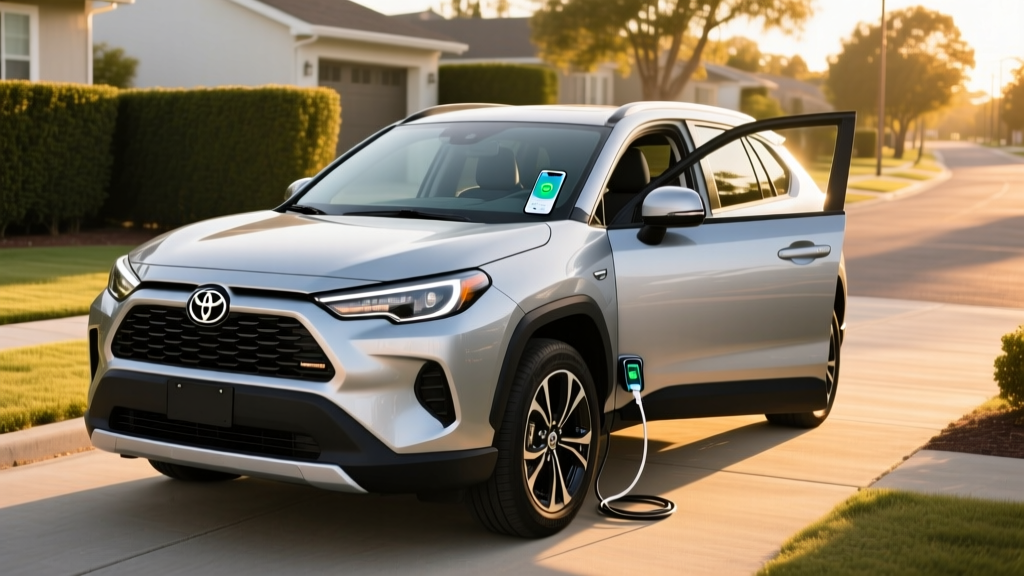
The Toyota Corolla Cross Hybrid AWD occupies a narrow but valuable lane: a compact crossover that delivers genuine all-wheel-drive traction, 42 MPG combined, and Toyota's hybrid reliability without requiring you to plug in or rethink your driving habits. For 2026, it remains one of the most fuel-efficient AWD vehicles on the market, undercutting rivals like the Honda CR-V Hybrid and Ford Escape Hybrid at the pump while offering a lower entry price than the RAV4 Hybrid.
This is a conventional hybrid (HEV), not a plug-in hybrid (PHEV). You will never need to find a charging station or install a home charger. The gasoline engine and regenerative braking handle all battery charging automatically. If you want electric-only driving, you need to look at the RAV4 Prime PHEV or a full battery-electric vehicle instead.
HEV vs PHEV vs EV: Where the Corolla Cross Hybrid Fits
| Factor | Corolla Cross Hybrid (HEV) | RAV4 Prime (PHEV) | bZ4X (BEV) |
|---|---|---|---|
| Plug in required? | No | Yes, for EV range | Yes, always |
| Electric-only range | None (EV assist only) | 42 miles EPA | 252 miles EPA |
| Total range | ~530 miles | ~440 miles combined | 252 miles |
| Combined MPG/MPGe | 42 MPG | 94 MPGe / 38 MPG gas | 114 MPGe |
| Federal tax credit (§30D) | Not eligible | Up to $7,500 (check sourcing) | Up to $7,500 (check sourcing) |
| Starting MSRP (2026) | ~$29,990 | ~$44,590 | ~$37,070 |
| Home charging needed | No | Recommended (Level 2) | Required (Level 2) |
The Corolla Cross Hybrid is the clear choice for buyers who want maximum fuel savings with zero lifestyle change. You fuel it like any other gas car, and the hybrid system handles efficiency behind the scenes. The trade-off is that you never drive on electricity alone — there is no EV mode that lets you cruise silently through neighborhoods or avoid tailpipe emissions on short trips. If that matters to you, a PHEV or BEV is worth the premium.
Fuel Economy: EPA Numbers and Real-World MPG
| Metric | EPA Estimate | Real-World Expectation |
|---|---|---|
| City | 46 MPG | 44–48 MPG (hybrids often beat EPA in city) |
| Highway | 33 MPG | 30–35 MPG (hybrid advantage shrinks at sustained speed) |
| Combined | 42 MPG | 38–44 MPG depending on driving mix |
The EPA rates the 2026 Corolla Cross Hybrid AWD at 46 city / 33 highway / 42 combined, according to fueleconomy.gov. These are strong numbers for an AWD crossover — only the Hyundai Kona Hybrid and a few subcompact entries do better without a plug.
In real-world driving, Toyota's hybrid system excels in stop-and-go traffic where regenerative braking constantly recovers energy and the electric motor handles low-speed propulsion. Owners who do mostly city and suburban driving frequently report exceeding the 42 MPG combined sticker, with some seeing 45+ MPG in warm weather. Highway-heavy commutes tell a different story: at 75 MPH, the 2.0-liter four-cylinder engine does most of the work, and the hybrid advantage narrows. Expect 33–35 MPG on flat highway in mild weather, dropping to 30–32 MPG in cold conditions or mountainous terrain.
Cold-weather note: Hybrid fuel economy drops 10–15% in freezing temperatures because the engine runs more frequently to maintain cabin heat and battery temperature. This is normal for all hybrids and is less severe than the 20–30% range loss seen in full EVs in the same conditions.
Powertrain and Performance Specs
| Specification | Detail |
|---|---|
| Engine | 2.0L 4-cylinder Atkinson-cycle |
| Engine output | 150 hp / 138 lb-ft torque |
| Electric motors | Front motor + rear motor (e-AWD) |
| Net combined horsepower | 196 hp |
| Transmission | Electronically controlled CVT (eCVT) |
| Drivetrain | Electronic On-Demand AWD |
| 0–60 MPH | ~7.5 seconds (est.) |
| Towing capacity | Not rated for towing |
| Curb weight | ~3,400 lbs |
Toyota's fifth-generation hybrid system pairs the 2.0-liter Atkinson-cycle engine with two electric motor-generators up front and a dedicated rear-axle motor for AWD. The rear motor engages automatically when the system detects slip, providing torque to the rear wheels without a mechanical driveshaft. This "e-AWD" approach adds minimal weight and doesn't impact fuel economy significantly compared to the FWD variant.
With 196 net horsepower, the Corolla Cross Hybrid is notably quicker than the non-hybrid Corolla Cross (169 hp) and feels responsive in city merging and passing situations. The eCVT delivers smooth, stepless acceleration — there are no gear shifts to feel. The trade-off is the characteristic CVT drone under hard acceleration, though Toyota has improved the sound insulation for 2026.
Battery, Warranty, and Long-Term Reliability
The Corolla Cross Hybrid uses a compact lithium-ion hybrid battery pack (approximately 1.0 kWh usable capacity) mounted under the rear seat. This is not a large traction battery like you'd find in a PHEV or BEV — it's designed for frequent shallow charge-discharge cycles, not deep cycling or long electric-only driving.
Toyota Hybrid Battery Warranty: 10 years / 150,000 miles (whichever comes first) for the hybrid battery pack. This covers defects and abnormal capacity loss. The broader hybrid system (inverter, motor-generators, control electronics) carries the same 10-year/150,000-mile coverage.
Toyota's hybrid battery reliability record is among the best in the industry. The Prius, which pioneered this architecture, routinely sees original hybrid batteries lasting 150,000–200,000+ miles. The Corolla Cross Hybrid uses the same proven THS (Toyota Hybrid System) architecture in a newer, more compact form factor.
If the hybrid battery does eventually need replacement out of warranty, expect a cost of approximately $2,000–$3,500 for the battery pack itself, plus labor. Third-party refurbished battery options are increasingly available for $1,200–$2,000. This is a fraction of the $8,000–$20,000+ replacement costs associated with full EV traction batteries, and the smaller pack is less complex to swap.
For overall vehicle reliability, Toyota consistently ranks at or near the top in J.D. Power Vehicle Dependability studies, and the Corolla nameplate is historically one of the most trouble-free vehicles sold globally.
Pricing, Trims, and Tax Credit Eligibility
The 2026 Toyota Corolla Cross Hybrid AWD starts at approximately $29,990 MSRP (including destination) for the S trim. Key trim levels:
| Trim | MSRP (est.) | Key Additions |
|---|---|---|
| Hybrid S | $29,990 | 8-inch touchscreen, Toyota Safety Sense 3.0, 17-inch alloy wheels, LED headlights |
| Hybrid SE | $31,990 | SofTex seats, heated front seats, wireless phone charging, blind-spot monitor |
| Hybrid XSE | $34,490 | JBL audio (9 speakers), power liftgate, panoramic moonroof, 18-inch wheels |
Federal Tax Credit (§30D): The Corolla Cross Hybrid does not qualify for the federal §30D clean vehicle credit. That credit applies only to plug-in electric vehicles (PHEVs and BEVs) with battery packs of at least 7 kWh. The Corolla Cross Hybrid's ~1.0 kWh pack falls far below this threshold. No federal purchase incentive applies to conventional HEVs as of 2026. Check with your state — some states (e.g., Colorado, California) offer separate hybrid incentives or rebates, but these vary and change frequently. Consult irs.gov for current federal rules and your state's DMV or energy office for local programs.
Without a tax credit, the value proposition rests entirely on fuel savings. At 42 MPG combined versus the non-hybrid Corolla Cross AWD at 30 MPG combined, the hybrid saves approximately $425–$550 per year in fuel costs (assuming 12,000 miles/year and $3.40/gallon). The hybrid premium over the gas Corolla Cross AWD (~$2,500) pays for itself in roughly 5–6 years at current fuel prices.
Who Should Choose the Corolla Cross Hybrid AWD
Pros
- 42 MPG combined is class-leading for AWD crossovers
- No plug-in required — zero lifestyle change from a gas car
- 196 hp is a meaningful upgrade over the non-hybrid (169 hp)
- 10-year/150,000-mile hybrid battery warranty
- Standard AWD at a price point where most competitors charge extra
- Toyota Safety Sense 3.0 standard (adaptive cruise, lane-keep, auto emergency braking)
- Proven, low-risk hybrid technology with deep reliability history
Cons
- No electric-only driving mode — always burning some gasoline
- No federal tax credit eligibility (HEV limitation)
- Cargo space slightly reduced vs. gas model (battery placement)
- Highway MPG advantage is modest (33 MPG) — less impressive on long road trips
- CVT drone under hard acceleration
- Not rated for towing
- Infotainment is functional but not class-leading in responsiveness
Choose the Corolla Cross Hybrid AWD if: You want maximum fuel savings without changing how you refuel, you drive a city/suburban mix, you need AWD for weather, and you want a compact crossover under $35,000 with strong reliability.
Choose a PHEV (like the RAV4 Prime) if: You have home charging, want 30–40+ miles of electric-only commuting, and want to qualify for the $7,500 federal tax credit.
Choose a full EV (like the bZ4X or Ioniq 5) if: You have reliable home charging, want zero tailpipe emissions, and are ready to adapt to charging routines for maximum long-term cost savings.
Choose the gas Corolla Cross AWD if: You drive fewer than 8,000 miles per year (the hybrid premium won't pay back) or you're strictly budget-constrained below $28,000.
Frequently Asked Questions
How many MPG does the Corolla Cross Hybrid AWD get?
The EPA rates it at 46 city / 33 highway / 42 combined. Real-world results range from 38–48 MPG depending on your driving mix and climate. City-heavy drivers often exceed the combined sticker; highway-heavy drivers fall slightly short.
Do I need to plug in the Corolla Cross Hybrid?
No. This is a conventional hybrid (HEV), not a plug-in hybrid (PHEV). The battery charges itself through regenerative braking and the gasoline engine. You simply fill up at a gas station like any other vehicle.
Is the Corolla Cross Hybrid reliable, and what does battery replacement cost?
Toyota's hybrid system has a 25+ year track record of exceptional reliability. The hybrid battery is covered for 10 years / 150,000 miles. Out-of-warranty replacement runs approximately $2,000–$3,500, with refurbished options available for less. Most owners never need a battery replacement within the vehicle's normal lifespan.
Does the Corolla Cross Hybrid qualify for any tax credit?
It does not qualify for the federal §30D clean vehicle credit, which requires a plug-in vehicle with at least 7 kWh of battery capacity. Some states may offer separate hybrid incentives — check your state's energy office. The IRS §30D page details current federal eligibility rules.
How does the Corolla Cross Hybrid compare to the RAV4 Hybrid?
The RAV4 Hybrid offers more cargo space (37.6 vs. ~25.5 cu ft), more power (219 hp), and a higher tow rating (1,750 lbs), but starts about $4,000 higher and returns 39 MPG combined vs. the Corolla Cross Hybrid's 42 MPG. If you need the space and power, the RAV4 Hybrid is worth the premium. If you prioritize efficiency and value, the Corolla Cross Hybrid wins.
Can the Corolla Cross Hybrid drive on electric power only?
Only for very brief, low-speed moments (e.g., creeping in a parking lot or coasting to a stop). There is no dedicated EV mode and no meaningful electric-only range. For electric-only commuting, you need a PHEV or BEV.