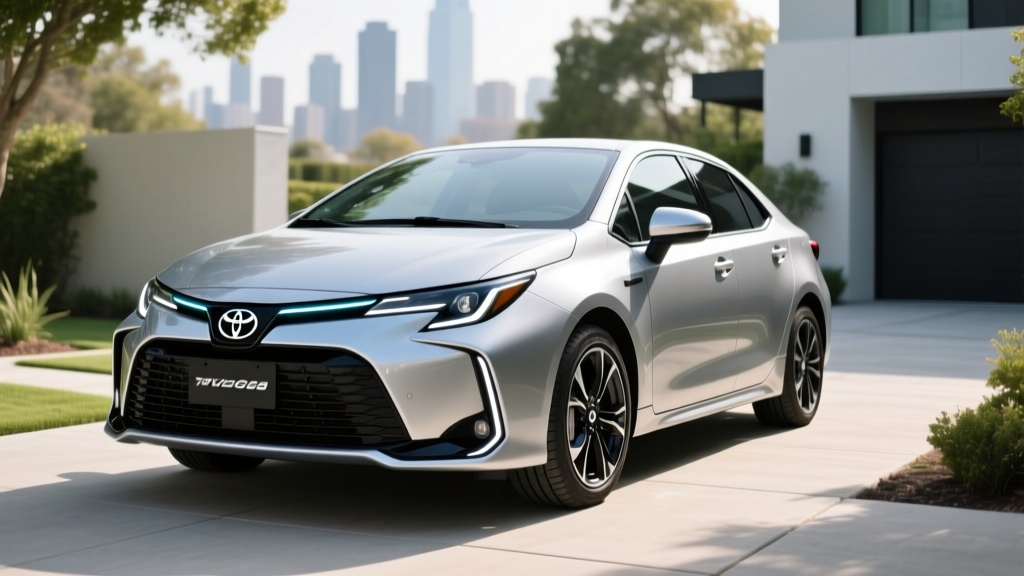
Compact sedans with all-wheel drive used to mean a steep fuel-economy penalty. The 2026 Toyota Corolla all wheel drive hybrid flips that equation: a fifth-generation Toyota hybrid system paired with an electronically controlled rear axle delivers genuine four-season traction while still returning nearly 50 MPG on the EPA combined cycle. For buyers in snow-belt states who aren't ready for a full battery-electric vehicle, it's one of the most practical drivetrains on the market.
This guide breaks down every number that matters — EPA fuel economy, real-world MPG expectations, powertrain output, pricing by trim, battery warranty, and how the Corolla Hybrid AWD stacks up against a PHEV or a full EV for your daily commute.
Corolla Hybrid AWD Powertrain and Performance Specs
The 2026 Corolla Hybrid uses Toyota's latest hybrid architecture: a 1.8-liter Atkinson-cycle four-cylinder engine mated to two front-mounted motor-generators and a separate rear-mounted electric motor that provides on-demand all-wheel drive. There is no mechanical driveshaft connecting the engine to the rear wheels — the rear axle is powered entirely by electricity, engaging automatically when the system detects slip or during hard acceleration from a stop.
| Specification | Value |
|---|---|
| Engine | 1.8L 4-cyl Atkinson-cycle |
| Combined System Horsepower | 138 hp |
| Front Electric Motor | 70 kW (94 hp) |
| Rear Electric Motor (AWD) | 30 kW (40 hp) |
| Transmission | eCVT (planetary gearset) |
| Hybrid Battery | ~1.3 kWh lithium-ion (self-charging HEV) |
| Drivetrain | Electronic On-Demand AWD |
| 0–60 mph | ~9.0 seconds (est.) |
| Curb Weight | ~3,115 lbs |
| Towing Capacity | Not rated |
The combined 138 hp is modest, and the Corolla Hybrid AWD is not a performance car. It's tuned for efficiency and smoothness. The eCVT eliminates shift shock entirely, and the electric motors provide instant torque off the line, making the car feel more responsive around town than the horsepower figure suggests. Highway merging requires planning, but the powertrain is never strained in normal driving.
EPA Fuel Economy and Real-World MPG
Fuel economy is the headline reason buyers choose the Corolla Hybrid over its gasoline-only counterparts. Here's what the EPA publishes for the 2026 AWD model:
| Cycle | MPG |
|---|---|
| City | 53 MPG |
| Highway | 46 MPG |
| Combined | 48 MPG |
Source: fueleconomy.gov
Hybrids often exceed their EPA city rating because regenerative braking recovers more energy in stop-and-go traffic. In mixed suburban driving, owners regularly report 50–55 MPG. On sustained highway trips at 75+ mph, expect the figure to settle closer to 42–45 MPG as aerodynamic drag dominates and the electric motors contribute less. In cold weather (below 30°F), short-trip city MPG can dip to the mid-40s because the engine runs longer to heat the cabin and bring the catalytic converter to operating temperature. Over a full tank in moderate climates, 48–52 MPG combined is a realistic expectation.
For comparison, the non-hybrid 2026 Corolla AWD with the 2.0L engine and CVT returns approximately 34 MPG combined — a gap of roughly 14 MPG. Over 15,000 miles per year at $3.40/gallon, that translates to about $450–$550 in annual fuel savings with the hybrid, enough to recoup the hybrid premium in roughly three to four years.
HEV vs. PHEV vs. Full EV: Which Drivetrain Fits You?
The Corolla Hybrid AWD is a conventional hybrid (HEV). It cannot be plugged in and has no meaningful electric-only range. The small ~1.3 kWh battery recharges through regenerative braking and the gasoline engine. This is a deliberate design choice — Toyota positions the Corolla Hybrid as the zero-effort electrification option for buyers who want better fuel economy without changing their refueling habits.
| Factor | HEV (Corolla Hybrid) | PHEV (e.g., Prius Prime) | BEV (e.g., Tesla Model 3) |
|---|---|---|---|
| Plug-in Required? | No | Yes (for EV range) | Yes |
| Electric-Only Range | ~1 mile at low speed | ~40–45 miles | 250–360 miles |
| Fuel/Charging Cost | Gas only (~$0.07/mi) | Electric + gas (~$0.04–0.08/mi) | Electric only (~$0.03–0.05/mi) |
| Home Charger Needed? | No | Recommended (Level 2) | Essential (Level 2) |
| Federal Tax Credit (§30D) | Not eligible | Up to $7,500* | Up to $7,500* |
| Upfront Price Premium | Low (~$1,500 over gas) | Medium ($4,000–$8,000) | High ($8,000–$15,000+) |
| Best For | No home charging access | Short commute + home charging | Home charging + low running cost |
*§30D credit eligibility depends on MSRP caps, buyer income limits, and battery mineral sourcing requirements per IRS guidelines. Always verify current-year rules with a tax professional.
If you have access to Level 2 home charging and your daily commute is under 40 miles, a PHEV like the Toyota Prius Prime (EPA-estimated 44 miles electric-only, 52 MPG combined on gas) may save you more fuel and qualify for federal incentives. If you lack home charging or regularly drive long distances, the Corolla Hybrid AWD's gas-only simplicity becomes a genuine advantage — no charging infrastructure anxiety, no cold-weather range loss to manage, and no need to plan stops around charging stations.
2026 Corolla Hybrid AWD Pricing by Trim
The Corolla Hybrid AWD is offered across three trims for the 2026 model year. Pricing below reflects MSRP before destination charges:
| Trim | MSRP (est.) | Key Additions Over Base |
|---|---|---|
| LE AWD | $25,225 | Toyota Safety Sense 3.0, 8" touchscreen, wireless CarPlay/Android Auto, LED headlights |
| SE AWD | $27,575 | Sport-tuned suspension, 18" alloy wheels, paddle shifters, Smart Key |
| XLE AWD | $29,625 | SofTex seats, heated front seats, 10.5" display, wireless charging, ambient lighting |
Destination adds approximately $1,095. Fully loaded, an XLE AWD lands near $31,000 before dealer adjustments.
The Corolla Hybrid AWD is a conventional HEV and does not qualify for the §30D New Clean Vehicle Credit (up to $7,500). That credit is reserved for plug-in vehicles — PHEVs and BEVs — that meet battery sourcing, MSRP, and buyer income requirements. Some states offer modest rebates for conventional hybrids (typically $500–$1,500), but these vary widely. Check your state energy office or AFDC incentive database for local programs.
Hybrid Battery Warranty, Lifespan, and Replacement Cost
Battery longevity is consistently the top concern among hybrid shoppers. Toyota addresses this with one of the strongest hybrid battery warranties in the industry.
Coverage: 10 years / 150,000 miles (whichever comes first)
What's covered: Hybrid battery pack and hybrid system components (inverter, motor-generators, control ECU)
Capacity threshold: Toyota warrants the battery against defects and abnormal capacity loss; gradual degradation is expected but typically minimal in the small HEV pack
Transferable: Yes — warranty transfers to subsequent owners
Toyota's hybrid battery packs use proven nickel-metal hydride or lithium-ion chemistry (depending on model year and market) that has demonstrated exceptional longevity in real-world use. The Prius, which shares the same hybrid architecture, has documented cases of original batteries lasting 200,000+ miles with less than 15% capacity degradation. The Corolla Hybrid's battery is smaller and less stressed than a PHEV or BEV pack, which works in its favor for longevity.
If replacement is needed out of warranty, a new OEM hybrid battery for the Corolla Hybrid typically costs $2,000–$3,500 including labor. Third-party refurbished packs are available for $1,000–$1,800. For context, that's roughly equivalent to a major transmission repair on a conventional vehicle — and far less than a BEV traction battery replacement ($8,000–$20,000+).
Reliability, Safety, and Ownership Costs
Toyota's hybrid system is among the most proven electrified powertrains on the road, with over 25 years of continuous production since the original 1997 Prius. The Corolla nameplate carries strong resale value, and the hybrid variant has historically depreciated slower than its gas-only counterpart due to sustained demand in the used market.
The 2026 model comes standard with Toyota Safety Sense 3.0, which includes:
- Pre-Collision System with Pedestrian Detection
- Full-Speed Range Dynamic Radar Cruise Control
- Lane Departure Alert with Steering Assist
- Lane Tracing Assist
- Automatic High Beams
- Road Sign Assist
- Proactive Driving Assist (gentle braking/deceleration support)
This is a Level 2 driver-assistance system per SAE classification — it can manage steering and speed on marked highways, but the driver must remain fully engaged with hands on the wheel and eyes on the road at all times. It is not autonomous driving.
Safety ratings from NHTSA and IIHS should be checked at launch, as the Corolla historically earns top marks in crashworthiness. Maintenance costs are low: no oil changes more frequently than a gas car (Toyota recommends 10,000-mile synthetic oil intervals), regenerative braking extends pad life significantly (60,000–100,000 miles is common), and there is no transmission fluid to service on the eCVT.
Five-Year Total Cost of Ownership Estimate
| Category | Hybrid AWD LE | Gas AWD LE |
|---|---|---|
| MSRP + Destination | $26,320 | $24,820 |
| Fuel (75,000 mi total) | $5,310 (48 MPG, $3.40/gal) | $7,500 (34 MPG, $3.40/gal) |
| Estimated Depreciation | $10,200 | $11,800 |
| Insurance (est. avg) | $7,500 | $7,200 |
| Maintenance & Repairs | $2,200 | $2,800 |
| 5-Year Total | $31,530 | $34,120 |
| Difference | Hybrid saves ~$2,590 over 5 years | |
The hybrid breaks even on its ~$1,500 price premium within approximately three years through fuel savings alone, and stronger resale value widens the gap further. Insurance may be marginally higher on the hybrid due to repair cost assumptions, but the difference is typically small.
Pros and Cons at a Glance
- 48 MPG combined EPA — class-leading for an AWD sedan
- Electronic AWD with no mechanical complexity
- 10-year / 150,000-mile hybrid battery warranty
- No plug-in charging required — works with existing gas infrastructure
- Toyota Safety Sense 3.0 standard on all trims
- Strong resale value and proven reliability track record
- Low starting price — under $26,000 for LE AWD
- 138 hp — leisurely acceleration, especially at highway speeds
- No federal tax credit (HEV, not a PHEV or BEV)
- Rear seat space is tight for taller passengers
- Cargo volume (~13.1 cu ft) trails some compact rivals
- AWD rear motor adds ~130 lbs over FWD hybrid
- Not eligible for HOV lane access in most states
- eCVT drone under hard acceleration
Frequently Asked Questions
How many MPG does the 2026 Corolla all wheel drive hybrid get?
The EPA rates the 2026 Corolla Hybrid AWD at 53 MPG city, 46 MPG highway, and 48 MPG combined. In real-world mixed driving, expect 48–52 MPG in moderate climates, with city driving potentially exceeding 50 MPG thanks to regenerative braking. Highway-only trips at 75+ mph will return closer to 42–45 MPG.
Does the Corolla Hybrid AWD need to be plugged in?
No. The Corolla Hybrid is a conventional HEV (hybrid electric vehicle). Its small battery recharges through regenerative braking and the gasoline engine. You fuel it exactly like a standard gasoline car — there is no plug, no charging cable, and no electric-only driving range to manage.
How does the AWD system work on the Corolla Hybrid?
Toyota's Electronic On-Demand AWD uses a separate 30 kW electric motor mounted on the rear axle. There is no driveshaft or mechanical connection to the engine. The rear motor engages automatically during acceleration from a stop, when front-wheel slip is detected, or in low-traction conditions. Under steady-state cruising, the car operates in front-wheel drive to maximize efficiency.
Is the Corolla Hybrid reliable, and what does battery replacement cost?
Toyota's hybrid system has an extensive reliability record spanning 25+ years. The hybrid battery is warranted for 10 years / 150,000 miles. Out-of-warranty replacement costs approximately $2,000–$3,500 for a new OEM pack. Many Toyota hybrid batteries last well beyond 200,000 miles with minimal degradation.
Does the 2026 Corolla Hybrid AWD qualify for a federal tax credit?
No. The §30D New Clean Vehicle Credit applies only to plug-in electric vehicles (PHEVs and BEVs) that meet specific battery sourcing, MSRP, and buyer income requirements. The Corolla Hybrid is a conventional HEV and does not qualify. Some states offer smaller incentives for hybrids — check your state energy office for details.
Should I buy the Corolla Hybrid AWD or a plug-in hybrid like the Prius Prime?
Choose the Corolla Hybrid AWD if you lack home charging access, drive long distances regularly, want the lowest upfront cost, or need AWD for winter conditions. Choose a PHEV like the Prius Prime if you have Level 2 home charging, your daily commute is under 40 miles, and you want the lowest possible operating cost plus potential federal tax credits. The Prius Prime does not offer AWD, however, which may be a deciding factor in snowy climates.
How long will the hybrid battery last?
Based on Toyota's track record with the Prius and Camry Hybrid, the Corolla Hybrid's battery pack is designed to last the life of the vehicle under normal use. The 10-year/150,000-mile warranty provides strong protection. Degradation in HEV packs is typically modest (10–20% over 150,000 miles) because the battery operates in a narrow state-of-charge window, avoiding the deep cycles that accelerate wear in BEVs.