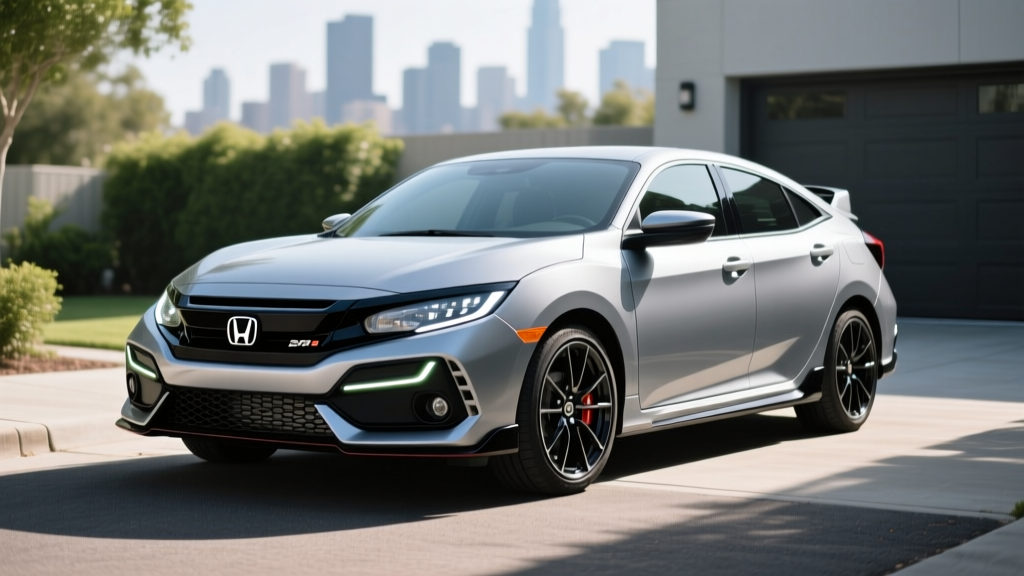
The 2026 Honda Civic Hybrid Sport Touring Hatchback sits at a crossroads that more buyers are actively navigating: it promises near-EV efficiency in city driving without requiring a plug, a home charger, or any change in daily routine. As the top-tier trim in Honda's hybrid hatchback lineup, the Sport Touring adds premium features on top of a two-motor hybrid system that prioritizes electric propulsion whenever possible. This guide breaks down the exact fuel economy numbers, powertrain specs, battery longevity data, and ownership economics you need before signing the paperwork.
HEV vs PHEV: Where the Civic Hybrid Fits
Before examining the numbers, it's essential to place the Civic Hybrid in the correct category. Honda's system is a conventional hybrid (HEV), not a plug-in hybrid (PHEV). That distinction matters for three reasons:
Conventional Hybrid (HEV) — Civic Hybrid
- Battery recharges through regenerative braking and the gasoline engine — no plug required
- Small battery (~1.0 kWh usable) acts as a buffer, not a primary energy source
- Cannot drive on electric-only power for meaningful distances
- No federal §30D tax credit eligibility (that credit targets PHEVs and BEVs with ≥7 kWh batteries)
Plug-In Hybrid (PHEV) — e.g., Toyota Prius Prime, Chrysler Pacifica Hybrid
- Larger battery (typically 12–20 kWh) charges via a plug (Level 1 or Level 2)
- 25–45 miles of electric-only range before the gas engine engages
- May qualify for up to $7,500 in federal tax credits if MSRP, income, and battery-sourcing rules are met
- Requires access to charging infrastructure to realize full efficiency benefit
The Civic Hybrid targets buyers who want maximum fuel economy with zero behavioral change. You fill it with gas and drive. The hybrid system handles the rest.
EPA Fuel Economy: City, Highway, and Combined MPG
Honda's two-motor hybrid system operates primarily in electric-drive mode at low and moderate speeds, with the 2.0-liter Atkinson-cycle engine acting as a generator. At highway speeds, a lock-up clutch connects the engine directly to the wheels for efficiency. This architecture produces EPA-rated numbers that stand out in the compact hatchback segment.
| Metric | Value |
|---|---|
| City MPG | 50 MPG |
| Highway MPG | 45 MPG |
| Combined MPG | 48 MPG |
| Fuel Tank Capacity | 12.4 gallons |
| Total Driving Range | ~595 miles |
| Annual Fuel Cost (EPA est.) | ~$1,100 (15,000 mi/yr) |
Source: fueleconomy.gov
Real-World MPG: What Owners Actually See
EPA city ratings tend to understate real-world city efficiency for Honda's hybrid system. In stop-and-go traffic, the two-motor setup runs on electric drive for extended stretches, with the engine cycling on briefly to replenish the buffer battery. Owners and independent testers routinely report 52–55 MPG in urban and suburban driving. Highway figures are more honest: at 75 mph on flat terrain, expect 42–44 MPG. Cold weather (below 35°F) reduces efficiency by roughly 5–8% because the engine runs more frequently to provide cabin heat and reach operating temperature. A realistic year-round blended expectation is 46–50 MPG for mixed driving.
Powertrain Specs: Horsepower, Torque, and Drivetrain
The Civic Hybrid's powertrain pairs a 2.0-liter direct-injected Atkinson-cycle four-cylinder engine with Honda's fourth-generation two-motor hybrid system. The combined output is competitive with turbocharged compact hatchbacks while delivering dramatically better fuel economy.
| Specification | Value |
|---|---|
| Engine | 2.0L DOHC Atkinson-cycle 4-cylinder |
| Combined System Horsepower | 200 HP |
| Combined System Torque | 232 lb-ft |
| Drive Motor Output | 184 HP / 232 lb-ft |
| Transmission | Electric CVT (e-CVT, no belt) |
| Drivetrain | Front-wheel drive |
| 0–60 mph | ~7.2 seconds (est.) |
| Hybrid Battery Capacity | ~1.0 kWh (lithium-ion) |
| Regenerative Braking | 4-level paddle-selectable |
| Drive Modes | Normal, Sport, Econ, Individual |
The 232 lb-ft of torque from the drive motor is available from near-zero RPM, which gives the Civic Hybrid immediate off-the-line responsiveness that belies its efficiency focus. The Sport driving mode sharpens throttle mapping and increases regenerative braking aggression. The four selectable regen levels, controlled via steering-wheel paddles, allow a degree of one-pedal-style driving in city traffic — though the system will not bring the car to a complete stop without brake application.
Sport Touring Trim: What You Get for the Price
The Sport Touring is the range-topping Civic Hybrid Hatchback trim, and Honda positions it as a premium compact hatchback with hybrid efficiency. Here's what the 2026 model includes above the Sport trim:
- Leather-trimmed seats with heated front and rear outboard seats
- 12-speaker Bose premium audio system
- Wireless Apple CarPlay and Android Auto on a 9-inch touchscreen
- Wireless phone charging pad
- Low-speed braking control and front/rear parking sensors
- Heated steering wheel
- Honda Sensing suite (adaptive cruise, lane-keeping, collision mitigation, traffic-sign recognition)
- 18-inch alloy wheels with all-season tires
- LED headlights with auto high-beam
- Power tailgate with walk-away close
| Trim | MSRP |
|---|---|
| Sport Hybrid | $30,750 |
| Sport Touring Hybrid | $34,750 |
Source: Honda.com — Civic Hatchback. Destination charge additional (~$1,095). Prices subject to change; verify with dealer.
Tax Credit Eligibility
The Civic Hybrid does not qualify for the federal §30D Clean Vehicle Credit. That credit requires a battery capacity of at least 7 kWh and applies to plug-in hybrids (PHEVs) and battery-electric vehicles (BEVs). The Civic Hybrid's ~1.0 kWh battery places it firmly outside eligibility. Some states offer rebates for conventional hybrids, but these vary by jurisdiction and change frequently — check your state energy office or IRS.gov for current programs.
Battery Longevity, Warranty, and Replacement Cost
Hybrid battery anxiety is the single most common concern among first-time hybrid buyers. Here's what the data shows for Honda's system:
Honda Hybrid Battery Warranty
- Coverage: 8 years / 100,000 miles (10 years / 150,000 miles in CARB states including CA, NY, MA, and others)
- What's covered: Hybrid battery pack, power control unit, drive motor, and related hybrid-system components
- Capacity threshold: Honda warrants against abnormal degradation; no published minimum SoH percentage like BEV warranties
- Transferability: Fully transferable to subsequent owners
Real-World Battery Lifespan
Honda's lithium-ion hybrid battery is small (~1.0 kWh) and operates within a narrow state-of-charge window — typically between 20% and 80% SoC. This shallow-cycling strategy dramatically reduces degradation stress compared to a BEV battery that regularly cycles through 80–100% of its capacity. Real-world data from prior-generation Honda hybrid systems (Insight, Accord Hybrid, CR-V Hybrid) indicates that most hybrid batteries last 150,000–200,000+ miles without requiring replacement. Failure before 100,000 miles is uncommon.
Replacement Cost If Needed
If the hybrid battery does require replacement outside of warranty, expect a dealer-installed replacement to cost between $2,000 and $4,000 depending on labor rates. Independent hybrid-battery specialists can often refurbish or replace individual cells for $1,000–$2,000. Given the small battery size, this is substantially less expensive than a BEV battery replacement ($8,000–$20,000+).
Who Should Choose the Civic Hybrid vs a PHEV or Full EV?
Choose the Civic Hybrid (HEV) if:
- You don't have reliable access to home or workplace charging
- You want 48+ MPG with zero behavior change — just fill up with gas
- You regularly take long road trips where charging infrastructure is sparse
- Your budget is under $35,000 and you want a premium-feel compact hatchback
- You want a manual-like driving feel from the e-CVT's direct engine connection at highway speeds
Choose a PHEV (e.g., Prius Prime) if:
- You have Level 2 charging at home and a commute under 40 miles
- You want 30–45 miles of electric-only daily driving with a gas engine backup
- You want to qualify for the federal §30D tax credit (up to $7,500, subject to income/MSRP/sourcing rules)
Choose a full BEV (e.g., Chevy Equinox EV, Tesla Model 3) if:
- You have reliable home Level 2 charging
- Your daily driving is under 250 miles and you're comfortable with public DC fast charging for road trips
- You want zero tailpipe emissions and the lowest per-mile fuel cost
- You want to maximize federal and state incentives
Ownership Economics: 5-Year Cost Snapshot
| Cost Category | Civic Hybrid Sport Touring | Civic Sport Touring (1.5T Gas) |
|---|---|---|
| Purchase Price (MSRP) | $34,750 | $32,250 |
| Fuel Cost (75k mi, $3.50/gal avg) | ~$5,470 | ~$8,240 (at 32 MPG combined) |
| Fuel Savings vs Gas | ~$2,770 saved over 5 years | |
| Maintenance (est.) | ~$2,200 | ~$2,500 |
| Insurance (avg, est.) | ~$7,500 | ~$7,200 |
The Civic Hybrid's ~$2,500 price premium over the gas Sport Touring is recovered through fuel savings in approximately 4–5 years at current gas prices and 15,000 miles per year. If gas prices rise, that payback period shortens. The hybrid also benefits from reduced brake wear due to regenerative braking — expect brake pads to last 60,000–80,000 miles versus 30,000–50,000 on the gas model.
Pros and Cons at a Glance
Pros
- 48 MPG combined EPA; 50+ MPG achievable in real-world city driving
- 200 HP and 232 lb-ft of torque — genuinely quick for a hybrid
- No charging infrastructure or behavior change required
- Premium Sport Touring trim with Bose audio, leather, and Honda Sensing
- ~595 miles of total range between fill-ups
- Strong reliability track record for Honda hybrid systems
- 8yr/100k-mile hybrid battery warranty (10yr/150k in CARB states)
Cons
- No federal tax credit eligibility (HEV, not PHEV/BEV)
- Front-wheel drive only — no AWD option unlike the CR-V Hybrid
- Highway MPG drops to low 40s at sustained 75+ mph speeds
- Cargo space slightly reduced vs gas hatchback due to battery placement (~23.8 cu ft)
- No spare tire — tire-inflation kit only
- e-CVT drone under hard acceleration (though less pronounced than older CVTs)
Frequently Asked Questions
How many MPG does the Civic Hybrid Sport Touring Hatchback get?
The EPA rates it at 50 city / 45 highway / 48 combined MPG. In real-world city driving, many owners report 52–55 MPG thanks to the two-motor system's electric-drive dominance at low speeds. Highway driving at 75 mph typically yields 42–44 MPG.
Does the Civic Hybrid need to be plugged in?
No. The Civic Hybrid is a conventional hybrid (HEV), not a plug-in hybrid. Its small battery recharges through regenerative braking and the gasoline engine. You never need to plug it in — just fill it with regular unleaded gasoline.
Does the 2026 Civic Hybrid qualify for a federal tax credit?
No. The federal §30D Clean Vehicle Credit requires a battery capacity of at least 7 kWh and applies only to plug-in hybrids and battery-electric vehicles. The Civic Hybrid's ~1.0 kWh battery does not meet this threshold. Check IRS.gov for current credit rules and any state-level hybrid incentives in your area.
How long will the Civic Hybrid battery last?
Honda warrants the hybrid battery for 8 years/100,000 miles (10 years/150,000 miles in CARB states). Based on historical data from Honda hybrid vehicles, most batteries last 150,000–200,000+ miles. The small battery operates in a shallow charge window that minimizes degradation. Out-of-warranty replacement costs approximately $2,000–$4,000 at a dealer.
Is the Civic Hybrid faster than the gas Civic?
In terms of peak horsepower, the hybrid's 200 HP is comparable to the gas 1.5T's 180 HP, but the hybrid's 232 lb-ft of electric motor torque is available instantly from low RPM. This makes the hybrid feel noticeably quicker in city and suburban driving (0–30 mph). At highway passing speeds, the difference narrows. Honda estimates 0–60 mph in approximately 7.2 seconds for the hybrid hatchback.
Hybrid vs PHEV vs EV — which should I buy?
If you lack home charging access or regularly drive long distances in rural areas, the Civic Hybrid (HEV) is the pragmatic choice — maximum efficiency, zero infrastructure dependence. If you have home charging and a short commute, a PHEV like the Prius Prime gives you 40+ electric-only miles daily with gas backup. If you have reliable home charging, mostly drive under 250 miles daily, and want the lowest running costs, a full BEV is worth considering. Your charging access is the single biggest factor in this decision.
Does the Sport Touring hatchback have less cargo space than the gas model?
Slightly. The hybrid battery is packaged under the rear seats, which reduces cargo volume marginally. Expect approximately 23.8 cubic feet behind the rear seats and around 47 cubic feet with the rear seats folded, compared to roughly 24.5/48 cubic feet in the gas hatchback. The difference is negligible for most daily use.