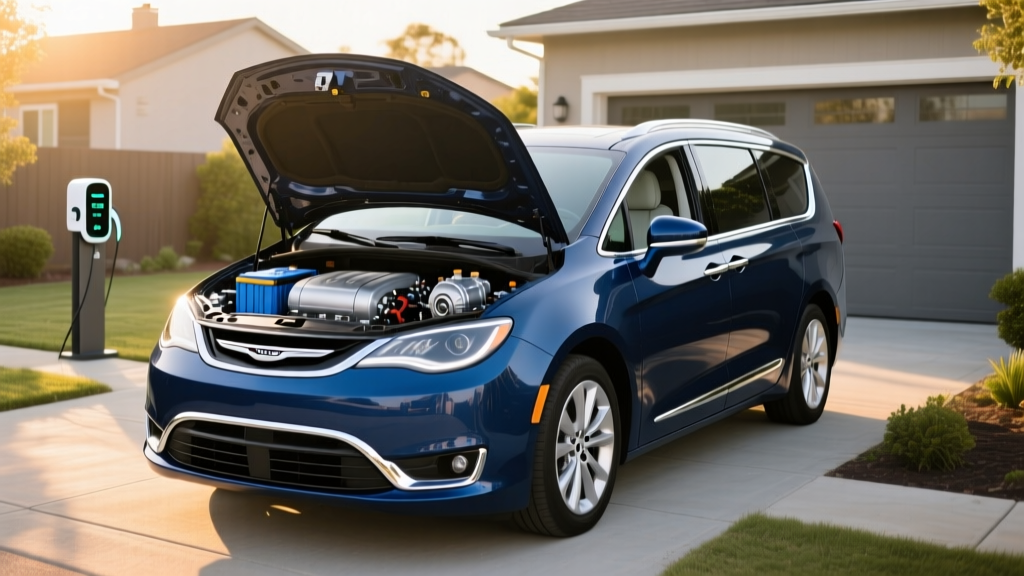
If you've been researching the Chrysler Pacifica Hybrid, you've likely encountered forum threads and owner complaints about stalling, battery faults, and recalls. The Pacifica Plug-In Hybrid (PHEV) remains the only plug-in hybrid minivan on the US market, offering 32 miles of electric-only driving and up to 82 MPGe. But is it reliable enough for family duty in 2026?
This guide breaks down documented Chrysler Pacifica Hybrid problems, what Stellantis has done to address them, the real-world fuel economy and electric range you can expect, and whether this PHEV minivan still makes sense versus a conventional hybrid or a full EV alternative.
HEV vs PHEV: Which Pacifica Are We Talking About?
Chrysler sells two electrified Pacifica variants. Understanding the difference is critical before diagnosing any "Pacifica Hybrid problem":
| Feature | Pacifica Hybrid (PHEV) | Pacifica (Gas-Only / Mild Hybrid) |
|---|---|---|
| Powertrain type | Plug-in Hybrid (PHEV) | Conventional V6 (with eTorque mild hybrid on some trims) |
| Plugs in? | Yes — Level 1 (120V) or Level 2 (240V) | No — gas only |
| Electric-only range | 32 miles (EPA) | None |
| Battery size | 16 kWh (usable) | ~0.5 kWh (eTorque assist only) |
| Combined output | 260 hp | 287 hp (V6) |
| EPA combined | 82 MPGe (electric+gas) / 30 MPG (gas-only) | 22 MPG combined |
| Starting MSRP (2026) | ~$51,095 | ~$40,440 |
When owners report "Chrysler Pacifica Hybrid problems," they are almost always referring to the PHEV model, which has a more complex powertrain with a high-voltage battery, onboard charger, and dual-motor eFlite transmission. The conventional gas Pacifica has its own issues but is mechanically simpler.
The Most Common Chrysler Pacifica Hybrid Problems
Based on NHTSA complaint databases, owner forums, and recall records, here are the most frequently documented issues with the Pacifica Plug-In Hybrid across the 2017–2026 model years:
1. High-Voltage Battery Faults and Shutdowns
The most widely reported problem involves the 16 kWh lithium-ion battery pack throwing fault codes, triggering a "Service Hybrid System" warning, and in some cases shutting down the hybrid system entirely. Early model years (2017–2018) were most affected. Some owners reported the vehicle entering limp mode or refusing to start. Stellantis issued software updates and, in some cases, replaced battery modules under warranty.
2. Engine Stalling at Low Speeds
A notable number of owners have reported the engine stalling when transitioning between electric and gas power, particularly at low speeds or when the engine first kicks on after EV driving. This was tied to software calibration issues in the powertrain control module (PCM). A 2020–2021 recall addressed some of these scenarios, and subsequent model years received revised software.
3. Onboard Charger (OBC) Failures
The 6.6 kW onboard charger — the component that converts AC power from your wall outlet to DC for the battery — has been a known failure point. Symptoms include the vehicle refusing to charge, charging extremely slowly, or throwing a charging fault code. Replacement OBC units have cost owners $1,200–$1,800 out of warranty. Later model years (2022+) appear to have improved OBC reliability.
4. 12V Auxiliary Battery Drain
Like many PHEVs and EVs, the Pacifica Hybrid uses a conventional 12V battery to run accessories and computers. If the vehicle sits unplugged for extended periods, the 12V battery can drain, preventing the vehicle from starting even though the high-voltage pack has charge. This is not unique to Chrysler — it affects many electrified vehicles — but it catches new PHEV owners off guard.
5. Recall History
The Pacifica PHEV has had several recalls. The most significant include a 2022 recall for potential battery cell fires (limited to specific 2017–2018 VINs with certain Samsung SDI cells), and PCM software recalls addressing stalling. Always check the NHTSA recall lookup with a specific VIN before purchasing a used Pacifica Hybrid.
Specs, Range, and Fuel Economy
| Specification | 2026 Chrysler Pacifica Hybrid (PHEV) |
|---|---|
| Powertrain | 3.6L V6 + dual electric motors (eFlite transmission) |
| Combined output | 260 hp |
| High-voltage battery | 16 kWh usable, lithium-ion (NMC chemistry) |
| Electric-only range (EPA) | 32 miles |
| Total range (electric + gas) | 520 miles |
| EPA MPGe (electric + gas) | 82 MPGe combined |
| EPA MPG (gas-only, battery depleted) | 30 combined (29 city / 30 highway) |
| Onboard charger | 6.6 kW (Level 2 AC) |
| DC fast charging | Not supported |
| Level 2 charge time (0–100%) | ~2 hours at 6.6 kW |
| Level 1 charge time (120V, 0–100%) | ~14 hours |
| 0–60 mph | ~7.1 seconds |
| Drivetrain | FWD only (no AWD on PHEV) |
| Towing capacity | Not rated for towing (PHEV) |
| Starting MSRP | $51,095 (Select trim) |
MPG and Efficiency Breakdown
| Driving Scenario | EPA Estimate | Real-World Expectation |
|---|---|---|
| Combined (electric + gas, first 32 mi) | 82 MPGe | 70–80 MPGe (varies by charging frequency) |
| Gas-only combined (battery depleted) | 30 MPG | 28–31 MPG |
| Gas-only city | 29 MPG | 28–32 MPG (regen helps in stop-and-go) |
| Gas-only highway | 30 MPG | 27–29 MPG |
The Pacifica PHEV's efficiency advantage is most pronounced when you charge regularly and stay within the 32-mile electric window for daily errands and school runs. Owners who charge nightly and drive less than 30 miles per day report using very little gasoline for weeks at a time. However, if you rarely plug in, you're essentially driving a 30 MPG minivan — still better than the 22 MPG gas-only Pacifica, but you're not capturing the PHEV's full value.
Battery Warranty, Lifespan, and Replacement Cost
Battery lifespan in practice: Lithium-ion PHEV batteries in the Pacifica have generally held up well when the vehicle is regularly charged and not subjected to extreme heat or repeated full-depth discharges. Most 2017–2019 Pacifica PHEVs with original batteries report 85–92% state of health (SoH) at 80,000–100,000 miles. However, the early battery fault issues (mentioned above) were related to individual cell or module failures, not gradual degradation.
Replacement cost: If the battery falls outside warranty coverage, a full high-voltage battery replacement for the Pacifica PHEV runs $7,500–$9,500 including parts and labor at a dealership. Individual module replacement (if only one or two modules are faulty) can cost $1,500–$3,000. Third-party hybrid repair shops are increasingly offering module-level diagnostics and repair at lower cost.
Tax Credits and Incentives: Does It Qualify?
Here's where the Pacifica PHEV faces a significant challenge in 2026. Under the current IRS §30D Clean Vehicle Credit rules, the Chrysler Pacifica Hybrid does not currently qualify for the full $7,500 federal tax credit. The reasons:
- Battery sourcing requirements: The Pacifica PHEV's battery cells have not met the critical-minerals and battery-component sourcing thresholds required under current §30D rules for vehicles assembled in North America.
- MSRP cap: The Pacifica PHEV's MSRP ($51,095+) falls under the $80,000 van/SUV/truck cap, so MSRP is not the disqualifier.
- Income limits: Even if it qualified, buyers must fall under $150,000 (single) / $300,000 (joint) adjusted gross income.
State incentives may apply. Some states offer their own rebates or HOV lane access for PHEVs with 20+ miles of electric range. Check your state's energy office or DMV for current programs. The Pacifica PHEV does qualify for HOV lane stickers in California (Clean Air Vehicle decal, subject to availability and income caps).
Tax credit rules change frequently. Always verify current eligibility on the fueleconomy.gov tax credit page and consult a tax professional before purchasing.
Who Should Buy the Pacifica Hybrid (and Who Shouldn't)?
- Only PHEV minivan on the market — no direct competitor
- 32 miles electric covers most school runs, errands, and commutes
- Stow 'n Go seating still partially available (third row folds; second row does not stow on PHEV due to battery placement)
- 30 MPG gas-only is strong for a minivan when battery is depleted
- Comfortable ride, quiet cabin, family-friendly tech
- 10-year / 100,000-mile battery warranty
- Documented reliability concerns (battery faults, OBC failures, stalling history)
- No DC fast charging — Level 2 only
- FWD only — no AWD option (gas Pacifica offers AWD)
- No federal tax credit under current §30D rules
- Second-row seats don't fold into the floor (battery occupies the stowage well)
- Premium price: ~$10,000+ more than the gas Pacifica
- You need minivan space and want to run most daily trips on electricity
- You have home Level 2 charging and a commute under 30 miles
- You want to reduce fuel costs without committing to a full EV or worrying about range
- You need AWD for snow or mountain driving (Pacifica PHEV is FWD only)
- You want a vehicle with a stronger reliability track record
- You can't charge at home — without regular plug-in, the PHEV premium is hard to justify
- You need maximum cargo flexibility with full Stow 'n Go seating
Pacifica Hybrid vs Full EV vs Gas Minivan
| Factor | Pacifica PHEV | Gas Minivan (e.g., Honda Odyssey) | 3-Row EV (e.g., Kia EV9) |
|---|---|---|---|
| Starting price | $51,095 | $39,635 | $54,900 |
| Daily fuel cost (30 mi) | ~$0.50 (electric) / ~$3.50 (gas) | ~$4.50 | ~$0.90 (electric) |
| Road trip readiness | 520 mi total range, gas anywhere | 450+ mi, gas anywhere | 270–300 mi, then 20–30 min DC charge |
| Home charging needed? | Optional but recommended | No | Essential |
| AWD available? | No | Yes (some models) | Yes |
| Tax credit (2026) | Not eligible | N/A | Up to $7,500 (model-dependent) |
Frequently Asked Questions
How many MPG does the Chrysler Pacifica Hybrid get?
The EPA rates the Pacifica PHEV at 82 MPGe combined when using both electric and gas power, and 30 MPG combined (29 city / 30 highway) once the battery is depleted and you're driving on gasoline alone. Real-world owners report 28–31 MPG in gas-only mode, which is excellent for a minivan of this size.
How far can the Pacifica Hybrid go on electric only?
The EPA rates it at 32 miles of electric-only range. In real-world conditions, expect 26–30 miles in mild weather and 20–24 miles in cold weather or at sustained highway speeds. For most families, this covers daily school drops, errands, and short commutes without using any gasoline.
Is the Chrysler Pacifica Hybrid reliable?
The Pacifica PHEV has a mixed reliability record. Early model years (2017–2019) experienced high-voltage battery faults, stalling, and onboard charger failures that led to recalls and software updates. Later model years (2022–2026) have shown improved reliability, though the PHEV powertrain is inherently more complex than a conventional gas or hybrid system. The 10-year / 100,000-mile battery warranty provides significant protection.
What does a Pacifica Hybrid battery replacement cost?
A full high-voltage battery replacement costs approximately $7,500–$9,500 at a dealership. However, most battery issues involve individual module failures, which can be repaired for $1,500–$3,000. The 10-year / 100,000-mile warranty covers most owners through the vehicle's prime ownership period.
Does the Pacifica Hybrid qualify for a tax credit?
As of 2026, the Chrysler Pacifica Hybrid does not qualify for the $7,500 federal §30D Clean Vehicle Credit due to battery sourcing requirements. State-level incentives may still apply. Check fueleconomy.gov for the latest eligibility list and consult a tax professional.
Can the Pacifica Hybrid DC fast charge?
No. The Pacifica PHEV supports only Level 1 (120V) and Level 2 (240V) AC charging, with a maximum onboard charger rate of 6.6 kW. A full charge from empty takes about 2 hours on Level 2 or 14 hours on a standard 120V outlet. This is typical for PHEVs — DC fast charging is generally reserved for full battery-electric vehicles.
Does the Pacifica Hybrid have AWD?
No. The Pacifica PHEV is front-wheel drive only. If you need all-wheel drive in a Chrysler minivan, the gas-only Pacifica offers an AWD option, but it is not available on the plug-in hybrid variant.