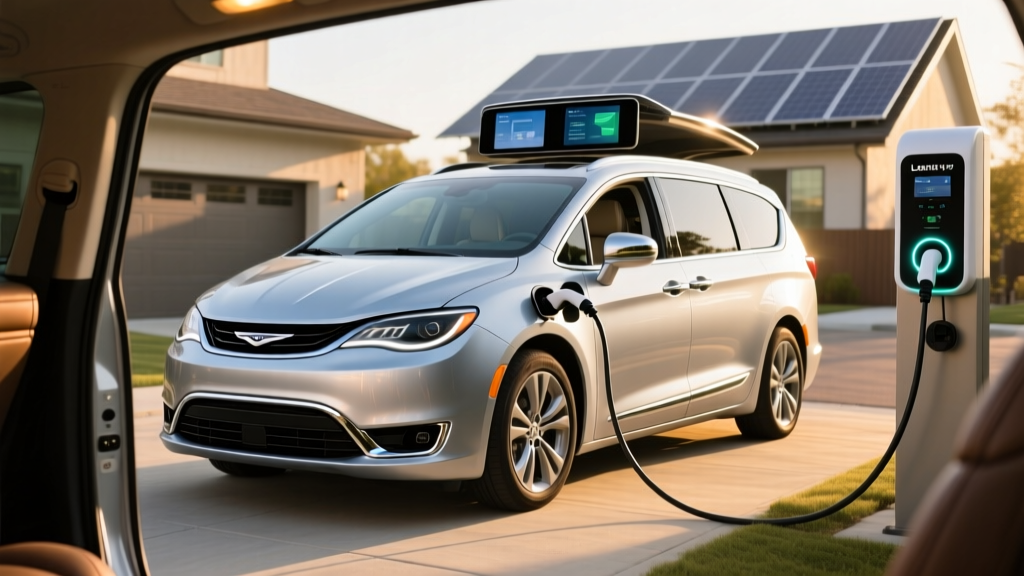
Chrysler's electrified lineup in 2026 centers on a single, well-established model: the Chrysler Pacifica Hybrid, a plug-in hybrid (PHEV) minivan that has occupied a unique niche since its 2017 debut. While Chrysler has no conventional hybrid (HEV) or fully electric vehicle on sale as of the 2026 model year, the Pacifica PHEV remains the only plug-in hybrid minivan available in the U.S. market — making it a default choice for families who want electric commuting with gas-engine road-trip flexibility.
This guide covers the Pacifica Hybrid's real-world efficiency, electric-only range, powertrain specs, charging behavior, tax-credit eligibility, and long-term battery outlook. We'll also address the broader question of whether Chrysler hybrids fit your needs compared to a full EV or a conventional gas minivan.
Pacifica Hybrid at a Glance: 2026 Specs
| Spec | Value |
|---|---|
| Powertrain | 3.6L V6 + 2 electric motors (eCVT) |
| Combined Horsepower | 260 hp |
| Battery (usable) | 16 kWh lithium-ion (NMC chemistry) |
| EPA Electric-Only Range | 32 miles |
| EPA Combined MPGe (electric + gas) | 82 MPGe |
| EPA MPG (gas-only, combined) | 30 MPG (29 city / 30 highway) |
| Total Combined Range | ~430 miles |
| Level 2 Charge Time (0–100%) | ~2 hours at 7.2 kW |
| DC Fast Charging | Not supported |
| Base MSRP (2026) | ~$51,095 (before incentives) |
| Federal Tax Credit (§30D) | Up to $7,500 (eligibility varies) |
| Battery Warranty | 10 years / 100,000 miles |
The Pacifica Hybrid pairs a naturally aspirated 3.6-liter Pentastar V6 with a dual-motor electric drive unit integrated into a continuously variable transmission (eCVT). The system produces a combined 260 horsepower, routed to the front wheels. Unlike some PHEV competitors, there is no all-wheel-drive option on the Hybrid — AWD is available only on the gas-only Pacifica.
HEV vs PHEV: What Chrysler Actually Offers
A common source of confusion when shoppers search for "Chrysler hybrids" is the distinction between a conventional hybrid (HEV) and a plug-in hybrid (PHEV). Here's how they differ and where Chrysler fits:
Conventional Hybrid (HEV)
- Small battery (~1–2 kWh) recharged by regenerative braking and the engine
- Never needs to be plugged in
- Electric motor assists the gas engine; minimal electric-only driving (under 1 mile at low speed)
- Example: Toyota Sienna Hybrid (36 MPG combined)
Plug-In Hybrid (PHEV)
- Larger battery (16 kWh in the Pacifica) that can be charged via a plug
- Offers meaningful electric-only range (32 miles EPA in the Pacifica)
- Once the battery is depleted, operates as a conventional hybrid on gas
- Example: Chrysler Pacifica Hybrid
Chrysler does not currently sell a conventional HEV. If you want a Chrysler-branded electrified vehicle, the Pacifica Hybrid PHEV is the only option. If you're looking for a non-plug-in hybrid minivan, the closest competitor is the Toyota Sienna Hybrid, which achieves 36 MPG combined without ever needing a charger.
Real-World MPG and Electric Range: Beyond the EPA Sticker
| Scenario | EPA Sticker | Real-World Expectation |
|---|---|---|
| Electric-only range | 32 miles | 25–30 miles (highway/cold weather); 30–34 miles (city, mild weather) |
| Gas-only MPG (combined) | 30 MPG | 27–29 MPG highway; 30–33 MPG city (hybrids favor stop-and-go) |
| MPGe (electric + gas) | 82 MPGe | Varies heavily with how often you charge |
The Pacifica Hybrid's 32-mile electric range is the EPA estimate under mixed driving conditions. In practice, expect closer to 25–28 miles if you're driving at sustained highway speeds or in temperatures below 40°F, where battery efficiency drops and cabin heating draws significant energy. Around town in mild weather, many owners report squeezing out 30–34 miles before the gas engine engages.
Once the battery is depleted, the Pacifica operates as a conventional hybrid. The EPA rates it at 30 MPG combined, which is competitive for a minivan but trails the Toyota Sienna Hybrid's 36 MPG. The difference largely comes down to weight: the Pacifica Hybrid carries roughly 600 extra pounds from its battery pack and electric motors compared to the gas-only Pacifica, and about 300 more pounds than the Sienna Hybrid.
Charging frequency is the single biggest variable in real-world efficiency. If you plug in every night and your daily commute is under 30 miles round-trip, you may go months without buying gas. If you rarely charge, you're carrying a heavy battery you're not using, and your effective MPG will hover near the 28–30 range — still good for a minivan, but not transformative.
Charging the Pacifica Hybrid: Level 1, Level 2, and What to Expect
The Pacifica Hybrid's 16 kWh battery can be charged two ways:
| Level | Power (kW) | Time (0–100%) | Source |
|---|---|---|---|
| Level 1 (120V household outlet) | ~1.4 kW | ~14 hours | Standard outlet with included cord |
| Level 2 (240V home/public charger) | 7.2 kW | ~2 hours | Home wallbox or public Level 2 station |
The Pacifica Hybrid uses a standard J1772 connector for Level 2 AC charging. It does not support DC fast charging — a limitation shared with most PHEVs, since their smaller batteries aren't designed to absorb the high charge rates (50–350 kW) that full EVs use. For a PHEV with 32 miles of range, overnight Level 2 charging is the practical norm.
If you're installing a Level 2 charger at home, expect to pay $500–$1,500 for the charging equipment (a quality J1772 wallbox like the ChargePoint Home Flex or Emporia Level 2) plus $800–$2,500 for electrician labor and permitting, depending on whether your electrical panel needs an upgrade. Total home installation typically runs $1,300–$4,000.
Battery Warranty and Replacement Cost
Chrysler (Stellantis) backs the Pacifica Hybrid's 16 kWh lithium-ion battery with a 10-year / 100,000-mile warranty (8 years / 100,000 miles in states that do not follow California Air Resources Board emissions standards). The warranty covers battery capacity loss below 70% of original capacity, as well as defects.
If the battery needs replacement outside of warranty, expect a cost in the range of $7,000–$9,500 for the battery pack itself, plus $1,000–$2,000 in labor. This is a significant expense, though PHEV battery degradation tends to be moderate because the system rarely cycles the battery to full 0% or 100% — the software maintains a buffer to prolong life.
According to fueleconomy.gov, the Pacifica Hybrid's battery system is designed for long-term durability under normal use, and real-world data from earlier model years shows most units retaining 85–90% capacity after 5 years and 60,000 miles.
2026 Pricing, Trims, and Federal Tax Credit Eligibility
The 2026 Chrysler Pacifica Hybrid is offered in several trims, with pricing starting around $51,095 for the base Select trim and climbing to approximately $58,000+ for the top Pinnacle trim (all figures include destination charge but before incentives).
Federal §30D Tax Credit: Does the Pacifica Hybrid Qualify?
Under the IRS §30D Clean Vehicle Credit, the Pacifica Hybrid may qualify for up to $7,500 — but eligibility is not automatic. Here's what determines it:
- MSRP cap: Vans/minivans must have an MSRP at or below $80,000. The Pacifica Hybrid qualifies on price.
- Buyer income cap: Modified adjusted gross income must not exceed $150,000 (single), $225,000 (head of household), or $300,000 (joint filers).
- Battery sourcing: A percentage of critical minerals and battery components must be sourced from the U.S. or free-trade-agreement countries. These thresholds increase annually. Verify current-year compliance with your dealer.
- Point-of-sale transfer: As of 2024, eligible buyers can transfer the credit to the dealer at purchase, reducing the purchase price directly rather than waiting for a tax refund.
Important: Battery sourcing requirements tighten each year under the Inflation Reduction Act. A vehicle that qualified in 2024 may have different eligibility in 2026. Always confirm with your dealer and consult IRS guidance or a tax professional before relying on the credit.
If you don't qualify for the federal credit (due to income limits or sourcing changes), some states offer additional PHEV rebates. California, Colorado, New York, and others have their own incentive programs — check your state's energy or DMV website for current amounts.
Pros and Cons: Living with the Pacifica Hybrid
Pros
- Only PHEV minivan on the market — no direct competitor offers plug-in capability
- 32 miles electric-only covers most school-run and commute trips
- Stow 'n Go second-row seating (unique among hybrid minivans) — Sienna Hybrid lacks this
- Smooth, quiet electric driving around town
- 10-year / 100,000-mile battery warranty
- Potential $7,500 federal tax credit + state incentives
Cons
- 30 MPG combined on gas trails Toyota Sienna Hybrid's 36 MPG
- No DC fast charging — Level 2 only
- No AWD option (AWD available only on gas Pacifica)
- ~600 lbs heavier than gas Pacifica, affecting handling and tire wear
- Starting MSRP above $51K — steep entry for a minivan
- Third-row and cargo space slightly reduced by battery placement under the floor
Who Should Buy a Chrysler Hybrid — and Who Shouldn't
The Pacifica Hybrid serves a specific buyer profile well. Here's a decision framework:
Choose the Chrysler Pacifica Hybrid if:
- You have home charging access (garage or driveway with a 240V outlet or wallbox)
- Your daily driving is under 30 miles round-trip, so you can run mostly on electricity
- You need a minivan specifically (three rows, sliding doors, family hauling)
- You take occasional road trips and don't want to plan around EV charging stations
- You value Stow 'n Go seating flexibility for cargo
Look elsewhere if:
- You can't charge at home — without plugging in, you're paying a premium for a battery you're not using
- Fuel economy on gas is your top priority — the Sienna Hybrid's 36 MPG combined is significantly better
- You need AWD — consider the gas Pacifica AWD, Sienna AWD, or a fully electric SUV
- You want a fully electric experience — consider the Kia EV9, Tesla Model X, or upcoming electric minivans
- Budget is tight — a used gas Pacifica or new Sienna Hybrid costs substantially less upfront
Pacifica Hybrid vs. Full EV vs. Gas Minivan: The Economics
To put the Pacifica Hybrid in context, here's a simplified 5-year cost comparison for a family driving 15,000 miles per year (75,000 miles total), assuming $3.50/gallon gas and $0.15/kWh electricity:
| Vehicle | Type | Est. Fuel/Energy Cost (5 yr) | Base MSRP |
|---|---|---|---|
| Chrysler Pacifica Hybrid | PHEV | ~$4,800* | ~$51,095 |
| Toyota Sienna Hybrid | HEV | ~$7,300 | ~$39,000 |
| Chrysler Pacifica (gas) | Gas | ~$10,500 | ~$40,000 |
| Kia EV9 (3-row EV) | BEV | ~$3,400 | ~$55,000 |
*Pacifica Hybrid fuel cost assumes 60% of miles driven on electricity (home charging nightly) and 40% on gasoline. Your ratio will vary dramatically based on commute length and charging habits.
The Pacifica Hybrid's advantage is clear if you charge regularly: you spend far less on energy than the gas Pacifica. But the Sienna Hybrid achieves strong fuel savings without ever plugging in, at a lower purchase price. And a full EV like the Kia EV9 offers the lowest energy costs, but requires commitment to charging infrastructure and acceptance of range limitations on long trips.
Frequently Asked Questions
How many MPG does the Chrysler Pacifica Hybrid get?
The EPA rates the 2026 Pacifica Hybrid at 30 MPG combined (29 city / 30 highway) when operating on gasoline after the battery is depleted. In real-world city driving, many owners see 30–33 MPG thanks to regenerative braking. Highway driving tends to yield 27–29 MPG. The combined MPGe rating (which accounts for electric driving) is 82 MPGe, but this number is only meaningful if you charge regularly.
How far can the Pacifica Hybrid go on electric only?
The EPA rates the Pacifica Hybrid at 32 miles of electric-only range. In real-world conditions, expect 25–30 miles at highway speeds or in cold weather, and up to 34 miles in city driving during mild temperatures. Once the battery is depleted, the gas engine starts seamlessly and the vehicle operates as a conventional hybrid.
Does the Chrysler Pacifica Hybrid qualify for a tax credit?
Under the federal §30D Clean Vehicle Credit, the Pacifica Hybrid may qualify for up to $7,500, subject to buyer income limits ($150K single / $300K joint), the $80,000 MSRP cap for vans (which it clears), and battery-sourcing requirements that tighten annually. The credit can be transferred to the dealer at the point of sale. Always verify current-year eligibility on IRS.gov and with your dealer before purchasing.
Is the Pacifica Hybrid reliable, and what does battery replacement cost?
The Pacifica Hybrid's powertrain is generally well-regarded, though early model years (2017–2019) had some reported issues with the hybrid control module and 12V battery system. The 2026 model benefits from years of refinement. The high-voltage battery is covered by a 10-year / 100,000-mile warranty (in CARB states; 8 years / 100,000 miles elsewhere). Out-of-warranty battery replacement costs approximately $7,000–$9,500 for the pack plus $1,000–$2,000 in labor.
Can I charge the Pacifica Hybrid at a DC fast charger?
No. The Pacifica Hybrid only supports AC charging: Level 1 (120V, ~14 hours for a full charge) and Level 2 (240V, ~2 hours at 7.2 kW). It uses a J1772 connector. DC fast charging is not available on this or most PHEVs, because the 16 kWh battery is too small to safely absorb high DC charge rates.
Should I get the Pacifica Hybrid, the Sienna Hybrid, or a full EV?
If you can charge at home, drive under 30 miles daily, and need a minivan with Stow 'n Go seating, the Pacifica Hybrid is a strong fit. If you can't charge at home or want maximum fuel economy without plugging in, the Toyota Sienna Hybrid (36 MPG) is more practical and affordable. If you're ready to go fully electric and can accept range planning on road trips, the Kia EV9 offers three rows with 270+ miles of range and lower running costs — but at a higher starting price and without the minivan sliding-door convenience.
Do Chrysler hybrids need to be plugged in?
The Chrysler Pacifica Hybrid is a plug-in hybrid (PHEV), meaning it can be plugged in to charge the battery and unlock its 32-mile electric range. However, it does not require plugging in — if you never charge it, the vehicle will still operate as a conventional hybrid on gasoline alone (at 30 MPG combined). That said, not plugging in defeats the purpose of buying a PHEV, as you're paying extra for battery capacity you're not using.