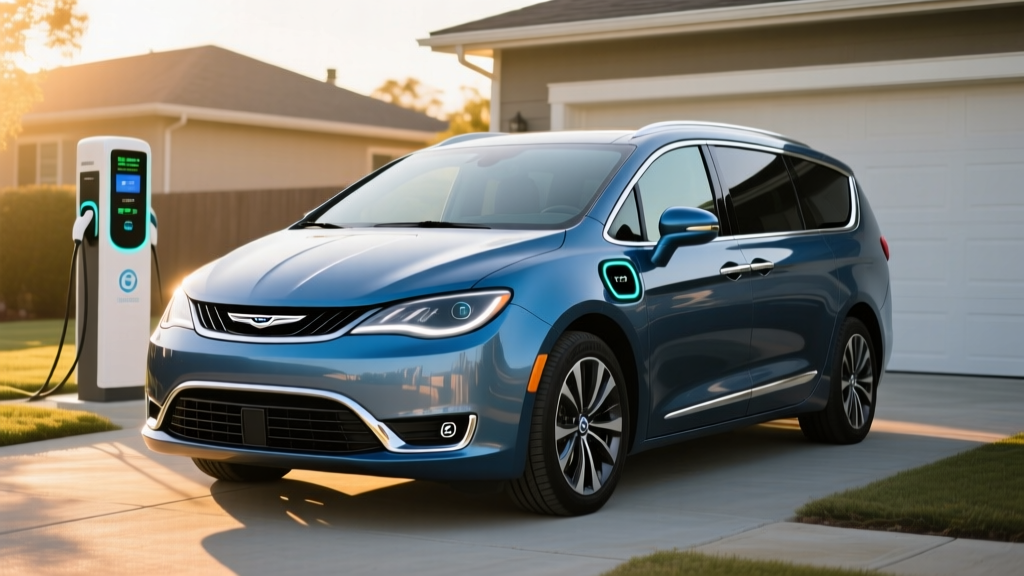
The Chrysler Pacifica Hybrid remains the only plug-in hybrid minivan sold in the United States, and for families weighing electrification without fully committing to a battery-electric vehicle, that exclusivity matters. But the headline question for shoppers searching Chrysler Pacifica MPG hybrid data is whether the PHEV powertrain delivers meaningful fuel savings over the gas-only Pacifica — and how far it actually goes on electricity alone before the 3.6-liter V6 wakes up.
This guide breaks down the 2026 Chrysler Pacifica Hybrid's EPA fuel economy, real-world MPG behavior, electric-only range, charging logistics, powertrain specs, battery longevity, and tax-credit eligibility so you can decide if it fits your driveway.
HEV vs PHEV: Which Pacifica Are We Talking About?
Chrysler sells the Pacifica in two electrified-adjacent forms, and confusing them is the most common buyer mistake:
| Attribute | Pacifica Hybrid (PHEV) | Gas-Only Pacifica (Non-Hybrid) |
|---|---|---|
| Powertrain type | Plug-in hybrid (PHEV) | Conventional V6 (no hybrid system) |
| Plug-in charging | Yes — Level 1 & Level 2 | No — gas only |
| EPA electric-only range | 32 miles | 0 miles |
| Battery | 16 kWh lithium-ion | Standard 12V auxiliary only |
| EPA combined MPG (gas) | 30 MPG combined | 22 MPG combined (FWD) |
| EPA MPGe (electric + gas) | 82 MPGe | N/A |
| Stow 'n Go seating (2nd row) | No — battery occupies under-floor space | Yes |
| Starting MSRP (2026) | ~$51,095 | ~$39,690 |
Key takeaway: The Pacifica Hybrid is a plug-in hybrid (PHEV), not a conventional hybrid (HEV) like a Toyota Sienna. You plug it in to unlock its electric-only range. If you never plug it in, you're carrying 16 kWh of dead battery weight and getting roughly 30 MPG — still better than the gas model, but you're leaving most of the value on the table.
There is no conventional hybrid (HEV) Pacifica. Chrysler does not offer a self-charging hybrid variant. If you want a non-plug-in hybrid minivan, the Toyota Sienna (36 MPG combined, HEV) is the direct cross-shop.
Chrysler Pacifica Hybrid MPG: EPA Numbers and Real-World Results
Here's the official fuel-economy breakdown from fueleconomy.gov for the 2026 Chrysler Pacifica Hybrid:
| Metric | EPA Rating |
|---|---|
| Combined MPGe (electric + gas) | 82 MPGe |
| Combined MPG (gas-only, battery depleted) | 30 MPG |
| City MPG (gas-only) | 29 MPG |
| Highway MPG (gas-only) | 30 MPG |
| Electric-only range | 32 miles |
| Total range (electric + gas) | ~430 miles |
| Fuel tank capacity | 14.0 gallons |
| Energy consumption (electric) | 41 kWh/100 mi |
Real-World MPG vs. EPA: What Owners Actually See
PHEVs are uniquely sensitive to driving habits because their fuel economy depends on how often you recharge. Here's what to expect:
- Short commutes under 30 miles with daily charging: You may use almost zero gasoline for weeks. Effective MPG approaches infinity on electric-only days.
- Mixed driving (some electric, some gas): Owners typically report 35–50 MPG equivalent over a month of mixed use, depending on charge frequency.
- Road trips / never plugging in: Expect 28–31 MPG combined once the battery is depleted. The city MPG can actually exceed the EPA estimate thanks to regenerative braking recapturing energy in stop-and-go traffic — some owners see 32–33 MPG in urban driving on gas alone.
- Highway-only at 75+ mph: Expect 26–28 MPG. The Pacifica Hybrid's aerodynamic profile and added battery weight hurt highway efficiency relative to the EPA highway estimate.
- Cold weather (below 30°F): Electric-only range drops to roughly 22–26 miles as the battery's usable capacity shrinks and cabin heating demands energy. Gas MPG may dip 1–2 MPG due to cold-start enrichment.
The Pacifica Hybrid's real-world advantage over the gas Pacifica is substantial in city and suburban driving — roughly 35–40% better fuel economy when regularly charged. On long highway runs with no charging, the gap narrows to about 8–10 MPG improvement.
Electric-Only Range and Charging: The Daily-Commute Question
The 2026 Pacifica Hybrid's EPA-rated 32 miles of electric-only range covers the average American's one-way commute and school-run loop. But that number assumes moderate temperatures, flat terrain, and speeds under 65 mph.
EPA Electric Range: 32 miles
Real-world expectation: 26–30 miles in mild weather; 22–26 miles in freezing temperatures or at sustained highway speeds above 70 mph. Aggressive acceleration and full passenger/cargo loads will also reduce range.
Charging Specs and Times
| Charging Level | Power (kW) | 0–100% Time | Connector |
|---|---|---|---|
| Level 1 (120V household outlet) | ~1.4 kW | ~14 hours | J1772 |
| Level 2 (240V, 32A) | ~7.7 kW | ~2 hours | J1772 |
| DC Fast Charging | Not supported | N/A | N/A |
No DC fast charging. The Pacifica Hybrid uses a J1772 connector for Level 1 and Level 2 AC charging only. This is typical for PHEVs — the 16 kWh battery is small enough that overnight Level 1 charging or a 2-hour Level 2 session fully replenishes it. For most owners, a standard 120V outlet in the garage is sufficient if the van sits parked for 10+ hours overnight.
If you want faster turnaround (say, topping up between morning and afternoon school runs), a Level 2 home charger like a ChargePoint Home Flex or Emporia Vue will cut charge time to about 2 hours. Installation typically costs $500–$1,500 depending on your electrical panel's capacity and proximity to the parking spot.
Powertrain: What's Under the Hood
| Specification | 2026 Chrysler Pacifica Hybrid |
|---|---|
| Engine | 3.6L Pentastar V6 (Atkinson cycle) |
| Electric motors | Dual-motor eFlite electrically variable transmission (EVT) |
| Combined system horsepower | 260 hp |
| Engine horsepower | 262 hp @ 6,400 rpm (gas only) |
| Battery capacity | 16 kWh lithium-ion (NMC chemistry) |
| Usable battery capacity | ~13 kWh (buffer protects longevity) |
| Transmission | eFlite EVT (no traditional gears) |
| Drivetrain | Front-wheel drive only (no AWD option on Hybrid) |
| 0–60 mph | ~7.1 seconds |
| Towing capacity | Not rated for towing (gas Pacifica: 3,600 lbs) |
| Cargo volume (behind 3rd row) | 32.3 cu ft |
| Cargo volume (all seats folded) | 140.5 cu ft |
Chrysler's eFlite transmission uses two electric motors integrated into the transaxle. One motor primarily drives the wheels; the other can either assist propulsion or act as a generator to recharge the battery. The system seamlessly blends electric and gas power — you won't feel a jarring "handoff" when the V6 starts, though you will hear it.
Notable limitation: The Pacifica Hybrid is front-wheel drive only. If you need all-wheel drive, the gas-only Pacifica offers an AWD option, but it is not available on the Hybrid trim. This matters for buyers in snow-belt states.
Pricing, Trims, and Tax Credit Eligibility
2026 Chrysler Pacifica Hybrid MSRP by Trim
| Trim | Starting MSRP |
|---|---|
| Hybrid Select | ~$51,095 |
| Hybrid Limited | ~$54,595 |
| Hybrid Pinnacle | ~$57,400 |
(Destination charge of ~$1,795 additional.)
Federal Tax Credit: Does the Pacifica Hybrid Qualify?
This is where it gets complicated. Under current IRS §30D clean vehicle credit rules for 2026:
- Battery capacity requirement: The Pacifica Hybrid's 16 kWh battery exceeds the 7 kWh minimum — passes.
- Vehicle type: It's a minivan, classified as an SUV/van for MSRP cap purposes — the cap is $80,000 — passes.
- MSRP cap: All trims are under $80,000 — passes.
- Buyer income cap: Modified AGI must not exceed $150,000 (single), $225,000 (head of household), or $300,000 (joint) — varies by buyer.
- Critical minerals & battery component sourcing: This is the sticking point. The Pacifica Hybrid's battery sourcing must meet escalating annual thresholds for North American or FTA-partner content. Verify current-year eligibility with your dealer and a tax professional before purchase, as sourcing compliance can change mid-year based on supply-chain shifts.
- Point-of-sale transfer: If eligible, you can transfer the credit to the dealer for an immediate price reduction at purchase.
Bottom line: The Pacifica Hybrid may qualify for up to $7,500 in federal tax credits, but eligibility hinges on battery-sourcing rules that shift frequently. Do not assume you'll receive the credit — confirm with the dealer's F&I department and cross-reference the IRS's qualified vehicles list at the time of purchase.
Battery Longevity, Warranty, and Replacement Cost
High-Voltage Battery Warranty: 10 years / 100,000 miles (whichever comes first) in most states; 15 years / 150,000 miles in California and states adopting CARB/PZEV standards.
Capacity retention threshold: Stellantis warrants the battery against defect and excessive capacity loss. If the battery falls below a usable capacity threshold (typically ~70% of original), the warranty covers repair or replacement.
How Long Will the Battery Last?
PHEV batteries experience less stress than full-EV batteries because they operate in a narrower state-of-charge window (the system maintains a buffer at both the top and bottom). The Pacifica Hybrid's NMC battery has a proven track record since the nameplate's 2017 launch:
- Expected lifespan: 12–15 years or 150,000+ miles with normal use before significant degradation.
- Typical degradation at 100,000 miles: 10–15% capacity loss based on owner reports, meaning electric range drops from 32 miles to roughly 27–29 miles.
- Factors that accelerate degradation: Frequent Level 2 charging to 100% in extreme heat, prolonged storage at full charge in hot climates, and repeated deep discharges.
Battery Replacement Cost
If the battery fails outside of warranty, replacement costs range from $7,000 to $9,500 including parts and labor at a dealership. Independent hybrid-battery specialists may offer refurbished replacements for $4,500–$6,000. This is a real but unlikely expense within the first decade of ownership.
The conventional 12V auxiliary battery (which powers electronics and starts the system) is a separate, standard item costing $150–$250 to replace every 3–5 years.
Reliability and Ownership Considerations
The Pacifica Hybrid's reliability record has improved since early model years (2017–2019), which saw some high-voltage battery recall campaigns and software-related stalling complaints. The 2021+ refresh addressed many of these issues with updated battery management software and revised powertrain control modules.
From NHTSA data, the 2024–2026 models show fewer powertrain-related complaints than earlier years. However, the Pacifica Hybrid carries more mechanical complexity than the gas-only model — there's the V6 engine, two electric motors, the EVT, and the high-voltage battery system. More components mean more potential failure points long-term.
Maintenance advantages over the gas Pacifica include regenerative braking (which extends brake pad life significantly) and the engine running less frequently (reducing oil degradation). Chrysler recommends oil changes every 10,000 miles, but many PHEV owners who drive mostly on electric find their oil lasts even longer — though you should still follow the manufacturer's schedule.
Pros
- Only PHEV minivan available in the US — no direct competitor
- 32 miles electric covers most school runs and commutes
- 30 MPG gas-only still beats the gas Pacifica by ~8 MPG
- Smooth, quiet electric-only driving in suburban conditions
- Full minivan utility: sliding doors, 7-passenger seating, large cargo area
- Strong battery warranty (10yr/100k or 15yr/150k in CARB states)
Cons
- No Stow 'n Go second-row seats (battery occupies under-floor storage)
- No AWD option — FWD only
- No DC fast charging
- Starting price ~$11,000 above the gas Pacifica
- Towing not rated (gas Pacifica tows 3,600 lbs)
- Tax credit eligibility uncertain due to battery-sourcing rules
Pacifica Hybrid vs. Sienna Hybrid vs. Full EV: Which Fits You?
| Factor | Pacifica Hybrid (PHEV) | Toyota Sienna (HEV) | Full EV (e.g., Kia EV9) |
|---|---|---|---|
| Plug-in required? | Yes (for max benefit) | No | Yes (always) |
| Electric-only range | 32 miles | 0 miles | 250–300+ miles |
| Combined MPG / MPGe | 82 MPGe / 30 MPG gas | 36 MPG | 85–95 MPGe |
| Starting MSRP | ~$51,095 | ~$38,085 | ~$54,900 (EV9) |
| Federal tax credit | Up to $7,500 (if eligible) | None (HEV) | Up to $7,500 (if eligible) |
| Home charging needed? | Recommended | No | Essential |
| Road-trip convenience | Gas station (easy) | Gas station (easy) | DC fast charging (plan routes) |
| AWD available? | No | Yes | Yes |
Choose the Pacifica Hybrid if: You have home charging access, your daily driving is under 35 miles, you want electric commuting with gas-engine road-trip freedom, and you need minivan space with no BEV minivan currently available.
Choose the Toyota Sienna HEV if: You can't charge at home, you want the lowest purchase price, you need AWD, or you prefer the simplest ownership experience with no plug-in behavior changes.
Choose a full EV (like the Kia EV9) if: You have reliable home Level 2 charging, you want zero tailpipe emissions, you drive mostly within 250 miles of home, and you're ready to plan road trips around DC fast-charging stops.
Frequently Asked Questions
How many MPG does the Chrysler Pacifica Hybrid get?
The EPA rates the 2026 Pacifica Hybrid at 82 MPGe when combining electric and gas driving, and 30 MPG combined (29 city / 30 highway) once the battery is depleted and you're running on gasoline alone. Real-world city driving on gas often yields 31–33 MPG thanks to regenerative braking, while sustained highway driving at high speeds may return 26–28 MPG.
How far can the Pacifica Hybrid go on electric only?
The EPA rates it at 32 miles of electric-only range. In real-world conditions, expect 26–30 miles in moderate weather and 22–26 miles in freezing temperatures or at sustained highway speeds above 70 mph. For most families, this covers a round-trip school run and local errands without using gasoline.
Does the Chrysler Pacifica Hybrid qualify for a tax credit?
It may qualify for up to $7,500 under the federal §30D clean vehicle credit, but eligibility depends on your income, the vehicle's battery-sourcing compliance (critical minerals and component manufacturing requirements), and current-year IRS rules. Always verify with the IRS qualified vehicle list and a tax professional before purchasing. The credit can be transferred to the dealer as a point-of-sale discount if eligible.
Is the Pacifica Hybrid reliable, and what does a battery replacement cost?
Reliability has improved significantly since the 2021 refresh. The high-voltage battery is covered by a 10-year/100,000-mile warranty (15 years/150,000 miles in CARB states). Battery replacement outside of warranty costs approximately $7,000–$9,500 at a dealership. Based on owner data, most batteries retain 85–90% capacity at 100,000 miles and last 12–15 years with normal use.
Do I have to plug in the Pacifica Hybrid?
You don't have to — the van will operate as a conventional hybrid on gasoline alone. But to get the full value of the PHEV system (32 miles of electric driving and 82 MPGe), you should plug it in regularly. Without plugging in, you'll get roughly 30 MPG, which is still better than the gas-only Pacifica but wastes the electric-range advantage you paid extra for.
Can the Pacifica Hybrid DC fast charge?
No. The Pacifica Hybrid supports only Level 1 (120V, ~1.4 kW) and Level 2 (240V, ~7.7 kW) AC charging via a J1772 connector. A full charge on Level 2 takes about 2 hours. This is standard for PHEVs — the 16 kWh battery is small enough that DC fast charging is unnecessary.
Why doesn't the Pacifica Hybrid have Stow 'n Go second-row seats?
The high-voltage battery pack is mounted under the floor where the second-row Stow 'n Go compartments would be. The second-row seats in the Hybrid are captain's chairs that fold forward but do not stow into the floor. If maximum cargo flexibility with fold-flat second-row seating is a priority, the gas-only Pacifica is the better choice.