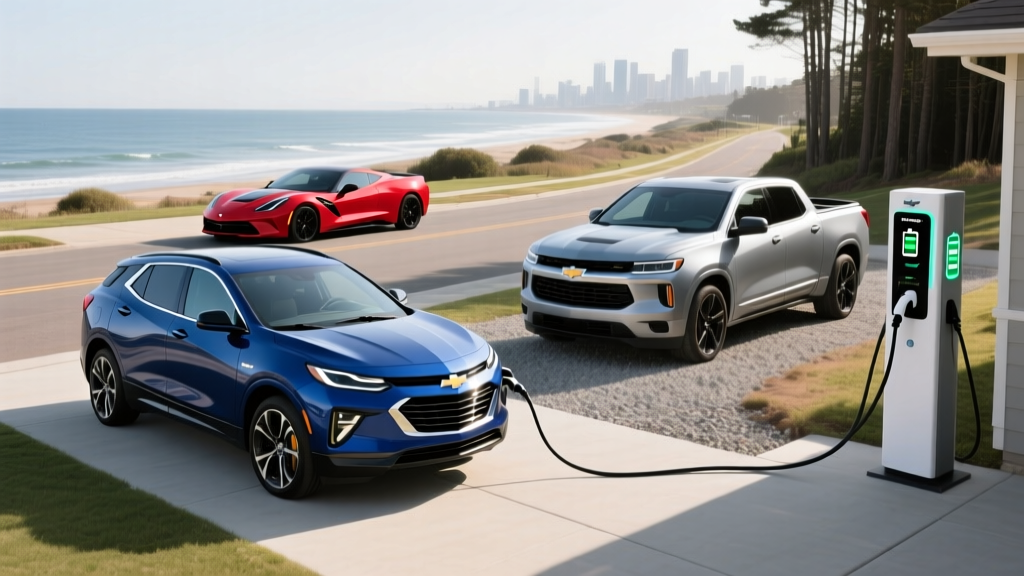
Chevrolet's hybrid lineup for 2026 is compact but strategically diverse. Rather than offering a sprawling menu of electrified options, Chevy has concentrated on three distinct hybrid vehicles that each serve a fundamentally different purpose: a fuel-sipping compact SUV for commuters, a hybridized sports car for performance enthusiasts, and a full-size pickup that trims fuel costs under heavy-duty use. None of these are plug-in hybrids (PHEVs) in the traditional sense of offering 30+ miles of electric-only commuting range. That's an important distinction that shapes who should — and shouldn't — consider a Chevy hybrid in 2026.
This guide covers every current Chevy hybrid with exact EPA MPG figures, real-world efficiency expectations, battery specs and warranty coverage, pricing, and federal tax-credit eligibility. If you're cross-shopping Chevy hybrids against Toyota, Honda, or Ford alternatives, you'll find the data you need to make a precise comparison.
Chevy's 2026 Hybrid Lineup at a Glance
Before diving into individual models, here's how the three Chevy hybrids stack up on paper. Note that all three are conventional hybrids (HEVs) — they recharge their small batteries through regenerative braking and the gasoline engine. You never plug them in.
| Specification | 2026 Equinox Hybrid | 2026 Corvette E-Ray | 2026 Silverado Hybrid |
|---|---|---|---|
| Type | HEV | HEV (Performance) | HEV |
| Body Style | Compact SUV | Sports Car (Coupe/Convertible) | Full-Size Pickup |
| Powertrain | 1.5L Turbo I4 + Electric Motor | 6.2L V8 + Front Electric Motor | 5.3L V8 + Electric Motor |
| Combined HP | ~200 hp | 655 hp | ~390 hp |
| EPA Combined MPG | ~39 MPG | ~19 MPG | ~22 MPG |
| Electric-Only Range | N/A (HEV) | N/A (HEV) | N/A (HEV) |
| Battery | ~1.5 kWh (Li-ion) | ~1.9 kWh (Li-ion) | ~1.5 kWh (Li-ion) |
| Plug-In Charging | No | No | No |
| Starting MSRP | ~$31,900 | ~$73,300 | ~$55,800 |
HEV vs. PHEV: What Chevy Hybrids Actually Are
Conventional Hybrid (HEV) — What Chevy offers: The gasoline engine and a small electric motor share propulsion duties. A compact battery (typically 1–2 kWh) is recharged exclusively by regenerative braking and the engine. There is no plug and no meaningful electric-only driving range. The benefit is improved fuel economy, especially in stop-and-go city driving where the electric motor handles low-speed crawling and the engine shuts off at stops.
Plug-In Hybrid (PHEV) — What Chevy does NOT currently offer: A PHEV carries a larger battery (typically 13–20 kWh) and can be plugged into a wall outlet or Level 2 charger. It delivers 25–45 miles of pure electric driving before the gas engine takes over, functioning as a conventional hybrid afterward. The Toyota RAV4 Prime and Hyundai Tucson PHEV are examples. As of the 2026 model year, Chevrolet does not sell a PHEV in the U.S. market.
This matters for tax-credit purposes and for buyers whose primary goal is to drive on electricity for daily commutes. If that's you, a Chevy hybrid won't deliver it — you'd need to look at a PHEV from a competing brand or a full battery-electric vehicle (BEV) like the Chevy Equinox EV.
2026 Chevy Equinox Hybrid: MPG, Specs & Real-World Efficiency
The Equinox Hybrid is the volume play in Chevy's hybrid stable. It targets the same buyers cross-shopping the Toyota RAV4 Hybrid and Honda CR-V Hybrid — compact-SUV shoppers who want meaningful fuel savings without the complexity or cost of a plug-in vehicle.
| Driving Cycle | EPA Estimate | Real-World Expectation |
|---|---|---|
| City | ~41 MPG | 40–44 MPG (hybrids often beat EPA in city) |
| Highway | ~37 MPG | 34–37 MPG (less regen benefit at steady speed) |
| Combined | ~39 MPG | 37–40 MPG |
The Equinox Hybrid pairs a turbocharged 1.5-liter inline-four with an electric motor integrated into the transmission, producing a combined output of approximately 200 horsepower. A continuously variable transmission (eCVT) manages power delivery. The ~1.5 kWh lithium-ion battery pack sits beneath the rear seat, preserving the cargo area.
Real-world note: Conventional hybrids tend to exceed their EPA city estimates because regenerative braking is most effective in stop-and-go traffic. On sustained highway trips at 70+ mph, expect fuel economy to drop closer to the mid-30s. In cold weather (below 30°F), expect a 5–10% efficiency reduction as the engine runs more frequently for cabin heat and battery conditioning.
Starting MSRP is approximately $31,900 for the base LT trim, with the RS and Activ trims pushing toward $36,000–$38,000. That positions the Equinox Hybrid at a moderate premium over the gas-only Equinox (starting ~$28,600) but competitive with the RAV4 Hybrid (~$33,350). See fueleconomy.gov for the official EPA figures once published.
2026 Corvette E-Ray: Hybrid Performance Without the Plug
The Corvette E-Ray is a different breed of hybrid entirely. It exists not to save fuel but to add all-wheel-drive traction and explosive acceleration. A front-axle electric motor supplements the mid-mounted 6.2-liter V8, creating Chevy's first all-wheel-drive Corvette.
| Driving Cycle | EPA Estimate | Real-World Expectation |
|---|---|---|
| City | ~17 MPG | 15–18 MPG |
| Highway | ~24 MPG | 22–25 MPG |
| Combined | ~19 MPG | 17–21 MPG |
Combined output is 655 horsepower, with the V8 contributing 495 hp to the rear wheels and the electric motor adding 160 hp to the front axle. The result is a 0–60 mph time of approximately 2.5 seconds, making the E-Ray the quickest production Corvette ever sold. The ~1.9 kWh battery is small — it exists to provide short bursts of electric assist and enable a stealth electric-only mode for very low-speed maneuvers (under ~45 mph, for roughly 1–2 miles in ideal conditions). This is not a commuting range; it's a neighborhood-quiet-exit feature.
Starting MSRP is approximately $73,300 for the 1LZ coupe, with the 2LZ and convertible variants climbing past $85,000. For context, the E-Ray prioritizes performance over efficiency — its MPG figures are comparable to a standard Stingray, with the hybrid system adding capability rather than economy.
2026 Silverado Hybrid: Full-Size Truck Efficiency
Chevrolet's hybrid truck strategy for the Silverado 1500 uses a mild-hybrid system paired with the 5.3-liter V8. The electric motor assists during acceleration, enables auto stop-start, and captures energy during braking. It does not provide electric-only propulsion.
| Driving Cycle | EPA Estimate | Real-World Expectation |
|---|---|---|
| City | ~22 MPG | 20–23 MPG |
| Highway | ~23 MPG | 21–24 MPG |
| Combined | ~22 MPG | 20–23 MPG |
The hybrid system adds roughly 2–3 MPG over the standard 5.3L V8 Silverado (EPA ~19 combined). Combined output is approximately 390 horsepower. The system's primary benefits are smoother stop-start operation and a modest fuel savings that compounds for fleet buyers and high-mileage truck owners. For a truck covering 20,000 miles annually, the hybrid system could save approximately 100–140 gallons of fuel per year versus the non-hybrid V8 — roughly $350–$500 at current fuel prices.
The Silverado Hybrid starts around $55,800 and is available in LT and LTZ trims. Towing capacity remains competitive at approximately 9,200 lbs when properly equipped, though the hybrid system adds roughly 150 lbs of curb weight.
Battery Warranty, Reliability & Replacement Costs
Chevy Hybrid Battery Warranty: All 2026 Chevy hybrids carry GM's standard hybrid battery warranty of 8 years or 100,000 miles (whichever comes first). In states that follow California Air Resources Board (CARB) emissions standards — including California, New York, Massachusetts, and several others — the warranty extends to 10 years or 150,000 miles.
The warranty covers battery capacity loss below a defined threshold (typically 60–70% of original capacity) and defects. It does not cover damage from accidents, modifications, or neglect.
Reliability track record: GM's hybrid systems in the Equinox and Silverado use relatively simple, proven architectures. The eCVT-style power-split devices have fewer wear components than traditional automatic transmissions. The Corvette E-Ray's front-axle electric motor is a newer design, and long-term reliability data is still accumulating.
Replacement cost if out of warranty: Hybrid battery replacement for the Equinox and Silverado typically ranges from $2,000 to $4,000 including labor at a dealership. The Corvette E-Ray's specialized battery pack is likely higher, estimated at $4,000–$6,000. However, modern hybrid batteries frequently last 150,000–200,000+ miles with minimal degradation, as they operate in a narrow state-of-charge window (roughly 40–80%) that reduces stress on the cells. This is fundamentally different from a full EV battery that cycles through deeper charge ranges.
Tax Credits & Incentives: What Chevy Hybrids Qualify For
This is where the HEV vs. PHEV distinction has direct financial consequences. Under current IRS §30D Clean Vehicle Credit rules for 2026:
- Federal tax credit ($7,500): Available only for plug-in electric vehicles (BEVs and PHEVs) meeting battery-sourcing, critical-mineral, MSRP cap, and buyer income requirements. No current Chevy hybrid qualifies because none are plug-in vehicles.
- Fuel cell credit: Not applicable to any Chevy hybrid.
- State incentives: Some states offer rebates or HOV-lane access for hybrids, but these vary significantly by jurisdiction. Check your state's energy or DMV website for current programs.
If federal tax-credit eligibility is a priority, you would need to look at a full BEV like the Chevy Equinox EV (starting ~$33,000, potentially eligible for the full $7,500 credit depending on sourcing and income rules) or a competing PHEV.
Who Should Buy a Chevy Hybrid — And Who Shouldn't
Chevy Hybrids Are Right For You If:
- You want better fuel economy without changing your fueling habits (no plugs, no apps, no charging stations)
- You drive a mix of city and highway miles and want the city-driving MPG boost that hybrids provide
- You plan to keep the vehicle 8–10+ years and want the security of a long hybrid-battery warranty
- You're a truck buyer seeking modest fuel savings on a high-mileage fleet vehicle (Silverado Hybrid)
- You want Corvette performance with AWD traction (E-Ray)
Look Elsewhere If:
- You want electric-only commuting range — you need a PHEV or BEV
- You want to qualify for the $7,500 federal EV tax credit — HEVs don't qualify
- You want the broadest hybrid selection — Toyota offers 15+ hybrid models in the U.S.
- You primarily drive highway miles — the hybrid fuel-economy advantage shrinks at sustained speeds
- You want a plug-in hybrid from Chevrolet — Chevy does not currently offer one
Chevy Hybrid vs. Competitors: Where They Stand
The Equinox Hybrid competes most directly with the Toyota RAV4 Hybrid (EPA ~41 combined MPG, ~$33,350) and the Honda CR-V Hybrid (EPA ~40 combined MPG, ~$35,350). On paper, the Chevy's ~39 combined MPG is slightly behind the Toyota, but real-world differences are narrow — typically within 1–2 MPG depending on driving style and conditions. The Equinox Hybrid's pricing advantage (starting ~$1,400 less than the RAV4 Hybrid) is meaningful for budget-conscious buyers.
The Silverado Hybrid has fewer direct competitors. Ford offers the F-150 PowerBoost Full Hybrid (EPA ~24 combined MPG, starting ~$54,000), which uses a more capable hybrid system with genuine electric-only low-speed driving and available onboard power generation. The Ford system is more sophisticated but also commands a price premium on higher trims.
Frequently Asked Questions
How many MPG does the 2026 Chevy Equinox Hybrid get?
The Equinox Hybrid achieves an EPA-estimated ~39 MPG combined, with ~41 MPG city and ~37 MPG highway. In real-world driving, owners often see 40–44 MPG in city conditions thanks to regenerative braking, with highway efficiency dropping to the mid-30s at sustained speeds above 70 mph.
Does any Chevy hybrid go electric-only?
No current Chevy hybrid offers meaningful electric-only range. The Corvette E-Ray can travel approximately 1–2 miles at very low speeds (under 45 mph) on electric power alone, but this is designed for quiet neighborhood driving, not commuting. All three Chevy hybrids are conventional HEVs that cannot be plugged in.
Hybrid vs. PHEV vs. EV — which should I choose?
Choose a conventional hybrid (HEV) if you want better fuel economy with zero lifestyle change — no charging, no range planning, no plug. Choose a PHEV if you have home charging access and a commute under 30–40 miles; you'll drive on electricity most days and use gas only for longer trips. Choose a full EV (BEV) if you want maximum operating-cost savings, qualify for the federal tax credit, and have reliable home or workplace charging. For a deeper comparison, see the DOE's vehicle technology guide.
Is the Chevy hybrid battery reliable, and what does replacement cost?
GM's hybrid battery systems are proven and carry an 8-year/100,000-mile warranty (10 years/150,000 miles in CARB states). Modern hybrid batteries operate in a narrow charge window that minimizes degradation, and many last 150,000–200,000+ miles. Out-of-warranty replacement costs range from approximately $2,000–$4,000 for the Equinox and Silverado, and $4,000–$6,000 for the Corvette E-Ray.
Do Chevy hybrids qualify for the $7,500 federal tax credit?
No. The IRS §30D Clean Vehicle Credit applies only to plug-in electric vehicles (BEVs and PHEVs) that meet battery-sourcing, MSRP, and buyer-income requirements. Since all current Chevy hybrids are conventional HEVs without plug-in capability, none qualify. If the federal credit is important to you, consider the Chevy Equinox EV or Bolt EV instead.
Can I convert a Chevy hybrid to plug-in?
No. There is no factory or certified aftermarket conversion to add plug-in capability to a Chevy HEV. The battery, power electronics, and onboard charger hardware required for plug-in charging are fundamentally different systems.