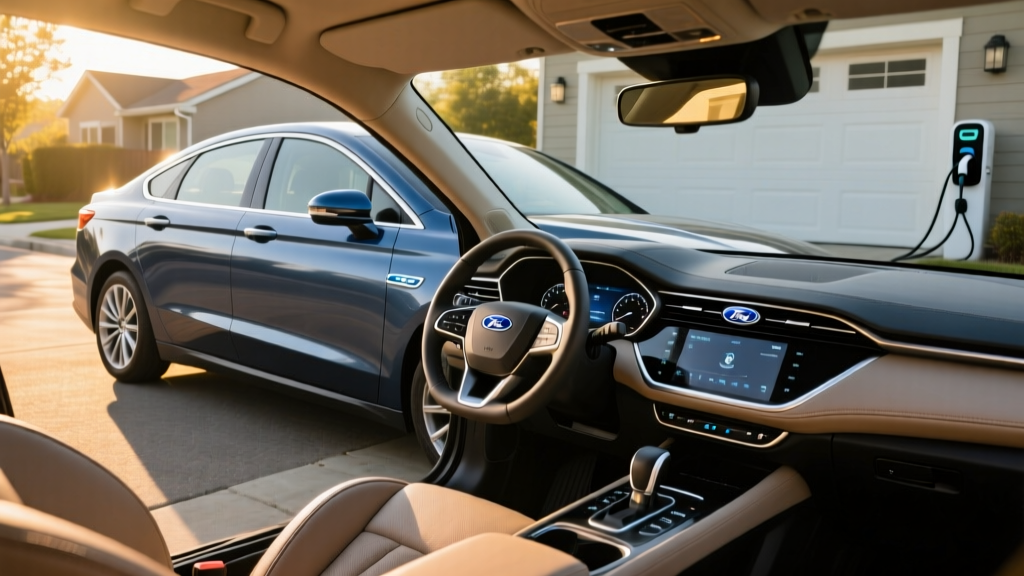
The Ford Fusion Hybrid was discontinued after the 2020 model year, but the 2019 Ford Fusion Hybrid SE remains one of the most compelling used midsize sedans on the market in 2026. With EPA-rated fuel economy that still rivals newer hybrids, a proven 2.0-liter Atkinson-cycle powertrain, and a comfortable cabin, this car continues to attract buyers who want hybrid efficiency without plugging in. This guide breaks down the exact numbers, real-world MPG expectations, battery longevity data, and ownership economics you need before buying one.
2019 Ford Fusion Hybrid SE: Quick Verdict
The 2019 Fusion Hybrid SE is a conventional hybrid electric vehicle (HEV) — not a plug-in. It charges its own small battery through regenerative braking and the gasoline engine, meaning you never need to plug it in. If you want electric-only driving, you'd need the separately badged Fusion Energi, Ford's PHEV variant of the same car. The Hybrid SE targets buyers who want set-it-and-forget-it fuel savings with zero lifestyle change from a gas car.
Fusion Hybrid (HEV): No plug. Charges via regen and engine. EPA 42 MPG combined. Lower purchase price.
Fusion Energi (PHEV): Plugs in. 11.4 kWh battery. ~26 miles electric-only range before the gas engine kicks in. Higher price, requires home charging access to realize full benefit.
This article covers the Hybrid SE (HEV).
Fuel Economy: EPA Numbers and Real-World MPG
| Metric | Value |
|---|---|
| City MPG | 43 |
| Highway MPG | 41 |
| Combined MPG | 42 |
| Fuel Tank Capacity | 13.5 gallons |
| Estimated Total Range | ~567 miles |
Source: EPA Fuel Economy Guide (fueleconomy.gov)
Real-World MPG: What Owners Actually See
The Fusion Hybrid's EPA rating of 42 MPG combined is genuinely achievable in mixed driving. Like most Toyota- and Ford-derived hybrid systems, the Atkinson-cycle engine and regenerative braking shine in stop-and-go city traffic, where the electric motor handles low-speed propulsion and the engine shuts off at stops. Many owners report 44–48 MPG in city-heavy commutes, exceeding the EPA city estimate.
Highway driving tells a slightly different story. At sustained 75+ MPH speeds, the aerodynamic drag of a midsize sedan and the less-efficient high-RPM engine operation can pull real-world highway fuel economy down to 37–40 MPG, a few ticks below the EPA highway rating. Cold weather (below 30°F) typically costs 3–5 MPG as the engine runs more frequently to generate cabin heat and maintain battery temperature.
EPA combined: 42 MPG (~567 miles per tank)
Expect in practice: 38–46 MPG depending on driving mix, yielding roughly 510–620 miles per tank. City-heavy drivers will see the high end; highway-heavy and cold-climate drivers the low end.
Powertrain and Performance Specs
| Specification | Value |
|---|---|
| Engine | 2.0L Atkinson-cycle 4-cylinder |
| Engine Horsepower | 141 hp @ 6,000 RPM |
| Electric Motor Output | 88 kW (118 hp) |
| Combined Net Horsepower | 195 hp |
| Transmission | eCVT (planetary gearset) |
| Drivetrain | Front-wheel drive |
| 0–60 MPH (est.) | ~7.8 seconds |
| Hybrid Battery Capacity | 1.4 kWh (lithium-ion) |
| Plug-In Charging | No — self-charging HEV |
The 2019 model year marked an important battery upgrade for the Fusion Hybrid: Ford switched from the older nickel-metal hydride (NiMH) pack to a 1.4 kWh lithium-ion battery. This pack is smaller and lighter than the NiMH unit it replaced, contributing to improved efficiency and packaging. The eCVT is not a belt-driven CVT like those in some competitors — it's a planetary gearset (similar in concept to Toyota's Hybrid Synergy Drive) that blends engine and motor power seamlessly, with no rubber-band acceleration feel.
Hybrid Battery Warranty, Lifespan, and Replacement Cost
Ford warranted the 2019 Fusion Hybrid's lithium-ion battery pack for 8 years / 100,000 miles (whichever comes first) in most states, and 10 years / 150,000 miles in California Air Resources Board (CARB) states (CA, CT, ME, MA, NJ, NY, OR, RI, VT, WA, and others adopting CARB standards). Coverage applies to capacity loss below a defined threshold and defects.
How Long Do Fusion Hybrid Batteries Actually Last?
The 2019 Fusion Hybrid's 1.4 kWh lithium-ion pack has proven durable. Because Ford's hybrid system uses a relatively conservative state-of-charge (SoC) window — the battery is never fully charged to 100% or fully depleted to 0% in normal operation — the cells experience less stress than those in a full EV or PHEV. Real-world data from fleet and owner reports suggests these packs routinely last 150,000–200,000+ miles before significant degradation.
For a 2019 model purchased in 2026, the vehicle is approximately 7 years old. The original 8-year/100,000-mile federal hybrid battery warranty may still have residual coverage depending on the odometer reading, or it may have just expired. CARB-state vehicles retain warranty coverage through year 10 (2029) or 150,000 miles.
Battery Replacement Cost
If the hybrid battery does fail outside warranty, replacement costs in 2026 typically range from $2,500 to $4,000 for a refurbished or aftermarket pack, and $4,000 to $6,000+ for a new OEM unit from Ford (availability may be limited given the Fusion's discontinuation). Independent hybrid-specialist shops often offer refurbished packs at the lower end of that range. This is a fraction of the cost of replacing a full EV's large traction battery, precisely because the Fusion Hybrid's 1.4 kWh pack is small.
2019 Fusion Hybrid SE Features and Pricing in 2026
The SE was the mid-level trim in the Fusion Hybrid lineup (base S → SE → Titanium). The SE added significant equipment over the S, including:
- Ford SYNC 3 infotainment with 8-inch touchscreen, Apple CarPlay, and Android Auto
- Push-button start with intelligent access
- 10-way power driver's seat
- Automatic dual-zone climate control
- Ford Co-Pilot360 suite: pre-collision assist with automatic emergency braking, lane-keeping system, blind-spot information system (BLIS), auto high-beam headlamps
- 17-inch aluminum wheels
Used Pricing (2026 Market)
| Condition / Mileage | Estimated Price Range |
|---|---|
| 60,000–80,000 miles, excellent | $16,000 – $19,500 |
| 80,000–120,000 miles, good | $12,500 – $16,000 |
| 120,000+ miles, fair | $9,500 – $12,500 |
Prices reflect typical private-party and dealer listings as of early 2026. Actual values vary by region, condition, and accident history.
Tax Credit Eligibility
The 2019 Ford Fusion Hybrid SE does not qualify for the federal §30D new clean vehicle tax credit — that credit applies only to new vehicle purchases with specific MSRP, income, and battery-sourcing requirements. It also does not qualify for the §25E used clean vehicle credit (up to $4,000 or 30% of sale price) because that credit is restricted to used plug-in electric vehicles and fuel-cell vehicles. Conventional hybrids like the Fusion Hybrid are not eligible for either federal credit.
Some states may offer separate incentives for hybrid purchases or registrations — check your state's energy or DMV website for current programs.
Fusion Hybrid vs. Fusion Energi vs. Full EV: Which Is Right for You?
| Attribute | Fusion Hybrid (HEV) | Fusion Energi (PHEV) | Comparable BEV (e.g., Chevy Bolt) |
|---|---|---|---|
| Plug-In Required? | No | Yes (Level 1/2) | Yes (Level 1/2/DC) |
| Electric-Only Range | ~1 mile (low speed) | ~26 miles | 238–259 miles |
| Combined MPG / MPGe | 42 MPG | 42 MPG / 97 MPGe | 118–120 MPGe |
| Battery Size | 1.4 kWh | 9.0 kWh (usable) | 60–66 kWh |
| Home Charging Needed? | No | Strongly recommended | Essential |
| Used Price (2026) | $12K–$19K | $14K–$21K | $14K–$22K |
| Federal Tax Credit (Used) | Not eligible | Up to $4,000 (§25E) | Up to $4,000 (§25E) |
- Choose the Fusion Hybrid (HEV) if: You have no home charging access, want maximum simplicity, drive a mix of city and highway miles, and want the lowest upfront cost with zero plug-in hassle.
- Choose the Fusion Energi (PHEV) if: You can install a Level 2 charger at home, your daily commute is under 25 miles (so you rarely burn gas), and you want to qualify for the up-to-$4,000 used EV tax credit under IRS §25E.
- Choose a full EV if: You have reliable home charging, want zero tailpipe emissions, lower per-mile fuel costs, and are ready to plan around DC fast charging for road trips over 250 miles.
Reliability, Maintenance, and Known Issues
The 2019 Fusion Hybrid benefits from Ford's mature hybrid system, which shares engineering DNA with the Escape Hybrid and C-Max Hybrid — platforms that accumulated years of fleet and taxi service proving durability. The eCVT planetary gearset has no belts, chains, or clutches to wear, making it one of the most reliable transmission designs in any vehicle.
Common Maintenance Items
- 12V auxiliary battery: Like all hybrids, the Fusion has a standard 12V battery (separate from the hybrid traction pack) that powers electronics and starts the computer. Expect replacement every 4–6 years (~$180–$250).
- Brake pads: Regenerative braking significantly reduces friction brake wear. Original brake pads often last 80,000–100,000+ miles.
- Coolant service: The hybrid system has its own coolant loop. Follow Ford's maintenance schedule (typically every 100,000 miles for the inverter coolant).
- Oil changes: Conventional 5W-20 synthetic, every 7,500–10,000 miles under normal driving.
Known Issues to Check Before Buying
- Hybrid battery cooling fan: Located behind the rear seat, this fan can accumulate dust. If clogged, the battery may overheat and reduce performance. Check that rear-seat side vents are clean.
- SYNC 3 software: Early SYNC 3 versions had Bluetooth connectivity quirks. Verify software is updated to the latest version via Ford's owner portal.
- Transmission fluid: While the eCVT is robust, Ford recommends fluid inspection at higher mileages. A fluid exchange (~$150–$200) at 120,000+ miles is prudent preventive maintenance.
Pros and Cons of the 2019 Fusion Hybrid SE
- Proven 42 MPG combined — often exceeded in city driving
- No plug-in required — zero lifestyle change from gas car
- Refined, quiet cabin for a midsize sedan
- Strong ADAS suite (Co-Pilot360) standard on SE
- eCVT planetary gearset is extremely reliable
- Comfortable ride quality, spacious rear seat
- Competitive used pricing ($12K–$19K)
- Discontinued — no new models, potential parts lead times
- No DC fast charging (not applicable — it's an HEV)
- Modest 195 hp — adequate, not quick
- Trunk slightly reduced vs. gas Fusion (battery packaging)
- Not eligible for federal EV or hybrid tax credits
- Infotainment feels dated vs. 2024+ vehicles
- AWD not available
Frequently Asked Questions
How many MPG does the 2019 Ford Fusion Hybrid SE get?
The EPA rates the 2019 Fusion Hybrid SE at 43 city / 41 highway / 42 combined MPG. In real-world driving, city-heavy commuters often achieve 44–48 MPG, while highway-dominant driving at 75+ MPH typically yields 37–40 MPG. Cold weather reduces efficiency by roughly 3–5 MPG.
Is the 2019 Fusion Hybrid a plug-in?
No. The Fusion Hybrid is a conventional HEV that charges its own 1.4 kWh battery via regenerative braking and the gasoline engine. You never plug it in. If you want plug-in capability, look for the separately badged Fusion Energi, which is Ford's PHEV variant with approximately 26 miles of electric-only range and a 9.0 kWh usable battery.
Is the hybrid battery reliable, and what does replacement cost?
Yes — the 2019 model's lithium-ion hybrid battery has proven durable, with most packs lasting 150,000–200,000+ miles. The original warranty was 8 years/100,000 miles (10 years/150,000 miles in CARB states). Out-of-warranty replacement costs $2,500–$6,000 depending on whether you use a refurbished or new OEM pack.
Does the 2019 Fusion Hybrid qualify for any tax credit?
Not at the federal level. The IRS §30D credit applies to new plug-in vehicles only, and the §25E used clean vehicle credit applies only to used plug-in vehicles (BEVs and PHEVs), not conventional hybrids. The Fusion Energi (PHEV) may qualify for the §25E used credit (up to $4,000 or 30% of sale price) if buyer income and sale-price caps are met — see IRS.gov §25E guidelines. Some states offer separate hybrid incentives.
How does the Fusion Hybrid compare to a Toyota Camry Hybrid?
The 2019 Camry Hybrid LE is rated at 52 MPG combined (EPA) versus the Fusion's 42 MPG — a significant 10 MPG advantage for Toyota. However, the Fusion offers a more substantial ride, a slightly larger trunk (when accounting for the Camry Hybrid's battery intrusion), and Ford's Co-Pilot360 safety suite. On the used market, Camry Hybrids typically command a $2,000–$4,000 premium over comparably equipped Fusion Hybrids. If maximum MPG is your priority, the Camry wins. If value and comfort matter more, the Fusion Hybrid SE is the stronger buy in 2026.
What should I check before buying a used 2019 Fusion Hybrid?
Prioritize these inspections: (1) Verify the hybrid battery health via an OBD-II scanner that reads Ford hybrid parameters — look for voltage delta between cells. (2) Confirm the hybrid battery cooling fan vent (rear seat, passenger side) is free of debris. (3) Check maintenance records for inverter coolant service. (4) Verify 12V battery age. (5) Test all Co-Pilot360 features (BLIS, lane-keeping, pre-collision assist) during the test drive. (6) Pull a vehicle history report for accident damage that could affect the hybrid system wiring.