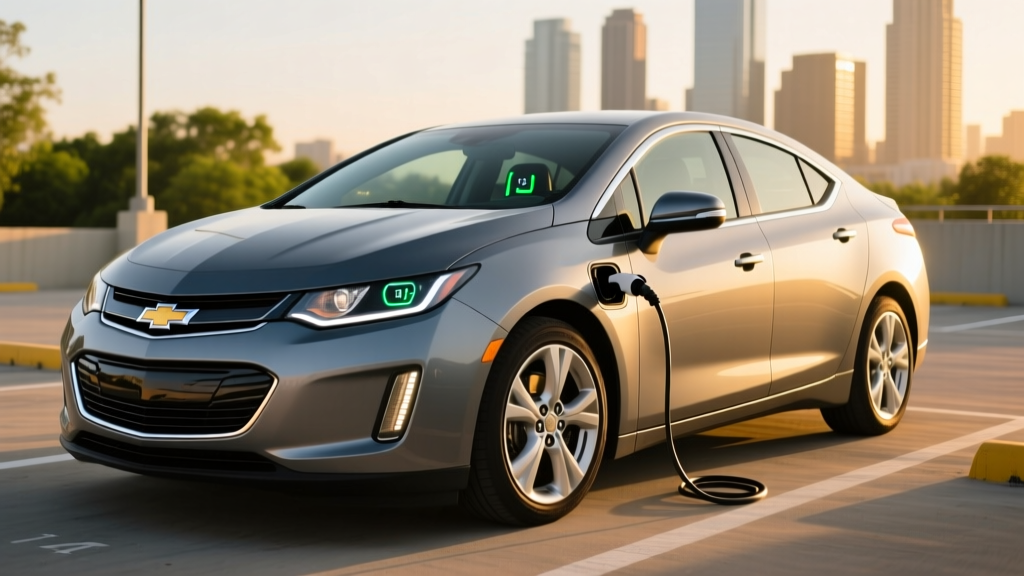
The Chevrolet Volt plug-in hybrid remains one of the most practical entries into electrified driving on the used market. Discontinued after the 2019 model year, the second-generation Volt (2016–2019) still holds up as a compelling PHEV for drivers who want daily electric commuting without range anxiety on longer trips. With 53 miles of EPA-rated electric-only range and a combined 42 MPG on gasoline, it bridges the gap between a full battery-electric vehicle (BEV) and a conventional hybrid in a way few vehicles have matched since.
This guide covers everything a prospective used Volt buyer needs: real-world efficiency, battery health expectations, charging logistics, ownership costs, and how the Volt stacks up against today's PHEVs and BEVs.
What Is the Chevrolet Volt and How Does a PHEV Differ from a Regular Hybrid?
The Chevrolet Volt is a plug-in hybrid electric vehicle (PHEV), not a conventional hybrid (HEV) like the Toyota Prius. The distinction matters for your daily driving and fuel costs.
HEV vs. PHEV: Key Differences
| Feature | Conventional Hybrid (HEV) | Plug-In Hybrid (PHEV) — Volt |
|---|---|---|
| Plug-in charging | No — charges via regenerative braking and engine | Yes — plug in to charge the larger battery |
| Battery size | ~1–2 kWh | 18.4 kWh (2nd-gen Volt) |
| Electric-only range | 0–2 miles at low speed | 53 miles EPA |
| Gas engine role | Primary propulsion, assisted by motor | Backup generator/motor after battery depletes |
| Fueling | Gasoline only | Electricity + gasoline |
The Volt operates as a series-parallel PHEV. For the first 53 miles (EPA), it runs purely on battery power using its electric motors. Once the battery is depleted to its programmed buffer, the 1.5-liter gasoline engine activates — primarily as a generator to feed electricity to the drive motors, though it can mechanically couple to the drivetrain at highway speeds for efficiency. This "range-extended EV" architecture is what made the Volt unique: you drive an EV most days and a hybrid on road trips.
Chevrolet Volt Specifications and Efficiency
| Specification | 2016–2019 Chevrolet Volt (2nd Gen) |
|---|---|
| EPA Electric-Only Range | 53 miles |
| Total Range (Electric + Gas) | ~420 miles |
| MPGe (Electric Mode) | 106 MPGe combined |
| EPA MPG (Gas, Charge-Sustaining) | 42 city / 42 hwy / 42 combined |
| Battery Capacity | 18.4 kWh total (~14 kWh usable, NMC chemistry) |
| Combined System Power | 149 hp / 294 lb-ft torque |
| Electric Motors | Two-motor Voltec drive unit (117 kW primary, 48 kW secondary) |
| Gas Engine | 1.5L naturally aspirated I4, 101 hp |
| 0–60 mph | ~7.8 seconds |
| Level 1 Charging (120V) | ~13 hours (full charge) |
| Level 2 Charging (240V, 3.6 kW) | ~4.5 hours (full charge) |
| DC Fast Charging | Not supported |
| Fuel Tank | 8.9 gallons |
| Cargo Volume | 10.6 cu ft |
How Many MPG Does the Chevrolet Volt Get?
According to fueleconomy.gov, the second-generation Volt achieves 42 MPG combined when operating in charge-sustaining (hybrid) mode after the battery is depleted. This figure holds at 42 city and 42 highway — unusually flat for a PHEV, thanks to the series-hybrid architecture that lets the engine run at its most efficient RPM regardless of vehicle speed.
In electric mode, the Volt earns 106 MPGe combined, consuming roughly 31 kWh per 100 miles. For context, that's comparable to a Nissan Leaf or early Tesla Model 3 in efficiency.
Real-World MPG vs. EPA Estimates
Real-world results for the Volt depend heavily on your driving pattern:
- Mostly electric commuting (under 53 miles/day): Owners frequently report using little to no gasoline for weeks. If you charge nightly and drive 30–40 miles daily, your effective "MPG" is essentially infinite — you're running on electricity.
- Mixed driving with regular battery depletion: Expect 38–44 MPG in gas mode. Highway driving at 75+ mph can drop this to 35–38 MPG; city driving in hybrid mode often matches or slightly exceeds the 42 MPG EPA figure.
- Cold weather impact: Electric range drops 15–25% in freezing temperatures (expect 40–45 miles instead of 53). Gas-mode MPG also dips modestly to ~38–40 combined due to cold-start enrichment and cabin heating load.
Real-World Range Expectation: EPA rates the Volt at 53 miles electric-only. In moderate weather at mixed speeds, expect 48–55 miles. Highway-only driving at 70+ mph: ~42–46 miles. Freezing weather with heat on: ~38–45 miles. The Volt's generous buffer (roughly 4.4 kWh held in reserve) protects the battery but means you use only ~14 of the 18.4 kWh total.
Charging the Volt: What You Need at Home
The Volt does not support DC fast charging. All charging is AC, through the J1772 connector standard on all non-Tesla PHEVs and EVs.
| Charging Level | Power | Time to Full | Miles of Range per Hour |
|---|---|---|---|
| Level 1 (120V outlet) | ~1.4 kW | ~13 hours | ~4 miles/hr |
| Level 2 (240V, 16A) | 3.6 kW | ~4.5 hours | ~12 miles/hr |
The Volt's onboard charger is limited to 3.6 kW, meaning even a 48-amp Level 2 station will only deliver 3.6 kW to the car. This is perfectly adequate overnight — plug in when you get home, and the battery is full by morning. A dedicated 240V Level 2 home charger (such as a ChargePoint Home Flex or Emporia Level 2) is the practical choice for daily Volt ownership.
Level 1 viability: If you drive under 40 miles daily and park for 10+ hours overnight, Level 1 on a standard 120V outlet can replenish enough range to cover your commute. It's slow but functional for low-mileage drivers.
Battery Health, Degradation, and Warranty
The Volt's 18.4 kWh lithium-ion battery uses NMC (nickel-manganese-cobalt) chemistry. A critical design advantage: GM programmed a large buffer — the Volt never uses the full battery, keeping roughly 4.4 kWh in reserve (about 24% of total capacity). This top-and-bottom buffer significantly slows degradation.
Battery Warranty
GM warranted the Volt's battery for 8 years / 100,000 miles (10 years / 150,000 miles in CARB states including California, New York, Massachusetts, and others). The warranty covers capacity loss below ~60–70% of original capacity, though the exact threshold is defined in GM's warranty documentation.
For a 2017 Volt, the 8-year/100,000-mile federal warranty has expired as of 2025. A 2019 model's warranty expires in 2027. CARB-state 10-year warranties on 2016–2017 models have also expired. Buyers should verify any remaining warranty through a GM dealer using the VIN.
Real-World Battery Degradation Data
Long-term owner data from Volt forums and fleet studies shows the second-generation Volt battery holds up well:
- 5 years / 75,000 miles: Typical capacity retention of 88–94%, translating to roughly 47–50 miles of electric range (down from 53).
- 8 years / 100,000+ miles: Most units retain 80–88% capacity. Range loss to ~42–47 miles is common but still practical for commuting.
- Outliers: A small percentage of early 2016 Volt batteries experienced cell-balance issues leading to steeper loss. GM addressed many under warranty. Later model years (2017–2019) show more consistent longevity.
Battery Replacement Cost
If the battery requires full replacement outside warranty, expect $3,500–$5,500 for a refurbished or new pack plus labor at an independent EV-capable shop. GM dealer pricing has historically run higher, sometimes $6,000–$8,000+. Salvage-yard packs from low-mileage Volts are an emerging option at $1,500–$3,000, though installation still requires a qualified technician. The Volt's modular battery design (96 cells in 3 modules) allows individual module replacement in some failure scenarios, potentially reducing cost to $800–$1,500 per module.
Used Pricing and Tax Credit Eligibility
The Chevrolet Volt was discontinued after the 2019 model year. As of 2026, all Volts are purchased on the used market. Pricing varies by model year, mileage, condition, and battery health:
- 2016 Volt: $9,000–$13,000 (80,000–120,000 miles typical)
- 2017 Volt: $11,000–$16,000 (60,000–100,000 miles typical)
- 2018 Volt: $13,000–$18,000 (50,000–90,000 miles typical)
- 2019 Volt: $15,000–$21,000 (30,000–70,000 miles typical)
Premium trims (Premier) and low-mileage examples command the top of each range. Battery health reports (available via the car's diagnostics or an OBD2 reader app like myChevy or Torque Pro) should influence your offer — a Volt showing 95%+ capacity retention is worth a premium over one at 82%.
Does the Used Volt Qualify for a Federal Tax Credit?
Yes — under the IRS §25E Used Clean Vehicle Credit, you may qualify for up to $4,000 (30% of the sale price, capped at $4,000) when purchasing a used Volt from a licensed dealer. Key eligibility requirements for 2026:
- Sale price: Must be $25,000 or less (virtually all used Volts qualify)
- Buyer income caps: Adjusted gross income ≤ $75,000 (single), $112,500 (head of household), $150,000 (married filing jointly)
- Vehicle age: Must be at least 2 model years old (all Volts qualify)
- Dealer sale required: Private-party sales do not qualify
- Battery capacity: Must have at least 7 kWh (Volt's 18.4 kWh qualifies)
- One-time use: You can only claim the used-vehicle credit once every 3 years
- Point-of-sale transfer: The credit can be applied at purchase to reduce your out-of-pocket cost
A $14,000 used Volt with the $4,000 credit effectively costs $10,000 — exceptional value for a PHEV with 53 miles of electric range. Always confirm eligibility with a tax professional before relying on the credit, as IRS rules are subject to change.
Volt vs. Today's PHEVs and Full EVs: Which Should You Choose?
The Volt's discontinuation means you're comparing a used PHEV against new PHEVs (like the Toyota RAV4 Prime or Hyundai Tucson PHEV) and affordable used BEVs (like the Chevrolet Bolt EV or Nissan Leaf). Here's a decision framework:
Choose the Chevrolet Volt If:
- Your daily commute is under 50 miles and you can charge at home
- You take 3+ road trips per year and don't want to plan around charging stations
- Your budget is $10,000–$20,000 and you want PHEV flexibility
- You don't need DC fast charging or the latest infotainment
Choose a New PHEV (RAV4 Prime, Tucson PHEV) If:
- You need an SUV body style with more cargo space
- You want a full factory warranty and latest safety tech
- You qualify for the $7,500 new-vehicle §30D credit (subject to MSRP caps, income limits, and battery-sourcing rules per IRS guidelines)
Choose a Full EV (Bolt EV, Model 3, Leaf) If:
- You can charge at home and your daily driving is under 200 miles
- You want minimal maintenance (no oil changes, no gas engine)
- You want DC fast charging for road trips
- You're ready to commit to full electrification
Volt Pros
- 53-mile electric range covers most commutes gas-free
- 42 MPG in gas mode — no range anxiety on road trips
- Large battery buffer yields excellent long-term degradation profile
- Eligible for up to $4,000 used-EV tax credit
- Low cost of entry: effective price as low as $6,000–$10,000 after credit
- Smooth, quiet electric driving experience with instant torque
Volt Cons
- No DC fast charging — not ideal for apartment dwellers without home charging
- Tight rear seats and only 10.6 cu ft of cargo space
- Discontinued — no new models, warranty expiring on older units
- Infotainment and driver-assist tech dated by 2026 standards
- 3.6 kW onboard charger limits Level 2 speed
- Battery replacement cost of $3,500+ if out of warranty
Is the Chevrolet Volt Reliable?
The second-generation Volt has a strong reliability reputation among owners. The Voltec powertrain is mechanically simpler than a conventional automatic transmission — the two-motor drive unit has no traditional gears or clutch packs to wear. The 1.5L engine, when it runs, operates under light load as a generator, which reduces wear compared to a traditional gas car engine.
Common maintenance items include:
- Standard 12V battery replacement every 4–6 years (shared with all cars; ~$150–$250)
- Engine oil changes every 2 years or when the maintenance minder triggers — many Volt owners go 10,000+ miles between oil changes because the engine runs so infrequently
- Coolant system service per GM schedule (the Volt has multiple cooling circuits for battery, powertrain, and electronics)
- Tire rotation and brake inspection — regenerative braking significantly extends pad life; many Volts reach 80,000+ miles on original brake pads
The NHTSA gave the 2019 Volt a 5-star overall safety rating. The IIHS rated the 2017–2019 Volt as a Top Safety Pick with acceptable headlight ratings on Premier trims.
Frequently Asked Questions
How far can the Chevrolet Volt go on electric only?
The EPA rates the second-generation Volt (2016–2019) at 53 miles of electric-only range. In real-world driving at moderate temperatures and mixed speeds, expect 48–55 miles. Highway driving at 75+ mph reduces this to about 42–46 miles, and freezing temperatures can drop it to 38–45 miles.
Does the Volt need to be plugged in to work?
No. The Volt will operate perfectly fine as a hybrid without ever being plugged in, getting 42 MPG combined on gasoline. However, you lose the primary economic benefit — cheap electric commuting. Without plugging in, you're carrying 400+ pounds of battery you're not utilizing.
Can the Volt charge at Tesla Superchargers or DC fast chargers?
No. The Volt only supports AC charging via the J1772 connector at Level 1 (120V) or Level 2 (240V). It has no DC fast-charge capability. Maximum charge rate is 3.6 kW on Level 2.
What is the total cost of ownership compared to a gas car?
If you charge at home at an average electricity rate of $0.14/kWh and drive 40 miles daily on electric power, your "fuel" cost is roughly $1.85/day. The same commute in a 30 MPG gas car at $3.40/gallon costs $4.53/day. Over a year (250 commuting days), that's a savings of ~$670 in fuel alone. Factor in reduced brake wear and infrequent oil changes, and the Volt's total operating cost undercuts a comparable gas car by $800–$1,200 annually for a typical commuter.
Is the Volt a good choice if I can only charge at work or on Level 1?
Level 1 charging (120V) adds about 4 miles of range per hour. Over a 10-hour workday, that's ~40 miles — enough to cover most commutes. If your workplace offers Level 2 charging, you'll fully replenish the battery in about 4.5 hours. The Volt is one of the most practical PHEVs for Level 1-only charging because its daily electric range needs are modest.
How does the Volt compare to the Toyota Prius Prime?
The 2017–2019 Prius Prime offers 25 miles of electric range (vs. the Volt's 53) but achieves 54 MPG in hybrid mode (vs. the Volt's 42). The Volt is the better choice if your commute is 30–50 miles and you want to minimize gas use. The Prius Prime wins if you drive mostly in hybrid mode and prioritize MPG over electric range. The Prius Prime also offers slightly more cargo space (19.8 cu ft vs. 10.6).