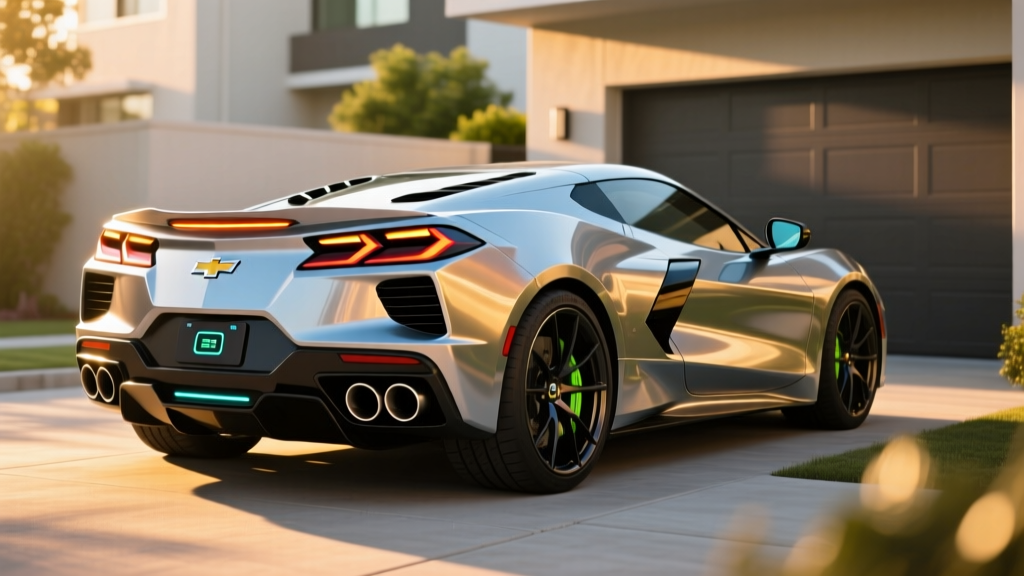
The Chevrolet Corvette E-Ray is not your typical hybrid. While most electrified vehicles prioritize fuel savings, the E-Ray uses its hybrid system for something else entirely: all-wheel-drive traction and supercar-rivaling acceleration. For 2026, the Corvette E-Ray returns as a conventional hybrid (HEV) — meaning it never plugs in — pairing a mid-mounted 6.2L V8 with a front-axle electric motor to produce 655 combined horsepower and a 2.5-second 0-60 mph time.
This guide breaks down everything a prospective buyer needs to know: real-world fuel economy, how the E-Ray's hybrid system actually works, pricing across all three trims, warranty coverage, and whether this performance hybrid makes sense compared to a full EV or the standard Stingray.
HEV vs PHEV: Where the Corvette E-Ray Fits
Before diving into specs, it's critical to understand what the E-Ray is not: it is not a plug-in hybrid (PHEV). There is no charging port, no electric-only driving mode for commuting, and no eligibility for federal EV tax credits. Here's the distinction:
| Feature | Conventional Hybrid (HEV) | Plug-In Hybrid (PHEV) |
|---|---|---|
| Plugs in to charge? | No — charges via engine & regen | Yes — has a charge port |
| Electric-only range | None (motor assists engine) | Typically 20-50 miles |
| Battery size | Small (~1-2 kWh) | Larger (~12-25 kWh) |
| Federal tax credit (§30D) | Not eligible | Potentially up to $7,500 |
| Corvette E-Ray? | ✓ This is the E-Ray | Not applicable |
The E-Ray's 1.9 kWh lithium-ion battery pack is charged exclusively through regenerative braking and the V8 engine. You will never search for a charger or install a Level 2 home station for this car. The electric motor exists to fill torque gaps, enable AWD, and provide brief electric-only movement at very low speeds (Chevrolet quotes under 1 mile at parking-lot speeds in Stealth mode) — not to replace gasoline.
Powertrain: 655 Horsepower From Two Sources
The E-Ray's powertrain is a technical showcase. The rear wheels are driven by Chevrolet's familiar LT2 6.2-liter naturally aspirated V8, producing 495 horsepower and 470 lb-ft of torque — the same engine found in the standard Corvette Stingray. The front axle gets its own permanent-magnet electric motor contributing 160 horsepower and 125 lb-ft of torque, powered by the 1.9 kWh battery mounted in the center tunnel where a traditional Corvette would route a driveshaft.
| Specification | 2026 Corvette E-Ray |
|---|---|
| Combined Horsepower | 655 hp |
| Combined Torque | 595 lb-ft |
| Engine | 6.2L LT2 V8, 495 hp / 470 lb-ft |
| Electric Motor (Front Axle) | 160 hp / 125 lb-ft |
| Battery Capacity | 1.9 kWh (lithium-ion) |
| Drivetrain | eAWD (rear V8 + front electric) |
| Transmission | 8-speed dual-clutch automatic (rear) |
| 0-60 mph | 2.5 seconds |
| Quarter Mile | 10.5 seconds @ 130 mph |
| Top Speed | 183 mph (w/ ZER package) |
| Curb Weight | ~3,774 lbs |
The result is the quickest production Corvette Chevrolet has ever built, and the first with all-wheel drive. The electric motor provides instant torque at the front axle while the V8 builds through its rev range at the rear, creating a seamless power delivery that neither a pure gas Stingray nor any current EV supercar quite replicates.
Fuel Economy: EPA MPG and Real-World Expectations
Let's address the obvious question: How many MPG does the Corvette E-Ray hybrid get?
| Driving Cycle | EPA Estimate | Real-World Expectation |
|---|---|---|
| City | 17 MPG | 16-18 MPG (regen helps slightly in stop-and-go) |
| Highway | 24 MPG | 21-23 MPG (aero drag and weight hurt at speed) |
| Combined | 19 MPG | 17-20 MPG depending on driving style |
For context, the standard 2026 Corvette Stingray with the same V8 and 8-speed DCT rates at 16 city / 24 highway / 19 combined per fueleconomy.gov. The E-Ray's hybrid system doesn't meaningfully improve fuel economy — the added weight of the electric motor, battery, and AWD hardware roughly cancels out any efficiency gains from regenerative braking and torque fill.
Real-world nuance: If you drive conservatively in suburban conditions with frequent regen opportunities, you may see 20 MPG combined. On a track day or aggressive canyon run, expect that number to drop into the low teens. The E-Ray's fuel tank holds 18.5 gallons, giving roughly 350 miles of cruising range at combined MPG — adequate for road trips but not exceptional.
2026 Corvette E-Ray Trims, Pricing, and Tax Credits
The 2026 E-Ray is offered in three trim levels, all available as either a coupe (removable roof panel) or convertible. Pricing has increased modestly over the 2024 launch year:
| Trim | Coupe MSRP | Convertible MSRP | Key Additions |
|---|---|---|---|
| 1LZ | $106,595 | $114,595 | Base E-Ray, GT1 seats, 12" touchscreen, Performance Data Recorder |
| 2LZ | $114,595 | $122,595 | GT2 seats, head-up display, Bose 14-speaker audio, front curb cameras |
| 3LZ | $121,595 | $129,595 | Nappa leather interior, suede microfiber trim, carbon fiber accents |
Options like the ZER (Zero Equipment Replacement) performance package, carbon-ceramic brakes, and carbon-fiber aero add-ons can push a well-equipped 3LZ convertible past $140,000.
Does the Corvette E-Ray Qualify for a Federal Tax Credit?
No. The Corvette E-Ray is a conventional hybrid (HEV), not a plug-in vehicle. The federal §30D Clean Vehicle Credit applies only to battery electric vehicles (BEVs) and plug-in hybrids (PHEVs) that meet battery capacity, critical-mineral sourcing, MSRP, and buyer income requirements. Since the E-Ray has no plug and a battery far below the §30D minimum threshold, it does not qualify for any federal EV purchase incentive.
Some states offer modest incentives for conventional hybrids, but these are rare and typically small (under $1,000). Check your state's energy office or department of environmental quality for current programs. For most buyers, the E-Ray's purchase is a performance decision, not an incentive-driven one.
Driving Modes: Stealth, Tour, Sport, and Track
The E-Ray's hybrid system enables driving modes the standard Stingray cannot offer:
- Stealth Mode: Electric-only at speeds up to ~45 mph for brief distances (under 1 mile). Useful for quietly exiting a neighborhood at dawn. The engine will start if you exceed the speed or power threshold.
- Tour Mode: Default for daily driving. The V8 and electric motor cooperate for smooth acceleration with maximum regenerative braking.
- Sport Mode: Sharper throttle response, more aggressive regen, and the electric motor pre-charges more frequently for instant AWD torque.
- Track Mode: Full system output available. The electric motor and V8 are coordinated for maximum launch grip via eAWD. Charge Sustaining mode keeps the battery topped up during hot laps.
The electric front axle also enables a degree of torque vectoring — the E-Ray can send more or less torque to individual front wheels to help rotate the car through corners, something the rear-drive Stingray cannot do.
Reliability, Battery Lifespan, and Maintenance
Is the Corvette E-Ray hybrid reliable? The C8 Corvette platform is now in its sixth model year, and the core LT2 V8 and 8-speed DCT have proven robust in the Stingray and Z06. The E-Ray's electric front axle adds complexity, but it's a relatively simple system: one motor, one inverter, one small battery. There are no high-voltage contactors cycling constantly, no large battery pack degrading through daily deep cycles, and no plug-in charging hardware to fail.
Chevrolet has not published a projected battery replacement cost for the E-Ray specifically. For reference, hybrid battery replacement on mainstream vehicles (Toyota Camry Hybrid, etc.) typically runs $2,000-$4,000. The E-Ray's battery is smaller but more specialized, and given Corvette production volumes, replacement costs could be higher — likely in the $3,000-$6,000 range if needed out of warranty. That said, the 1.9 kWh pack undergoes shallow charge/discharge cycles, which heavily favors long-term health. Deep degradation is unlikely under normal use.
The 5-year/60,000-mile powertrain warranty covers hybrid-specific components. For buyers planning to keep the car beyond that window, an extended warranty from Chevrolet or a third-party provider is worth considering — especially given the specialized nature of the eAWD system.
Corvette E-Ray vs. Stingray vs. Full EV: Which Fits You?
Choose the Corvette E-Ray if:
- You want the quickest production Corvette with AWD all-weather capability
- You live in a region with rain, snow, or cold where rear-drive sports cars lose traction
- You value the V8 sound and character but want electric torque fill
- You don't need electric-only commuting range or home charging
Choose the standard Corvette Stingray if:
- You prioritize lighter weight (~200 lbs less) and a purer rear-drive experience
- You want a manual-ish feel (the Stingray's DCT tuning is slightly more aggressive)
- Budget matters — the Stingray starts around $68,000, roughly $38,000 less than the E-Ray
Choose a full EV (Porsche Taycan, Tesla Model S Plaid, Lucid Air) if:
- You want electric-only daily driving with 250+ miles of range
- Home charging and low per-mile energy cost are priorities
- You want to qualify for the federal §30D tax credit (up to $7,500 for eligible BEVs)
- Instant, silent torque is more appealing than V8 character
The E-Ray occupies a narrow but compelling niche: it's a hybrid for people who don't care about saving fuel. The electric motor exists to make the car faster and more capable, not greener. If that proposition resonates — a 2.5-second supercar you can daily-drive in the rain — there's nothing else on the market quite like it at any price, let alone under $130,000.
Pros and Cons at a Glance
Pros
- 2.5-second 0-60 mph — quickest production Corvette ever
- AWD capability in rain and light snow
- V8 sound and character preserved
- No charging infrastructure needed
- Stealth mode for quiet neighborhood exits
- Practical cargo space (front trunk + rear hatch) for a sports car
Cons
- No federal tax credit eligibility
- 19 MPG combined — no fuel savings over Stingray
- ~200 lbs heavier than the standard Stingray
- 5-year/60,000-mile hybrid warranty is shorter than mainstream hybrids
- Starting price over $106,000 — $38K more than a base Stingray
- Electric-only range is negligible (under 1 mile at low speed)
Frequently Asked Questions
How many MPG does the Corvette E-Ray hybrid get?
The EPA rates the 2026 Corvette E-Ray at 17 MPG city, 24 MPG highway, and 19 MPG combined. Real-world results cluster around 17-20 MPG depending on driving style. The hybrid system provides minimal fuel-economy benefit over the standard Stingray, which rates identically.
How far can the Corvette E-Ray drive on electric power alone?
In Stealth mode, the E-Ray can travel under 1 mile at speeds up to approximately 45 mph before the V8 engine starts. This is designed for quiet neighborhood departures, not electric commuting. The E-Ray is not a plug-in hybrid and has no meaningful electric-only range.
Does the Corvette E-Ray qualify for any tax credit?
No. The E-Ray is a conventional hybrid (HEV), not a plug-in hybrid or battery electric vehicle. It does not qualify for the federal §30D Clean Vehicle Credit. Per IRS guidelines, only vehicles with a plug and sufficient battery capacity are eligible. Some states may offer minor hybrid incentives — check your state's energy office.
Is the Corvette E-Ray hybrid reliable? What about battery replacement cost?
The C8 platform and LT2 V8 have proven reliable over six model years. The E-Ray's hybrid system is relatively simple — a small battery with shallow charge cycles favors longevity. Chevrolet covers hybrid components for 5 years/60,000 miles. Out-of-warranty battery replacement is estimated at $3,000-$6,000, though deep degradation is unlikely given the mild usage pattern.
Can I plug in the Corvette E-Ray to charge at home?
No. The Corvette E-Ray has no charging port. Its 1.9 kWh battery is charged exclusively through regenerative braking and the V8 engine. You cannot install a home charger for this vehicle, and it does not accept DC fast charging.
Is the E-Ray faster than the Corvette Z06?
In a straight line to 60 mph, yes — marginally. The E-Ray hits 60 mph in 2.5 seconds thanks to AWD grip, while the rear-drive Z06 (670 hp) does it in 2.6 seconds. On a road course, the Z06 is significantly quicker due to its lighter weight, higher-revving engine, and track-focused chassis tuning.