2026 Camry Hybrid Fuel Economy: The Numbers That Matter
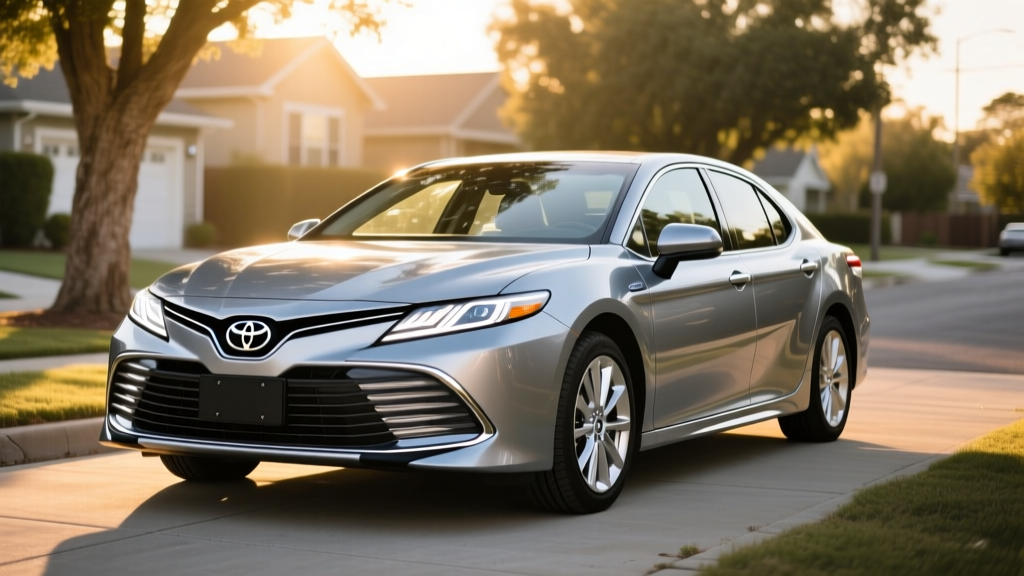
Toyota rebuilt the Camry lineup for the current generation around a single powertrain: a 2.5-liter four-cylinder hybrid system. There is no gas-only Camry anymore. That decision alone tells you where Toyota sees efficiency heading, and the Camry Hybrid fuel economy figures back it up with some of the highest MPG numbers in the midsize sedan segment.
For 2026, the Camry Hybrid carries over the fifth-generation Toyota Hybrid System (THS) introduced with the redesigned model. Every trim is a conventional hybrid (HEV) — meaning it charges its own small battery through regenerative braking and the gas engine. You never plug it in. If you want plug-in capability, you'll need to look at the RAV4 Prime or Prius Prime, as Toyota does not currently offer a Camry PHEV.
| Spec | FWD Trims | AWD Trims |
|---|---|---|
| Powertrain | 2.5L 4-cyl + 2 electric motors | 2.5L 4-cyl + 3 electric motors |
| Combined Horsepower | 225 hp | 232 hp |
| EPA City MPG | 51 | 49 |
| EPA Highway MPG | 44 | 43 |
| EPA Combined MPG | 47 | 46 |
| Fuel Tank | 13.2 gal | 13.2 gal |
| Total Range (est.) | ~620 miles | ~607 miles |
| 0–60 mph | ~7.1 sec | ~6.9 sec |
| Hybrid Battery | Lithium-ion, ~1.6 kWh (nominal) | |
| Plug-in Required? | No — self-charging HEV | |
| Base MSRP (LE) | ~$30,000 | |
The city-biased EPA rating (51 city vs. 44 highway for FWD) is typical of Toyota's power-split hybrid architecture. At low speeds, the electric motors do most of the work, and the gas engine operates only in its most efficient RPM range. Highway driving relies more heavily on the engine directly, which is why the highway number drops.
Real-World MPG: Do Owners Actually Hit 47 Combined?
EPA estimates are a baseline, not a guarantee. For the Camry Hybrid, real-world data consistently shows that city drivers often exceed the EPA city rating, while sustained highway driving at 75+ mph can fall below the highway sticker.
Owner-reported averages on fueleconomy.gov for the current-generation Camry Hybrid cluster around 44–49 MPG combined. In warm-weather city driving with moderate traffic — the scenario where regenerative braking shines — some drivers report 52–55 MPG. Cold weather, aggressive acceleration, and mountain grades pull that number down to the high 30s.
| Driving Scenario | Expected MPG | Notes |
|---|---|---|
| EPA Combined (sticker) | 47 (FWD) / 46 (AWD) | Official test cycle |
| City, warm weather | 50–55 | Regen braking maximized |
| Highway, 65 mph | 43–46 | Close to EPA highway |
| Highway, 75–80 mph | 37–41 | Aero drag penalty |
| Cold weather, mixed | 36–42 | Engine runs more for cabin heat |
| Mountain / steep grades | 32–38 | Heavy engine load uphill |
The key takeaway: if your commute is mostly stop-and-go city driving under 45 mph, the Camry Hybrid will likely beat its sticker. If you spend most of your time at interstate speeds in cold climates, expect something closer to 38–42 MPG combined. Both scenarios still handily beat any turbocharged gas midsize sedan, which typically delivers 25–30 MPG combined.
HEV vs. PHEV vs. EV: Which Powertrain Fits Your Life?
The Camry is a conventional hybrid (HEV). Toyota does not sell a Camry plug-in hybrid (PHEV) in the US market. Understanding the difference is essential before you shop.
| Factor | HEV (Camry Hybrid) | PHEV (e.g., Prius Prime) | BEV (e.g., Tesla Model 3) |
|---|---|---|---|
| Plug in to charge? | No | Yes (optional) | Yes (required) |
| Electric-only range | ~1 mile at low speed | 35–44 miles | 250–350+ miles |
| Total range | ~600–620 miles | ~500–600 miles | 250–350+ miles |
| Home charging needed? | No | Recommended, not required | Yes — Level 2 ideal |
| Federal tax credit | Not eligible (§30D) | Up to $7,500 (varies) | Up to $7,500 (varies) |
| Best for | No home charging access | Short commutes + road trips | Home charging + daily EV driving |
| Fuel cost per mile | ~$0.08–0.10 | ~$0.03–0.04 (electric) / $0.09 (gas) | ~$0.03–0.05 |
Choose the Camry Hybrid (HEV) if: you don't have access to home or workplace charging, you want a no-compromise sedan with excellent fuel economy, and you want to avoid the complexity of managing charge states. The HEV is invisible efficiency — you just drive and fill up at gas stations less often.
Consider a PHEV (like the Prius Prime) if: your commute is under 40 miles round-trip, you can install a Level 2 charger at home, and you want electric-only daily driving with gas-engine backup for road trips. A PHEV gives you EV-like daily costs without range anxiety.
Consider a full BEV if: you have reliable home charging, your daily driving is under 250 miles, and you want to eliminate gas entirely. BEVs have lower per-mile energy costs and fewer moving parts, but require charging infrastructure planning.
Powertrain Deep Dive: How the Camry Hybrid Makes 225 HP and 47 MPG
The 2026 Camry Hybrid uses Toyota's fifth-generation hybrid system, pairing a 2.5-liter Dynamic Force four-cylinder engine with electric motor-generators through a planetary gearset (the e-CVT). There are no traditional gear shifts and no belt-driven accessories — even the air conditioning compressor is electric.
In FWD trims, two motor-generators (MG1 and MG2) manage power splitting and propulsion. MG1 acts primarily as a generator and engine starter, while MG2 drives the front wheels. AWD trims add a third motor (MG-R) on the rear axle, providing electronic all-wheel drive without a mechanical driveshaft. The rear motor engages during acceleration, low-traction conditions, and certain braking scenarios.
The combined system output of 225 hp (FWD) or 232 hp (AWD) is competitive with turbocharged four-cylinder rivals. The 0–60 time of roughly 7 seconds puts it in the adequate-but-not-sporty category. The hybrid system's real advantage is seamless low-speed torque from the electric motors, making city driving feel responsive even though peak horsepower is modest.
The lithium-ion hybrid battery pack is small — roughly 1.6 kWh nominal capacity. It's not designed for extended electric-only driving. Instead, it serves as a buffer: capturing energy from regenerative braking, smoothing out engine load, and enabling brief electric-only operation at very low speeds (parking lots, stop-and-go traffic under ~25 mph). Toyota's hybrid management system continuously optimizes the split between engine and electric power for maximum efficiency.
Pricing, Trims, and Tax Credit Reality
The 2026 Camry Hybrid is offered across multiple trims, all with the same hybrid powertrain:
- LE: ~$30,000 MSRP — the volume seller, well-equipped with Toyota Safety Sense 3.0, 8-inch touchscreen, wireless CarPlay/Android Auto
- SE: ~$32,000 — sport-tuned suspension, 19-inch wheels, sport seats
- XLE: ~$34,500 — leather-trimmed seats, larger 12.3-inch display, premium audio
- XSE: ~$35,500 — sport styling with premium features, heated/ventilated front seats
AWD adds approximately $1,500 to any trim. Fully loaded, a Camry Hybrid XSE AWD approaches $40,000 with options.
Federal Tax Credit Eligibility
The Camry Hybrid is a conventional HEV — it does not qualify for the IRS §30D Clean Vehicle Credit. That credit applies only to plug-in vehicles (PHEVs and BEVs) with a minimum battery capacity of 7 kWh. The Camry's ~1.6 kWh pack falls far short of that threshold.
What about state incentives? Some states offer rebates or HOV-lane access for hybrids, but these programs vary widely and change frequently. Check your state's energy office or AFDC state incentive database for current availability. A few states have offered modest hybrid rebates ($250–$500), but most incentive dollars now target plug-in vehicles.
Battery Longevity, Warranty, and Replacement Cost
Hybrid battery anxiety is the number-one concern we hear from first-time hybrid buyers. Here's the data.
Toyota covers the Camry Hybrid battery with a 10-year/150,000-mile warranty (in states that follow California emissions standards, which is most of the US). In the handful of states that follow federal emissions rules, coverage is 8 years/100,000 miles. The warranty guarantees the battery will retain sufficient capacity to operate the hybrid system — Toyota defines this as maintaining the ability to hold a minimum charge threshold.
| Component | Warranty Period |
|---|---|
| Hybrid Battery Pack | 10 yr / 150,000 mi (most states) |
| Hybrid System Components (inverter, motors, control module) | 8 yr / 100,000 mi |
| Powertrain (engine, transaxle) | 5 yr / 60,000 mi |
| Basic Bumper-to-Bumper | 3 yr / 36,000 mi |
Real-world degradation data: Toyota's hybrid battery packs have an excellent longevity track record. The current lithium-ion packs in the Camry are less prone to the degradation seen in early nickel-metal-hydride (NiMH) packs from the 2000s-era Prius. Data from fleet operators and long-term owners suggests modern Toyota hybrid batteries typically retain 85–90%+ capacity after 150,000 miles. Complete failure before 200,000 miles is uncommon.
Replacement cost if out of warranty: A new OEM hybrid battery pack for the current-generation Camry runs approximately $3,000–$4,500 installed at a Toyota dealer. Independent hybrid specialists sometimes offer refurbished packs for $1,500–$2,500. Given the 10-year/150,000-mile warranty and the pack's demonstrated longevity, most owners will never face this expense.
Maximizing battery life: Toyota's hybrid management system already handles most battery care automatically — it never lets the pack fully charge or fully discharge, keeping it in a healthy state-of-charge window (roughly 40–80%). The best thing owners can do is simply drive normally and follow scheduled maintenance. There's no need to baby the system.
Camry Hybrid vs. the Competition: MPG Context
The Camry Hybrid doesn't exist in a vacuum. Here's how its fuel economy stacks up against the closest midsize hybrid sedans:
| Vehicle | City | Highway | Combined | Starting MSRP |
|---|---|---|---|---|
| Toyota Camry Hybrid (FWD) | 51 | 44 | 47 | ~$30,000 |
| Honda Accord Hybrid | 51 | 44 | 48 | ~$33,000 |
| Hyundai Sonata Hybrid | 44 | 51 | 47 | ~$31,000 |
| Kia K5 Hybrid (if avail.) | ~42 | ~49 | ~45 | ~$30,500 |
The Camry and Accord Hybrid trade blows at the top of the segment. The Sonata Hybrid is notable for its higher highway MPG (51 highway vs. 44 for the Camry), thanks to Hyundai's conventional 6-speed automatic hybrid transmission, which is more efficient at steady highway speeds. If your driving is overwhelmingly interstate commuting, the Sonata Hybrid's highway advantage is worth considering. For mixed and city-heavy driving, the Camry's system is equally strong.
Who Should Buy the Camry Hybrid — and Who Shouldn't
Pros
- Class-leading city MPG (51 EPA)
- No plug-in required — works with any lifestyle
- 600+ mile total range between fill-ups
- Standard AWD availability across trims
- 10-year/150,000-mile hybrid battery warranty
- Strong resale value and Toyota reliability reputation
- Competitive starting price (~$30,000)
Cons
- No PHEV variant available (no electric-only commuting)
- No federal tax credit eligibility
- Highway MPG trails Hyundai Sonata Hybrid
- e-CVT drone under hard acceleration
- AWD fuel economy penalty (~1 MPG combined)
- Not eligible for HOV-lane access in most states (unlike PHEVs/EVs)
Frequently Asked Questions
How many MPG does the 2026 Camry Hybrid actually get?
The EPA rates the Camry Hybrid FWD at 51 city / 44 highway / 47 combined MPG. AWD trims are rated 49/43/46. Real-world results vary: city drivers often see 50–55 MPG, while sustained 75+ mph highway driving can drop to 37–41 MPG. Cold weather reduces efficiency by roughly 10–15%.
Can I plug in the Camry Hybrid to charge?
No. The Camry Hybrid is a conventional HEV (hybrid electric vehicle). It charges its own battery through regenerative braking and the gasoline engine. There is no plug, no charging port, and no electric-only driving mode beyond very low-speed creeping. If you want a plug-in Toyota sedan, look at the Prius Prime.
Does the Camry Hybrid qualify for any tax credit?
The Camry Hybrid does not qualify for the federal §30D Clean Vehicle Credit, which requires a plug-in vehicle with at least 7 kWh of battery capacity. Some states may offer small hybrid rebates, but most incentive programs now target PHEVs and BEVs. Consult your state's energy office or a tax professional for specifics.
How long will the Camry Hybrid battery last?
Toyota warrants the hybrid battery for 10 years or 150,000 miles in most states. Real-world data shows modern Toyota lithium-ion hybrid packs commonly last 200,000+ miles with minimal degradation. Out-of-warranty replacement costs approximately $3,000–$4,500 at a dealer.
Is the Camry Hybrid better than a full EV for my commute?
It depends on your charging access. If you can install a Level 2 home charger and your daily driving is under 250 miles, a BEV will cost less per mile to operate and eliminate gas entirely. If you lack home charging, frequently drive over 300 miles in a day, or live in an area with sparse public charging infrastructure, the Camry Hybrid gives you excellent efficiency with zero infrastructure requirements.
How does AWD affect Camry Hybrid fuel economy?
The electronic AWD system costs about 1 MPG combined (46 vs. 47 for FWD). The penalty is small because the rear electric motor only engages when needed — during acceleration, low-traction conditions, and certain braking events. It does not add significant weight or mechanical drag.
What is the Camry Hybrid's total driving range?
With a 13.2-gallon fuel tank and 47 combined MPG (FWD), the Camry Hybrid can travel approximately 620 miles on a full tank under EPA conditions. Real-world range typically falls between 520 and 650 miles depending on driving style and conditions.
The 2026 Camry Hybrid delivers on its core promise: sedan practicality with fuel economy that rivals much smaller cars, without requiring any change to your driving or fueling habits. For buyers who want maximum efficiency without the infrastructure planning that a PHEV or BEV demands, it remains one of the most compelling choices on the market. Verify current pricing on Toyota's official Camry Hybrid page and check the latest EPA data at fueleconomy.gov.