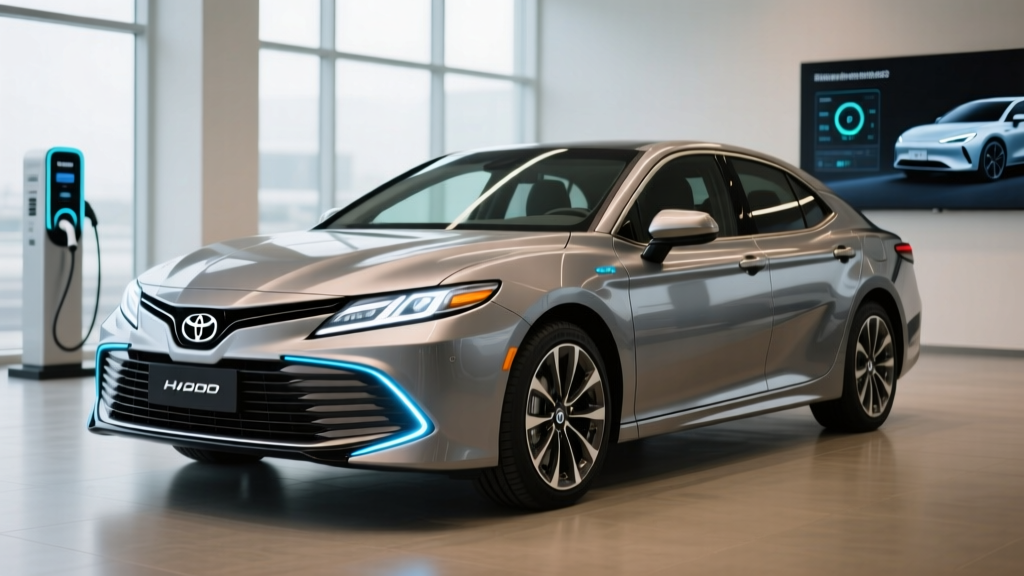
If you've been searching for a midsize hybrid sedan that delivers exceptional fuel economy without the plug-in complexity, the Toyota Camry Hybrid remains the segment benchmark. Now fully redesigned for the ninth generation, the 2026 Camry is offered exclusively as a hybrid—Toyota dropped the gas-only four-cylinder after 2024. For buyers tracking Camry Hybrid availability, this guide breaks down every trim, real-world MPG expectations, powertrain specs, warranty coverage, and whether you can actually find one on a dealer lot today.
Camry Hybrid Availability in 2026: What You Can Buy Right Now
Toyota has simplified the Camry Hybrid lineup for 2026, offering four trims across front-wheel drive (FWD) and electronic all-wheel drive (AWD) configurations. Unlike the previous generation, there is no plug-in hybrid (PHEV) variant—the Camry is a conventional hybrid electric vehicle (HEV), meaning it charges its battery through regenerative braking and the gasoline engine. You never plug it in.
| Trim | Drivetrain | MSRP | Availability Status |
|---|---|---|---|
| LE | FWD | $29,990 | Widely available |
| LE | AWD | $31,390 | Limited; 4–8 week wait |
| SE | FWD | $31,490 | Widely available |
| SE | AWD | $32,890 | Moderate supply |
| XLE | FWD | $34,490 | Widely available |
| XLE | AWD | $35,890 | Limited; 4–6 week wait |
| XSE | FWD | $35,990 | Widely available |
| XSE | AWD | $37,390 | Moderate supply |
AWD-equipped trims continue to face tighter allocation, a pattern that has persisted since Toyota introduced electronic AWD on the Camry. FWD models are generally in stock at most Toyota dealerships, particularly in the LE and XLE trims. Destination charges add approximately $1,195 to all prices listed above.
EPA MPG and Real-World Fuel Economy
The 2026 Camry Hybrid's fifth-generation Toyota Hybrid System delivers impressive EPA numbers, and in real-world driving, this sedan often exceeds its sticker—especially in city traffic where regenerative braking does the heavy lifting.
| Trim | Drivetrain | City MPG | Highway MPG | Combined MPG |
|---|---|---|---|---|
| LE | FWD | 53 | 50 | 51 |
| SE / XLE / XSE | FWD | 48 | 47 | 47 |
| All trims | AWD | 46 | 46 | 46 |
Real-world expectations: In mixed suburban and city driving, FWD LE owners consistently report 52–55 MPG, thanks to the hybrid system's efficiency at lower speeds and frequent stop-and-go regen opportunities. Highway-only driving at 75+ mph drops efficiency to approximately 42–45 MPG for the LE and 40–43 for SE/XLE/XSE trims (the larger wheels and sport-tuned suspension add rolling resistance). In cold weather (below 30°F), expect a 5–10% reduction as the engine runs more frequently to provide cabin heat and maintain battery temperature.
The LE trim's advantage comes from its lighter weight, lower-rolling-resistance tires, and the absence of sport-mode throttle mapping. If maximum MPG is your priority, the LE FWD is the clear choice. Source: fueleconomy.gov.
Powertrain Specs: Engine, Motors, and Horsepower
Every 2026 Camry Hybrid uses Toyota's fifth-generation hybrid powertrain, pairing a 2.5-liter Dynamic Force four-cylinder engine with electric motor-generators and a lithium-ion hybrid battery pack.
| Specification | FWD Models | AWD Models |
|---|---|---|
| Engine | 2.5L 4-cylinder DOHC | 2.5L 4-cylinder DOHC |
| Engine horsepower | 184 hp | 184 hp |
| Front electric motor | 134 hp | 134 hp |
| Rear electric motor (AWD) | N/A | 54 hp |
| Net combined horsepower | 225 hp | 232 hp |
| Transmission | eCVT | eCVT |
| 0–60 mph (est.) | ~7.1 seconds | ~6.9 seconds |
| Hybrid battery type | Lithium-ion | Lithium-ion |
| Hybrid battery capacity | ~1.1 kWh (usable) | ~1.1 kWh (usable) |
| Fuel tank | 13.2 gallons | 13.2 gallons |
| Total driving range | ~670 miles | ~607 miles |
The Camry Hybrid is a conventional hybrid (HEV). Its small ~1.1 kWh battery recharges through regenerative braking and the gas engine. There is no plug, no electric-only range to speak of (the car can creep short distances on electric power at very low speeds, typically under 1 mph), and no federal tax credit eligibility for plug-in vehicles. If you want plug-in capability with Toyota reliability, the RAV4 Prime (42 miles electric-only) or Prius Prime (44 miles electric-only) are Toyota's PHEV options—but neither is a midsize sedan.
Hybrid Battery Warranty and Long-Term Reliability
Battery longevity is the single most common concern among first-time hybrid buyers. Toyota addresses this with one of the strongest hybrid battery warranties in the industry.
• Hybrid battery: 10 years / 150,000 miles (whichever comes first)
• Hybrid system components (inverter, motor-generators, control module): 8 years / 100,000 miles
• Powertrain (engine, transmission): 5 years / 60,000 miles
• Basic bumper-to-bumper: 3 years / 36,000 miles
Note: In states that follow California Air Resources Board (CARB) emissions standards—CA, CO, CT, ME, MD, MA, NJ, NY, OR, RI, VT, WA—hybrid battery coverage extends to 10 years / 150,000 miles under PZEV provisions, which Toyota already meets nationwide for the Camry Hybrid.
Battery replacement cost: If the hybrid battery fails outside of warranty, a new OEM replacement from Toyota currently costs between $3,000 and $4,500 including labor, depending on the dealership and region. Third-party reconditioned batteries are available for $1,500–$2,500. However, Toyota's hybrid battery track record is exceptional—data from fleet operators and long-term owners shows that Camry Hybrid batteries routinely last 180,000–250,000 miles with minimal degradation. The lithium-ion pack in the ninth-generation model is smaller and less stressed than a full EV battery, contributing to its longevity.
Toyota's hybrid system has been in continuous production since 1997 (Prius), and the Camry Hybrid has used successive generations since 2007. The system is among the most proven electrified powertrains on the road. Toyota Camry Hybrid official page.
Does the Camry Hybrid Qualify for a Federal Tax Credit?
No. The 2026 Toyota Camry Hybrid does not qualify for the federal §30D Clean Vehicle Credit. That credit—up to $7,500—is reserved for plug-in electric vehicles (BEVs and PHEVs) that meet specific battery capacity, critical mineral sourcing, and MSRP/income requirements under current IRS rules.
Because the Camry Hybrid is a conventional HEV with no plug and a battery far below the 4 kWh minimum threshold for §30D eligibility, it is ineligible for the federal EV tax credit. This also means it does not qualify for most state-level EV rebates, which typically mirror the federal plug-in requirement.
What incentives might apply:
- Some states and local utilities offer small rebates ($250–$750) for purchasing any hybrid vehicle—check your state energy office or utility provider.
- Employer commuter benefit programs may offer hybrid purchase incentives.
- The lower purchase price ($29,990 base) and exceptional fuel economy (51 MPG combined for LE) deliver total cost of ownership advantages that often exceed the value of a one-time tax credit over a 5-year ownership period.
Camry Hybrid vs. Plug-In Hybrid vs. Full EV: Which Is Right for You?
The Camry Hybrid occupies a specific niche. Here's how to decide whether it's the right electrified vehicle for your situation.
• You don't have reliable access to home or workplace charging
• You want maximum simplicity—no plugs, no charging apps, no range planning
• You drive 15,000+ miles per year and want consistently low fuel costs
• You want a proven, reliable sedan with a 10-year battery warranty
• Your budget is $30,000–$38,000
Choose a PHEV (like the Prius Prime) if:
• You have home Level 2 charging and a commute under 40 miles
• You want to drive most days on electricity alone but need gas for road trips
• You qualify for the $7,500 federal tax credit (check income/MSRP/sourcing rules)
Choose a full EV (like the Tesla Model 3 or Hyundai Ioniq 6) if:
• You have reliable home charging (Level 2)
• Your daily driving is under 250 miles and you're comfortable with DC fast charging on road trips
• You want zero tailpipe emissions and the lowest per-mile energy cost
• You qualify for the federal tax credit and state EV incentives
Pros, Cons, and the Bottom Line
- 51 MPG combined (LE FWD) — best in the midsize sedan class
- No plug-in required; zero lifestyle change from a gas car
- 10-year / 150,000-mile hybrid battery warranty
- 225–232 hp provides confident highway merging
- Available AWD for snow-belt buyers
- Strong resale value; Toyota reliability track record
- ~670-mile total range (LE) eliminates fuel stops on road trips
- No federal tax credit eligibility
- AWD trims face limited availability and 4–8 week waits
- SE/XLE/XSE trims drop to 47 MPG combined (4 MPG less than LE)
- Highway MPG dips at sustained 75+ mph speeds
- No PHEV variant available (no electric-only driving)
- eCVT drone under hard acceleration (common to all Toyota hybrids)
Frequently Asked Questions
How many MPG does the 2026 Camry Hybrid get?
The FWD LE trim achieves 53 city / 50 highway / 51 combined MPG. The SE, XLE, and XSE FWD trims get 48/47/47 MPG. All AWD trims achieve 46/46/46 MPG. In real-world city driving, FWD LE owners frequently report 52–55 MPG.
Is the Camry Hybrid a plug-in vehicle?
No. The Camry Hybrid is a conventional hybrid (HEV). It does not have a plug and does not need to be charged externally. The hybrid battery recharges through regenerative braking and the gasoline engine. If you want a Toyota plug-in hybrid, look at the Prius Prime or RAV4 Prime.
How long will the Camry Hybrid battery last?
Toyota warranties the hybrid battery for 10 years or 150,000 miles. Real-world data from fleet and long-term owners shows Camry Hybrid batteries commonly lasting 180,000–250,000 miles. Replacement cost outside of warranty is $3,000–$4,500 for a new OEM battery.
Can I find a 2026 Camry Hybrid in stock now?
FWD trims (LE, SE, XLE, XSE) are widely available at most Toyota dealerships. AWD trims have more limited supply, with typical wait times of 4–8 weeks depending on your market. Check Toyota's inventory search tool or contact local dealers for specific availability.
Does the Camry Hybrid qualify for any tax credits?
The Camry Hybrid does not qualify for the federal §30D Clean Vehicle Credit because it is not a plug-in vehicle. Some state utilities offer small hybrid purchase rebates ($250–$750). The vehicle's low purchase price and exceptional fuel economy deliver strong total cost of ownership regardless.
How far can the Camry Hybrid drive on a full tank?
The FWD LE trim, with its 13.2-gallon fuel tank and 51 MPG combined rating, can travel approximately 670 miles between fill-ups. AWD models achieve roughly 607 miles per tank. Real-world range varies with driving style and conditions.