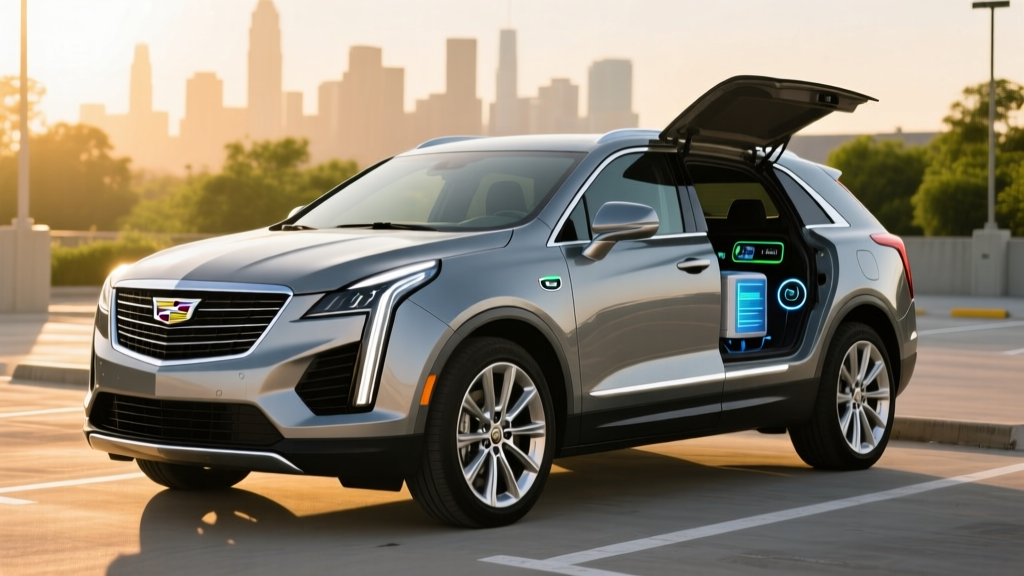
The Cadillac XT5 has long been a staple in the luxury compact SUV segment, but as buyers increasingly search for a Cadillac XT5 hybrid, the reality of what's actually available deserves a clear-eyed look. For the 2026 model year, Cadillac does not offer a conventional hybrid (HEV) or plug-in hybrid (PHEV) variant of the XT5. The XT5 continues with its turbocharged gasoline powertrain while Cadillac channels its electrification strategy into fully electric models like the Lyriq and the upcoming Optiq.
If you've landed here researching a Cadillac XT5 hybrid, this guide will give you the exact specs on the current XT5 powertrain, explain why Cadillac skipped a hybrid variant, walk you through the closest electrified alternatives from GM and rival luxury brands, and help you decide whether a PHEV, HEV, or full BEV actually fits your driving pattern.
Does a Cadillac XT5 Hybrid Exist for 2026?
The short answer: No. The 2026 Cadillac XT5 is offered exclusively with a 2.0-liter turbocharged four-cylinder engine paired with a 9-speed automatic transmission and a mild-hybrid assist system (GM's eBoost). This is not a true hybrid in the way Toyota or Honda use the term. The eBoost system uses a small belt-driven motor-generator primarily to smooth stop-start transitions and provide marginal torque fill — it cannot propel the vehicle on electric power alone, nor does it meaningfully improve fuel economy the way a full parallel or series-parallel hybrid system does.
| Specification | Value |
|---|---|
| Engine | 2.0L Turbocharged I-4 |
| Horsepower | 235 hp @ 5,000 rpm |
| Torque | 258 lb-ft @ 1,500-4,000 rpm |
| Transmission | 9-speed automatic |
| Drivetrain | FWD standard; AWD available |
| Mild-Hybrid Assist | eBoost (belt-driven motor-generator) |
| EPA MPG (FWD) | 22 city / 29 highway / 24 combined |
| EPA MPG (AWD) | 21 city / 27 highway / 23 combined |
| Fuel Tank Capacity | 19.4 gallons |
| Total Range (FWD est.) | ~466 miles |
| Base MSRP (Luxury FWD) | $45,990 |
| 0-60 mph (est.) | ~7.5 seconds |
The eBoost system is worth understanding because it causes confusion. Unlike a Toyota RAV4 Hybrid, which can drive short distances on electric power and recaptures significant energy through regenerative braking, the XT5's eBoost provides no electric-only driving capability and no measurable MPG improvement over a conventional turbo-four. Think of it as a refined alternator, not a hybrid powertrain.
Understanding HEV vs PHEV: What Cadillac Buyers Should Know
Before evaluating alternatives, it's essential to distinguish the three types of electrified vehicles you'll encounter in your search:
| Feature | HEV (Conventional Hybrid) | PHEV (Plug-In Hybrid) | BEV (Battery Electric) |
|---|---|---|---|
| Plugs in? | No — charges via regen & engine | Yes — plus regen & engine | Yes — only electric |
| Electric-only range | None (motor assists only) | 20-45 miles typical | 200-400+ miles |
| Gas engine | Yes — primary + secondary power | Yes — kicks in after battery depletes | None |
| Battery size | 1-2 kWh | 12-25 kWh | 60-120+ kWh |
| Fueling | Gasoline only | Gasoline + electricity | Electricity only |
| Federal tax credit (§30D) | No | Up to $7,500 (if eligible) | Up to $7,500 (if eligible) |
| Example | Toyota RAV4 Hybrid | BMW X5 xDrive50e | Cadillac Lyriq |
The XT5's eBoost system doesn't qualify under any of these categories as a true hybrid. If fuel economy is your priority, you'll need to look beyond the XT5's current powertrain.
Real-World MPG: How the XT5 Actually Performs
The EPA rates the 2026 XT5 FWD at 22 city / 29 highway / 24 combined MPG (fueleconomy.gov). In real-world mixed driving, owners typically report numbers close to the EPA combined figure — around 23-25 MPG — with highway-heavy commutes occasionally touching 28-30 MPG on flat terrain at steady speeds.
For context, here's how the XT5's efficiency stacks up against hybrid competitors in the luxury compact SUV segment:
| Vehicle | Powertrain | EPA City | EPA Highway | EPA Combined | Electric-Only Range |
|---|---|---|---|---|---|
| 2026 Cadillac XT5 (FWD) | 2.0T Turbo I-4 + eBoost | 22 | 29 | 24 | None |
| 2026 Lexus NX 350h (AWD) | 2.5L HEV | 41 | 37 | 39 | None |
| 2026 BMW X5 xDrive50e | 3.0L I-6 PHEV | N/A (MPGe: 56) | N/A | 22 (gas only) | ~38 miles |
| 2026 Lincoln Corsair Grand Touring | 2.5L PHEV | N/A (MPGe: 78) | N/A | 33 (gas only) | ~28 miles |
| 2026 Genesis GV60 (AWD) | BEV | N/A | N/A | 97 MPGe | 248 miles |
The gap is substantial. The Lexus NX 350h delivers 39 MPG combined — a 62% improvement over the XT5 — while the BMW X5 xDrive50e lets you cover 38 miles on electricity before the gas engine engages. These are the efficiency benchmarks a hypothetical XT5 hybrid would need to compete against.
Cadillac's Electrified Alternatives: Lyriq and Optiq
GM's strategy for Cadillac has been unambiguous: skip hybrids and go straight to full electric. The result is that Cadillac buyers seeking electrification have two in-brand options for 2026:
Cadillac Lyriq (BEV)
The Lyriq is Cadillac's production electric SUV, built on GM's Ultium platform. It offers an EPA-estimated 314 miles of range (RWD), a 102 kWh usable battery, DC fast charging up to 190 kW (10-80% in approximately 30 minutes), and 340 horsepower in the single-motor RWD configuration. Pricing starts at approximately $58,590 for 2026, and it qualifies for the full §30D federal tax credit of up to $7,500 for eligible buyers (subject to income caps of $150,000 single / $300,000 joint and battery sourcing requirements).
Cadillac Optiq (BEV — Compact)
The Optiq, Cadillac's smaller electric crossover, slots below the Lyriq and targets buyers in the XT5's size and price bracket. With a starting MSRP closer to the XT5's range, the Optiq is arguably the closest thing to an "electrified XT5" that Cadillac offers.
The tradeoff is clear: if you want a Cadillac badge with electrification, you're committing to a full BEV — there's no halfway step with a PHEV or HEV.
Closest Hybrid & PHEV Alternatives to the XT5
If hybrid efficiency matters more than the Cadillac badge, several luxury compact SUVs fill the gap the XT5 leaves open:
Lexus NX 350h (HEV)
The segment benchmark. 39 MPG combined, standard AWD, 240 combined horsepower, and a starting MSRP around $44,000. The hybrid battery carries a 10-year/150,000-mile warranty. No plug-in required — it charges itself through regenerative braking and engine power. Real-world city driving often exceeds the EPA rating thanks to the hybrid system's efficiency in stop-and-go traffic.
BMW X5 xDrive50e (PHEV)
A larger SUV but a compelling option if you want electric commuting with gas flexibility. Approximately 38 miles of electric-only range, 483 combined horsepower, and an 8-speed automatic. The 25.7 kWh battery (usable ~22 kWh) charges via Level 2 in roughly 3.5 hours. No DC fast charging. Base MSRP near $73,000 — a significant step up from the XT5, but the PHEV system may qualify for the §30D credit depending on battery sourcing compliance.
Lincoln Corsair Grand Touring (PHEV)
A direct XT5 competitor in size and luxury positioning. The PHEV variant offers ~28 miles of electric-only range, 266 combined horsepower, and starts around $52,000. It charges on Level 2 in about 3-4 hours. The smaller battery and shorter electric range make it best for short commutes with occasional longer trips.
Reasons to Still Choose the Gas XT5
- Lower starting MSRP ($45,990) than most hybrid/PHEV luxury rivals
- Proven 2.0T powertrain with wide dealer service network
- Strong highway cruising comfort and quiet cabin
- No charging infrastructure needed
- Cadillac's Super Cruise (Level 2 ADAS) available on higher trims
Reasons to Look Elsewhere
- 24 MPG combined trails hybrid rivals by 15+ MPG
- No electric-only driving capability
- No federal tax credit eligibility for hybrid or EV incentives
- GM has signaled no hybrid XT5 variant is planned
- Higher annual fuel cost vs. HEV/PHEV alternatives
Tax Credit Reality: What You Can and Cannot Claim
Because the 2026 Cadillac XT5 is not a hybrid or plug-in hybrid — it's a conventional gasoline vehicle with mild-hybrid assist — it does not qualify for the IRS §30D New Clean Vehicle Credit. This credit applies only to BEVs and PHEVs that meet specific requirements:
§30D Federal Tax Credit Eligibility Checklist (2026)
- Vehicle type: Must be a new BEV or PHEV (HEVs and mild hybrids excluded)
- MSRP cap: SUVs must be under $80,000; sedans under $55,000
- Buyer income cap: AGI ≤ $150,000 (single) / $225,000 (HOH) / $300,000 (joint)
- Battery sourcing: Critical minerals and battery components must meet phased-in domestic/free-trade sourcing thresholds
- Point-of-sale transfer: Eligible buyers can apply the credit as a down payment reduction at the dealer
- Assembly: Final assembly must occur in North America
Source: IRS.gov — Credits for New Clean Vehicles. Eligibility rules change; consult a tax professional before purchase.
If you want a Cadillac with tax-credit eligibility, the Lyriq is your path. If you want a PHEV with potential credit eligibility, the BMW X5 xDrive50e or Lincoln Corsair Grand Touring are candidates — though battery component sourcing rules can disqualify specific model years, so always verify at the point of purchase.
Reliability, Battery Warranty, and Long-Term Costs
For the conventional XT5, long-term reliability follows GM's 2.0T turbo engine track record, which has been generally solid in the Cadillac CT4, CT5, and GMC Acadia applications. The standard powertrain warranty covers 6 years / 70,000 miles, and the eBoost mild-hybrid components fall under this coverage.
For hybrid alternatives, battery longevity is the top buyer concern — and it's worth addressing with data:
| Vehicle | Hybrid Battery Warranty | Estimated Replacement Cost |
|---|---|---|
| Lexus NX 350h | 10 years / 150,000 miles | $3,000-$5,000 |
| BMW X5 xDrive50e | 8 years / 80,000 miles | $10,000-$16,000 (PHEV battery) |
| Lincoln Corsair PHEV | 8 years / 100,000 miles | $7,000-$10,000 |
| Cadillac Lyriq (BEV) | 8 years / 100,000 miles | $12,000-$18,000 (full pack) |
Toyota and Lexus hybrid batteries have demonstrated exceptional longevity in real-world use, with many exceeding 200,000 miles before significant degradation. BMW and Lincoln PHEV batteries carry shorter warranty periods but are larger and more expensive to replace. For most buyers who plan to own their vehicle 5-8 years, the battery will remain well within warranty coverage.
Who Should Choose What: A Decision Framework
Which Vehicle Fits Your Situation?
Choose the gas Cadillac XT5 if: You want a luxury compact SUV under $50K, you drive mostly highway miles where hybrid advantages shrink, you have no home charging access, and the Cadillac brand and Super Cruise availability matter to you.
Choose the Lexus NX 350h (HEV) if: You want maximum MPG without plugging in, you do a lot of city driving where hybrids shine (real-world often beats EPA), you want a proven 10-year hybrid battery warranty, and you can live without the Cadillac badge.
Choose the BMW X5 xDrive50e (PHEV) if: You have home Level 2 charging, your daily commute is under 35 miles (covering it on electric), you want 483 hp when the gas engine kicks in, and you take longer road trips where BEV range anxiety is a concern.
Choose the Cadillac Lyriq (BEV) if: You want to stay in the Cadillac family, you have reliable home charging, your daily driving is under 250 miles, you want the lowest per-mile fuel cost, and you qualify for the $7,500 federal tax credit.
Frequently Asked Questions
How many MPG does the 2026 Cadillac XT5 get?
The EPA rates the 2026 XT5 at 22 city / 29 highway / 24 combined MPG with front-wheel drive, and 21 city / 27 highway / 23 combined with all-wheel drive. Real-world results generally track close to these figures, with highway-heavy driving occasionally reaching 28-30 MPG on flat terrain.
Is there a plug-in hybrid Cadillac XT5?
No. Cadillac does not offer a PHEV variant of the XT5 for 2026 or any prior model year. GM has directed Cadillac's electrification strategy toward fully electric vehicles (Lyriq, Optiq) rather than plug-in hybrids.
Does the Cadillac XT5 qualify for any federal tax credit?
No. The XT5 is a gasoline vehicle with mild-hybrid assist (eBoost), which does not meet the IRS §30D definition of a qualified clean vehicle. Only BEVs and PHEVs are eligible for the federal tax credit, subject to MSRP caps, income limits, and battery sourcing requirements.
What is the closest hybrid alternative to the Cadillac XT5?
The Lexus NX 350h is the closest competitor in size, luxury positioning, and price — and it delivers 39 MPG combined as a conventional hybrid. For a plug-in hybrid, the Lincoln Corsair Grand Touring offers similar luxury with ~28 miles of electric-only range.
Is the XT5's eBoost system a real hybrid?
No. The eBoost system is a belt-driven mild-hybrid assist that smooths the stop-start function and provides minor torque fill during acceleration. It cannot propel the vehicle on electric power alone and does not significantly improve fuel economy. It is not comparable to a Toyota, Honda, or Hyundai full hybrid system.
How long do hybrid batteries last, and what does replacement cost?
Most hybrid batteries are warranted for 8-10 years / 100,000-150,000 miles. Toyota/Lexus hybrid batteries routinely last 200,000+ miles in real-world use. Replacement costs range from $3,000-$5,000 for a conventional hybrid (like the NX 350h) to $10,000-$16,000 for a PHEV battery (like the BMW X5). By the time replacement is needed, aftermarket and refurbished options typically reduce costs further.
Hybrid vs PHEV vs EV — which should I buy?
Choose a conventional hybrid (HEV) if you want better MPG with zero lifestyle change — no plugging in, no range planning. Choose a PHEV if you have home charging and a short commute you can cover on electricity, plus the flexibility of a gas engine for longer trips. Choose a BEV if you want the lowest operating cost, have reliable charging access, and your daily driving falls within the vehicle's range. For most buyers with home charging, a PHEV offers the best of both worlds; for those without, an HEV is the practical choice.
Editorial note: Specifications reflect 2026 model year data as published by Cadillac and the EPA. Tax credit eligibility is subject to change; verify current rules at IRS.gov and consult a tax professional before making purchase decisions based on incentive availability. Real-world MPG and range figures are estimates based on aggregated owner reports and independent testing; individual results vary with driving style, climate, and terrain.