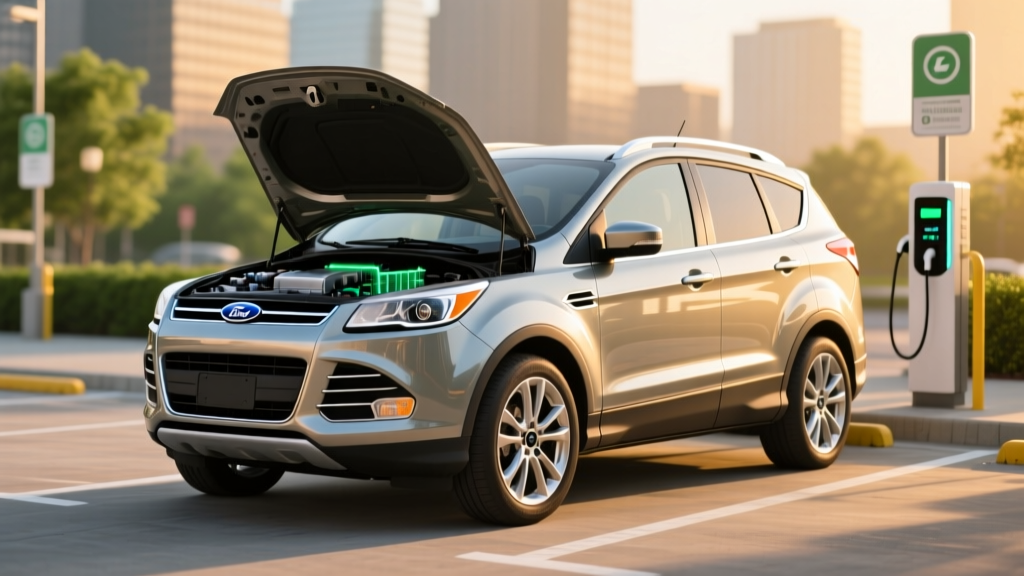
The 2012 Ford Escape Hybrid was the last model year of Ford's first-generation hybrid SUV before the nameplate transitioned to the redesigned 2013 Escape (which dropped the hybrid option until later generations). For used-car shoppers searching for a 2012 Ford hybrid SUV, the Escape Hybrid remains a practical, proven commuter with exceptional city fuel economy and a well-understood powertrain. But at over a decade old, battery health and replacement cost become the central ownership questions.
This guide covers everything a 2026 used buyer needs to know: real-world MPG versus EPA stickers, the hybrid battery's expected lifespan, what a replacement costs, and whether a 14-year-old hybrid SUV still makes financial sense compared to a newer hybrid, plug-in hybrid, or full EV.
What Exactly Is the 2012 Ford Escape Hybrid?
The 2012 Escape Hybrid is a conventional hybrid electric vehicle (HEV) — not a plug-in hybrid (PHEV). This distinction matters because it shapes every aspect of ownership.
HEV vs PHEV: Key Differences
| Feature | Conventional Hybrid (HEV) | Plug-In Hybrid (PHEV) |
|---|---|---|
| Plug-in charging? | No — refuels with gas only | Yes — plugs into Level 1 or Level 2 |
| Electric-only range | Less than 1 mile at very low speed | 20–50 miles typically |
| Battery size | 1.0–2.0 kWh (small) | 10–30 kWh (large) |
| Federal tax credit (new) | None | Up to $7,500 (§30D, subject to rules) |
| Primary fuel | Gasoline (electric assists) | Electricity + gasoline |
The 2012 Escape Hybrid uses a 1.8 kWh nickel-metal hydride (NiMH) battery pack — far smaller than any modern PHEV or BEV. It cannot be plugged in. The battery recharges through regenerative braking and the gasoline engine. You simply fill it with regular unleaded and drive.
EPA Fuel Economy and Real-World MPG
Ford's 2.5-liter Atkinson-cycle four-cylinder paired with an electric motor and eCVT transmission was optimized for city efficiency, where regenerative braking recovers the most energy.
| Drivetrain | City MPG | Highway MPG | Combined MPG |
|---|---|---|---|
| FWD (2012 Escape Hybrid) | 34 | 31 | 32 |
| AWD (2012 Escape Hybrid) | 31 | 29 | 30 |
| 2012 Escape Gas (2.5L I4, FWD) | 22 | 31 | 25 |
Source: EPA Fuel Economy
Real-World MPG vs. EPA Sticker
Hybrids routinely exceed their EPA city estimate in stop-and-go traffic because regenerative braking works hardest at low speeds. Owners on Fuelly report real-world averages of 29–33 MPG combined for the FWD model, with some drivers consistently achieving 35+ MPG in urban commuting. Highway driving at sustained 70+ MPH typically yields 28–30 MPG — slightly below the EPA highway figure, as aerodynamic drag dominates and the electric motor provides less benefit.
With a 16.5-gallon fuel tank, expect a real-world range of approximately 480–540 miles per tank depending on driving mix.
Powertrain Specifications
| Specification | 2012 Ford Escape Hybrid |
|---|---|
| Engine | 2.5L Atkinson-cycle I4 |
| Engine horsepower | 156 HP @ 6,000 RPM |
| Electric motor | AC synchronous permanent-magnet |
| Combined system output | 177 HP |
| Transmission | eCVT (electronically controlled CVT) |
| Hybrid battery | 1.8 kWh NiMH (nickel-metal hydride) |
| Drivetrain options | FWD or AWD (eAWD with rear electric motor) |
| 0–60 MPH | ~9.8 seconds (FWD) |
| Curb weight | ~3,820 lbs (FWD) |
| Towing capacity | 1,000 lbs (not rated for heavy towing) |
The AWD version uses a unique eAWD system: a second electric motor on the rear axle provides all-wheel drive without a mechanical driveshaft. This is elegant engineering but adds complexity. If you live in a snowy climate, the eAWD system is effective for light traction needs but isn't a substitute for a dedicated off-road SUV.
Hybrid Battery Lifespan, Warranty, and Replacement Cost
This is the single biggest concern for any used-hybrid buyer, and it's the question that determines whether a 2012 Escape Hybrid is a bargain or a money pit.
Original Battery Warranty
Ford covered the 2012 Escape Hybrid battery with an 8-year / 100,000-mile warranty (extended to 10 years / 150,000 miles in California and states that follow CARB emissions rules). As of 2026, the original warranty has expired for every 2012 model regardless of mileage.
How Long Does the NiMH Battery Actually Last?
Nickel-metal hydride batteries, while less energy-dense than modern lithium-ion packs, are remarkably durable in hybrid applications. The 2012 Escape Hybrid's battery operates in a narrow state-of-charge window (roughly 40–60% SoC), which dramatically reduces stress and degradation. This is fundamentally different from a full EV battery that cycles between 10% and 90%+ regularly.
Based on fleet data, owner reports, and hybrid technician experience:
- Typical lifespan: 150,000–200,000 miles before noticeable capacity loss
- Failure pattern: Gradual degradation (MPG slowly drops 2–4 MPG over years), not sudden failure
- Age factor: At 14 years old, calendar aging is a real concern even on low-mileage examples. NiMH cells lose capacity with time regardless of use
Battery Replacement Cost (2026 Estimates)
| Option | Cost Range | Notes |
|---|---|---|
| New OEM battery (Ford dealer) | $3,500–$5,000 | Includes parts and labor; availability may be limited for 2012 model |
| Remanufactured battery | $1,800–$3,000 | Third-party suppliers; common choice for older hybrids |
| Used/salvage battery | $500–$1,200 | From a wrecked Escape Hybrid; gamble on remaining life |
| Individual cell replacement | $400–$800 | Specialty hybrid shops can replace only failed cells |
If you're buying a 2012 Escape Hybrid today, budget $2,000–$3,500 for a potential battery replacement within the first few years of ownership. Many examples still have functional original batteries, but at this age, it's a matter of when, not if.
Pre-Purchase Battery Health Check
Before purchasing any used hybrid, have the battery's state of health (SoH) evaluated. Options include:
- A Ford dealer diagnostic scan that reads individual cell voltages and internal resistance
- An independent hybrid specialist with a scan tool capable of reading the battery management system (BMS)
- A simple OBD-II reader with hybrid-specific apps (e.g., FORScan) that can pull battery data from the vehicle's modules
Look for cell voltage variance of less than 0.2V across all modules. Higher variance signals an imbalanced pack heading toward failure.
Is the 2012 Escape Hybrid Reliable?
The 2012 Escape Hybrid's powertrain — the 2.5L Atkinson-cycle engine and eCVT — is one of Ford's most reliable hybrid systems. The eCVT has no traditional belts, clutches, or fixed gear ratios; it uses a planetary gearset that is mechanically simple and durable. Many examples have exceeded 200,000 miles with only the battery as a major service item.
Common issues reported by owners and mechanics:
- Hybrid battery degradation (expected at this age, as discussed above)
- Brake actuator assembly: The regenerative braking system uses an electrohydraulic brake actuator that can fail around 120,000–150,000 miles. Replacement: $1,200–$1,800
- Electric power steering (EPS): Some 2008–2012 Escape Hybrids have had EPS motor failures; check for any recalls or prior replacement
- Cooling system: The hybrid battery has its own cooling fan and duct; keep the rear-seat area vent clear of debris to prevent battery overheating
For a deeper look at reliability and crash-test data, consult NHTSA's 2012 Escape Hybrid page for recalls and consumer complaints.
Pricing and Tax Credit Eligibility (2026 Used Market)
What Does a 2012 Escape Hybrid Cost Today?
| Condition / Mileage | Typical Asking Price (2026) |
|---|---|
| Excellent, under 100K miles | $7,500–$9,500 |
| Good, 100K–150K miles | $5,000–$7,500 |
| Fair, 150K+ miles or needs battery | $3,000–$5,000 |
Does It Qualify for Any Tax Credit?
No. The 2012 Escape Hybrid does not qualify for any federal tax credit in 2026. Here's why:
- The §30D federal tax credit applies only to the purchase of new qualifying plug-in electric vehicles (BEVs and PHEVs) — conventional hybrids have never been eligible
- The used EV tax credit (§25E, up to $4,000) applies only to used BEVs and PHEVs with plug-in capability — a conventional HEV does not qualify
- The original hybrid vehicle tax credit that existed pre-2010 (up to $3,000 for the Escape Hybrid) expired long ago and was only available to original purchasers
- Some state-level programs offer rebates for hybrids, but these typically apply to new purchases only. Check your state's current incentive programs
For current federal incentive rules, always reference IRS.gov §30D guidance.
2012 Escape Hybrid vs. Alternatives: Which Fits You?
The 2012 Escape Hybrid occupies a specific niche: an affordable, fuel-efficient used SUV for buyers who can't charge at home and want zero lifestyle change compared to a gas car. Here's how it stacks up against the alternatives a 2026 shopper might consider.
Choose the 2012 Escape Hybrid If:
- Your budget is under $8,000 and you want hybrid fuel economy
- You don't have access to home or workplace charging (apartment, street parking)
- Your commute is primarily city/suburban stop-and-go driving (where hybrids shine)
- You want a simple ownership experience — just add gas, no plugs or apps
- You accept the risk of a $2,000–$3,500 battery replacement
Choose a Newer PHEV (e.g., 2020+ Ford Escape PHEV) If:
- You can install a Level 2 charger at home
- Your daily commute is under 37 miles (the Escape PHEV's EPA electric-only range)
- You want to drive mostly on electricity with gas backup for road trips
- You want a vehicle still under factory warranty
Choose a Full EV (e.g., used Chevrolet Bolt, Hyundai Kona Electric) If:
- You have reliable home charging
- You want the lowest per-mile fuel cost (~$0.04/mile on electricity vs. ~$0.12/mile in the Escape Hybrid at 32 MPG and $3.50/gal)
- You want minimal maintenance (no oil changes, no transmission fluid, far fewer moving parts)
- You don't regularly drive more than 200 miles in a single day
Pros and Cons of the 2012 Ford Escape Hybrid
Pros
- 34 MPG city EPA — excellent for an SUV of this era
- No plug-in required; zero infrastructure investment
- eCVT is mechanically robust with very low failure rates
- AWD available with eAWD rear motor (no mechanical drivetrain loss)
- Low purchase price on the used market ($5K–$8K for good examples)
- Strong parts availability; well-understood platform
Cons
- 14-year-old NiMH battery is near or past expected lifespan
- No federal or state tax credit eligibility
- Slow acceleration (~9.8 sec 0–60) — not ideal for highway merging
- Dated interior tech; no modern ADAS features (no AEB, no lane-keep)
- Limited towing capacity (1,000 lbs)
- Brake actuator replacement can be expensive ($1,200–$1,800)
Frequently Asked Questions
How many MPG does the 2012 Ford Escape Hybrid get?
The EPA rates the FWD 2012 Escape Hybrid at 34 city / 31 highway / 32 combined MPG. The AWD version is rated at 31 city / 29 highway / 30 combined. In real-world city driving, many owners report achieving 33–36 MPG thanks to aggressive regenerative braking at low speeds. Highway driving at 70+ MPH typically returns 28–30 MPG.
Does the 2012 Escape Hybrid need to be plugged in?
No. The 2012 Escape Hybrid is a conventional hybrid (HEV), not a plug-in hybrid. It charges its small 1.8 kWh battery through regenerative braking and the gasoline engine. You never plug it in — just fill it with regular 87-octane gasoline.
Is the 2012 Ford Escape Hybrid reliable?
The powertrain (2.5L Atkinson-cycle engine and eCVT) is among Ford's most reliable hybrid systems, with many examples exceeding 200,000 miles. The main reliability concern at this age is the hybrid battery, which will likely need replacement if it hasn't been replaced already. The brake actuator and electric power steering are other known wear items. Check NHTSA data for specific recalls and complaints.
How much does it cost to replace the hybrid battery?
A remanufactured replacement battery costs $1,800–$3,000 installed. A new OEM battery from Ford runs $3,500–$5,000, though availability may be limited. Individual cell replacement at a specialty hybrid shop costs $400–$800 if only a few cells have failed.
Does the 2012 Escape Hybrid qualify for any tax credit in 2026?
No. The federal §30D tax credit and the used EV credit (§25E) both require plug-in electric vehicles (BEVs or PHEVs). A conventional hybrid like the Escape Hybrid does not qualify. The original hybrid tax credit available at purchase expired years ago and applied only to the original buyer.
Hybrid vs. PHEV vs. EV — which should I buy?
Choose a conventional hybrid (like the 2012 Escape Hybrid) if you can't charge at home and want an affordable, efficient gas-powered SUV with no lifestyle change. Choose a PHEV if you can charge at home and want 20–40 miles of electric commuting with gas backup for long trips. Choose a full EV if you have home charging, want the lowest running costs, and your daily driving is under 200 miles.
What should I check before buying a used 2012 Escape Hybrid?
Prioritize a hybrid battery health scan (cell voltage variance under 0.2V), verify the brake actuator hasn't been replaced or is functioning properly, check for any outstanding NHTSA recalls, and review maintenance records for regular engine oil changes and coolant service. A pre-purchase inspection at a hybrid-experienced shop is strongly recommended.
Final Verdict for 2026 Buyers
The 2012 Ford Escape Hybrid is a rational, budget-conscious choice for a used hybrid SUV — if you price in the near-certainty of a battery replacement and don't expect modern safety technology or quick acceleration. At $5,000–$8,000 for a well-maintained example, it delivers 30+ MPG in an SUV package with no charging infrastructure required. Just enter the transaction with eyes open: this is a 14-year-old vehicle whose most expensive component is on borrowed time. Budget accordingly, and it can be a dependable, fuel-sipping daily driver for years to come.