The State of Cadillac Hybrid and Electrified Options in 2026
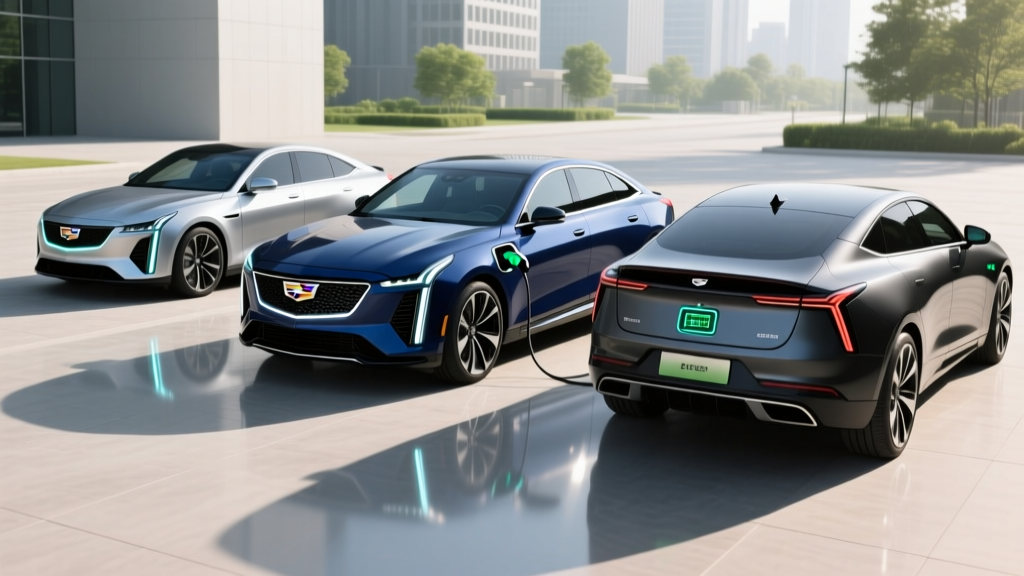
If you are searching for a Cadillac hybrid, the brand's current lineup requires some unpacking. Unlike Toyota or Hyundai, which offer dedicated hybrid variants across multiple nameplates, Cadillac has pursued a different electrification strategy for 2026: a pivot toward full battery-electric vehicles (BEVs) under the Lyriq, Optiq, and Escalade IQ badges, while maintaining conventional mild-hybrid assist on its remaining internal-combustion models. As of the 2026 model year, Cadillac does not sell a traditional full hybrid (HEV) or plug-in hybrid (PHEV) in the United States. The CT5 and XT6 continue with mild-hybrid systems that provide marginal efficiency gains but cannot drive on electric power alone.
This guide breaks down exactly what Cadillac offers today, how mild-hybrid systems differ from full HEVs and PHEVs, and whether a Cadillac electrified vehicle—or a competitor's hybrid—better fits your needs.
HEV vs PHEV vs Mild Hybrid: What Cadillac Actually Sells
Conventional Hybrid (HEV): Uses a gasoline engine paired with an electric motor and a small battery (typically 1–2 kWh). The battery recharges through regenerative braking and the engine—no plug required. Examples: Toyota RAV4 Hybrid, Honda CR-V Hybrid.
Plug-in Hybrid (PHEV): Larger battery (typically 15–25 kWh) that can be plugged in to charge. Offers 20–50 miles of electric-only driving before the gas engine engages. Examples: Toyota RAV4 Prime, Jeep Wrangler 4xe.
Mild Hybrid (MHEV): A small 48-volt system that assists the gas engine during acceleration and enables smoother stop-start. Cannot propel the vehicle on electric power alone. Battery capacity is under 1 kWh. This is what Cadillac currently uses on models like the XT6.
| Model | Powertrain Type | Engine | Combined HP | EPA MPG (City/Hwy/Combined) | Electric-Only Range | Starting MSRP |
|---|---|---|---|---|---|---|
| 2026 Cadillac CT5 (2.0T) | Mild Hybrid (48V) | 2.0L Turbo I4 | 237 hp | 23 / 33 / 26 | None | $39,990 |
| 2026 Cadillac XT6 (3.6L V6) | Mild Hybrid (48V) | 3.6L V6 | 310 hp | 21 / 27 / 23 | None | $50,595 |
| 2026 Cadillac Lyriq | Full EV (BEV) | Single/Dual Motor | 340–500 hp | 315 mi EPA range | 315 mi | $58,590 |
| 2026 Cadillac Optiq | Full EV (BEV) | Dual Motor AWD | 300 hp (est.) | ~300 mi EPA range (est.) | ~300 mi | ~$54,000 (est.) |
| 2026 Cadillac Escalade IQ | Full EV (BEV) | Dual Motor AWD | 680–750 hp | ~450 mi EPA range (est.) | ~450 mi | $130,000 (est.) |
How Many MPG Does a Cadillac Hybrid Get?
Because Cadillac's 2026 gasoline models use mild-hybrid systems rather than full hybrid powertrains, the MPG gains are modest compared to dedicated HEVs from competitors. The 2026 Cadillac CT5 2.0T with its 48-volt mild-hybrid assist achieves an EPA-estimated 23 city / 33 highway / 26 combined MPG. In real-world mixed driving, owners typically report between 24 and 27 MPG combined, with highway-heavy commutes occasionally reaching the low 30s.
The 2026 Cadillac XT6 with the 3.6L V6 and mild-hybrid system returns 21 city / 27 highway / 23 combined MPG. Real-world figures for this three-row SUV tend to land between 21 and 24 MPG combined. For comparison, the three-row Toyota Grand Highlander Hybrid achieves 36 combined MPG—illustrating the gap between mild-hybrid assist and a full hybrid powertrain.
| Vehicle | Type | City MPG | Highway MPG | Combined MPG |
|---|---|---|---|---|
| 2026 Cadillac CT5 2.0T | Mild Hybrid | 23 | 33 | 26 |
| 2026 Cadillac XT6 3.6L | Mild Hybrid | 21 | 27 | 23 |
| 2026 Lexus ES 300h | Full HEV | 43 | 44 | 44 |
| 2026 Toyota Grand Highlander Hybrid | Full HEV | 36 | 36 | 36 |
| 2026 Lincoln Corsair Grand Touring | PHEV | 33 combined (gas) / 80 MPGe | — | 28 mi electric-only |
Source: fueleconomy.gov, EPA estimates. Real-world results vary by driving style, terrain, and climate.
Cadillac's Mild-Hybrid Powertrain: Under the Hood
The 48-volt mild-hybrid system in the CT5 and XT6 is not a powertrain you choose for fuel savings alone. Its primary function is refinement: the small belt-driven motor-generator smooths out the engine's stop-start transitions, provides a minor torque fill during initial acceleration (roughly 10–15 lb-ft of supplemental torque), and enables brief engine-off coasting at highway speeds to reduce parasitic drag.
CT5 2.0T Mild-Hybrid Specs:
- 2.0L turbocharged inline-4: 237 hp, 258 lb-ft
- 48V motor-generator: ~15 lb-ft supplemental torque
- 10-speed automatic transmission
- 0–60 mph: approximately 6.2 seconds
XT6 3.6L Mild-Hybrid Specs:
- 3.6L naturally aspirated V6: 310 hp, 271 lb-ft
- 48V motor-generator: ~15 lb-ft supplemental torque
- 9-speed automatic transmission
- 0–60 mph: approximately 7.1 seconds
Neither system can propel the vehicle without the gasoline engine running. If you need electric-only driving capability, you must look at Cadillac's full EV lineup or a competitor's PHEV.
Does Any Cadillac Qualify for a Federal Tax Credit?
Federal Tax Credit Status (2026): Cadillac's mild-hybrid gasoline models (CT5, XT6) do not qualify for the IRS §30D Clean Vehicle Credit. That credit applies only to plug-in vehicles—PHEVs with at least 7 kWh of battery capacity or full BEVs.
For Cadillac's full EV lineup:
- Lyriq: May qualify for up to $7,500 under §30D, depending on battery-component and critical-mineral sourcing compliance, buyer income caps ($150K single / $300K joint AGI), and the vehicle's MSRP staying under the $80,000 SUV cap. Point-of-sale transfer is available if eligible. Verify current eligibility at IRS.gov.
- Optiq (announced): Credit eligibility TBD pending final battery sourcing confirmation.
- Escalade IQ: MSRP exceeds $80,000, which likely disqualifies it from §30D regardless of sourcing compliance.
Tax credit rules change frequently. Consult a tax professional before relying on credit eligibility for your purchase decision.
Battery Warranty and Reliability: What Cadillac Owners Should Expect
Mild-Hybrid Battery (CT5/XT6): The 48-volt mild-hybrid battery is a small lithium-ion unit (under 1 kWh) integrated into the powertrain. It is covered under Cadillac's standard powertrain warranty of 6 years / 70,000 miles. Because the battery is small and operates within a narrow state-of-charge window, degradation is minimal, and replacement costs are relatively modest—typically $800 to $1,500 for the 48V battery module if needed out of warranty.
Full EV Battery (Lyriq/Optiq/Escalade IQ): Cadillac provides an 8-year / 100,000-mile battery warranty on its Ultium-platform BEVs, guaranteeing the battery will retain at least 70% of its original capacity during the coverage period. Full battery replacement on an Ultium-platform vehicle currently costs between $15,000 and $25,000 depending on pack size, though prices are expected to decline as the platform matures.
Regarding overall reliability, Cadillac's gasoline models have historically scored average to slightly below average in J.D. Power and Consumer Reports dependability studies. The mild-hybrid system adds minimal complexity compared to a full HEV or PHEV, so it is unlikely to be a failure point. For the Ultium EV platform, early Lyriq owners have reported typical first-year software issues rather than battery degradation concerns.
Hybrid vs PHEV vs EV: Which Cadillac (or Alternative) Fits You?
Choose a Cadillac mild-hybrid (CT5 or XT6) if:
- You want a luxury sedan or three-row SUV with no plug-in requirement
- You drive fewer than 15,000 miles per year and fuel cost is not your primary concern
- You value Cadillac's ride quality, Super Cruise availability, and dealer network
- You cannot charge at home or lack reliable public charging access
Choose a Cadillac full EV (Lyriq or Optiq) if:
- You can install a Level 2 home charger (240V, ~$500–$1,500 installation)
- You want zero tailpipe emissions and lower per-mile energy costs (~$0.04–$0.06/mi on home electricity vs. $0.12–$0.18/mi on gasoline)
- You want to potentially claim the $7,500 federal tax credit
- You rarely take road trips over 300 miles without a planned charging stop
Look at a competitor PHEV (e.g., Lincoln Corsair Grand Touring, BMW X5 xDrive50e) if:
- You want 25–40 miles of electric-only commuting with a gas engine for longer trips
- You want the flexibility of plug-in efficiency without range anxiety
- Cadillac's lack of a PHEV offering is a dealbreaker for your use case
Pros of Cadillac's Current Electrified Lineup
- Super Cruise hands-free driving available on CT5 and Lyriq (SAE Level 2, driver must remain attentive)
- Lyriq offers competitive 315-mile EPA range and DC fast charging up to 190 kW
- Mild-hybrid CT5 and XT6 require zero behavioral change—no plugging in
- Strong luxury interior materials and ride comfort across the lineup
- Federal tax credit potential on Lyriq (up to $7,500, subject to sourcing and income rules)
Cons and Limitations
- No full hybrid (HEV) or plug-in hybrid (PHEV) in Cadillac's 2026 US lineup
- Mild-hybrid MPG gains are marginal—CT5 at 26 combined trails Lexus ES 300h at 44 combined
- Escalade IQ pricing likely exceeds the §30D MSRP cap, disqualifying it from the federal credit
- Ultium EV platform is still maturing; early-build software issues reported by some Lyriq owners
- Competitor PHEVs from BMW, Lincoln, and Volvo fill the gap Cadillac leaves open
Frequently Asked Questions
Does Cadillac make a hybrid in 2026?
Cadillac does not offer a conventional full hybrid (HEV) or plug-in hybrid (PHEV) for the 2026 model year. The CT5 sedan and XT6 SUV use a 48-volt mild-hybrid system that provides minor efficiency and refinement benefits but cannot drive on electric power alone. Cadillac's electrification strategy focuses on full battery-electric vehicles: the Lyriq, Optiq, and Escalade IQ.
How many MPG does the Cadillac CT5 hybrid get?
The 2026 Cadillac CT5 2.0T with mild-hybrid assist achieves an EPA-estimated 23 city / 33 highway / 26 combined MPG. Real-world driving typically yields 24–27 MPG combined. This is a mild hybrid, not a full hybrid—so efficiency gains are modest compared to vehicles like the Lexus ES 300h (44 combined MPG).
Can I plug in a Cadillac hybrid to charge it?
No. Cadillac's current mild-hybrid models (CT5, XT6) cannot be plugged in. The small 48-volt battery recharges through regenerative braking and the gasoline engine. If you want a plug-in Cadillac, you must look at the full EV lineup (Lyriq, Optiq, Escalade IQ), which requires charging via a Level 2 home charger or public DC fast-charging station.
What is the Cadillac Lyriq's range and charging speed?
The 2026 Cadillac Lyriq offers an EPA-estimated 315 miles of range on a full charge (RWD trim). It supports DC fast charging at up to 190 kW, enabling a 10–80% charge in approximately 30 minutes under optimal conditions. Level 2 home charging at 11.5 kW adds roughly 30–35 miles of range per hour. Real-world highway range in cold weather may drop to 250–270 miles.
Is the Cadillac Lyriq eligible for the $7,500 federal tax credit?
The Lyriq may qualify for up to $7,500 under IRS §30D, but eligibility depends on multiple factors: the buyer's modified adjusted gross income must not exceed $150,000 (single) or $300,000 (joint), the vehicle MSRP must remain under $80,000, and the battery must meet critical-mineral and component-sourcing thresholds that change annually. Point-of-sale transfer is available for eligible buyers. Always verify current eligibility at IRS.gov and consult a tax professional.
How long will the Cadillac mild-hybrid battery last?
The 48-volt mild-hybrid battery in the CT5 and XT6 is a small, low-stress component covered under Cadillac's 6-year/70,000-mile powertrain warranty. These batteries typically last the life of the vehicle with minimal degradation because they operate within a narrow charge window. If replacement is needed out of warranty, expect to pay approximately $800–$1,500.
Should I buy a Cadillac or a competitor hybrid?
If fuel efficiency is your top priority and you want a hybrid specifically, competitors offer significantly better MPG. The Lexus ES 300h delivers 44 combined MPG in a luxury sedan, and the BMW X5 xDrive50e provides 35 miles of electric-only range as a PHEV. Choose Cadillac if you prioritize the brand's ride quality, Super Cruise technology, and dealership experience—and are satisfied with either mild-hybrid efficiency or full EV operation.