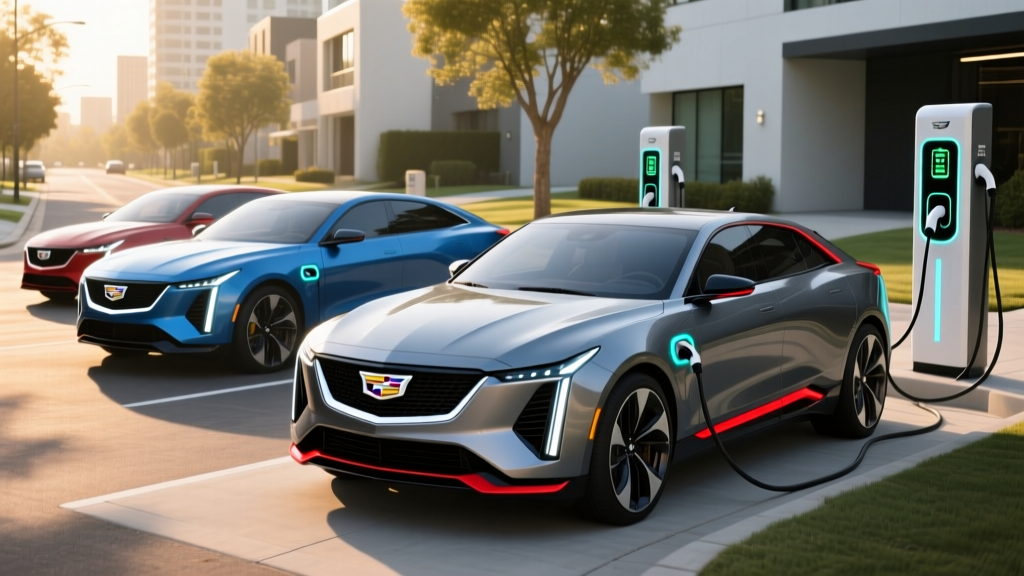
When luxury shoppers ask, "does Cadillac make a hybrid?" the answer requires some nuance in 2026. Cadillac has pivoted aggressively toward full battery-electric vehicles under its Ultium platform, but the brand still offers plug-in hybrid options for buyers who want electric commuting flexibility without range anxiety. What Cadillac does not offer — and hasn't for several years — is a conventional hybrid (HEV) that charges itself through regenerative braking. If you want a self-charging Cadillac hybrid, you're looking at the used market.
This guide breaks down every hybrid option Cadillac currently sells, explains the critical difference between HEV and PHEV powertrains, and helps you decide whether a Cadillac plug-in hybrid — or a full EV from the brand — fits your driving life.
Does Cadillac Make a Hybrid or a Plug-In Hybrid?
The distinction matters enormously for your daily routine and your wallet:
Conventional Hybrid (HEV)
A conventional hybrid like the Toyota RAV4 Hybrid pairs a small battery (typically 1-2 kWh) with a gasoline engine. It never plugs in. The battery recharges through regenerative braking and engine power. You simply drive it like a gas car and get better fuel economy — typically 30-50% improvement over a non-hybrid equivalent.
Plug-In Hybrid (PHEV)
A plug-in hybrid carries a much larger battery (usually 15-25 kWh) and a gasoline engine. You can plug it in to charge — and you should, to maximize value. A PHEV drives on electricity alone for 20-50 miles before the gas engine kicks in. Think of it as a short-range EV for daily commutes, with a gas backup for road trips.
Cadillac's 2026 answer: The brand offers plug-in hybrids (PHEVs) in select markets and models, but no conventional self-charging hybrids. Cadillac's electrification strategy has focused on BEVs (the Lyriq, Optiq, and Vistiq) and, for the Escalade, the full-electric Escalade IQ. However, a PHEV variant of the Escalade has been offered in recent model years, and the XT5 has seen plug-in hybrid variants in international markets.
2026 Cadillac Plug-In Hybrid Options
Here's what's available or announced for buyers who want Cadillac electrification without going full EV:
| Model | Type | Electric Range | Combined MPG/MPGe | Battery | Combined HP | Starting MSRP |
|---|---|---|---|---|---|---|
| Escalade PHEV | Plug-in Hybrid | ~35 mi (est.) | ~56 MPGe / 20 MPG gas | ~19 kWh (NMC) | ~420 hp | ~$92,000 (est.) |
| Escalade IQ (BEV) | Full Electric | ~450 mi (EPA) | 89 MPGe | 200+ kWh (NMC) | 750 hp | $129,990 |
| Lyriq (BEV) | Full Electric | 314 mi (EPA) | 89 MPGe | 102 kWh (NMC) | 500 hp | $58,590 |
Important context: Cadillac's PHEV availability varies by model year and market. The Escalade PHEV has been announced for select markets but may not be available at all U.S. dealers. Always confirm with your local dealer whether a PHEV variant is currently in production for your region. The brand's U.S. strategy has heavily favored BEVs.
How Many MPG Does a Cadillac Hybrid Get?
| Model | City | Highway | Combined | Notes |
|---|---|---|---|---|
| Escalade PHEV (electric mode) | 56 MPGe combined | Electric-only for ~35 mi | ||
| Escalade PHEV (gas mode) | ~18 | ~23 | ~20 MPG | After battery depleted |
| Escalade (gas V8, non-hybrid) | 14 | 19 | 16 MPG | 6.2L V8 baseline |
| Lyriq (BEV) | 89 MPGe combined | Full electric, no gas | ||
Real-world vs. EPA reality check: Plug-in hybrid MPG numbers are heavily dependent on your driving habits. If your daily commute is under 35 miles round-trip and you charge at home every night, you might use almost no gasoline for months. The EPA combined MPG figure blends electric and gas driving, so your actual fuel consumption could range from near-zero to 20 MPG depending on trip length and charging frequency. Source: fueleconomy.gov.
For the Escalade PHEV, expect real-world gas-only fuel economy of roughly 18-21 MPG in mixed driving once the battery is depleted — a meaningful improvement over the gas-only Escalade's 14/19 city/highway, but not a Prius-level transformation.
Electric-Only Range and Charging for Cadillac PHEVs
If you're considering a Cadillac plug-in hybrid, electric-only range is the number that determines whether it functions as an "EV" in your daily life:
- Estimated electric range: ~35 miles (Escalade PHEV)
- Battery capacity: ~19 kWh usable (NMC chemistry)
- Level 1 charging (120V household outlet): ~8-10 hours for a full charge — practical for overnight
- Level 2 charging (240V home charger): ~2.5-3 hours for a full charge at 7.2 kW
- DC fast charging: Typically not available on Cadillac PHEVs — this is standard across most luxury PHEVs, which rely on Level 2 for daily top-ups
Battery Warranty & Replacement
Federal law requires that hybrid and PHEV batteries carry a minimum warranty of 8 years or 100,000 miles (10 years/150,000 miles in California and states that follow CARB emissions rules). Cadillac honors these mandates. If the battery degrades below ~70% capacity within the warranty period, Cadillac will repair or replace it at no cost.
Out-of-warranty replacement cost: PHEV battery replacement typically runs $6,000-$10,000 depending on the model, including labor. However, PHEV batteries are substantially smaller than full EV batteries, so replacement costs are proportionally lower. Most PHEV batteries are engineered to last 150,000+ miles before significant degradation.
Who Should Buy a Cadillac PHEV vs. a Full EV?
Choose a Cadillac PHEV if:
- You commute under 35 miles round-trip and can charge at home nightly
- You regularly take road trips exceeding 300 miles and don't want to plan around charging stops
- You live in an area with limited DC fast charging infrastructure
- You want the Escalade's size, luxury, and towing capacity but want some fuel savings
- You're not ready to commit to a full EV but want to reduce gasoline consumption
Choose a Cadillac BEV (Lyriq, Escalade IQ) if:
- You have reliable home Level 2 charging and want to eliminate gasoline entirely
- Your daily driving is under 250 miles (well within the Lyriq's 314-mile EPA range)
- You want maximum performance, lowest running costs, and the latest EV technology
- You want to qualify for the full federal EV tax credit (up to $7,500 for eligible BEVs)
- You plan to keep the vehicle 8+ years and want fewer moving parts to maintain
Choose a gas-only Cadillac if:
- You cannot install a home charger (apartment, street parking, HOA restrictions)
- You drive very low annual miles and fuel cost is a minor concern
- You want the lowest upfront purchase price
Tax Credits: Do Cadillac Hybrids Qualify?
This is where the HEV vs. PHEV vs. BEV distinction has major financial implications under current IRS §30D rules:
- Conventional hybrids (HEV): Do NOT qualify for the federal clean vehicle tax credit. No plug, no credit.
- Plug-in hybrids (PHEV): MAY qualify for up to $7,500, but only if they meet battery sourcing, critical minerals, MSRP cap ($80,000 for SUVs/trucks), and buyer income limits ($300K joint / $150K single). Availability of PHEV credits depends on the specific model's battery component sourcing — many luxury PHEVs fail the sourcing requirements.
- Full EVs (BEV): The Cadillac Lyriq has qualified for partial or full credit in recent years, depending on battery sourcing compliance. The point-of-sale transfer option lets you apply the credit directly at the dealer.
Practical advice: Before counting on any tax credit, verify current eligibility for the exact model year and trim on the IRS Clean Vehicle Credit page and with your tax professional. Sourcing requirements have tightened significantly, and eligibility can change between model years.
Reliability and Long-Term Ownership
Cadillac's PHEV powertrains benefit from decades of GM hybrid expertise (the two-mode hybrid system dates back to 2008). Key reliability considerations:
- Hybrid battery longevity: PHEV batteries from major manufacturers routinely last 150,000-200,000 miles. NMC chemistry degrades gradually — expect ~10-15% capacity loss over 10 years under normal use.
- Warranty coverage: 8 years/100,000 miles on hybrid battery and powertrain components (federal mandate).
- Maintenance: PHEVs still require oil changes, spark plugs, and transmission fluid — unlike BEVs. However, regenerative braking extends brake pad life significantly.
- Complexity trade-off: A PHEV has two complete powertrains (electric + gasoline), which means more components that could theoretically fail vs. a pure EV or pure gas car. In practice, GM's hybrid systems have proven robust.
Pros of Cadillac PHEVs
- Electric commuting eliminates gas use for short trips
- No range anxiety — gas engine covers long road trips
- Regenerative braking extends brake life
- Luxury features and Escalade towing capacity retained
- Battery warranty protects against early failure
Cons of Cadillac PHEVs
- Limited electric-only range (~35 mi) vs. a BEV
- No DC fast charging — home Level 2 strongly recommended
- Higher complexity than a pure EV or pure gas car
- Tax credit eligibility uncertain due to sourcing rules
- Cargo space reduced by battery placement
- Limited model availability — Cadillac is prioritizing BEVs
The Bottom Line: Does Cadillac Make a Hybrid Worth Buying?
If you're asking "does Cadillac make a hybrid?" because you want a self-charging, no-plug-required HEV like a Toyota Camry Hybrid — the answer is no. Cadillac has exited that segment.
If you're asking because you want a luxury plug-in hybrid that blends electric commuting with gas-engine flexibility — Cadillac offers PHEV variants in select markets, primarily around the Escalade. But availability is limited, and the brand's clear direction is toward full EVs like the Lyriq and Escalade IQ.
For most luxury buyers in 2026 who have home charging access, the stronger value proposition is Cadillac's BEV lineup: the Lyriq offers 314 miles of EPA range, 500 hp, and potential federal tax credit eligibility at a $58,590 starting price — a package that a PHEV Escalade at $92,000+ struggles to match on total cost of ownership.
Frequently Asked Questions
Does Cadillac make a conventional hybrid that doesn't need to be plugged in?
No. As of 2026, Cadillac does not sell a conventional self-charging hybrid (HEV) in the U.S. market. The brand offers plug-in hybrids (PHEVs) in select markets and is focused primarily on full electric vehicles (BEVs) like the Lyriq, Optiq, Vistiq, and Escalade IQ.
How far can a Cadillac PHEV drive on electric power alone?
The Cadillac Escalade PHEV is estimated to deliver approximately 35 miles of electric-only range. This covers most daily commutes if you charge at home overnight. Once the battery is depleted, the gasoline engine takes over seamlessly.
How many MPG does a Cadillac hybrid get?
The Escalade PHEV achieves an estimated 56 MPGe in blended electric/gas mode and approximately 20 MPG combined when running on gasoline alone after the battery is depleted. Compare this to the gas-only Escalade's 16 MPG combined — a meaningful improvement, though not dramatic.
Do Cadillac hybrids qualify for the federal tax credit?
Conventional hybrids do not qualify. Plug-in hybrids may qualify for up to $7,500 under IRS §30D, but eligibility depends on battery sourcing requirements, MSRP caps ($80,000 for SUVs), and buyer income limits. Many luxury PHEVs do not meet current sourcing requirements. Always verify on irs.gov before purchasing.
Is a Cadillac hybrid reliable, and what does battery replacement cost?
Cadillac PHEV powertrains are backed by GM's extensive hybrid engineering history. The hybrid battery is warranted for 8 years/100,000 miles (federal minimum). Out-of-warranty PHEV battery replacement typically costs $6,000-$10,000, though most batteries last well beyond 150,000 miles with gradual capacity loss.
Should I buy a Cadillac PHEV or a full EV like the Lyriq?
If you have home charging, drive under 250 miles daily, and want the lowest running costs, the Lyriq BEV (314-mile range, $58,590) is the stronger choice. If you frequently tow, take long road trips in areas with sparse charging infrastructure, or need the Escalade's size and capability, a PHEV variant offers a compromise — but at a significantly higher price point.