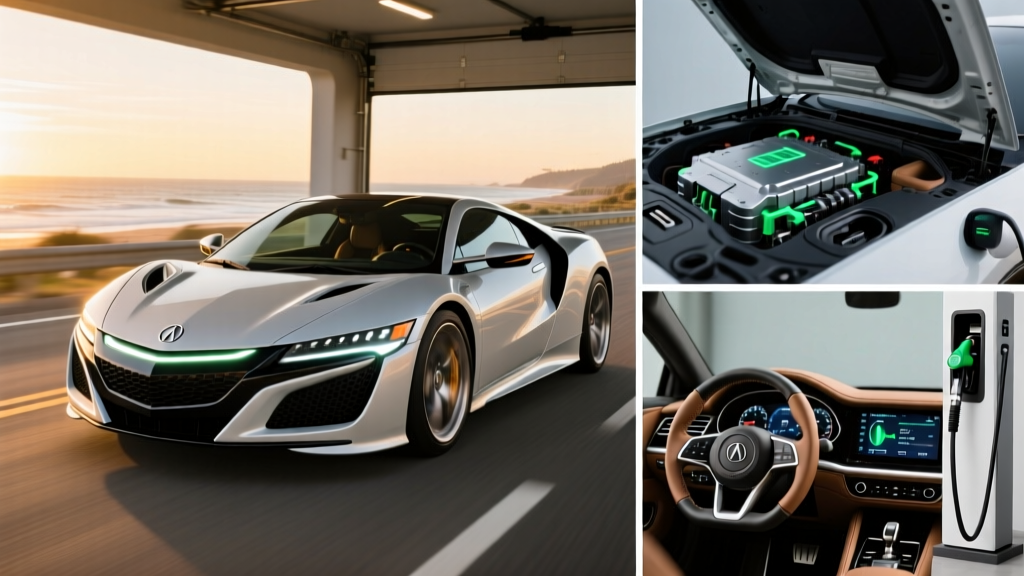
Quick Verdict: The Acura NSX Type S (final model year 2022) remains a benchmark hybrid supercar — pairing a twin-turbo V6 with three electric motors for 600 combined horsepower and a 0-60 time of 2.9 seconds. As a conventional hybrid (HEV), it requires no plug-in charging, achieves an EPA-estimated 21 MPG combined, and delivers all-wheel-drive torque vectoring that few rivals can match. Production ended in 2022, making this a used-market proposition in 2026 — but its Sport Hybrid powertrain remains one of the most sophisticated electrified systems ever fitted to a production supercar.
Why the Acura NSX Is a Hybrid Supercar Worth Studying
When Honda engineers designed the second-generation NSX, they didn't electrify the powertrain for fuel economy alone. The three-motor Sport Hybrid system serves a performance function: the twin-motor front axle provides instant torque vectoring through corners, while the rear-mounted direct-drive motor fills the turbo lag gap during hard acceleration. The result is a supercar that uses hybridization the way Porsche's 918 Spyder does — as a performance multiplier first, and an efficiency tool second.
The NSX competes in rarefied territory alongside the Porsche 911 Turbo S, Audi R8 V10, and McLaren Artura. But unlike most hybrid supercars, the NSX never required plug-in charging. It operates as a conventional hybrid (HEV), meaning its small lithium-ion battery recharges exclusively through regenerative braking and the gasoline engine. There is no electric-only driving range to manage, no charging cable to plug in — just a supercar that happens to use electric motors to sharpen its performance edge.
HEV vs PHEV: Where the NSX Fits
| Feature | Conventional Hybrid (HEV) — Acura NSX | Plug-In Hybrid (PHEV) — e.g., McLaren Artura | Battery Electric (BEV) — e.g., Porsche Taycan |
|---|---|---|---|
| Plug-in charging required? | No — self-charging via regen & engine | Yes — external charging for EV range | Yes — sole energy source |
| Electric-only range | None (motor assist only) | Typically 15–40 miles | 200–400+ miles (EPA) |
| Battery size | 1.3 kWh (NSX Type S) | 7.4–18 kWh typical | 70–100+ kWh typical |
| Primary benefit | Performance assist + modest MPG gain | EV commuting + gas road trips | Zero tailpipe emissions, lowest fuel cost |
| Fueling | Gasoline only | Gasoline + electricity | Electricity only |
The NSX's 1.3 kWh lithium-ion battery pack is tiny by PHEV or BEV standards — and that's by design. It exists to buffer energy captured during braking and deploy it in bursts to the front axle motors. You'll never see an electric-only range figure because the NSX was never intended to drive on electricity alone. Its hybrid system is performance architecture, not an efficiency play in the Prius sense.
Powertrain Breakdown: 600 HP from V6 + Three Motors
| Specification | Acura NSX Type S (2022 Final Edition) |
|---|---|
| Engine | 3.5L twin-turbo V6 |
| Engine output | 520 hp / 442 lb-ft torque |
| Electric motors | 3 total: 2 front (twin-motor unit), 1 rear (direct-drive) |
| Combined system output | 600 hp / 492 lb-ft torque |
| Transmission | 9-speed dual-clutch automatic (DCT) |
| Drivetrain | SH-AWD (Super Handling All-Wheel Drive) |
| 0–60 mph | 2.9 seconds |
| Top speed | 191 mph |
| Battery capacity | 1.3 kWh lithium-ion |
| Battery location | Behind seats, low center of gravity |
| Curb weight | ~3,893 lbs |
| MSRP (2022 Type S) | $171,495 (base) |
The front twin-motor unit (TMU) is the NSX's secret weapon. Each front wheel gets its own electric motor, allowing the car to apply positive torque to the outside wheel and negative torque (braking) to the inside wheel mid-corner. This torque vectoring happens faster and more precisely than any mechanical limited-slip differential could achieve. The rear direct-drive motor, sandwiched between the engine and transmission, fills torque gaps during the twin-turbo V6's spool-up and provides seamless power delivery through gear shifts.
The combined 600 hp output places the NSX Type S squarely against the McLaren 720S (710 hp) and Porsche 911 Turbo S (640 hp), though the NSX's all-wheel-drive traction gives it a 0-60 advantage over some higher-horsepower rear-wheel-drive rivals.
Fuel Economy: EPA MPG and Real-World Numbers
| Driving Condition | EPA Estimate | Real-World Expectation |
|---|---|---|
| City | 21 MPG | 19–22 MPG (hybrid assist helps in stop-and-go) |
| Highway | 22 MPG | 20–23 MPG (aerodynamic efficiency at speed) |
| Combined | 21 MPG | 19–21 MPG typical mixed driving |
| Track / aggressive driving | N/A | 10–14 MPG (expected for supercar use) |
For a 600-horsepower all-wheel-drive supercar, 21 MPG combined is genuinely impressive. The Porsche 911 Turbo S returns 20 MPG combined; the Audi R8 V10 Performance manages 17 MPG. The NSX's hybrid system earns its keep here — the front electric motors handle low-speed maneuvering and assist during acceleration, reducing the load on the twin-turbo V6.
In real-world ownership, expect the NSX to deliver slightly better city MPG than highway — a hallmark of hybrid powertrains, where regenerative braking recaptures energy during deceleration. Owners who drive primarily on back roads and highways at moderate speeds report 22–23 MPG. Those who exercise the car's performance potential regularly will see numbers closer to 14–16 MPG in spirited driving.
The NSX requires premium unleaded fuel (91 octane minimum, 93 recommended). With a 15.6-gallon fuel tank, total driving range sits around 325–340 miles per fill-up under normal conditions.
Hybrid Battery Warranty, Reliability, and Replacement Cost
Acura NSX Hybrid Battery Coverage
- Hybrid battery warranty: 8 years / unlimited miles (original factory coverage)
- Powertrain warranty: 6 years / 70,000 miles
- New vehicle limited warranty: 4 years / 50,000 miles
- Battery chemistry: Lithium-ion (1.3 kWh pack)
- Estimated replacement cost: $4,000–$7,000 (battery pack only, aftermarket/rebuilt options emerging)
Note: For 2026 buyers, original 8-year battery warranty on 2016–2019 models may be expiring or expired. Verify remaining coverage with Acura or an authorized dealer before purchase.
The NSX's hybrid battery is remarkably small compared to a PHEV or BEV pack, which works in its favor for longevity. The 1.3 kWh pack operates within a narrow state-of-charge window — the battery management system (BMS) prevents deep discharges and full charges, keeping the cells in their optimal operating range. This conservative management strategy significantly reduces degradation risk.
Real-world reliability data from the NSX community suggests the Sport Hybrid system has been robust. The most commonly reported hybrid-related issues involve the Intelligent Power Unit (IPU) cooling system rather than cell degradation itself. The twin-motor unit at the front axle and the direct-drive rear motor have shown excellent durability in vehicles with 50,000+ miles.
Should the hybrid battery require replacement, the cost is far lower than a full EV battery swap. Because the pack is small (1.3 kWh vs. 75–100 kWh in a typical BEV), replacement costs are measured in the low thousands rather than tens of thousands. As of 2026, third-party hybrid battery rebuild services are beginning to offer NSX-compatible packs at lower cost than OEM replacement.
The broader powertrain — the twin-turbo V6, 9-speed DCT, and associated electronics — follows Honda/Acura's well-established reliability patterns. The NSX shares engineering DNA with the Honda/Acura family, and the V6 engine architecture has proven durable in other applications.
Pricing, Used Market, and Tax Credit Eligibility
The Acura NSX was produced from 2016 through 2022, with the Type S serving as the final, most powerful variant. Here's the pricing landscape for 2026 buyers:
| Model Year / Variant | Original MSRP | 2026 Used Market Range (est.) |
|---|---|---|
| 2016–2018 NSX (base) | $157,500–$160,000 | $110,000–$140,000 |
| 2019–2021 NSX (updated) | $159,300–$164,000 | $130,000–$165,000 |
| 2022 NSX Type S | $171,495 | $200,000–$300,000+ (collector premium) |
Federal tax credit eligibility: The NSX does not qualify for the §30D Clean Vehicle Credit as a new vehicle purchase, since production ended in 2022. For used purchases, the Used Clean Vehicle Credit (up to $4,000 or 30% of sale price, whichever is lower) could theoretically apply if the vehicle meets the criteria — but the credit is capped at vehicles with a sale price of $25,000 or less, which excludes every NSX on the market. In practical terms, no federal tax credit applies to the Acura NSX in 2026.
Some states offer additional incentives for hybrid vehicle purchases, but these typically target PHEVs and BEVs rather than conventional hybrids. Check your state's energy office or Alternative Fuels Data Center for any local hybrid incentives that may apply.
Who Should Choose the NSX Hybrid vs. a Full EV or Gas Supercar?
Choose the Acura NSX Hybrid Supercar If:
- You want supercar performance (2.9s 0-60, 600 hp) with all-wheel-drive confidence in all weather
- You value torque-vectoring technology that enhances cornering, not just straight-line speed
- You want a hybrid that requires zero lifestyle change — no plug-in charging, no range planning
- You appreciate Honda/Acura engineering reliability in a low-volume exotic
- You're buying as a future collector car (limited production, final Type S edition)
Consider a Full EV (e.g., Porsche Taycan, Tesla Model S Plaid) If:
- Low daily operating cost is a priority (electricity vs. premium gasoline)
- You have reliable home charging access (Level 2)
- You want the latest infotainment, OTA updates, and driver-assist technology
- Instant torque delivery and silent operation appeal to you
Consider a Gas-Only Supercar (e.g., Porsche 911 GT3, Audi R8) If:
- You prioritize naturally aspirated engine sound and analog driving feel
- You want the widest dealer service network and parts availability
- Track-day simplicity (fewer electronic systems) matters to you
The NSX occupies a unique niche: it's the supercar for the driver who wants electrified performance without the charging infrastructure commitment of a PHEV or BEV. It's also the supercar for the daily-driver owner who needs all-wheel-drive capability — the SH-AWD system, enhanced by the front electric motors, provides exceptional traction in rain and even light snow, something mid-engine RWD rivals simply cannot match.
Ownership Costs: What to Budget in 2026
Owning an NSX hybrid supercar involves costs beyond the purchase price. Here's a realistic annual ownership budget for a 2026 buyer:
| Cost Category | Estimated Annual Cost | Notes |
|---|---|---|
| Insurance | $4,500–$7,500 | Varies heavily by driver profile, location, coverage level |
| Premium fuel (93 octane) | $2,800–$4,000 | Based on 8,000–10,000 miles/year at 20 MPG avg |
| Maintenance | $1,500–$3,000 | Oil changes, brake fluid, tire rotation; DCT service intervals |
| Tires | $1,200–$2,000 | Continental SportContact or Pirelli P Zero; replace every 8,000–12,000 mi |
| Registration / taxes | $500–$1,500 | Varies by state; some states assess luxury vehicle surcharges |
Total estimated annual operating cost: $10,500–$18,000, depending on mileage, insurance profile, and whether you use an Acura dealer or independent specialist for maintenance.
One ownership advantage of the NSX over European exotic rivals: Acura dealer service networks are far more widespread than Ferrari, McLaren, or Lamborghini dealerships. Many routine services can be performed at any Acura dealer with NSX certification, reducing the need for long-distance transport to a specialist.
Frequently Asked Questions
How many MPG does the Acura NSX hybrid supercar get?
The EPA rates the NSX at 21 MPG combined (21 city / 22 highway). Real-world mixed driving typically yields 19–21 MPG, with city driving sometimes exceeding the EPA estimate thanks to regenerative braking assist. Aggressive or track driving drops fuel economy to 10–14 MPG.
Does the Acura NSX need to be plugged in to charge?
No. The NSX is a conventional hybrid (HEV), not a plug-in hybrid (PHEV). Its 1.3 kWh battery recharges entirely through regenerative braking and the gasoline engine. There is no charging port, no plug, and no electric-only driving mode. You fuel it like any other gasoline car.
How far can the NSX drive on electric power alone?
The NSX cannot drive on electric power alone. Its electric motors work in concert with the twin-turbo V6 at all times — they provide torque fill, torque vectoring, and acceleration assist, but the gasoline engine is always engaged during driving. This is fundamentally different from PHEVs like the McLaren Artura, which offers approximately 19 miles of EV-only range.
Is the NSX hybrid system reliable, and what does battery replacement cost?
The Sport Hybrid system has demonstrated strong reliability in the field. The small 1.3 kWh battery pack is conservatively managed by the BMS, limiting degradation. Original hybrid battery warranty was 8 years / unlimited miles. Estimated battery replacement cost is $4,000–$7,000 — far less than a full EV battery swap. For 2026 buyers of earlier model years, verify remaining warranty coverage before purchase.
Does the Acura NSX qualify for any federal or state tax credit?
No. Since production ended in 2022, the NSX cannot be purchased new, and the Used Clean Vehicle Credit caps eligible sale prices at $25,000 — well below any NSX's market value. No federal tax credit applies. Some states may offer minor hybrid incentives, but most target PHEVs and BEVs. Consult your state's energy office for specifics.
How does the NSX compare to the McLaren Artura hybrid?
The McLaren Artura is a PHEV with a 2.5L twin-turbo V6 and approximately 19 miles of electric-only range from a 7.4 kWh battery. It produces 671 hp combined and starts around $240,000+. The NSX is a conventional HEV with no EV range, 600 hp, and a significantly lower entry price on the used market. The Artura offers the EV-commuting capability the NSX lacks; the NSX offers all-wheel-drive traction and a lower cost of entry that the Artura cannot match.
What makes the NSX's hybrid system different from a Toyota Prius hybrid?
Both are conventional hybrids (HEVs) that don't require plug-in charging, but the engineering goals are opposite. The Prius uses its hybrid system primarily for fuel efficiency — the electric motor assists the gasoline engine to reduce fuel consumption. The NSX uses its three-motor system primarily for performance — the front motors enable torque vectoring for cornering agility, and the rear motor fills turbo lag for seamless acceleration. Fuel economy is a secondary benefit, not the primary goal.
Pros
- 600 hp and 2.9s 0-60 with all-wheel-drive traction
- Advanced torque-vectoring via twin front electric motors
- No plug-in charging required — zero lifestyle change vs. gas car
- 21 MPG combined is exceptional for a 600-hp supercar
- Acura dealer service network (vs. exotic-brand specialists)
- Future collector car potential (limited production run, Type S final edition)
Cons
- Production ended 2022 — only available on used/collector market
- No electric-only driving range (not a PHEV)
- No federal tax credit eligibility at current market prices
- Insurance costs are significant ($4,500–$7,500/year)
- Interior tech feels dated vs. 2026 supercar competitors
- Limited cargo space and practicality (mid-engine supercar constraints)