Does Cadillac Even Make a Hybrid in 2025?
Here's the reality many luxury SUV shoppers discover when researching a Cadillac hybrid 2025: General Motors' luxury brand has made a decisive pivot. Unlike BMW, Volvo, or Lexus — which offer plug-in hybrid (PHEV) variants alongside battery-electric models — Cadillac's 2025 lineup is built around full battery-electric vehicles (BEVs) and traditional gasoline engines. There is no conventional hybrid (HEV) or plug-in hybrid (PHEV) wearing the Cadillac crest for the 2025 model year.
That doesn't mean Cadillac has nothing for buyers who want electrification without full commitment. The 2025 Cadillac Lyriq and the newly arriving 2025 Cadillac Optiq are the brand's electric offerings, while models like the Escalade and XT5 remain gasoline-only. For buyers specifically seeking a Cadillac-badged PHEV, the closest mechanical cousin is the Chevrolet Tahoe Hybrid concept or the Buick Encore GX mild-hybrid — neither of which carries the Cadillac name.
This guide breaks down what Cadillac actually offers for 2025, the real specs and range you can expect, and whether a Cadillac BEV, a competitor's PHEV, or a gasoline model makes the most sense for your garage.
HEV vs. PHEV vs. BEV — Quick Refresher
- HEV (Hybrid Electric Vehicle): Gas engine + small battery. Charges via regenerative braking. No plug needed. Example: Toyota RAV4 Hybrid. Cadillac offers none in 2025.
- PHEV (Plug-In Hybrid): Gas engine + larger battery you plug in. Typically 20–40 miles electric-only, then operates as a hybrid. Example: BMW X5 xDrive50e. Cadillac offers none in 2025.
- BEV (Battery Electric Vehicle): No gas engine. 100% electric, plug-in only. Example: Cadillac Lyriq. This is Cadillac's electrified path for 2025.
2025 Cadillac Lyriq: The Brand's Electrified Flagship
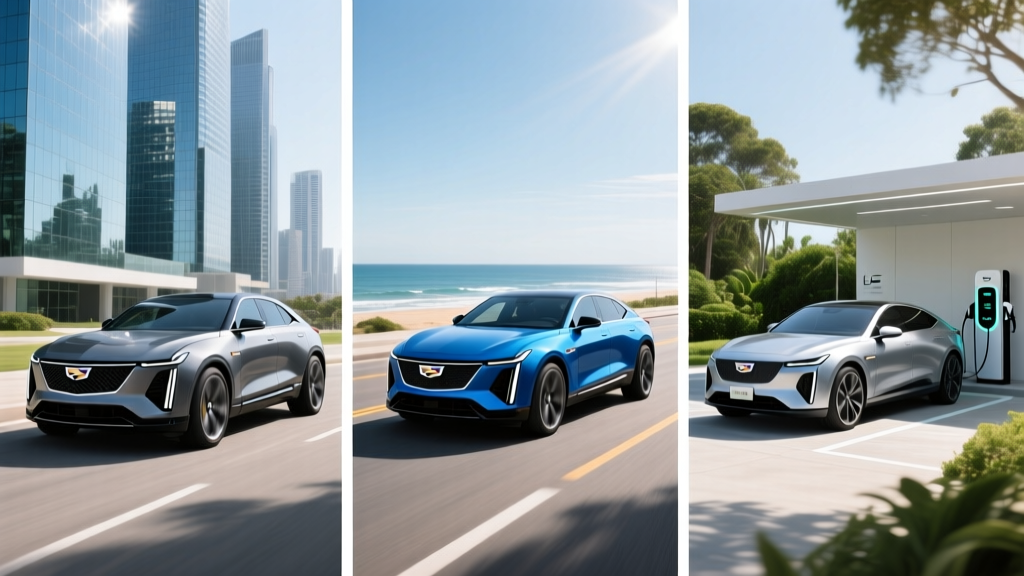
The 2025 Cadillac Lyriq is a midsize luxury crossover built on GM's Ultium BEV3 platform. It's not a hybrid — it's a full battery-electric vehicle — but it's what Cadillac offers to buyers who want an electrified luxury SUV. For the 2025 model year, the Lyriq receives meaningful updates including available all-wheel drive across more trims, an updated infotainment system, and a starting price that undercuts key German rivals.
| Spec | RWD (Tech/Luxury) | AWD (Sport/Premium) |
|---|---|---|
| EPA Range | 314 miles | 307 miles |
| Battery (Usable) | 102 kWh (NMC) | 102 kWh (NMC) |
| Horsepower | 340 hp | 500 hp |
| 0–60 mph | ~6.0 sec | ~4.6 sec |
| Peak DC Fast Charge | 190 kW | 190 kW |
| 10–80% DC Charge | ~35 min | ~35 min |
| Level 2 Charge Rate | 19.2 kW (AC) | 19.2 kW (AC) |
| MPGe (Combined) | 89 MPGe | 88 MPGe |
| Starting MSRP | ~$58,590 | ~$62,090 |
| Battery/Powertrain Warranty | 8 yr / 100,000 mi | 8 yr / 100,000 mi |
The EPA rates the Lyriq RWD at 314 miles. In real-world highway driving at 70–75 mph, expect approximately 250–275 miles before needing a charge. In cold weather (below 30°F), range can drop an additional 15–25%, yielding roughly 210–235 miles. The Lyriq's heat pump helps mitigate winter losses compared to EVs without one, but physics still applies. For daily commuting under 60 miles round-trip, you'll charge at home every 3–4 days and rarely think about range.
2025 Cadillac Optiq: The Compact Electric Entry Point
New for 2025, the Cadillac Optiq slots below the Lyriq as a compact luxury electric crossover. Think of it as Cadillac's answer to the BMW iX1 or Volvo EX40. It shares the Ultium platform but in a smaller, more affordable package.
| Spec | Optiq AWD |
|---|---|
| EPA Range (Est.) | ~300 miles |
| Battery (Usable) | ~85 kWh (NMC) |
| Horsepower | ~400 hp |
| 0–60 mph (Est.) | ~5.0 sec |
| Peak DC Fast Charge | ~150 kW |
| Starting MSRP (Est.) | ~$48,000–$52,000 |
| Battery/Powertrain Warranty | 8 yr / 100,000 mi |
Note: The Optiq's final EPA-certified figures were not published at the time of writing. Specs above reflect GM's preliminary estimates and may shift. Always verify at fueleconomy.gov before purchasing.
Tax Credit Eligibility for Cadillac's Electric Lineup
Federal EV tax credits under IRS §30D remain a top purchase factor. For 2025, the rules are stringent:
- MSRP Cap: SUVs must be priced at or below $80,000; sedans at or below $55,000.
- Buyer Income Cap: Modified AGI ≤ $150,000 (single), ≤ $225,000 (head of household), ≤ $300,000 (joint).
- Battery Sourcing: Critical minerals and battery components must meet escalating domestic/free-trade-partner thresholds. For 2025, ≥80% of critical minerals and ≥100% of battery components must comply — effectively excluding many vehicles with Chinese-sourced materials.
- Point-of-Sale Transfer: Eligible buyers can transfer the credit to the dealer at purchase, reducing the purchase price directly rather than waiting for a tax refund.
- Maximum Credit: Up to $7,500 ($3,750 for critical minerals + $3,750 for battery components).
The Lyriq's MSRP (starting ~$58,590) falls under the $80,000 SUV cap. However, eligibility for the full $7,500 depends on battery-sourcing compliance, which GM has been actively re-shoring. Check the latest qualified vehicle list on fueleconomy.gov before purchasing, as eligibility can change mid-year based on supply-chain shifts. Higher trims (Lyriq Sport/Premium Luxury above $80K MSRP) will not qualify.
Charging the Lyriq and Optiq: What Owners Actually Experience
Since Cadillac's electrified models are BEVs — not hybrids — charging infrastructure matters far more than MPG. Here's what the charging picture looks like:
| Level | Power | Miles Added per Hour | Best For |
|---|---|---|---|
| Level 1 (120V) | ~1.4 kW | ~4–5 mi/hr | Overnight trickle / emergencies |
| Level 2 (240V Home) | Up to 19.2 kW | ~52–60 mi/hr | Daily home charging (full in ~6 hr) |
| DC Fast Charge | Peak 190 kW | ~180+ mi in 15 min | Road trips (10–80% in ~35 min) |
A critical detail many spec sheets bury: the Lyriq's 19.2 kW onboard charger is among the fastest in its class for Level 2 AC charging. Most competitors (BMW iX, Audi Q8 e-tron) max out at 11–11.5 kW on AC. This means a Lyriq on a properly equipped home Level 2 circuit can fully replenish overnight in roughly 6 hours — a genuine advantage for drivers who need maximum daily turnaround.
On DC fast chargers, the Lyriq peaks at 190 kW but — like all EVs — does not sustain that rate. The charge curve tapers significantly above 55–60% state of charge (SoC). Expect roughly 15 minutes to go from 10–50%, but 35 minutes total from 10–80%. Always precondition the battery via the navigation system before arriving at a DC fast charger to maximize charge speed.
The Lyriq uses the NACS (Tesla) connector for 2025, granting access to Tesla Supercharger stations via native plug — no adapter required. This is a significant infrastructure advantage over CCS-equipped rivals.
If You Really Need a Hybrid: Alternatives to Cadillac
If your situation genuinely calls for a hybrid or PHEV — perhaps you lack home charging, regularly tow, or drive in areas with sparse charging infrastructure — Cadillac's current lineup won't serve you. Here are the luxury alternatives that do:
| Model | Type | EPA Electric Range | Combined MPG (Gas) | Starting MSRP |
|---|---|---|---|---|
| BMW X5 xDrive50e | PHEV | 38 mi | 50 MPGe / 22 MPG gas | ~$74,000 |
| Volvo XC90 Recharge | PHEV | 32 mi | 55 MPGe / 27 MPG gas | ~$78,000 |
| Lexus RX 450h+ | PHEV | 37 mi | 64 MPGe / 35 MPG gas | ~$63,000 |
| Lincoln Corsair Grand Touring | PHEV | 28 mi | 78 MPGe / 30 MPG gas | ~$55,000 |
| Mercedes GLE 450e | PHEV | 45 mi | 56 MPGe / 23 MPG gas | ~$72,000 |
Each of these PHEVs offers 28–45 miles of electric-only range — enough for most daily commutes — with a gasoline engine for longer trips. None qualifies for the full $7,500 federal credit in 2025 due to battery-sourcing rules, though some may qualify for partial credits. Consult IRS guidance for current eligibility.
Battery Longevity and Warranty: What Cadillac Covers
Whether you're considering the Lyriq BEV or weighing it against a competitor's PHEV, battery longevity is a legitimate concern. Here's what Cadillac provides:
- Coverage: 8 years or 100,000 miles (whichever comes first)
- Capacity Threshold: Warranty covers battery if it falls below ~60–70% of original capacity (exact threshold varies by model year — confirm in your purchase agreement)
- What's Covered: Battery cell defects, module replacement, battery management system failures
- Replacement Cost (Out of Warranty): Full Ultium pack replacement is estimated at $15,000–$25,000 depending on pack size. However, module-level repairs are significantly cheaper and more common.
For context, NMC (nickel manganese cobalt) batteries like those in the Lyriq typically degrade 8–15% over 100,000 miles based on data from similar Ultium-based vehicles. That means a Lyriq with 314 miles of EPA range when new might deliver roughly 270–290 miles at 100,000 miles — still well within usable territory. To maximize longevity, avoid routinely charging to 100% or draining below 10%; set your daily charge limit to 80% and save 100% for road trips.
Who Should Buy a Cadillac BEV vs. a Competitor's Hybrid?
Decision Framework
Choose the Cadillac Lyriq or Optiq (BEV) if:
- You can install a Level 2 home charger (240V / 40–80A circuit)
- Your daily driving is under 100 miles round-trip
- You want the lowest per-mile fuel cost (~$0.04–$0.06/mile on home electricity vs. ~$0.12–$0.16/mile for gas)
- You value access to the Tesla Supercharger network (NACS native)
- You want Cadillac's latest tech, Super Cruise capability, and luxury fitment
Choose a competitor's PHEV (BMW X5 50e, Lexus RX 450h+, etc.) if:
- You cannot install home charging (apartment, street parking, HOA restrictions)
- You regularly drive 300+ miles in a day without time for a 30-minute charge stop
- You tow frequently (PHEVs handle towing without range cliff)
- You live in a region with limited DC fast-charging infrastructure
- You want the flexibility of gas-engine backup with electric daily driving
Stick with a gasoline Cadillac (Escalade, XT5, CT5) if:
- You need maximum towing capacity (Escalade: up to 8,000 lbs)
- You drive in extreme cold frequently and can't charge at home
- Your budget doesn't accommodate the EV/PHEV price premium
✓ Cadillac Lyriq Pros
- 314-mile EPA range (RWD)
- Class-leading 19.2 kW AC home charging
- Native NACS / Tesla Supercharger access
- Available Super Cruise (hands-free highway)
- Spacious interior with 33" LED display
- Competitive starting price for luxury segment
✗ Cadillac Lyriq Cons
- No hybrid/PHEV option available
- DC fast charge peak (190 kW) trails Hyundai/Kia (350 kW)
- Real-world highway range ~250–275 mi, not 314
- Higher trims exceed $80K tax credit cap
- No frunk (front trunk) storage
- Regen braking feel less refined than one-pedal leaders
Frequently Asked Questions
Does Cadillac make a hybrid SUV for 2025?
No. Cadillac does not offer a conventional hybrid (HEV) or plug-in hybrid (PHEV) for the 2025 model year. The brand's electrified offerings are the fully electric Lyriq and Optiq. For a GM-brand hybrid or PHEV, you'd need to look at Chevrolet or Buick, or consider luxury competitors like BMW, Lexus, or Volvo.
How many MPG does the Cadillac Lyriq get?
The Lyriq is a battery-electric vehicle, so it doesn't use MPG in the traditional sense. It's rated by the EPA in MPGe (miles per gallon equivalent): 89 MPGe combined for RWD and 88 MPGe combined for AWD, per fueleconomy.gov. In practical terms, the Lyriq uses roughly 34–35 kWh per 100 miles. At a national average electricity rate of $0.16/kWh, that's about $0.055/mile — roughly one-third the cost of a comparable gasoline luxury SUV.
How far can the Cadillac Lyriq go on a single charge?
The EPA rates the 2025 Lyriq RWD at 314 miles and the AWD at 307 miles. Real-world highway driving at sustained speeds of 70–75 mph typically yields 250–275 miles. In cold weather below 30°F, expect 210–235 miles. For daily commuting and errands, most owners report going 3–5 days between charges with home Level 2 charging.
Does the Cadillac Lyriq qualify for the $7,500 federal tax credit?
The Lyriq's starting MSRP is under the $80,000 SUV cap, making it potentially eligible. However, full credit eligibility depends on battery-sourcing compliance (§30D critical mineral and component rules), buyer income limits ($150K single / $300K joint MAGI), and current-year IRS determinations. Higher trims pushing MSRP above $80,000 will not qualify. Always verify on fueleconomy.gov's credit list and consult a tax professional before relying on the credit.
Is the Cadillac Lyriq reliable? What about battery replacement cost?
The Lyriq is built on GM's Ultium platform, which is relatively new (launched 2023), so long-term reliability data beyond early ownership is still accumulating. The battery carries an 8-year/100,000-mile warranty covering capacity loss below a defined threshold. Out-of-warranty full battery replacement is estimated at $15,000–$25,000, though module-level repairs are far more common and significantly cheaper. For comparison, a PHEV's smaller battery pack typically costs $5,000–$10,000 to replace. GM's hybrid battery warranty across its brands is also 8 years/100,000 miles.
Should I wait for a Cadillac PHEV or buy the Lyriq now?
GM has not announced any Cadillac-badged PHEV for the 2026 or 2027 model years. The company's strategy is to skip PHEVs and move directly to full BEVs on the Ultium platform. If a PHEV is essential for your situation (no home charging, frequent long rural trips, towing), you'll need to look at competitors or consider a gasoline Cadillac. If you can charge at home and your daily driving is under 100 miles, the Lyriq's 314-mile range eliminates the need for a gas backup for the vast majority of driving scenarios.