The Escalade Goes Electric — But Not All at Once
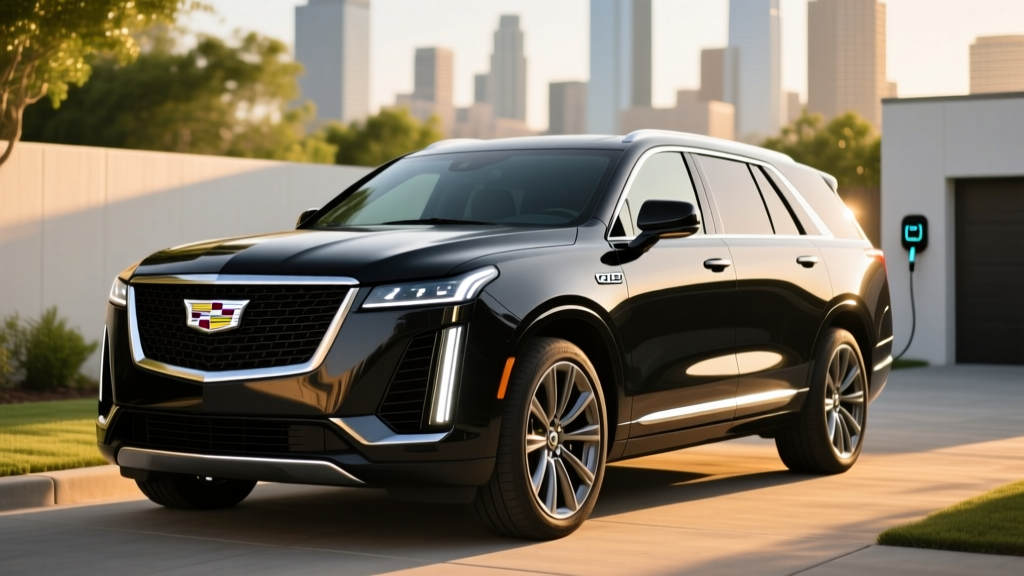
Cadillac's flagship SUV is navigating the transition from V8 gasoline to full battery-electric in stages. For the 2026 model year, buyers searching for an Escalade hybrid SUV actually have two distinct vehicles to evaluate: the newly launched Cadillac Escalade IQ (a dedicated battery-electric luxury SUV on GM's Ultium platform) and the refreshed internal-combustion Escalade with its 3.0L Duramax inline-six diesel. There is no conventional hybrid (HEV) or plug-in hybrid (PHEV) variant in the current Escalade lineup — a reality that changes how we frame this buying guide.
This guide breaks down what Cadillac actually offers, compares the IQ's EV powertrain against the ICE Escalade's diesel efficiency, and helps you decide whether to go electric, stick with combustion, or wait for a potential future PHEV variant.
Hybrid vs PHEV vs EV — Where Does the Escalade Fit?
- HEV (Conventional Hybrid): Pairs a gas engine with a small battery and electric motor. Charges via regenerative braking — no plug required. The Escalade does NOT offer an HEV variant.
- PHEV (Plug-In Hybrid): Larger battery (typically 15-30 kWh) provides 20-50 miles of electric-only range, plus a gas engine for longer trips. Requires plug-in charging for maximum benefit. The Escalade does NOT currently offer a PHEV variant.
- BEV (Battery Electric Vehicle): 100% electric — no gas engine. The Escalade IQ is Cadillac's full-electric flagship, with an EPA-estimated 450+ miles of range and a 200+ kWh Ultium battery.
2026 Cadillac Escalade IQ: The Electric Flagship
The Escalade IQ is not a hybrid — it's a dedicated battery-electric SUV built on GM's BT1 platform (shared with the Silverado EV and GMC Sierra EV). It replaces the V8 with dual electric motors and a massive Ultium battery pack. Here are the key specifications:
| Specification | Escalade IQ Luxury | Escalade IQ Sport |
|---|---|---|
| Drivetrain | Dual-motor AWD (e4) | Dual-motor AWD (e4) |
| Combined Horsepower | 680 hp (Velocity Max: 754 hp) | 680 hp (Velocity Max: 754 hp) |
| Torque | 615 lb-ft | 615 lb-ft |
| 0-60 mph | ~4.7 sec (est.) | ~4.7 sec (est.) |
| Battery (usable) | ~200 kWh (NMC, Ultium) | ~200 kWh (NMC, Ultium) |
| EPA Range (est.) | 450 mi | 440 mi |
| Max DC Fast Charge | 350 kW (800V architecture) | 350 kW (800V architecture) |
| 10-80% DC Charge | ~20 min (est.) | ~20 min (est.) |
| Level 2 Charge Rate | 19.2 kW (AC) | 19.2 kW (AC) |
| Towing Capacity | 8,000 lbs | 8,000 lbs |
| Starting MSRP | $129,990 | $130,690 |
The ICE Escalade: Diesel Efficiency Without Electrification
For 2026, the traditional Escalade (on the GMT T1XX platform) offers a 3.0L Duramax turbo-diesel inline-six as an alternative to the 6.2L V8. This is not a hybrid — it's a conventional internal-combustion engine — but its fuel economy competes with mid-size hybrid SUVs and is worth evaluating for buyers not ready to go electric.
| Powertrain | City MPG | Highway MPG | Combined MPG |
|---|---|---|---|
| 6.2L V8 (420 hp) | 14 | 19 | 16 |
| 3.0L Duramax Diesel (305 hp) | 20 | 27 | 23 |
Source: fueleconomy.gov (EPA)
Real-world MPG note: Diesel engines typically deliver highway MPG very close to the EPA sticker, and the Duramax inline-six is no exception. Owners report consistent 25-27 MPG on highway trips. In city driving, the stop-start system and turbo diesel's low-end torque help achieve 19-21 MPG. These figures are strong for a 5,800-lb body-on-frame SUV, but they're still 23 MPG combined — not the 30+ MPG you'd get from a dedicated hybrid crossover like the Toyota Highlander Hybrid.
Charging the Escalade IQ: Speed, Infrastructure, and Costs
The Escalade IQ's 800-volt architecture is its charging ace. At a compatible 350 kW DC fast charger (like Electrify America's latest stalls or Tesla Supercharger V4 via the NACS adapter), the IQ can accept peak charging rates up to 350 kW. In practice, the charge curve tapers significantly after 80% State of Charge (SoC) to protect the NMC battery cells.
| Charging Level | Power (kW) | Miles Added per Hour | Typical Use Case |
|---|---|---|---|
| Level 1 (120V outlet) | ~1.4 kW | ~3 mi/hr | Emergency/trickle only |
| Level 2 (240V, 48A) | 11.5 kW | ~28 mi/hr | Home overnight charging |
| Level 2 (240V, 80A) | 19.2 kW | ~46 mi/hr | Fast home / destination |
| DC Fast (350 kW peak) | Up to 350 kW | ~750+ mi/hr (peak) | Road trips, 10-80% in ~20 min |
Home charging reality: To achieve the full 19.2 kW Level 2 rate, you'll need a hardwired 100-amp circuit and a compatible charge station (like the ChargePoint Home Flex or Cadillac-branded PowerShift charger). Most homes have 200-amp electrical panels, so a panel upgrade ($2,000-$4,000) may be necessary. Expect total home installation costs between $1,500 and $5,500 depending on your electrical panel capacity and run distance.
Cost to charge: At the national average residential electricity rate of ~$0.17/kWh, fully charging the ~200 kWh battery at home costs roughly $34. That's approximately $0.075-$0.09 per mile — dramatically less than the diesel Escalade's ~$0.18/mile fuel cost (at $4.20/gallon diesel, 23 MPG combined).
Pricing, Tax Credits, and Total Cost of Ownership
The Escalade IQ's pricing places it firmly in ultra-luxury territory. Here's the 2026 lineup:
- Escalade IQ Luxury: $129,990 MSRP (est.)
- Escalade IQ Sport: $130,690 MSRP (est.)
- ICE Escalade Premium Luxury (Diesel): ~$92,990 MSRP
- ICE Escalade Sport (V8): ~$97,990 MSRP
Federal §30D EV Tax Credit — Does the Escalade IQ Qualify?
Under current IRS §30D rules, the Escalade IQ faces significant eligibility hurdles:
- MSRP Cap: SUVs must be under $80,000 MSRP. The IQ starts at ~$129,990 — it does NOT qualify for the federal purchase credit.
- Buyer Income Cap: AGI limits ($300K joint / $225K head of household / $150K individual) — moot given the MSRP disqualification.
- Battery Sourcing: Critical minerals and battery component requirements — also moot.
- Point-of-Sale Transfer: Available for eligible vehicles, but again, the IQ exceeds the MSRP cap.
Bottom line: No federal EV tax credit for the Escalade IQ. Buyers should check their state for any luxury-EV incentives, though most state programs also have price caps. Consult a tax professional for your specific situation.
| Cost Factor (5 Years / 75,000 mi) | Escalade IQ (EV) | ICE Escalade Diesel |
|---|---|---|
| Purchase Price (base) | $129,990 | $92,990 |
| Federal Tax Credit | $0 | $0 |
| Fuel / Electricity | ~$6,000 | ~$13,700 |
| Maintenance (est.) | ~$2,500 | ~$5,500 |
| Insurance (est.) | ~$18,000 | ~$14,000 |
| Estimated Depreciation | ~$52,000 | ~$37,000 |
| 5-Year Total Cost | ~$208,490 | ~$163,190 |
The IQ saves substantially on fuel and maintenance but carries higher depreciation (EV luxury depreciation remains steep) and insurance costs. The ~$37,000 purchase price gap is difficult to close through operational savings alone within five years.
Battery Warranty, Reliability, and Longevity
Escalade IQ Battery Warranty
GM provides an 8-year / 100,000-mile warranty on the Ultium battery pack, covering defects and capacity loss below 70% of original capacity. This is standard across GM's EV lineup and aligns with the federal minimum mandated by the EPA for emissions-related components.
Battery replacement cost: Out of warranty, a ~200 kWh Ultium pack replacement is estimated at $25,000-$35,000 (parts and labor) based on current Ultium platform data. However, real-world degradation data from GM's existing Ultium vehicles (Lyriq, Blazer EV) suggests most packs will retain 85-90% capacity after 100,000 miles under normal use.
For the ICE Escalade, the 3.0L Duramax diesel carries GM's standard 5-year / 60,000-mile powertrain warranty (with a 5-year / 100,000-mile diesel engine warranty). The Duramax inline-six is a proven design in GM trucks, and reliability data from the 2023-2025 model years has been strong, with no widespread issues reported.
Reliability context: Neither the Escalade IQ nor the latest ICE Escalade has extensive long-term reliability data from sources like Consumer Reports or J.D. Power at this point. The IQ is a first-year nameplate on a relatively new platform, and first-year models historically carry higher risk of early-build quality issues.
Escalade IQ — Pros
- 450+ miles of EPA-estimated range eliminates most range anxiety
- 350 kW DC fast charging on 800V architecture
- 754 hp in Velocity Max mode — effortless performance for a 7,500-lb SUV
- Ultra-quiet cabin with no engine noise
- Lower per-mile energy cost vs. diesel
- 8-year/100,000-mile battery warranty
- Latest Super Cruise hands-free driving (Level 2, driver-supervised)
Escalade IQ — Cons
- $130K+ MSRP — no federal tax credit due to MSRP cap
- 7,500+ lbs means real-world highway range drops to ~350-380 mi
- Home charging may require expensive panel upgrade
- First-year model — potential early-build reliability unknowns
- Steep luxury EV depreciation expected
- Public charging infrastructure still inconsistent in rural areas
Escalade IQ vs ICE Escalade: Which Should You Choose?
Choose the Escalade IQ (Electric) If:
- You have reliable home charging (Level 2, 240V) and your daily driving is under 200 miles
- You want maximum horsepower and the quietest, smoothest ride
- You frequently drive in cities where regenerative braking maximizes efficiency
- You want the latest EV tech (800V charging, Super Cruise, 55-inch hyperscreen)
- Fuel savings and zero tailpipe emissions matter to you
Choose the ICE Escalade (Diesel) If:
- You regularly tow heavy loads long distances through areas with sparse charging
- You want a proven powertrain with established long-term reliability data
- Your budget is closer to $90,000-$100,000
- You live in a region with extreme cold where EV range loss is significant
- You don't have access to home Level 2 charging
Wait for a PHEV Escalade If:
- You want 30-40 miles of electric-only commuting range with a gas engine for road trips
- You're not ready for full EV ownership but want some electrification benefits
Note: Cadillac has not announced an Escalade PHEV. The GMC Hummer EV and Cadillac Celestiq use Ultium, but a plug-in hybrid Escalade is speculative at this point.
Super Cruise and Driver Assistance
Super Cruise — available on both the Escalade IQ and the ICE Escalade — is a Level 2 driver-assistance system per SAE International. It provides hands-free driving on pre-mapped divided highways using a combination of LiDAR map data, cameras, radar, and a driver-attention monitoring system. You must remain alert and ready to take over at any time. This is not autonomous or self-driving. Only Level 4 systems (like Waymo's robotaxi service) operate without driver supervision.
Super Cruise covers over 750,000 miles of compatible roads in the US and Canada. The Escalade IQ's latest iteration includes lane-change-on-confirm and adaptive cruise integration. It's one of the most capable Level 2 systems available, but it is categorically not a replacement for an attentive driver.
- Drive autonomously on unmapped or local roads
- Navigate construction zones without driver intervention
- Handle severe weather (heavy rain, snow, fog) reliably
- Replace driver attention — the infrared camera monitors your eyes and will disengage if you look away
Frequently Asked Questions
How many MPG does the Escalade get?
The 2026 ICE Escalade with the 3.0L Duramax diesel achieves an EPA-estimated 20 city / 27 highway / 23 combined MPG. The 6.2L V8 version gets 14 city / 19 highway / 16 combined MPG. The Escalade IQ is fully electric and uses MPGe (miles per gallon equivalent) — estimated at ~75-80 MPGe combined — rather than liquid fuel.
How far can the Escalade IQ go on a single charge?
The Escalade IQ's EPA-estimated range is approximately 450 miles. In real-world highway driving at 75 mph, expect 350-380 miles in mild conditions, and 280-320 miles in freezing temperatures. The ~200 kWh Ultium battery (NMC chemistry) is one of the largest in any production vehicle.
Does the Escalade IQ qualify for the $7,500 federal EV tax credit?
No. The IRS §30D tax credit has an MSRP cap of $80,000 for SUVs. The Escalade IQ starts at ~$129,990, making it ineligible regardless of buyer income or battery sourcing. Check IRS.gov for current rules and consult a tax professional.
Is the Escalade IQ reliable? What about battery replacement costs?
The IQ is a first-year nameplate on GM's BT1 platform, so long-term reliability data is limited. GM's Ultium battery warranty covers 8 years / 100,000 miles with a 70% capacity retention threshold. Out-of-warranty battery replacement is estimated at $25,000-$35,000, though most packs should last well beyond the warranty period based on early Ultium vehicle data.
Is there a hybrid Escalade (not electric)?
As of the 2026 model year, Cadillac does not offer a conventional hybrid (HEV) or plug-in hybrid (PHEV) Escalade. The choices are the fully electric Escalade IQ or the ICE Escalade with either a 6.2L V8 or 3.0L Duramax diesel. If a PHEV Escalade is critical to your purchase decision, you'll need to wait or look at competitors like the BMW XM or Range Rover PHEV.
How long does it take to charge the Escalade IQ at home?
With a 19.2 kW Level 2 home charger (80A, hardwired), a full 0-100% charge takes approximately 10-11 hours. With a standard 11.5 kW (48A) Level 2 setup, expect 17-18 hours for a full charge. Most owners charge overnight and rarely deplete the full battery, so partial charging (e.g., 30-80%) takes proportionally less time. Level 1 (120V) is impractical for daily use at ~3 miles of range per hour.
Can the Escalade IQ use Tesla Superchargers?
Yes. GM has adopted the NACS (North American Charging Standard) connector for the Escalade IQ, providing native access to Tesla's Supercharger network (15,000+ stalls in North America). The IQ can also use CCS-equipped networks like Electrify America and EVgo via the included adapter.