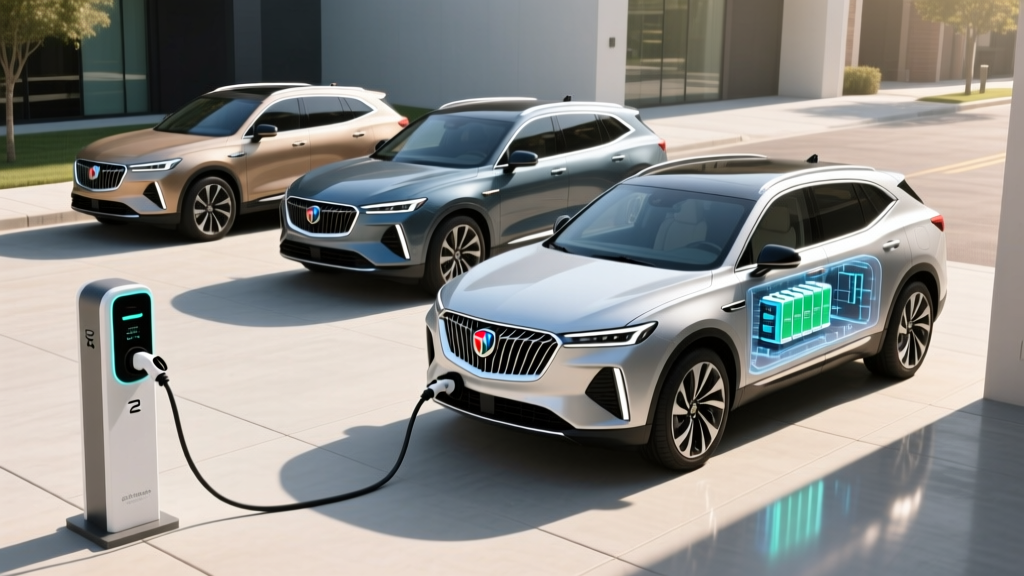
Buyers searching for a Buick hybrid SUV 2025 model year will find Buick in a transitional state. General Motors has committed to an all-electric future by 2035, and the Buick brand is leading that charge with the Electra E5 and upcoming Ultium-based models. However, for the 2025 model year, Buick's U.S. SUV lineup — the Envista, Encore GX, Enclave, and Encore — does not offer a conventional hybrid (HEV) or plug-in hybrid (PHEV) variant in the American market.
This guide breaks down exactly what Buick offers for 2025, why a Buick hybrid SUV isn't yet available stateside, what the Chinese-market Buick Velite 6 PHEV tells us about GM's hybrid strategy, and how to decide between waiting for a future Buick PHEV, choosing a competitor hybrid SUV, or jumping to a full EV like the Buick Electra E5.
Does Buick Offer a Hybrid SUV for 2025 in the U.S.?
The short answer: no. As of the 2025 model year, Buick's U.S. SUV lineup consists exclusively of gasoline-powered and battery-electric vehicles. Here's the current roster:
| Model | Powertrain | EPA Combined MPG / Range | Starting MSRP |
|---|---|---|---|
| Buick Envista | 1.2L Turbo 3-cyl (Gas) | 30 MPG combined | ~$23,495 |
| Buick Encore GX | 1.2L / 1.3L Turbo 3-cyl (Gas) | 30 MPG combined | ~$26,995 |
| Buick Enclave | 2.5L Turbo 4-cyl (Gas) | 25 MPG combined (est.) | ~$45,095 |
| Buick Encore (discontinued after 2024) | 1.2L Turbo 3-cyl (Gas) | 30 MPG combined | N/A |
| Buick Electra E5 | BEV (Ultium) | EPA est. ~300 mi range | ~$44,995 (China) |
No trim level of the Envista, Encore GX, or Enclave includes a hybrid or plug-in hybrid powertrain for the U.S. market. This stands in contrast to competitors like Toyota (RAV4 Hybrid, Highlander Hybrid), Honda (CR-V Hybrid), and Hyundai (Tucson Hybrid/PHEV), all of which offer electrified variants.
HEV vs. PHEV vs. EV: What Buick Buyers Need to Understand
Hybrid Powertrain Types Explained
Conventional Hybrid (HEV): Uses a small battery (typically 1–2 kWh) charged by regenerative braking and the engine. No plug required. Improves city MPG significantly. Example: Toyota RAV4 Hybrid.
Plug-in Hybrid (PHEV): Larger battery (12–25 kWh) that can be plugged in for 20–50 miles of electric-only driving before the gas engine engages. Requires a plug to realize full benefit. Example: Hyundai Tucson PHEV.
Battery Electric Vehicle (BEV): No gas engine. Runs entirely on a large battery pack (60–100+ kWh). Zero tailpipe emissions. Example: Buick Electra E5.
Buick's U.S. strategy has skipped the HEV/PHEV middle ground, moving directly from conventional gas to battery-electric via GM's Ultium platform. This means if you want a Buick-badged electrified vehicle today, you're looking at a full EV — or waiting.
The China-Market Buick Velite 6 PHEV: A Preview of What Could Come
GM does sell a Buick-branded PHEV in China: the Buick Velite 6 PHEV (also known as the Velite 6 Plus). While not available in the U.S., its specifications reveal the hybrid technology GM has in its toolbox:
| Spec | Buick Velite 6 PHEV (China) |
|---|---|
| Battery | ~15 kWh (NMC lithium-ion) |
| Electric-only range | ~60 km (CLTC) / ~37 miles |
| Combined system output | ~184 hp |
| Engine | 1.5L naturally aspirated 4-cyl |
| DC fast charging | No (Level 2 AC only, ~3.5 hours to full) |
| Total range | ~700+ km (CLTC) / ~435 miles combined |
The Velite 6 PHEV uses an e-CVT transmission and GM's Voltec-derived hybrid architecture — a distant relative of the system that powered the Chevrolet Volt. In China, PHEVs are heavily incentivized and popular as a bridge technology. Whether GM brings this powertrain to U.S. Buick models depends on market demand and CAFE regulatory strategy.
Real-world note: Chinese CLTC range figures are notably optimistic compared to U.S. EPA testing. A 37-mile CLTC electric range would likely translate to roughly 28–32 EPA miles if this vehicle were sold in the U.S.
Competitor Hybrid SUVs: What You Can Buy Instead
If you need a hybrid SUV today and were considering Buick for its comfort, quiet ride, and premium positioning, these are the closest competitors offering hybrid or PHEV powertrains for 2025:
| Model | Type | EPA Combined MPG | EV Range (PHEV) | Starting MSRP |
|---|---|---|---|---|
| Toyota RAV4 Hybrid | HEV | 39 MPG | N/A | ~$33,425 |
| Toyota RAV4 Prime | PHEV | 38 MPG / 94 MPGe | 42 mi | ~$44,515 |
| Honda CR-V Hybrid | HEV | 37 MPG | N/A | ~$35,395 |
| Hyundai Tucson Hybrid | HEV | 38 MPG | N/A | ~$37,750 |
| Hyundai Tucson PHEV | PHEV | 35 MPG / 80 MPGe | 33 mi | ~$40,250 |
| Ford Escape PHEV | PHEV | 39 MPG / 105 MPGe | 37 mi | ~$40,500 |
| Kia Sportage PHEV | PHEV | 38 MPG / 84 MPGe | 34 mi | ~$39,890 |
For Buick-like comfort in a hybrid: The Lexus NX 350h (HEV, 39 MPG combined, ~$42,065) or NX 450h+ (PHEV, 37 mi EV range, ~$60,765) come closest to Buick's premium aspirations with hybrid efficiency. Among mainstream brands, the Honda CR-V Hybrid Sport Touring offers the quietest cabin and most refined ride.
Real-World MPG: What Hybrid SUVs Actually Deliver
One advantage of conventional hybrids (HEVs) is that they often exceed their EPA combined MPG in real-world city driving. This is because city driving maximizes regenerative braking and electric-motor assist at low speeds — exactly where gas engines are least efficient.
Real-World MPG Expectations (HEV SUVs)
City driving: Expect EPA city MPG or slightly better. A RAV4 Hybrid rated at 41 city may return 42–44 in moderate-temperature stop-and-go traffic.
Highway driving: Expect 2–5 MPG below the EPA highway figure. Hybrids lose their regenerative advantage at sustained high speeds. A RAV4 Hybrid rated at 38 highway typically returns 34–36 at 75 mph.
Cold weather (below 30°F): Expect a 5–10% MPG drop across all hybrid types. The engine runs more often to provide cabin heat and warm up the catalytic converter.
PHEV electric range in cold: Expect 20–30% less EV range in freezing temperatures due to battery chemistry limitations and cabin heating demands.
These real-world figures matter when calculating total cost of ownership. A hybrid rated at 39 MPG combined that actually delivers 37 in mixed real-world driving still saves significantly over a gas-only SUV at 25 MPG — roughly $600–$800/year in fuel at 15,000 miles driven annually and $3.40/gallon.
Battery Warranty, Lifespan, and Replacement Costs
Hybrid Battery Warranty Standards
Federal emissions regulations require that hybrid and PHEV battery packs carry a minimum warranty of 8 years / 100,000 miles in most states, and 10 years / 150,000 miles in California and states that follow CARB standards (Colorado, Connecticut, Maine, Maryland, Massachusetts, New Jersey, New York, Oregon, Rhode Island, Vermont, Washington).
Typical warranty coverage: The battery is warranted against failure and excessive capacity loss (usually defined as dropping below 60–70% of original capacity). Check the specific manufacturer's warranty language.
Hybrid battery replacement cost (out of warranty):
- HEV (conventional hybrid): $2,000–$4,000 for the battery pack. The packs are small (1–2 kWh), keeping costs manageable.
- PHEV: $4,000–$8,000 depending on battery size. Larger packs (12–25 kWh) cost more.
- BEV: $10,000–$20,000+ depending on pack size. This is a key reason BEV warranties are critical.
Lifespan reality: Modern hybrid batteries (nickel-metal hydride and lithium-ion) routinely last 150,000–200,000+ miles before significant degradation. Toyota's hybrid system, the most proven in the market, has documented examples exceeding 300,000 miles on the original battery. Battery replacement is a legitimate but statistically uncommon expense for most original owners.
Tax Credits: Do Hybrids and PHEVs Qualify?
Under current IRS §30D Clean Vehicle Credit rules for 2025:
- Conventional hybrids (HEVs): Do NOT qualify for any federal tax credit. They lack the minimum 7 kWh battery capacity required by the law.
- Plug-in hybrids (PHEVs): May qualify for up to $7,500, but must meet all of the following criteria:
- Battery capacity ≥ 7 kWh
- MSRP ≤ $80,000 for SUVs, vans, and trucks; ≤ $55,000 for sedans
- Buyer income ≤ $300,000 (MFJ) / $225,000 (HoH) / $150,000 (single)
- Battery components and critical minerals must meet escalating domestic-sourcing thresholds (increasingly restrictive through 2025–2026)
- Final assembly in North America
- Vehicle must be on the IRS qualified vehicles list
- Point-of-sale transfer: As of 2024, qualifying buyers can transfer the credit to the dealer for an immediate price reduction rather than waiting to claim it on their tax return.
Critical sourcing caveat: The battery-sourcing requirements under §30D have tightened significantly. Many PHEVs that previously qualified have lost eligibility as critical-mineral and battery-component rules excluded vehicles with Chinese-sourced materials. Always verify current eligibility on fueleconomy.gov before purchasing, and consult a tax professional for your specific situation.
Since no Buick PHEV is sold in the U.S. for 2025, this is currently a moot point for Buick buyers. However, if Buick introduces a PHEV variant in future model years, credit eligibility will depend entirely on where GM sources the battery and minerals.
Who Should Choose a Hybrid, PHEV, or Full EV?
Choose a Hybrid (HEV) If:
- You can't charge at home or work
- You want better MPG with zero behavior change
- You drive mostly city miles
- You want to minimize upfront cost
- You plan to keep the vehicle 10+ years
Choose a PHEV If:
- You can charge at home (Level 1 or 2)
- Your daily commute is under 35 miles
- You take regular road trips beyond EV range
- You want EV-like daily driving with gas backup
- You want to qualify for potential tax credits
Choose a Full EV If:
- You have reliable home Level 2 charging
- Your daily driving is under 200 miles
- You want minimal maintenance (no oil changes, fewer moving parts)
- You want maximum tax credit ($7,500)
- You want the lowest per-mile energy cost
For Buick-loyal buyers specifically: If you can install a Level 2 home charger and your daily driving is under 200 miles, the Buick Electra E5 (when it arrives in the U.S. market) or a future Ultium-based Buick EV will likely offer a better ownership experience than waiting for a hybrid variant that may never come. If you need a hybrid today, you'll need to look at Lexus, Toyota, or Hyundai for premium-adjacent hybrid SUVs.
Frequently Asked Questions
How many MPG does the 2025 Buick Envista get?
The gas-powered 2025 Buick Envista is EPA-rated at approximately 28 city / 32 highway / 30 combined MPG with the 1.2L turbocharged 3-cylinder engine. This is competitive for a gas-only subcompact crossover but falls short of hybrid competitors that achieve 37–42 MPG combined.
Does Buick make a hybrid or PHEV SUV?
Not for the U.S. market as of 2025. Buick sells a PHEV in China (the Velite 6 PHEV) but has not announced a U.S. hybrid SUV. GM's U.S. strategy for Buick focuses on battery-electric vehicles via the Ultium platform.
Will Buick release a hybrid SUV in the future?
GM has not announced a U.S.-market Buick hybrid or PHEV. The company's stated direction for Buick is all-electric, with multiple Ultium-based EVs planned. However, GM has recently extended hybrid investment across Chevrolet and GMC, so a Buick hybrid isn't impossible — just unannounced.
What's the closest alternative to a Buick hybrid SUV?
The Lexus NX 350h (HEV, 39 MPG combined, ~$42,065) offers the closest combination of premium branding, quiet ride, and hybrid efficiency. For a PHEV, the Lexus NX 450h+ delivers 37 miles of electric range. Among mainstream brands, the Honda CR-V Hybrid Sport Touring offers near-premium refinement at ~$39,000.
Is a hybrid SUV reliable long-term?
Yes. Hybrid systems from Toyota, Honda, and Hyundai have proven exceptionally reliable. The hybrid battery is warrantied for 8–10 years / 100,000–150,000 miles, and real-world data shows these batteries frequently last 150,000–200,000+ miles. The electric motor adds fewer failure points than a conventional transmission, and regenerative braking reduces wear on brake pads.
Does a Buick hybrid qualify for a tax credit?
Since no Buick hybrid or PHEV is sold in the U.S. for 2025, there's no applicable tax credit. Conventional hybrids (HEVs) never qualify for the federal §30D credit. PHEVs may qualify if they meet battery-sourcing, MSRP, income, and assembly requirements — but this would apply only if Buick introduces a qualifying PHEV in the future.
Sources: fueleconomy.gov (EPA ratings), IRS §30D Clean Vehicle Credit, GM corporate product announcements.