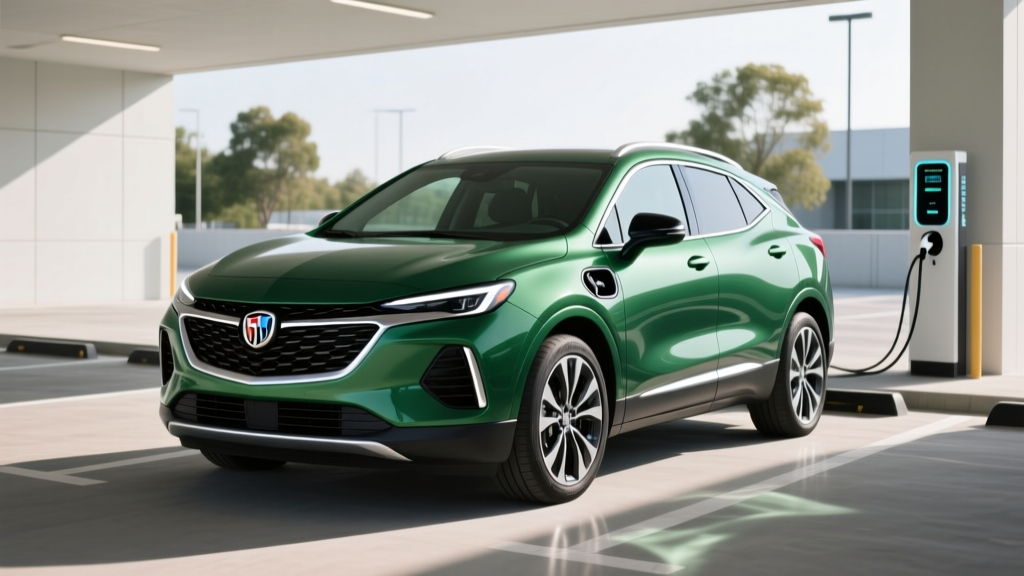
For years, Buick's lineup has been a purely gasoline affair in the United States. That changed when General Motors introduced the Buick Encore Plus PHEV for the 2025 model year, giving the brand its first plug-in hybrid in the American market heading into 2026. If you're researching Buick hybrid models, the Encore Plus PHEV is currently the sole electrified offering available from the marque — and it's worth a close look if you want electric commuting flexibility without full EV range commitment.
This guide breaks down everything you need to know: EPA fuel economy, real-world electric range, powertrain specs, charging logistics, pricing, tax credit eligibility, and long-term battery reliability. We'll also address a common question — does Buick make a conventional (non-plug-in) hybrid? — and help you decide whether this PHEV, a full BEV, or a standard gas car is the right call.
Does Buick Offer a Conventional Hybrid (HEV) or Only a PHEV?
As of the 2026 model year, Buick does not sell a conventional hybrid electric vehicle (HEV) in the United States. The only electrified Buick you can buy is the Encore Plus PHEV, a plug-in hybrid that pairs a turbocharged gasoline engine with a larger battery pack and electric motor capable of driving the vehicle on electricity alone.
HEV vs. PHEV — What's the Difference?
Conventional Hybrid (HEV): Uses a small battery (typically 1–2 kWh) recharged by regenerative braking and the engine. You never plug it in. Electric-only driving is limited to very low speeds and short distances. Example: Toyota RAV4 Hybrid.
Plug-In Hybrid (PHEV): Carries a much larger battery (12–20+ kWh) that you charge by plugging in. Delivers meaningful electric-only range (typically 25–50 miles) before the gas engine takes over. Example: Buick Encore Plus PHEV.
In China, Buick sells additional PHEV variants (including an Electra E5-based plug-in model), but these are not available in North America. For US buyers, the Encore Plus PHEV is the one and only Buick hybrid model to consider.
2026 Buick Encore Plus PHEV: Powertrain and Performance Specs
The Encore Plus PHEV uses GM's proven PHEV architecture — a 1.5-liter turbocharged four-cylinder engine mated to an electric motor integrated into the transmission. The result is a compact crossover that can run as a quiet EV for daily commutes and seamlessly switch to hybrid mode for road trips.
| Specification | 2026 Buick Encore Plus PHEV |
|---|---|
| Combined Horsepower | 212 hp (system net) |
| Gas Engine | 1.5L turbocharged I4, 163 hp |
| Electric Motor | 130 kW (174 hp) permanent-magnet |
| Battery Capacity (Usable) | 17.7 kWh (NMC lithium-ion) |
| Drivetrain | Front-wheel drive |
| Transmission | Continuously variable (e-CVT) |
| 0–60 mph | 7.4 seconds (est.) |
| Cargo Volume | 22.0 cu ft (rear seats up) |
The 17.7 kWh battery pack uses NMC (nickel manganese cobalt) chemistry, which offers higher energy density than LFP — important in a compact crossover where space is limited. The battery is liquid-cooled, which helps preserve long-term health and supports consistent performance across temperature ranges.
Fuel Economy: EPA MPG and Electric-Only Range
The Encore Plus PHEV delivers two distinct efficiency figures depending on how you drive it: an electric-only MPGe rating when running on battery, and a combined MPG rating once the gas engine takes over.
| Metric | City | Highway | Combined |
|---|---|---|---|
| Electric Mode (MPGe) | — | — | 85 MPGe |
| Gas Hybrid Mode (MPG) | 38 | 35 | 36 |
🔋 EPA Electric-Only Range: 38 Miles
Real-world expectation: Expect 30–35 miles of electric driving in mixed conditions. In cold weather (below 32°F), battery efficiency drops and cabin heating draws additional energy — plan for 22–28 miles of electric range in winter. Highway-speed driving at 70+ mph will also reduce electric range to approximately 28–32 miles. For a daily commute under 30 miles round-trip, most owners will rarely burn gas on weekdays.
Total combined range (electric + full gas tank) is approximately 430 miles, per fueleconomy.gov. That eliminates range anxiety entirely — if you forget to charge, the Encore Plus PHEV simply operates as a 36 MPG hybrid.
Real-World MPG vs. EPA: What Owners Report
PHEVs are uniquely sensitive to owner charging habits. If you charge nightly and commute within the 38-mile electric envelope, your effective "MPG" is essentially infinite for weekday driving — you might visit a gas station once a month. Owners who never plug in will see the EPA-rated 36 MPG combined, and real-world highway-heavy driving may dip to 32–34 MPG. The upside: unlike a full EV, you're never stranded if you skip a charge session.
Charging: How Long Does the Encore Plus PHEV Take to Charge?
Plug-in hybrid batteries are smaller than full EV batteries, which means charging is relatively quick — but there's a catch. The Encore Plus PHEV supports Level 2 (AC) charging only. There is no DC fast charging capability, which is typical for PHEVs in this segment.
| Charging Level | Power (kW) | Full Charge Time | Connector |
|---|---|---|---|
| Level 1 (120V household) | 1.4 kW | ~12–14 hours | J1772 |
| Level 2 (240V home/public) | 7.2 kW (max) | ~2.5 hours | J1772 |
| DC Fast Charging | Not supported | — | — |
For most PHEV owners, a Level 2 home charger is the sweet spot. A 240V outlet (the same type used for a clothes dryer) with a Level 2 wallbox will fully replenish the battery in about 2.5 hours — easily enough to top off during the workday or overnight. A standard 120V outlet works too, but at 12+ hours, it's best reserved as a backup or for occasional use.
Practical note: Because the battery is only 17.7 kWh, public Level 2 charging at places like grocery stores or workplaces can meaningfully extend your electric driving — even a 45-minute top-up at 7.2 kW adds roughly 18–20 miles of electric range.
Pricing, Trims, and Federal Tax Credit Eligibility
The 2026 Buick Encore Plus PHEV starts at an MSRP of approximately $34,900 (including destination) for the Preferred trim, with the Avenir luxury trim reaching around $39,500.
| Trim | MSRP (incl. destination) | Key Features |
|---|---|---|
| Preferred | $34,900 | 18" wheels, heated front seats, 11" infotainment, wireless CarPlay/Android Auto |
| Sport Touring (ST) | $36,700 | Sport suspension tuning, dark exterior accents, leatherette seats |
| Avenir | $39,500 | Premium leather, panoramic sunroof, Bose audio, advanced safety suite |
Does the Encore Plus PHEV Qualify for the Federal Tax Credit?
Under IRS §30D rules for the 2026 tax year, qualifying new PHEVs may receive up to $7,500 in federal tax credits — but eligibility depends on several factors that change frequently:
- Battery sourcing: Critical minerals and battery components must meet phased-in domestic-content thresholds. Check the current year's eligible vehicle list on fueleconomy.gov before purchasing.
- MSRP cap: Vans, SUVs, and pickups must have an MSRP at or below $80,000. The Encore Plus PHEV clears this easily.
- Buyer income cap: Modified adjusted gross income must not exceed $150,000 (single), $225,000 (head of household), or $300,000 (joint).
- Point-of-sale transfer: As of 2024, eligible buyers can transfer the credit to the dealer at purchase, reducing the upfront price rather than waiting for a tax refund.
- Final assembly: Vehicle must undergo final assembly in North America. The Encore Plus is assembled in South Korea — verify current eligibility as this can affect qualification.
⚠️ Important: Tax credit rules for PHEVs involve specific battery-capacity thresholds and sourcing requirements that differ from full BEVs. Consult a tax professional and verify the vehicle's eligibility on the IRS and DOE websites before relying on the credit in your budget. State incentives may also apply — check your state's energy office for local rebate programs.
Battery Warranty, Reliability, and Replacement Cost
Battery longevity is the number-one concern for hybrid and PHEV buyers. GM backs the Encore Plus PHEV's high-voltage battery with a robust warranty that aligns with industry standards.
🛡️ Battery & Powertrain Warranty
- Hybrid/EV Battery: 8 years / 100,000 miles (whichever comes first)
- Battery capacity retention: Warranty covers failure to maintain at least 70% of original capacity
- Powertrain (engine, motor, transmission): 5 years / 60,000 miles
- Bumper-to-bumper: 3 years / 36,000 miles
Is the Encore Plus PHEV Reliable?
GM's PHEV powertrain architecture has been in use since the second-generation Volt (2016–2019) and has accumulated hundreds of millions of real-world miles across the Chevrolet, Buick, and Cadillac lineups. The 1.5L turbo engine is a proven unit shared across multiple GM models. NMC battery packs from LG Energy Solution (GM's primary supplier) have demonstrated strong cycle-life performance when properly thermally managed — and the Encore Plus uses active liquid cooling.
Historically, PHEV battery packs from major manufacturers rarely require full replacement within the warranty period. Degradation of 10–15% over 8–10 years is typical, meaning you'd still see roughly 32–34 miles of electric range at year eight versus the original 38.
Battery Replacement Cost
If the battery does need replacement outside of warranty, expect a cost in the range of $4,500–$7,000 (parts and labor) for a PHEV pack of this size. That's significantly less than a full BEV battery replacement ($10,000–$20,000+), because the PHEV pack is much smaller. However, based on current degradation data, most owners will sell or trade the vehicle before a replacement becomes necessary.
Encore Plus PHEV vs. Full EV vs. Gas Car: Which Is Right for You?
Choosing between a PHEV, a full battery-electric vehicle (BEV), and a conventional gas car depends on your driving patterns, charging access, and budget. Here's a practical decision framework:
Decision Framework
Choose the Buick Encore Plus PHEV if:
- Your daily commute is under 35 miles round-trip and you can charge at home
- You take road trips of 200+ miles several times a year and don't want to plan around charging
- You want to reduce fuel costs without committing to full EV infrastructure
- You live in an area with limited public DC fast-charging stations
Choose a full EV (e.g., Chevy Equinox EV, Hyundai Ioniq 5) if:
- You have reliable Level 2 home charging and your daily driving is under 250 miles
- You want zero tailpipe emissions and minimal maintenance (no oil changes, no spark plugs)
- You qualify for the full $7,500 federal credit, which often applies more broadly to BEVs
Stick with a gas car if:
- You cannot install any home charging (apartment, street parking only)
- Your annual mileage is very low (under 8,000 miles), making the PHEV price premium hard to recoup
- You frequently tow or drive in extreme off-road conditions
Pros and Cons of the 2026 Buick Encore Plus PHEV
✅ Pros
- 38-mile electric range covers most daily commutes
- 36 MPG hybrid mode when battery is depleted
- No range anxiety — 430+ mile total range
- Quiet, smooth electric driving in EV mode
- 8-year/100,000-mile battery warranty
- Premium Buick interior at a competitive price
❌ Cons
- No DC fast charging capability
- FWD only — no AWD option
- Final assembly in South Korea may affect tax credit
- Electric range drops significantly in cold weather
- Cargo space slightly reduced vs. gas-only Encore
- Only one Buick hybrid model available — limited choice
Frequently Asked Questions About Buick Hybrid Models
How many MPG does the Buick Encore Plus PHEV get?
Once the battery is depleted and the car operates as a conventional hybrid, the EPA rates it at 38 city / 35 highway / 36 combined MPG. In electric mode, it achieves 85 MPGe combined. If you charge daily and drive within the 38-mile electric envelope, you may use very little gasoline during the workweek.
How far can the Buick Encore Plus PHEV go on electric only?
The EPA rates the Encore Plus PHEV at 38 miles of electric-only range. Real-world conditions — especially cold weather, highway speeds, and aggressive acceleration — will reduce this to approximately 28–35 miles. Total combined range (electric + gas) is roughly 430 miles.
Does Buick make a conventional hybrid that doesn't need to be plugged in?
No. As of 2026, Buick does not offer a conventional (non-plug-in) hybrid in the US market. The Encore Plus PHEV is the brand's only electrified model. If you want a vehicle you never plug in, you'd need to look at a conventional gas Buick or consider a competitor's HEV like the Toyota RAV4 Hybrid or Honda CR-V Hybrid.
Is the Buick Encore Plus PHEV reliable, and what does a battery replacement cost?
GM's PHEV powertrain has a strong reliability track record dating back to the Chevrolet Volt. The battery is covered by an 8-year/100,000-mile warranty (70% capacity retention threshold). Out-of-warranty battery replacement is estimated at $4,500–$7,000, though most PHEV batteries last well beyond the warranty period based on historical data. According to NHTSA, the Encore Plus has no major safety recalls as of early 2026.
Does the Buick Encore Plus PHEV qualify for the $7,500 federal tax credit?
It may, but eligibility depends on current-year IRS rules regarding battery component sourcing, critical minerals content, and final assembly location. The Encore Plus PHEV is assembled in South Korea, which may affect qualification under the North American final assembly requirement. Always verify on fueleconomy.gov and consult a tax professional before relying on the credit.
Do I need to install a home charger for the Encore Plus PHEV?
You don't need one, but it's strongly recommended. A standard 120V outlet (Level 1) will fully charge the battery in 12–14 hours — workable if you park for long periods. A 240V Level 2 charger cuts that to ~2.5 hours and ensures you start every day with a full battery. Home Level 2 installation typically costs $500–$2,000 depending on your electrical panel and wiring distance.
Will Buick release more hybrid or electric models?
GM has announced that Buick will transition to an all-electric lineup globally by the end of the decade. Additional EV models based on GM's Ultium platform are expected after 2026, but specific US-market models and timelines remain unannounced. The Encore Plus PHEV serves as a bridge product during this transition.
The Bottom Line on Buick Hybrid Models
The 2026 Buick Encore Plus PHEV occupies a practical middle ground: enough electric range to cover most daily commuting without gas, combined with the freedom of a 430-mile total range for road trips. At a starting price around $34,900, it undercuts many competing PHEVs while delivering a premium interior and GM's proven hybrid powertrain reliability.
If your lifestyle includes home charging access and a commute under 35 miles, the Encore Plus PHEV can function as a weekday EV and a weekend road-trip companion — without the charging-infrastructure dependency of a full BEV. Just verify federal tax credit eligibility before you buy, and plan for a Level 2 home charger to get the most from its 38-mile electric envelope.