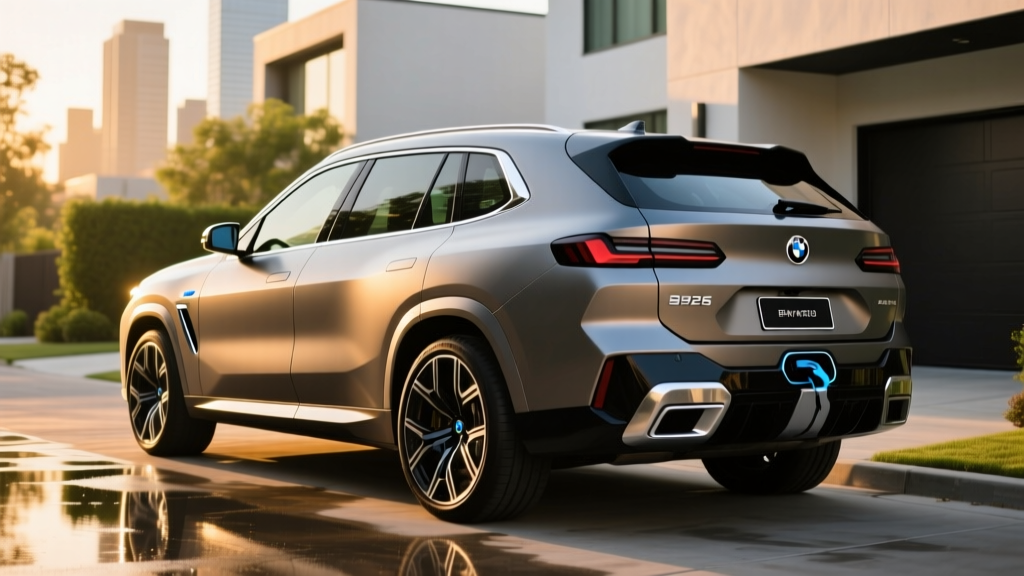
The BMW XM is an unapologetic statement: a 6,000-pound luxury performance SUV that pairs a twin-turbo V8 with a plug-in hybrid powertrain. It's not designed to maximize efficiency — it's designed to deliver supercar-rivaling acceleration while offering a short electric-only commute mode. For 2026, the BMW XM plug-in hybrid SUV lineup continues with the standard XM (644 hp) and the extreme XM Label Red (738 hp), both sharing the same PHEV architecture. If you're weighing this against a full EV like the BMW iX or a conventional luxury SUV, here's the data you need.
HEV vs PHEV: Where the BMW XM Fits
Before diving into specs, it's worth clarifying the distinction, since BMW's lineup spans both:
| Feature | Conventional Hybrid (HEV) | Plug-In Hybrid (PHEV) — BMW XM |
|---|---|---|
| Plug-in charging? | No — charges via engine/regen | Yes — Level 1 or Level 2 AC |
| Electric-only range | 0–2 miles at low speed | EPA 30 miles (XM) |
| Battery size | 1–2 kWh | 25.7 kWh gross (18.8 kWh usable) |
| Federal tax credit | None | Up to $7,500 (§30D, subject to rules) |
| Gas engine role | Primary propulsion + regen | Primary propulsion after battery depletes |
The BMW XM is strictly a PHEV. It is not a conventional hybrid like the Toyota RAV4 Hybrid — you get meaningful electric-only range and you're expected to plug it in to realize the efficiency benefit. Drive it without charging and it functions as a heavy hybrid, returning mediocre fuel economy.
Powertrain, Horsepower, and Performance Specs
| Spec | BMW XM (2026) | BMW XM Label Red (2026) |
|---|---|---|
| Engine | 4.4L Twin-Turbo V8 + electric motor | 4.4L Twin-Turbo V8 + electric motor |
| Combined Horsepower | 644 hp | 738 hp |
| Combined Torque | 590 lb-ft | 738 lb-ft |
| 0–60 mph | 4.1 seconds | 3.7 seconds |
| Battery (gross / usable) | 25.7 kWh / 18.8 kWh | 25.7 kWh / 18.8 kWh |
| Electric Motor Output | 194 hp / 207 lb-ft | 194 hp / 207 lb-ft |
| Transmission | 8-speed M Steptronic | 8-speed M Steptronic |
| Drivetrain | M xDrive AWD | M xDrive AWD |
| Curb Weight | ~5,960 lbs | ~6,030 lbs |
The electric motor is integrated into the transmission housing, providing torque fill at low RPMs and enabling pure electric driving. The V8 is BMW's S68 4.4-liter unit, a thoroughly modern twin-turbo with a hot-V configuration. Combined output makes the XM one of the most powerful production SUVs on the market.
Fuel Economy: EPA MPG, MPGe, and Real-World Expectations
| Metric | BMW XM | BMW XM Label Red |
|---|---|---|
| MPGe (combined, gas + electric) | 46 MPGe | 43 MPGe |
| MPG (gas-only, combined) | 14 MPG | 13 MPG |
| MPG City (gas-only) | 12 MPG | 12 MPG |
| MPG Highway (gas-only) | 17 MPG | 15 MPG |
| EPA Electric-Only Range | 30 miles | 28 miles |
| Total Combined Range | ~340 miles | ~320 miles |
| Fuel Tank Capacity | 18.5 gallons | 18.5 gallons |
The critical ownership insight: if you charge daily and commute under 30 miles, you may rarely use gasoline. If you don't charge, you're driving a 6,000-pound SUV that gets worse fuel economy than a conventional BMW X5 xDrive40i (22 MPG combined). The PHEV premium only pays off with regular plug-in use.
Charging: Battery Size, Speeds, and Home Setup
The BMW XM uses a 25.7 kWh gross (18.8 kWh usable) lithium-ion battery pack. Here's what charging looks like across levels:
| Charging Level | Power (kW) | Time (0–100%) | Notes |
|---|---|---|---|
| Level 1 (120V household) | ~1.4 kW | ~14 hours | Emergency/trickle only |
| Level 2 (240V, 32A) | 7.4 kW | ~3.25 hours | Standard home wallbox |
| Level 2 (240V, 48A) | 7.4 kW (max onboard) | ~3.25 hours | XM caps at 7.4 kW onboard |
| DC Fast Charge | Not supported | N/A | AC charging only |
No DC fast charging. The BMW XM cannot use CCS or NACS DC fast chargers. This is common for PHEVs with smaller batteries — the 18.8 kWh usable pack charges adequately on Level 2 overnight. A 7.4 kW onboard charger means a full charge in roughly 3 hours, which suits nightly home charging. If you rely on public infrastructure, this is a significant limitation: you cannot top up quickly on a road trip.
The charging port is located on the driver-side front fender and uses a J1772 connector (standard for AC charging in North America). A Level 2 home installation typically costs $800–$2,000 including a quality wallbox and electrician labor, depending on panel proximity and permit requirements.
Pricing, Trims, and Federal Tax Credit Eligibility
| Trim | 2026 MSRP (est.) | Federal §30D Credit Eligibility |
|---|---|---|
| BMW XM | ~$160,000 | Not eligible (MSRP cap exceeded) |
| BMW XM Label Red | ~$185,000 | Not eligible (MSRP cap exceeded) |
Tax credit reality check: Under IRS §30D rules, the federal plug-in vehicle tax credit has an MSRP cap of $80,000 for SUVs, pickups, and vans. Both BMW XM trims far exceed this threshold, making them ineligible for the federal credit regardless of battery sourcing or buyer income. This is confirmed by IRS guidelines on clean vehicle credits.
Some states offer their own PHEV incentives that may not carry the same MSRP caps — California's CVRP program, for example, has its own income and price structures. Check your state's energy office or DMV for current local incentives. Additionally, if you lease rather than purchase, the commercial clean vehicle credit (§45W) may allow the lessor to pass savings through, though lease terms vary by dealer.
Battery Warranty, Reliability, and Replacement Cost
BMW's PHEV powertrains have proven generally reliable in models like the X5 xDrive45e, which shares architectural DNA with the XM. The S68 V8 is relatively new, and long-term reliability data specific to the XM is still accumulating. Common PHEV concerns across brands include onboard charger failures and high-voltage cooling system issues — both covered under warranty.
Battery replacement cost: Out of warranty, a BMW XM high-voltage battery replacement is estimated at $12,000–$18,000 including parts and labor, based on comparable BMW PHEV battery pricing. However, BMW's battery management system uses a generous buffer (roughly 6.9 kWh of the 25.7 kWh gross is reserved) to minimize degradation. Real-world PHEV battery degradation from BMW's 4th- and 5th-generation eDrive systems has been modest — most owners report 90%+ capacity retention after 5 years of normal use.
The XM's conventional 12V starter battery is separate and may need replacement every 4–6 years like any vehicle (~$300–$500).
Who Should Buy the BMW XM PHEV vs a Full EV or Gas SUV?
Choose the BMW XM PHEV if:
- You want 600+ horsepower with the option of silent, zero-emission commuting under 30 miles
- You have reliable home Level 2 charging and a short daily commute
- You take frequent long road trips where EV charging infrastructure is still inconsistent
- You value M Division performance and exclusivity over efficiency
Choose a full EV (e.g., BMW iX M60) if:
- You want 300+ miles of range with no gasoline dependency
- You have home charging and want lower per-mile energy costs
- You prefer DC fast charging for road trips (200+ kW capability)
- You want to minimize maintenance (no oil changes, no V8 complexity)
Choose a conventional gas SUV if:
- You lack home charging access entirely
- You want lower upfront cost and simpler ownership
- You don't need electric-only driving capability
- 644–738 hp from a plug-in powertrain
- 30 miles electric-only covers many commutes
- M Division chassis tuning and exclusivity
- No range anxiety on long trips — gas tank backup
- 8-year/80,000-mile battery warranty
- 12–14 MPG gas-only once battery depletes
- No DC fast charging
- $160K+ MSRP — no federal tax credit
- Heavy curb weight affects handling and tire wear
- Polarizing exterior design
- Real-world electric range drops to ~24 mi in cold weather
Frequently Asked Questions
How many MPG does the BMW XM plug-in hybrid SUV get?
With a full battery charge, the BMW XM achieves 46 MPGe combined (gas + electric). Once the battery is depleted, it returns an EPA-estimated 14 MPG combined on gasoline alone (12 city / 17 highway). Real-world gas-only driving often yields 12–13 MPG in mixed conditions due to the vehicle's weight and performance tuning.
How far can the BMW XM go on electric only?
The EPA rates the BMW XM at 30 miles of electric-only range. In real-world conditions — highway speeds, cold weather, or aggressive acceleration — expect 24–27 miles. The XM Label Red is rated at 28 miles EPA due to its higher-output tuning and slightly greater weight.
Does the BMW XM qualify for the federal EV tax credit?
No. Under current IRS §30D rules, SUVs must have an MSRP at or below $80,000 to qualify for the federal plug-in vehicle tax credit. The BMW XM starts around $160,000, well above the cap. State-level incentives may still apply — check your local program for details. Consult a tax professional for eligibility guidance.
Can the BMW XM use DC fast chargers?
No. The BMW XM supports only AC charging (Level 1 and Level 2) via a J1772 connector. Its onboard charger maxes out at 7.4 kW, meaning a full charge takes about 3.25 hours on a 240V Level 2 wallbox. DC fast charging (CCS or NACS) is not available on this PHEV.
Is the BMW XM reliable, and what does battery replacement cost?
BMW's PHEV systems have shown solid reliability in related models (X5 xDrive45e, 745e). The high-voltage battery is warranted for 8 years/80,000 miles at a 70% capacity retention threshold. Out-of-warranty battery replacement is estimated at $12,000–$18,000. The generous battery buffer (~6.9 kWh reserved) helps minimize real-world degradation over the vehicle's lifespan.
How does the BMW XM compare to the BMW iX as a family SUV?
The BMW iX xDrive50 offers 324 miles of EPA range, DC fast charging at 200 kW, and a starting MSRP around $87,000 — it's more efficient, cheaper, and more practical for daily use. The XM trades efficiency for extreme performance (644+ hp) and the flexibility of a gas engine for road trips. For most families, the iX is the rational choice; the XM is a performance statement.
Do I need to plug in the BMW XM every night?
You don't have to — the XM will operate as a hybrid on gasoline alone. But to realize any efficiency benefit from the PHEV system, nightly Level 2 charging is strongly recommended. Without regular charging, you're paying a premium for a powertrain you're not utilizing, and fuel economy drops to 12–14 MPG.
Sources: fueleconomy.gov, IRS §30D Clean Vehicle Credits, BMW USA XM Specifications.