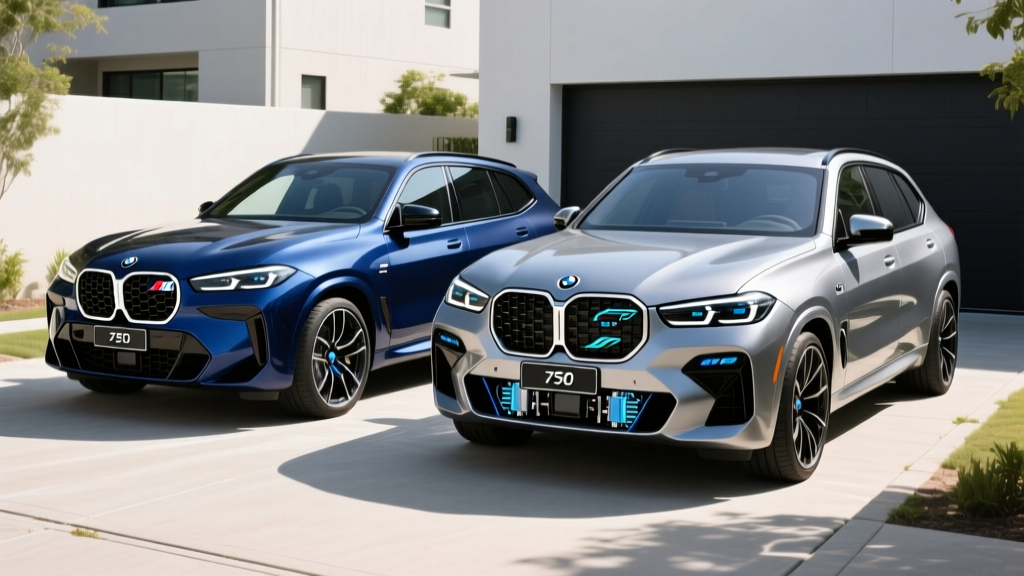
BMW's M division has embraced electrification, but not in the way most enthusiasts expected. Rather than building a pure electric super-SUV, BMW M has channeled plug-in hybrid (PHEV) technology into its performance lineup — pairing twin-turbo V8 engines with electric motors for combined outputs that rival hypercars while offering short electric-only commutes. The result is the BMW M hybrid portfolio: headlined by the flagship XM and the performance-luxury 750e xDrive sedan.
These aren't economy-minded hybrids. They're performance machines that happen to plug in. That distinction matters for buyers weighing a BMW M hybrid against a full BEV like the iX or i7, or against a conventional luxury SUV. Below, we break down the powertrains, real-world efficiency, charging logistics, tax-credit eligibility, and battery longevity so you can decide whether BMW's M hybrid approach fits your driving life.
BMW M Hybrid Lineup: HEV vs. PHEV Clarified
Before diving into specs, it's worth defining what BMW M actually sells versus what the broader BMW lineup includes, because the terminology matters.
Conventional Hybrid (HEV)
A conventional hybrid uses a small battery (typically 1–2 kWh) charged by regenerative braking and the engine. You never plug it in. It improves MPG modestly, especially in city driving. BMW's non-M models like the X5 xDrive50e offer mild-hybrid systems, but no current BMW M-badged vehicle is a conventional HEV.
Plug-In Hybrid (PHEV)
A PHEV carries a much larger battery (18–26 kWh in BMW's case) that you charge via a plug. It delivers meaningful electric-only range (25–40 miles) before the gasoline engine engages. Every BMW M hybrid is a PHEV. The XM and the M-tuned 750e xDrive both fall into this category.
If you're searching for a "BMW M hybrid," you're looking at PHEVs that require plug-in access to unlock their efficiency and tax-credit benefits. Without regular charging, a PHEV operates as a heavy conventional hybrid — and heavy means worse MPG.
BMW XM: The M Division's PHEV Flagship
The BMW XM is the first standalone M vehicle since the M1 of the 1970s, and it's exclusively a plug-in hybrid. For the 2025–2026 model years, it's offered in two trims: the XM (standard) and the XM Label (formerly Label Red).
| Specification | XM (Standard) | XM Label |
|---|---|---|
| Combined Horsepower | 644 hp | 745 hp |
| Combined Torque | 590 lb-ft | 738 lb-ft |
| Engine | 4.4L Twin-Turbo V8 (483 hp) | 4.4L Twin-Turbo V8 (577 hp) |
| Electric Motor | 194 hp (integrated in transmission) | 194 hp (integrated in transmission) |
| Battery Capacity | 25.7 kWh (gross) / ~19.2 kWh usable | 25.7 kWh (gross) / ~19.2 kWh usable |
| Battery Chemistry | NMC (nickel manganese cobalt) | NMC (nickel manganese cobalt) |
| EPA Electric-Only Range | 30 miles | 30 miles |
| Total Combined Range | ~370 miles (est.) | ~370 miles (est.) |
| EPA MPGe (Electric + Gas) | 46 MPGe | 43 MPGe |
| MPG (Gas Only, Combined) | 14 MPG | 12 MPG |
| 0–60 mph | 4.1 seconds | 3.7 seconds |
| Max AC Charging (Level 2) | 7.4 kW | 7.4 kW |
| DC Fast Charging | Not supported | Not supported |
| Charge Time (0–100%, Level 2) | ~3.25 hours | ~3.25 hours |
| Base MSRP | $159,995 | $185,995 |
A few realities emerge from this spec sheet. First, the electric-only range of 30 miles is modest — enough for a short commute or school run, but not a full day of mixed driving. Second, once the battery depletes, the XM's gas-only fuel economy is dismal at 12–14 MPG combined. This is a 6,000+ pound V8 SUV; the electric motor offsets weight at low speeds, but the engine drinks fuel when it's doing the heavy lifting.
Third, the XM does not support DC fast charging. That's a significant limitation shared with most PHEVs. You're limited to Level 2 AC charging at 7.4 kW, which means home or workplace charging is your only practical refueling strategy for the battery. A full charge from empty takes roughly 3.25 hours on a 240V Level 2 circuit.
BMW 750e xDrive: The M-Adjacent PHEV Sedan
While not officially an M car, the BMW 750e xDrive carries M Sport package options and M-tuned adaptive suspension, making it relevant to M hybrid shoppers who want performance sedan dynamics with plug-in efficiency. It's also considerably more efficient than the XM.
| Metric | Value |
|---|---|
| EPA Electric-Only Range | 34 miles |
| EPA MPGe (Combined) | 54 MPGe |
| EPA MPG (Gas Only, City) | 24 MPG |
| EPA MPG (Gas Only, Highway) | 27 MPG |
| EPA MPG (Gas Only, Combined) | 25 MPG |
| Battery Capacity | 18.7 kWh (gross) / ~15.5 kWh usable |
| Combined Horsepower | 483 hp |
| 0–60 mph | 4.5 seconds |
| Base MSRP | $107,895 |
The 750e xDrive uses a 3.0L turbocharged inline-six paired with an electric motor — a lighter, more efficient combination than the XM's V8. Its gas-only MPG of 25 combined is dramatically better, and the 34-mile electric range covers most daily commutes. If your priority is efficiency with M-Sport aesthetics rather than a full M badge, this sedan delivers a more livable package.
Real-World MPG vs. EPA: What to Actually Expect
EPA ratings for PHEVs are notoriously tricky to interpret because they blend electric and gasoline operation into a single MPGe figure. Your actual experience depends entirely on how often you charge.
BMW XM Real-World Expectations:
- Electric range: EPA rates 30 miles. Expect 24–28 miles in mixed driving; 18–22 miles in cold weather (below 35°F) or at sustained highway speeds above 70 mph.
- Gas-only MPG: EPA rates 14 combined. Real-world highway driving often yields 15–17 MPG; city stop-and-go without charge can drop to 11–12 MPG.
- If you charge nightly and commute under 25 miles: You may use gasoline only on weekend road trips, achieving an effective personal economy far above the EPA sticker.
- If you never charge: You're driving a 6,000-lb V8 SUV at 12–14 MPG. The PHEV premium becomes dead weight.
The 750e xDrive is more forgiving. Its gas-only 25 MPG combined is reasonable for a luxury sedan even without charging, and diligent plug-in owners can go weeks between fill-ups on short commutes.
Charging Logistics: Level 2 Only, No DC Fast Charge
This is the section where many PHEV buyers face an unpleasant surprise. Neither the BMW XM nor the 750e xDrive supports DC fast charging. This is standard for PHEVs — the battery is too small to justify the cost and weight of DC hardware — but it has practical implications.
| Charging Level | Power (kW) | XM Charge Time (0–100%) | 750e Charge Time (0–100%) |
|---|---|---|---|
| Level 1 (120V household outlet) | ~1.4 kW | ~18 hours | ~13 hours |
| Level 2 (240V, home or public) | 7.4 kW (max) | ~3.25 hours | ~2.5 hours |
| DC Fast Charging | N/A | Not supported | Not supported |
Home charging is essential. A Level 2 home charger (240V, 32–40 amp circuit) will fully replenish either vehicle overnight. Installation typically costs $800–$2,000 depending on panel capacity and run length, though some homes require a panel upgrade ($1,500–$3,500 additional) if the existing electrical service is near capacity. Level 1 charging from a standard outlet is technically possible but impractical — at 1.4 kW, it takes 13–18 hours for a full charge, which barely covers daily use even with long overnight parking.
On road trips, the PHEV battery is irrelevant for fast charging. You'll simply drive on gasoline, and the XM's 12–14 MPG means fuel stops every 200–250 miles with its ~25-gallon tank.
Federal Tax Credit Eligibility: The §30D Reality for BMW M Hybrids
The federal clean vehicle credit under IRS §30D offers up to $7,500 for qualifying new PHEVs, but eligibility hinges on three strict criteria that change frequently and vary by model year:
- MSRP Cap: SUVs must have an MSRP at or below $80,000; sedans at or below $55,000. The BMW XM ($159,995+) and 750e xDrive ($107,895+) both exceed these caps — neither qualifies for the new-vehicle §30D credit.
- Battery Sourcing Requirements: Critical minerals and battery components must meet phased-in domestic/FRTA-country sourcing thresholds. Even if pricing qualified, BMW's battery supply chain may not meet 2026 thresholds.
- Buyer Income Limits: AGI caps apply ($300K joint / $225K head of household / $150K single). Most BMW M hybrid buyers likely exceed these, though it varies.
The bottom line: do not expect a federal tax credit on a new BMW XM or 750e xDrive. The MSRP caps alone disqualify both vehicles. Some state-level incentives (California's CVRP, for example, has its own income and price limits) may offer partial rebates, but these are typically $1,000–$2,000 at most for PHEVs and come with their own eligibility restrictions. Check your state's energy office for current programs.
One avenue that can work: the used EV credit (§25E) offers up to $4,000 or 30% of the sale price (whichever is less) for qualifying pre-owned PHEVs priced at $25,000 or below. Given the XM's depreciation trajectory, a 3–4 year-old example could eventually qualify — though likely not before 2028–2029.
Battery Longevity, Warranty, and Replacement Cost
BMW PHEV High-Voltage Battery Warranty:
- Coverage: 8 years or 80,000 miles (whichever comes first)
- Capacity retention threshold: BMW warrants against defects and excessive capacity loss. Industry standard defines "excessive" as dropping below 70% of original capacity within the warranty period.
- What's covered: Cell defects, BMS failures, thermal management system issues.
- What's not covered: Normal degradation within the threshold, damage from accidents or improper charging equipment.
PHEV batteries experience less stress than full BEV batteries because they operate in a narrower state-of-charge window — BMW's battery management system maintains a buffer at the top and bottom to prevent deep cycling. This extends calendar life. Real-world data from earlier BMW PHEVs (X5 xDrive45e, 330e) suggests 85–92% capacity retention at 100,000 miles under normal use.
If replacement is needed out of warranty, BMW's high-voltage battery for the XM or 7-series PHEV runs $12,000–$18,000 including labor, based on current dealer pricing for comparable BMW PHEV packs. That's a significant sum, though the probability of needing it within the first decade is low based on historical failure rates.
For long-term ownership confidence, BMW's 8-year/80,000-mile warranty aligns with federal mandates for emissions-related components and matches competitors like Mercedes-AMG and Porsche. It's adequate, though Hyundai/Kia's 10-year/100,000-mile hybrid battery warranty remains the segment benchmark.
BMW M Hybrid vs. Full EV vs. Gas: Decision Framework
Choose the BMW XM PHEV if:
- You want 745 hp and M exclusivity without range anxiety on long road trips
- You have reliable Level 2 home charging and a commute under 30 miles
- You accept 12–14 MPG when the battery is depleted
- You value the ability to drive electrically through residential areas and switch to V8 on open roads
Choose the 750e xDrive PHEV if:
- You want M-Sport aesthetics with better fuel economy (25 MPG gas-only)
- Your daily commute is under 30 miles and you'll charge nightly
- You want a performance sedan without committing to the i7's $120K+ price
Choose a full EV (BMW iX M60, i7 M70) instead if:
- You have consistent home and/or workplace charging
- You want zero tailpipe emissions and no gasoline maintenance (oil changes, spark plugs)
- Your road trips are under 300 miles or you're comfortable with DC fast-charging stops
- You want lower running costs — electricity at $0.14/kWh costs roughly $0.04/mile vs. $0.20+/mile for the XM on gas
Choose a conventional gas vehicle if:
- You cannot install a Level 2 charger at home and lack workplace charging
- You regularly tow or take long road trips where PHEV weight is a penalty
- The $160K+ XM price is already at your ceiling and you'd rather allocate budget elsewhere
Pros and Cons at a Glance
Pros
- Supercar-level horsepower (644–745 hp XM) with electric torque fill
- 30-mile EV range covers most daily commutes emission-free
- No range anxiety — V8 and gas tank for long trips
- M-exclusive styling and chassis tuning
- Level 2 home charging is sufficient; no DC infrastructure dependency
Cons
- 12–14 MPG gas-only (XM) is among the worst in the luxury SUV segment
- No DC fast charging — road trips are 100% gasoline
- MSRP far exceeds §30D tax credit caps — no federal incentive
- PHEV system adds ~500 lbs of weight, hurting handling and tire wear
- Battery replacement cost ($12K–$18K) is a long-term ownership risk
- Electric range drops to ~20 miles in cold weather
Frequently Asked Questions
How many MPG does the BMW XM hybrid get?
The BMW XM achieves 46 MPGe when operating in blended electric-gas mode (EPA combined). Once the battery is depleted, it runs on gasoline only at an EPA-rated 14 MPG combined (XM standard) or 12 MPG combined (XM Label). Real-world gas-only figures range from 11–17 MPG depending on driving style and conditions. The 750e xDrive sedan is more efficient at 25 MPG combined on gas alone.
How far can the BMW XM go on electric only?
The EPA rates the XM at 30 miles of electric-only range. In real-world mixed driving, expect 24–28 miles. In cold weather (below 35°F) or at sustained highway speeds above 70 mph, that range drops to approximately 18–22 miles. The 750e xDrive offers slightly more at 34 miles EPA-rated.
Does the BMW XM hybrid qualify for a tax credit?
No. The IRS §30D federal clean vehicle credit caps SUV MSRPs at $80,000 and sedans at $55,000. The XM starts at $159,995 and the 750e xDrive at $107,895 — both far exceed these limits. State incentives vary; check your local energy authority for PHEV rebates that may apply.
Is the BMW XM hybrid reliable, and what does battery replacement cost?
BMW's PHEV powertrain is relatively new in the XM, so long-term reliability data is still accumulating. Earlier BMW PHEVs (X5 xDrive45e, 330e) have shown strong battery durability with 85–92% capacity retention at 100,000 miles. The high-voltage battery is warranted for 8 years/80,000 miles. Out-of-warranty replacement runs $12,000–$18,000 including labor. The twin-turbo V8 and 8-speed transmission are proven components with established service histories.
Can I charge the BMW XM at a Tesla Supercharger or DC fast charger?
No. The BMW XM and 750e xDrive do not support DC fast charging of any kind — no CCS, no NACS, no CHAdeMO. They accept only AC charging via a J1772 connector at up to 7.4 kW (Level 2). Home charging on a 240V circuit is the primary and most practical charging method, delivering a full charge in approximately 3.25 hours.
Hybrid vs. PHEV vs. EV — which BMW fits my lifestyle?
If you have home charging and a commute under 30 miles, the XM or 750e PHEV lets you drive electrically most weekdays while retaining a gas engine for road trips. If you want zero gasoline dependency and your trips are under 300 miles (or you don't mind DC charging stops), BMW's iX M60 or i7 M70 full EVs deliver better running costs and smoother operation. If you lack any charging access, a PHEV becomes a heavy, inefficient gas vehicle — consider a conventional model instead.
Sources: EPA fuel economy data via fueleconomy.gov; BMW USA specifications at bmwusa.com; IRS clean vehicle credit rules at irs.gov.