The Lexus Small Hybrid SUV Lineup: UX 250h vs. NX 350h at a Glance
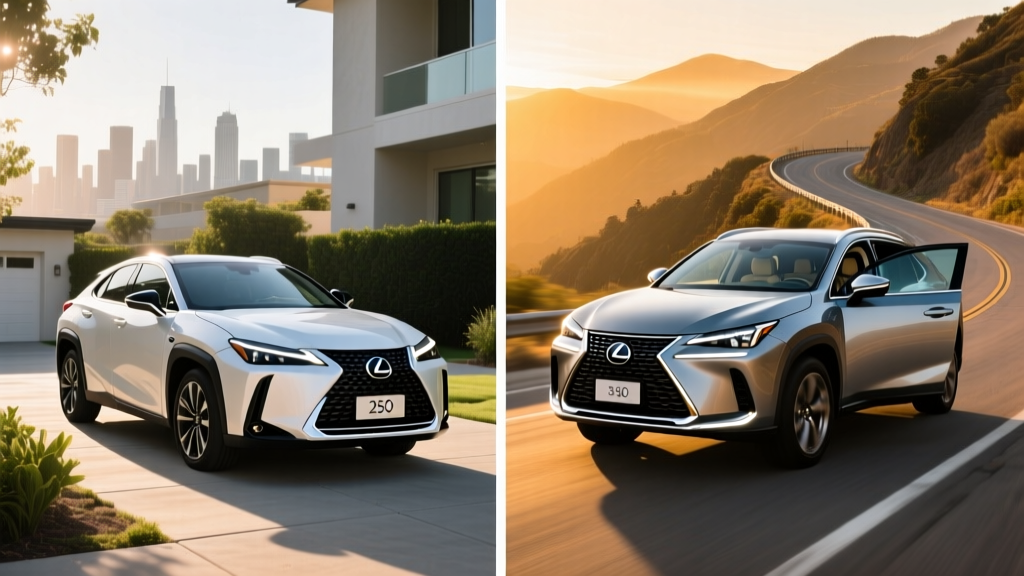
When shoppers search for a Lexus small hybrid SUV, they're looking at two distinct models that serve different needs. The Lexus UX 250h is a subcompact crossover built for urban efficiency and budget-conscious luxury, while the Lexus NX 350h steps up into the compact segment with more interior volume, a plug-in hybrid option (NX 450h+), and a more premium cabin. Both use Toyota's proven hybrid synergy drive architecture, but their powertrains, efficiency profiles, and price points diverge significantly.
Before we dig into the numbers, a critical distinction: the UX 250h and NX 350h are conventional hybrids (HEVs) — they generate electricity through regenerative braking and the gasoline engine, so you never plug them in. The NX 450h+ is a plug-in hybrid (PHEV) with a larger battery you charge from a wall outlet or public charger, giving it meaningful electric-only range before the gas engine kicks in.
HEV vs. PHEV: What's the Difference?
| Feature | Conventional Hybrid (HEV) | Plug-In Hybrid (PHEV) |
|---|---|---|
| Plugs in to charge? | No — self-charging via regen + engine | Yes — Level 1/Level 2 AC charging |
| Electric-only range | Less than 1 mile at low speeds | 37 miles (NX 450h+) |
| Battery size | ~1.4 kWh (small buffer) | 18.1 kWh usable |
| DC fast charging | No | No (AC only, up to 6.6 kW) |
| Federal tax credit | None under §30D | Up to $7,500 (subject to eligibility) |
| Best for | No home charging access; want simplicity | Home charging + short daily commutes |
2026 Lexus UX 250h: MPG, Powertrain, and Real-World Efficiency
The UX 250h pairs a 2.0-liter four-cylinder Atkinson-cycle engine with two electric motors (front and rear, enabling electronic Awd) through Toyota's e-CVT. Total system output is 181 horsepower. The hybrid battery is a compact nickel-metal hydride (NiMH) pack, approximately 1.4 kWh, used as a buffer — not for sustained electric-only driving.
| Spec | 2026 Lexus UX 250h |
|---|---|
| Powertrain | 2.0L I4 + 2 electric motors (e-CVT, AWD) |
| Combined HP | 181 hp |
| 0-60 mph | ~7.9 seconds |
| Battery | ~1.4 kWh NiMH (self-charging) |
| EPA MPG (City / Hwy / Combined) | 43 / 41 / 42 MPG |
| Fuel tank | 10.6 gallons |
| Total range | ~445 miles |
| Base MSRP (UX 250h Premium) | $38,990 |
| Federal tax credit | None (HEV not eligible under §30D) |
How Many MPG Does the Lexus UX 250h Actually Get?
The EPA rates the UX 250h at 43 city / 41 highway / 42 combined MPG per fueleconomy.gov. Here's where real-world driving gets interesting: Lexus hybrids routinely exceed their EPA city estimates because regenerative braking recaptures more energy in stop-and-go traffic. In mixed urban testing, owners commonly report 44-46 MPG on city-dominant commutes. Highway driving at 75+ mph, however, can drop efficiency to 36-38 MPG since the small engine works harder without regen assistance. Cold weather (below 30°F) reduces efficiency by roughly 5-8% due to increased engine warm-up cycles and cabin heating demands.
Battery Warranty & Replacement Cost
Lexus covers the UX 250h hybrid battery for 10 years or 150,000 miles (whichever comes first) — one of the longest hybrid battery warranties in the luxury segment. Out-of-warranty replacement for the UX 250h NiMH pack typically runs $2,500–$3,500 including labor at a dealership. Independent hybrid specialists often offer refurbished units for $1,500–$2,200. Given Toyota/Lexus hybrid battery longevity data, most packs last well beyond 150,000 miles before significant degradation.
2026 Lexus NX 350h and NX 450h+: Compact Hybrid SUV Specs
The NX is larger than the UX — roughly 7 inches longer with significantly more rear legroom and cargo space. It's available in two hybrid flavors: the conventional NX 350h and the plug-in NX 450h+.
| Spec | 2026 NX 350h (HEV) | 2026 NX 450h+ (PHEV) |
|---|---|---|
| Powertrain | 2.5L I4 + 2 motors (e-CVT, AWD) | 2.5L I4 + 2 motors (e-CVT, AWD) |
| Combined HP | 240 hp | 304 hp |
| 0-60 mph | ~7.2 seconds | ~6.0 seconds |
| Battery | ~1.6 kWh NiMH | 18.1 kWh lithium-ion |
| EPA MPG (Combined) | 39 MPG (37 city / 41 hwy) | 84 MPGe combined; 36 MPG gas-only |
| Electric-only range | N/A | 37 miles |
| Total range | ~560 miles | ~510 miles (37 EV + ~473 gas) |
| Level 2 charge time | N/A | ~3.5 hours (240V, 16A) |
| DC fast charging | No | No (AC only, 6.6 kW max) |
| Base MSRP | $46,990 | $60,990 |
| Federal tax credit | None | Up to $7,500 (see eligibility below) |
NX 450h+ Electric-Only Range: How Far Can It Go?
The EPA rates the NX 450h+ at 37 miles of electric-only range. In real-world driving, expect 32-35 miles in moderate temperatures (55-75°F) with mixed city/highway use. In cold weather (below 30°F), that drops to approximately 25-28 miles as the battery's usable capacity shrinks and cabin heating draws power. Highway-speed electric-only driving (65+ mph) also reduces range versus the EPA's mixed-cycle test. For commuters with a round trip under 30 miles and home Level 2 charging, the NX 450h+ can operate almost entirely on electricity on weekdays, with the gasoline engine reserved for longer trips.
The 18.1 kWh lithium-ion battery charges via a standard J1772 connector at up to 6.6 kW on Level 2 (240V). A full charge takes approximately 3.5 hours. There is no DC fast charging capability — this is typical for PHEVs in this class, as the battery is small enough that Level 2 is practical for overnight or workplace top-ups.
| Model | EPA City | EPA Highway | EPA Combined | Real-World Combined (est.) |
|---|---|---|---|---|
| UX 250h | 43 MPG | 41 MPG | 42 MPG | 40-46 MPG (city-biased vs. hwy-biased) |
| NX 350h | 41 MPG | 37 MPG | 39 MPG | 37-42 MPG |
| NX 450h+ (gas-only mode) | 38 MPG | 34 MPG | 36 MPG | 33-38 MPG |
Pricing, Trims, and Federal Tax Credit Eligibility
Here's where the math matters most. The UX 250h starts at approximately $38,990 for the Premium trim, climbing to around $46,000 for a fully loaded F SPORT Handling model. The NX 350h begins at $46,990 (Premium) and reaches roughly $56,000 at the Luxury trim. The NX 450h+ PHEV commands a significant premium at $60,990 and up.
Does the Lexus NX 450h+ Qualify for the Federal Tax Credit?
The NX 450h+ may qualify for a federal plug-in hybrid tax credit under IRS §30D, but eligibility is not automatic. Under current rules, several conditions must be met:
- MSRP cap: The vehicle's MSRP must not exceed $80,000 for SUVs (the NX 450h+ clears this at most trims).
- Buyer income cap: Modified adjusted gross income must be ≤ $150,000 (single), $225,000 (head of household), or $300,000 (joint).
- Battery sourcing: Critical minerals and battery components must meet phased-in domestic/free-trade sourcing percentages that tighten each year. This is the most volatile requirement — confirm current-year compliance with your dealer and IRS guidance.
- Point-of-sale transfer: You can apply the credit as an instant rebate at the dealership (reducing your out-of-pocket cost) or claim it on your tax return.
The conventional hybrids (UX 250h, NX 350h) do not qualify for the §30D federal credit, as it applies only to plug-in vehicles with ≥7 kWh of battery capacity. Some states offer separate incentives for HEVs — check your state's energy office for current programs.
Reliability, Battery Lifespan, and Long-Term Ownership
Lexus consistently ranks at or near the top of J.D. Power and Consumer Reports reliability surveys, and its hybrid powertrains are among the most proven in the industry. The Toyota Hybrid System that underpins both the UX and NX has been in production since 1997 (Prius), with billions of cumulative real-world miles.
Hybrid battery degradation in Lexus models is typically minimal — expect 5-10% capacity loss over 10 years for the NiMH packs in the UX 250h and NX 350h. The lithium-ion pack in the NX 450h+ may see slightly more measurable degradation (8-12% over 10 years), but the larger buffer means this rarely impacts the 37-mile electric range significantly within the warranty period.
Lexus Hybrid Battery Warranty Summary
| Model | Battery Type | Warranty | Est. Replacement Cost |
|---|---|---|---|
| UX 250h | NiMH (~1.4 kWh) | 10 years / 150,000 miles | $2,500–$3,500 |
| NX 350h | NiMH (~1.6 kWh) | 10 years / 150,000 miles | $3,000–$4,000 |
| NX 450h+ | Lithium-ion (18.1 kWh) | 10 years / 150,000 miles | $6,000–$9,000 |
Source: Lexus warranty documentation; replacement costs are dealer estimates and vary by region.
The powertrain (engine, e-CVT, motors) carries a 6-year/70,000-mile warranty, and the basic vehicle warranty is 4 years/50,000 miles. Lexus also includes 2 years of complimentary scheduled maintenance.
Hybrid vs. PHEV vs. Full EV: Which Lexus Small SUV Is Right for You?
Choose the UX 250h (HEV) if:
- You want the lowest purchase price and simplest ownership experience
- You don't have access to home or workplace charging
- Your priority is maximum MPG with zero plug-in hassle
- You primarily drive in urban or suburban environments
Choose the NX 350h (HEV) if:
- You need more cargo room and rear-seat space than the UX offers
- You want a more powerful powertrain (240 hp) without plugging in
- You value a quieter, more refined cabin with higher-end materials
Choose the NX 450h+ (PHEV) if:
- You have Level 2 charging at home or work
- Your daily commute is under 35 miles round-trip
- You want to drive mostly on electricity but need gas-engine flexibility for road trips
- You can take advantage of the potential $7,500 federal tax credit (effectively bringing the price close to a loaded NX 350h)
Consider a full EV (e.g., Lexus RZ 450e) if:
- You have reliable home Level 2 charging
- Your typical trips fall within the EV's range (RZ: ~220 miles EPA)
- You want to eliminate gasoline entirely and minimize maintenance
UX 250h Pros
- 42 MPG combined — best-in-class for luxury subcompact
- Low starting price for a luxury hybrid SUV
- Standard AWD with no efficiency penalty
- Proven hybrid reliability with 10-year battery warranty
UX 250h Cons
- Tight rear seat and limited cargo volume (17.1 cu ft)
- Modest 181 hp — adequate but not quick
- No plug-in option available
- Infotainment learning curve for new Lexus Interface
NX 450h+ Pros
- 37 miles electric-only covers most commutes
- 304 hp — quickest NX variant
- Potential $7,500 federal tax credit
- 510+ miles total range eliminates range anxiety
NX 450h+ Cons
- $60,990 starting price — $14K premium over NX 350h
- No DC fast charging (3.5-hour Level 2 only)
- Tax credit eligibility depends on sourcing rules and income caps
- Heavier than NX 350h, slightly lower gas-only MPG
Frequently Asked Questions
How many MPG does the Lexus small hybrid SUV get?
The UX 250h achieves 43 city / 41 highway / 42 combined MPG. The larger NX 350h gets 41 city / 37 highway / 39 combined MPG. In real-world city-heavy driving, owners frequently exceed EPA estimates by 2-4 MPG thanks to aggressive regenerative braking.
Does the Lexus UX or NX hybrid need to be plugged in?
No. The UX 250h and NX 350h are conventional hybrids that charge their own batteries through regenerative braking and the gasoline engine. You fuel them like any other car. Only the NX 450h+ plug-in hybrid benefits from being plugged in (Level 1 or Level 2 AC charging).
How far can the Lexus NX 450h+ drive on electric only?
The EPA rates it at 37 miles of electric-only range. Expect 32-35 miles in moderate weather and 25-28 miles in freezing conditions. Once the battery is depleted, the NX 450h+ operates as a conventional hybrid at approximately 36 MPG combined.
Is the Lexus hybrid battery reliable and what does replacement cost?
Lexus hybrid batteries are among the most reliable in the industry, backed by a 10-year/150,000-mile warranty. Real-world data shows most packs last well beyond 150,000 miles. Replacement costs range from $2,500–$3,500 for the UX 250h NiMH pack to $6,000–$9,000 for the NX 450h+ lithium-ion pack.
Does any Lexus small hybrid SUV qualify for a tax credit?
Only the NX 450h+ plug-in hybrid may qualify for the federal §30D clean vehicle credit (up to $7,500), subject to MSRP caps, buyer income limits, and battery-sourcing requirements. The conventional UX 250h and NX 350h do not qualify for the federal credit. Check IRS.gov for current eligibility details and consult a tax professional.
How does the Lexus UX 250h compare to a full EV like the RZ 450e?
The UX 250h wins on purchase price ($38,990 vs. ~$54,000 for the RZ), total range (~445 miles vs. ~220 miles EPA for the RZ), and fueling flexibility. The RZ wins on running cost per mile (electricity is cheaper than gasoline in most states), zero tailpipe emissions, and near-silent operation. If you have home charging and your daily driving stays under 150 miles, the RZ offers a more modern EV experience. If you take frequent long trips or lack charging access, the UX 250h is the pragmatic choice.
Does the Lexus NX hybrid have AWD?
Yes. All three models — NX 350h, NX 450h+, and UX 250h — come with standard electronic all-wheel drive. A rear-mounted electric motor powers the rear axle when needed, with no mechanical driveshaft. This system adds minimal weight and no efficiency penalty versus the FWD configuration.
For the latest EPA figures, visit fueleconomy.gov. For safety ratings, check NHTSA and IIHS. Always verify tax credit eligibility with the IRS and your tax advisor before purchasing.