BMW's 2025 Hybrid SUV Strategy: Two Very Different PHEVs
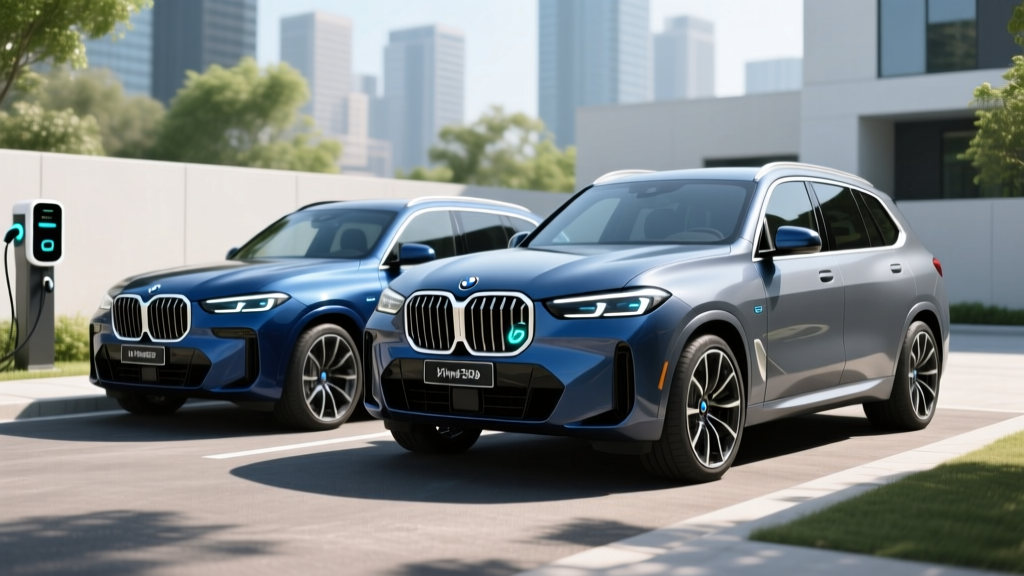
If you're researching a BMW hybrid SUV for 2025, you're looking at two plug-in hybrid (PHEV) models: the luxury-mainstream X5 xDrive50e and the ultra-performance XM. BMW discontinued the X3 PHEV (xDrive30e) after the 2022 model year and does not currently offer a conventional hybrid (HEV) SUV in the U.S. market — every BMW electrified SUV requires plugging in to unlock its full efficiency potential.
This guide breaks down exact EPA figures, real-world efficiency expectations, battery specs, federal tax credit eligibility under current IRS §30D rules, and which model (if either) fits your driving pattern. We'll also clarify the HEV vs. PHEV distinction, since many shoppers use "hybrid" generically.
HEV vs. PHEV: What BMW Actually Offers
Conventional Hybrid (HEV): Uses a small battery charged only by regenerative braking and the gas engine. No plug. Toyota RAV4 Hybrid is a classic example. BMW does not sell an HEV SUV in the U.S. for 2025.
Plug-in Hybrid (PHEV): Carries a larger battery you charge via a wall outlet or charging station. Offers 30–40 miles of electric-only driving before the gas engine takes over. Both the X5 xDrive50e and XM are PHEVs. If you never plug in, you still drive — but you lose the efficiency and electric-range benefits.
2025 BMW X5 xDrive50e: The Practical PHEV SUV
The X5 xDrive50e is the volume seller and the model most buyers should consider. It replaced the previous xDrive45e for the 2024 model year with a larger battery and more electric range, and those upgrades carry into 2025.
| Spec | Value |
|---|---|
| Powertrain | 3.0L turbocharged I6 + electric motor (integrated in transmission) |
| Combined Horsepower | 483 hp / 516 lb-ft torque |
| Battery (usable) | ~25.7 kWh (NMC chemistry) |
| EPA Electric Range | 38 miles |
| EPA MPGe (electric + gas) | 50 MPGe combined |
| EPA MPG (gas only, charge-sustaining) | 22 city / 24 hwy / 23 combined |
| Total Range (electric + gas) | ~440 miles |
| 0–60 mph | 4.6 seconds |
| AC Charging (Level 2) | 7.4 kW max — full charge in ~4.25 hours |
| DC Fast Charging | Not available |
| Base MSRP | $72,500 (before destination) |
Sources: EPA fueleconomy.gov, BMW Group PressClub
Real-World Range vs. EPA Sticker
The EPA rates the X5 xDrive50e at 38 miles electric-only. In real-world testing, expect 32–36 miles in mixed driving with moderate climate control use. In cold weather (below 40°F), electric range drops to roughly 25–30 miles due to battery chemistry limitations and cabin heating demand. Highway-only driving at 75+ mph will also reduce electric range to approximately 28–32 miles.
Once the battery depletes, the 23 MPG combined gas figure is accurate for mixed use. City-heavy driving in charge-sustaining mode may yield 21–22 MPG; steady highway cruising can reach 25–26 MPG.
2025 BMW XM: The Performance PHEV
The XM is BMW M's first standalone model since the 1970s M1, and it's exclusively a PHEV. It prioritizes power over efficiency — think of it as a performance vehicle that happens to have an electric assist, not an efficiency vehicle that happens to be quick.
| Spec | XM (Base) | XM Label Red |
|---|---|---|
| Powertrain | 4.4L twin-turbo V8 + electric motor | 4.4L twin-turbo V8 + electric motor |
| Combined HP | 644 hp / 590 lb-ft | 738 hp / 738 lb-ft |
| Battery (usable) | ~25.7 kWh | ~25.7 kWh |
| EPA Electric Range | 31 miles | 30 miles |
| EPA MPG (gas only) | 14 city / 18 hwy / 16 combined | 12 city / 17 hwy / 14 combined |
| 0–60 mph | 4.1 sec | 3.7 sec |
| Base MSRP | $159,995 | $185,000 |
The XM's electric-only range is shorter than the X5's because of higher curb weight (~6,000 lbs), wider tires, and less aerodynamic efficiency. Once the battery is depleted, fuel economy is frankly poor for a modern vehicle — 14–16 MPG combined is comparable to a conventional V8 performance SUV. The PHEV system here exists primarily for torque-fill and brief silent neighborhood driving, not efficiency.
Charging: Level 2 Only, No DC Fast Charge
Neither the X5 xDrive50e nor the XM supports DC fast charging. This is common among PHEVs — their smaller batteries make DC charging infrastructure unnecessary for most use cases, but it also means you can't top up quickly on a road trip.
| Charging Level | Power (kW) | X5 xDrive50e Time (0–100%) | Miles Added/Hour |
|---|---|---|---|
| Level 1 (120V household) | ~1.4 kW | ~22 hours | ~2 mi/hr |
| Level 2 (240V, 32A) | 7.4 kW | ~4.25 hours | ~9 mi/hr |
| DC Fast Charge | N/A | Not supported | — |
Practical recommendation: Install a Level 2 home charger (240V, 32-amp circuit minimum). This fully replenishes the X5's battery overnight — or during a workday if you charge at the office. A standard 120V outlet adds only about 2 miles of range per hour, which is insufficient unless your daily commute is under 10 miles.
Federal Tax Credit: Does a 2025 BMW PHEV Qualify?
Under the current IRS §30D Clean Vehicle Credit rules, the X5 xDrive50e does not qualify for the federal $7,500 tax credit for new EVs and PHEVs. There are two reasons:
- MSRP Cap: §30D limits the credit to SUVs with an MSRP at or below $80,000. The X5 xDrive50e starts at $72,500, but most well-equipped examples exceed $80,000 after options.
- Battery Sourcing Requirements: The credit requires that a percentage of critical minerals and battery components are sourced from the U.S. or free-trade-agreement countries. BMW's PHEV battery supply chain does not currently meet these thresholds for the 2025 model year.
The XM is disqualified on MSRP alone ($159,995+), far exceeding the $80,000 SUV cap.
§30D Tax Credit Eligibility Checklist (2025 Rules)
- ✅ Vehicle type: PHEV qualifies (if other requirements met)
- ✅ Battery capacity: ≥ 7 kWh (X5 and XM both meet this at ~25.7 kWh)
- ❌ MSRP cap: SUVs must be ≤ $80,000 (XM fails; X5 often fails with options)
- ❌ Critical minerals sourcing: Must meet annual percentage threshold (BMW PHEVs do not currently qualify)
- ❌ Battery component sourcing: Must meet annual percentage threshold (BMW PHEVs do not currently qualify)
- ⚠️ Buyer income cap: AGI ≤ $300K joint / $150K single (buyer-dependent)
Verify current rules at IRS.gov §30D. Tax credit eligibility changes frequently based on Treasury guidance. Consult a tax professional before purchasing.
Some states offer separate PHEV incentives (California's CVRP, Colorado's state credit, etc.) that have different eligibility rules. Check your state energy office or DMV for current programs.
Battery Warranty, Lifespan, and Replacement Cost
BMW PHEV Battery Warranty
High-voltage battery warranty: 8 years / 80,000 miles (whichever comes first), covering defects and capacity loss below 70% of original capacity.
Powertrain warranty: 4 years / 50,000 miles.
Federal emissions warranty (PHEV components): 8 years / 80,000 miles for specified major emission control components, which can include the hybrid battery in some interpretations.
BMW's PHEV batteries use NMC (nickel manganese cobalt) chemistry, which offers high energy density but degrades slightly faster than LFP chemistry found in some competitors. Real-world data from the previous-generation X5 xDrive45e (2021–2023) suggests owners retain approximately 90–94% battery capacity after 3 years and 30,000–40,000 miles with normal use.
Battery replacement cost: If the high-voltage battery fails outside warranty, expect a dealer replacement quote of $12,000–$18,000 including parts and labor. This is a significant out-of-pocket expense, though failures within the warranty period are covered.
Longevity tips: Avoid routinely charging to 100% and leaving the vehicle parked at full charge in hot weather. BMW's battery management system includes a buffer (the 25.7 kWh figure is usable, not gross capacity), which helps protect against deep degradation. Setting the charge limit to 80–90% for daily use and charging to 100% only before longer trips will extend battery life.
Real-World MPG: How Do BMW PHEVs Actually Perform?
PHEV fuel economy is uniquely dependent on driver behavior. The EPA reports two figures: MPGe (when driving on electricity) and MPG (when the battery is depleted). Your actual cost-per-mile depends entirely on how often you charge.
| Driving Pattern | Effective MPG / MPGe | Notes |
|---|---|---|
| Daily commute < 35 mi, charged nightly | 80–100+ MPGe equivalent | Rarely uses gas; electricity cost ~$0.04/mi at $0.15/kWh |
| Mixed driving, charged most nights | 35–45 MPG equivalent | Electric for short trips, gas for longer ones |
| Never plugged in | 22–24 MPG | Operates as heavy conventional hybrid; dead weight of battery hurts efficiency |
| Long highway road trip | 24–26 MPG | Electric range used up in first 30 mi, then gas-only |
The critical insight: if you cannot charge at home or work, a PHEV is a poor financial choice. Driving the X5 xDrive50e without ever plugging in yields worse fuel economy than a non-hybrid BMW X5 xDrive40i (rated at 23 city / 27 hwy / 25 combined) because you're hauling 500+ lbs of battery and motor you never use.
Who Should Buy a BMW PHEV — And Who Shouldn't
✓ Choose the BMW X5 xDrive50e If:
- Your daily round-trip commute is under 35 miles
- You can install a Level 2 charger at home
- You want electric daily driving but gas flexibility for road trips
- You value BMW's driving dynamics and interior quality
- You tow occasionally (X5 PHEV rated at 5,000+ lbs — check specific trim)
- You're not ready for full EV due to apartment living or unreliable charging access
✗ Look Elsewhere If:
- You cannot charge at home or work (buy a conventional HEV like the Toyota Highlander Hybrid instead)
- Your daily commute exceeds 40 miles (a full BEV like the BMW iX or Tesla Model X makes more sense)
- You need the federal $7,500 tax credit (BMW PHEVs don't qualify)
- Budget is a primary concern (the X5 PHEV starts at $72,500 before options)
- You want DC fast charging for road-trip convenience
Decision Framework: Hybrid vs. PHEV vs. Full EV
Conventional Hybrid (HEV) — Choose if you want better MPG with zero behavior change. No plug, no range anxiety. Best for: apartment dwellers, high-mileage drivers, budget-conscious buyers. BMW doesn't offer one; consider Toyota/Lexus.
Plug-in Hybrid (PHEV) — Choose if you have home charging and a short commute but need gas flexibility. Best for: homeowners with garages, two-car households replacing one gas car, frequent road-trippers who want some electric driving. The X5 xDrive50e fits here.
Full Battery Electric (BEV) — Choose if you can charge at home and want lowest operating cost, zero tailpipe emissions, and minimal maintenance. Best for: daily drivers under 300 miles, those who qualify for the $7,500 federal credit, tech-forward buyers. Consider the BMW iX or iX3 (if available in your market).
Frequently Asked Questions
How many MPG does the 2025 BMW X5 hybrid get?
The EPA rates the X5 xDrive50e at 50 MPGe combined when using both electric and gas power, and 23 MPG combined (22 city / 24 highway) when the battery is depleted and the vehicle runs on gas alone. Real-world gas-only MPG ranges from 21–26 depending on driving conditions.
How far can the BMW X5 PHEV drive on electric only?
The EPA rates the X5 xDrive50e at 38 miles of electric-only range. Real-world results are typically 32–36 miles in moderate weather, dropping to 25–30 miles in cold weather or sustained highway driving above 70 mph.
Does the 2025 BMW X5 PHEV qualify for the $7,500 federal tax credit?
No. Under current IRS §30D rules, the X5 xDrive50e does not qualify due to battery component and critical mineral sourcing requirements that BMW's supply chain does not meet for the 2025 model year. The XM also fails the MSRP cap ($80,000 for SUVs). Always verify current eligibility at IRS.gov before purchasing.
Is the BMW X5 hybrid reliable?
BMW's PHEV powertrain in the X5 has proven reasonably reliable since the xDrive45e launched for 2021. The high-voltage battery is warrantied for 8 years / 80,000 miles against defects and capacity loss below 70%. Main concerns are typical BMW complexity (electronics, air suspension if equipped) rather than hybrid-specific failures. Out-of-warranty battery replacement costs $12,000–$18,000.
Can I charge the BMW X5 PHEV at a Tesla Supercharger or DC fast charger?
No. The X5 xDrive50e and XM only accept AC charging (Level 1 or Level 2) via a J1772 connector. DC fast charging is not supported. A full Level 2 charge takes approximately 4.25 hours at 7.4 kW.
What happens if I never plug in the BMW X5 PHEV?
The vehicle operates as a conventional hybrid, using regenerative braking to maintain a small battery buffer. However, fuel economy drops to approximately 22–24 MPG combined — worse than a non-hybrid X5 — because you're carrying the weight of the battery and electric motor without using them. You'll also miss the cost savings that make a PHEV financially worthwhile.
For the latest EPA data, see fueleconomy.gov. For tax credit rules, consult IRS.gov §30D. Safety ratings available at NHTSA.gov and IIHS.org.