Hybrid Plugin Powertrains in 2026: What Buyers Actually Need to Know
Shoppers searching for a hybrid plugin option in 2026 face a wider field than ever — but also more confusion. Automakers now sell conventional hybrids (HEVs) that never plug in alongside plug-in hybrid electric vehicles (PHEVs) that deliver 25–50 miles of electric-only driving before the gas engine takes over. Both use regenerative braking and electric motors to cut fuel consumption, but their ownership experiences, costs, and tax-credit eligibility diverge sharply.
This guide breaks down the mechanical differences, real-world fuel economy, battery longevity, and total cost of ownership for both HEV and PHEV powertrains — with exact 2026 EPA figures and IRS §30D credit rules so you can decide which hybrid plugin strategy fits your commute, your garage, and your budget.
HEV vs PHEV: The Core Mechanical Difference
A conventional hybrid (HEV) pairs a small battery — typically 1.0 to 1.6 kWh — with a gasoline engine and one or more electric motor-generators. The battery recharges exclusively through regenerative braking and engine power. You never plug it in. The electric motor assists during acceleration and enables brief low-speed electric driving, but the engine remains the primary energy source.
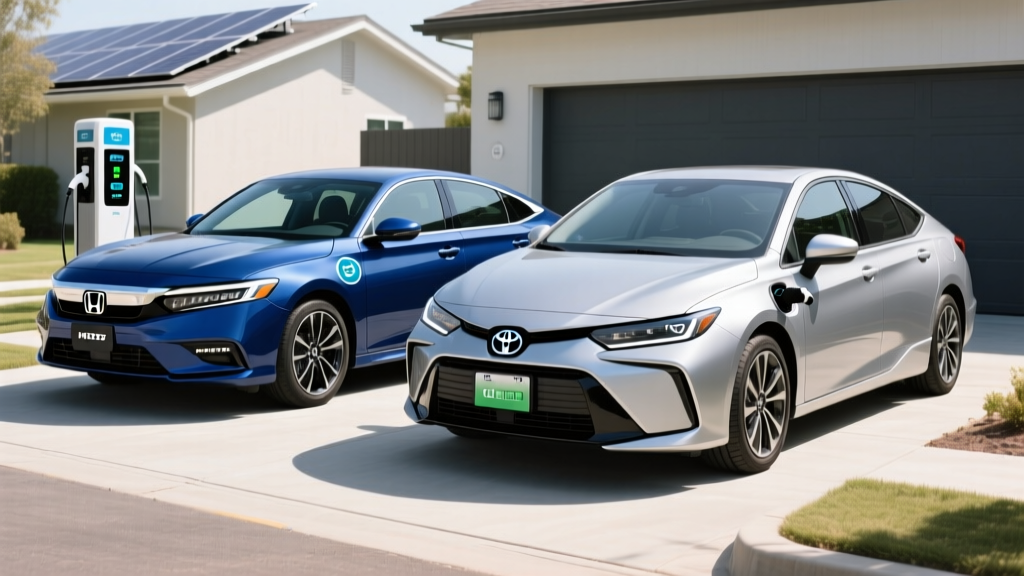
A plug-in hybrid (PHEV) uses a much larger battery — usually 13 to 25 kWh — that you charge from a wall outlet or Level 2 charger. This battery powers 25 to 50 miles of pure electric driving at highway speeds before the vehicle seamlessly switches to hybrid mode, operating like a conventional HEV for the remaining range. PHEVs effectively give you an EV for short commutes and a hybrid for long trips.
| Attribute | Conventional Hybrid (HEV) | Plug-In Hybrid (PHEV) |
|---|---|---|
| Battery capacity | 1.0–1.6 kWh | 13–25 kWh |
| Plug-in charging | No — self-charging | Yes — Level 1 (120V) or Level 2 (240V) |
| Electric-only range | ~1 mile at low speed | 25–50 miles at full speed |
| DC fast charging | N/A | Rare; most PHEVs lack DC capability |
| Federal tax credit (§30D) | Not eligible | Up to $7,500 if all criteria met |
| Home electrical work needed | None | Level 2 install recommended ($500–$2,000) |
| Typical price premium over gas model | $1,000–$2,500 | $4,000–$8,000 |
2026 PHEV Spotlight: Toyota RAV4 Prime
The 2026 Toyota RAV4 Prime remains one of the most popular hybrid plugin vehicles in the US, and for good reason: it delivers strong electric-only range, all-wheel drive, and competitive fuel economy once the battery depletes. Here are the exact numbers.
| EPA electric-only range | 42 miles |
| Total combined range (EV + gas) | ~600 miles |
| Battery capacity | 18.1 kWh (lithium-ion, NMC chemistry) |
| Level 2 charge time (0–100%) | ~2.5 hours at 6.6 kW |
| DC fast charging | Not available |
| Combined horsepower | 302 hp (2.5L I4 + 2 electric motors) |
| 0–60 mph | 5.7 seconds |
| Drivetrain | Electronic AWD (eAWD) |
| EPA MPG (hybrid mode, combined) | 38 MPG |
| MPGe (electric mode) | 94 MPGe |
| Base MSRP (SE trim) | $44,985 |
| Battery warranty | 10 years / 150,000 miles |
The RAV4 Prime's 42-mile electric range covers most daily commutes. Owners who charge nightly at home report using gasoline only on weekend road trips. However, note that the 42-mile EPA figure assumes moderate temperatures and mixed driving — expect roughly 34–38 miles in freezing weather due to cabin heating demand and reduced battery efficiency.
2026 HEV Spotlight: Honda CR-V Hybrid
For buyers who cannot charge at home or prefer a simpler ownership experience, the 2026 Honda CR-V Hybrid exemplifies the conventional HEV approach. No plug, no range anxiety, just consistently strong fuel economy.
| EPA city MPG | 43 MPG |
| EPA highway MPG | 36 MPG |
| EPA combined MPG | 40 MPG |
| Battery capacity | 1.06 kWh (lithium-ion) |
| Combined horsepower | 204 hp (2.0L I4 + 2 electric motors) |
| 0–60 mph | 7.6 seconds |
| Drivetrain | AWD (standard on hybrid trims) |
| Base MSRP (Sport trim) | $36,395 |
| Battery warranty | 8 years / 100,000 miles |
Real-world fuel economy for the CR-V Hybrid often exceeds the EPA combined figure in city driving. Hybrids recapture energy during stop-and-go traffic, so urban drivers regularly report 42–45 MPG. Highway driving, where the engine runs continuously, tends to yield 33–36 MPG — slightly below the EPA highway estimate. This city-better efficiency pattern is a hallmark of all HEVs.
Fuel Economy Breakdown: EPA vs Real-World MPG
Fuel economy stickers tell only part of the story. Here's how popular hybrid plugin and HEV models perform across EPA cycles and real-world conditions, based on fueleconomy.gov data and owner reports.
| Model | Type | EV Range | EPA City | EPA Hwy | EPA Combined | Real-World Combined* |
|---|---|---|---|---|---|---|
| Toyota RAV4 Prime | PHEV | 42 mi | 40 MPG | 36 MPG | 38 MPG | 35–40 MPG (hybrid mode) |
| Honda CR-V Hybrid | HEV | N/A | 43 MPG | 36 MPG | 40 MPG | 38–44 MPG |
| Toyota Prius Prime | PHEV | 44 mi | 52 MPG | 48 MPG | 50 MPG | 48–54 MPG (hybrid mode) |
| Hyundai Tucson PHEV | PHEV | 33 mi | 38 MPG | 35 MPG | 37 MPG | 34–38 MPG |
| Toyota Camry Hybrid | HEV | N/A | 53 MPG | 50 MPG | 52 MPG | 48–55 MPG |
| Ford Escape PHEV | PHEV | 37 mi | 42 MPG | 36 MPG | 39 MPG | 36–41 MPG |
*Real-world ranges reflect owner-reported averages; cold weather and sustained highway speeds reduce figures by 5–15%.
Charging a PHEV: What You Need at Home
Plug-in hybrids charge at far lower power levels than full EVs because their batteries are smaller. Most PHEVs accept only Level 1 (120V) or Level 2 (240V) AC charging — DC fast charging is virtually nonexistent in this segment due to cost and packaging constraints.
| Charging Level | Power | Time (0–100%) | Equipment Needed |
|---|---|---|---|
| Level 1 (120V outlet) | ~1.4 kW | ~12–13 hours | Included charging cord |
| Level 2 (240V, 32A) | ~6.6 kW | ~2.5–3 hours | Home wall charger or public Level 2 |
For most PHEV owners, a standard 120V outlet in the garage is sufficient — plug in overnight and the battery is full by morning. A Level 2 home charger is a convenience upgrade, not a necessity, for PHEV batteries under 20 kWh. If you're already installing a Level 2 circuit for a future full EV, it will charge your PHEV faster, but the investment isn't justified by PHEV charging alone.
Federal Tax Credit: Does a Hybrid Plugin Qualify?
Under the current IRS §30D Clean Vehicle Credit, only plug-in hybrids (PHEVs) — not conventional HEVs — may qualify for up to $7,500 in federal tax credits. However, eligibility is not automatic. Multiple criteria must align:
- Battery capacity: Minimum 7 kWh (all current PHEVs exceed this)
- MSRP cap: Vans/SUVs/pickups ≤ $80,000; sedans ≤ $55,000
- Buyer income cap: AGI ≤ $150,000 (single) / $225,000 (head of household) / $300,000 (joint)
- Critical minerals requirement: ≥ 80% of critical minerals from US or FTA partners (for full $3,750 component)
- Battery component sourcing: ≥ 100% of components manufactured or assembled in North America (for full $3,750 component)
- Point-of-sale transfer: You may transfer the credit to the dealer at purchase for an immediate price reduction, or claim it on your tax return
2026 credit reality: Many popular PHEVs qualify for only $3,750 (half credit) or $0 due to battery-sourcing rules. Always verify a specific VIN's eligibility on fueleconomy.gov before purchasing. Conventional HEVs like the CR-V Hybrid and Camry Hybrid do not qualify for any federal EV credit.
Battery Reliability, Warranty & Replacement Costs
Hybrid battery longevity is the most common concern among first-time hybrid buyers — and it's the area where real-world data is most reassuring. Both HEV and PHEV batteries are covered by federally mandated minimum warranties of 8 years / 100,000 miles (10 years / 150,000 miles in California and states adopting CARB standards). Toyota extends this to 10 years / 150,000 miles nationwide for its 2026 hybrid lineup.
Replacement costs vary widely by model:
- HEV battery replacement: $2,000–$4,000 (small battery, simpler pack design)
- PHEV battery replacement: $5,000–$9,000 (larger battery, more complex thermal management)
In practice, hybrid batteries rarely fail within the warranty period. Degradation is gradual — a PHEV that originally delivered 42 miles of electric range might provide 36–38 miles after 8 years and 100,000 miles. This is normal lithium-ion aging and does not constitute a warranty claim unless capacity drops below 60–70% of original (the exact threshold varies by manufacturer). Toyota, Honda, and Hyundai have strong track records; Prius taxis routinely surpass 200,000 miles on original hybrid batteries.
HEV vs PHEV vs Full EV: Which Powertrain Fits You?
Choose a conventional HEV if:
- You cannot charge at home (apartment, street parking, no garage)
- Your budget is tight and you want a $1,000–$2,500 premium over a gas model
- You want zero behavioral change — just drive and refuel normally
- You primarily drive in stop-and-go city traffic (where hybrids shine)
Choose a PHEV if:
- You can charge at home (even a 120V outlet works for overnight)
- Your daily commute is under 40 miles round-trip
- You take regular road trips and don't want to plan around DC chargers
- You want EV-like daily driving with a gas safety net
- The specific model qualifies for a federal or state tax credit that narrows the price gap
Choose a full BEV if:
- You can install a Level 2 home charger
- Your daily driving is under 250 miles and you have access to DC fast charging for road trips
- You want to eliminate gasoline entirely and minimize moving-part maintenance
- Total cost of ownership over 5+ years matters most (lowest per-mile energy cost)
PHEV Advantages
- 25–50 miles of zero-gas daily driving
- No range anxiety on road trips
- Lower fuel cost when regularly charged
- May qualify for $3,750–$7,500 federal credit
- Regenerative braking extends brake life
PHEV Limitations
- $4,000–$8,000 price premium over gas equivalent
- Heavier than HEV (two full powertrains)
- Requires plug-in access to realize fuel savings
- No DC fast charging on most models
- Smaller cargo space vs gas models (battery packaging)
Frequently Asked Questions
How many MPG does a hybrid plugin (PHEV) get?
Once a PHEV's electric range is depleted, it operates as a conventional hybrid. EPA combined MPG in hybrid mode ranges from 35 to 52 depending on the model. The Toyota Prius Prime leads at 50 MPG combined; the RAV4 Prime delivers 38 MPG combined. In electric mode, efficiency is measured in MPGe — the RAV4 Prime achieves 94 MPGe, meaning it uses energy equivalent to a 94-MPG gas car while running on battery alone.
How far can a PHEV go on electric only?
2026 PHEVs offer between 25 and 50 miles of EPA-rated electric range. The Prius Prime reaches 44 miles; the RAV4 Prime achieves 42 miles; the Ford Escape PHEV manages 37 miles. Real-world electric range drops to 80–90% of EPA figures in cold weather (below 40°F) due to cabin heating loads and reduced lithium-ion efficiency. If your commute is 30 miles round-trip, most current PHEVs will cover it entirely on electricity year-round.
Do conventional hybrids (HEVs) need to be plugged in?
No. Conventional hybrids recharge their small batteries entirely through regenerative braking and the gasoline engine. There is no plug, no charging cord, and no electric-only range to manage. You fuel them exactly like a gas car and benefit from improved MPG — especially in city driving where regen captures braking energy that would otherwise be wasted as heat.
Is a hybrid battery reliable and what does replacement cost?
Hybrid batteries from Toyota, Honda, and Hyundai have proven exceptionally reliable, with many lasting 150,000+ miles before significant degradation. All are warranted for at least 8 years / 100,000 miles (10 years / 150,000 in CARB states). HEV battery replacement costs $2,000–$4,000; PHEV replacement runs $5,000–$9,000. However, out-of-warranty failures remain uncommon — most hybrids are retired or sold before the battery needs replacement.
Does a hybrid qualify for any tax credit in 2026?
Only plug-in hybrids (PHEVs) may qualify for the federal §30D Clean Vehicle Credit, which offers up to $7,500. Conventional HEVs are not eligible. Even among PHEVs, credit amounts vary: some models qualify for the full $7,500, others for $3,750, and some for $0 based on battery-sourcing and critical-mineral requirements. Buyer income caps ($150K single / $300K joint) and MSRP caps ($55K sedans / $80K SUVs) also apply. Check the specific VIN on fueleconomy.gov before purchasing, and consult a tax professional to confirm your personal eligibility.
Is a PHEV better than a full EV for my situation?
A PHEV is better if you lack reliable home Level 2 charging, regularly drive more than 200 miles in a day, or live in an area with sparse DC fast-charging infrastructure. A full EV is better if you can charge at home, want the lowest per-mile energy cost (electricity at $0.14/kWh costs roughly $0.04/mile vs $0.12–$0.15/mile for gas), and prefer minimal maintenance. PHEVs are the bridge solution — ideal for households transitioning to electric who aren't ready to commit fully.