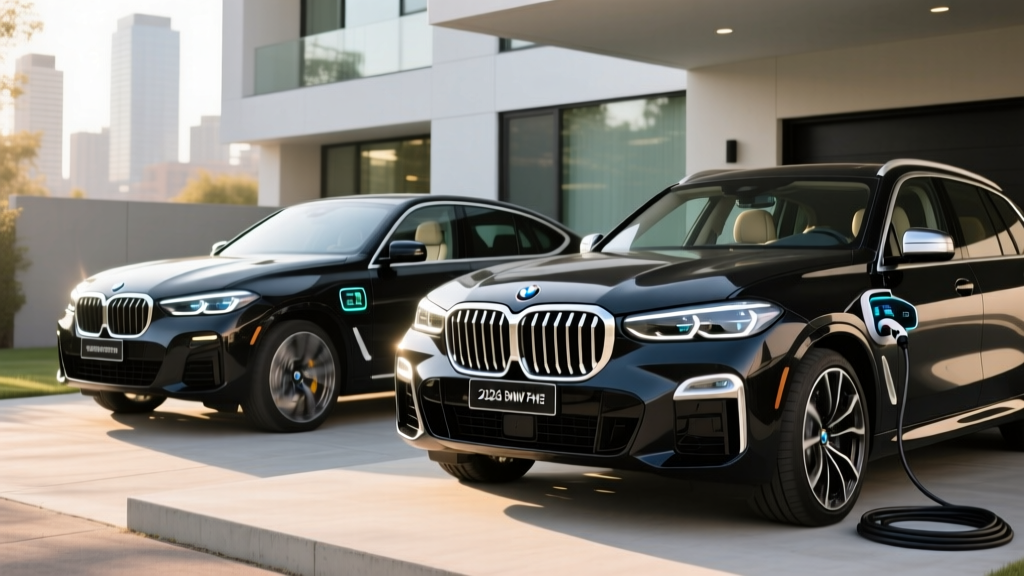
BMW has committed hard to plug-in hybrid electrification across its lineup, and for 2026 the strategy is paying off. The current crop of BMW hybrid autos spans a compact sport sedan (330e), a midsize luxury SUV (X5 xDrive50e), and a flagship luxury sedan (750e xDrive) — all pairing turbocharged gasoline engines with electric motors and batteries large enough for meaningful electric-only commutes. Unlike conventional hybrids, these PHEVs can plug in and drive 30-40 miles on electricity before the gas engine ever fires.
This guide breaks down the three core 2026 BMW PHEVs with exact EPA figures, real-world expectations, charging logistics, tax credit eligibility, and battery longevity data — the specifics you need before spending $60K-$110K.
BMW's 2026 PHEV Lineup at a Glance
BMW does not currently sell a conventional hybrid (HEV) in the U.S. market — every electrified BMW is either a plug-in hybrid (PHEV) or a full battery electric vehicle (BEV like the i4, iX, or i7). Here's what that distinction means in practice:
HEV vs. PHEV: What BMW Buyers Need to Know
| Feature | Conventional Hybrid (HEV) | Plug-In Hybrid (PHEV) |
|---|---|---|
| Plug-in charging | No — charges via regen/braking | Yes — Level 1/Level 2 |
| Electric-only range | ~1 mile or less | 30-40 miles (BMW PHEVs) |
| Battery size | 1-2 kWh | 19-29 kWh usable |
| Federal tax credit | No | Up to $3,750 (varies) |
| Ideal for | Drivers who never want to plug in | Commuters with home charging |
BMW's U.S. lineup is exclusively PHEV for hybrid buyers. If you want a non-plug-in hybrid, you'll need to look at Toyota, Honda, or Hyundai.
2026 BMW 330e: The Entry-Level PHEV Sedan
The 330e pairs a 2.0-liter turbocharged inline-four with an electric motor integrated into the 8-speed automatic transmission. Combined output is 288 horsepower and 310 lb-ft of torque. The 19.5 kWh (gross) lithium-ion battery provides an EPA-rated 22 miles of electric-only range — modest by current PHEV standards but enough for short commutes.
| Spec | 2026 BMW 330e |
|---|---|
| Powertrain | 2.0L turbo I4 + electric motor |
| Combined HP | 288 hp / 310 lb-ft |
| Battery (gross / usable) | 19.5 kWh / ~17 kWh |
| Electric-only range (EPA) | 22 miles |
| Total range (gas + electric) | ~420 miles |
| EPA MPG (combined gas) | 28 MPG |
| MPGe (electric + gas) | 75 MPGe |
| Level 2 charge time (0-100%) | ~3.5 hours (7.4 kW onboard) |
| DC fast charging | Not available |
| 0-60 mph | 5.6 seconds |
| Starting MSRP | $46,900 |
| Mode | City | Highway | Combined |
|---|---|---|---|
| Charge-sustaining (gas only) | 25 MPG | 33 MPG | 28 MPG |
| Blended (MPGe) | — | — | 75 MPGe |
Real-world MPG note: In city driving with a depleted battery, owners regularly report 30-34 MPG — exceeding the EPA's 25 MPG city figure, which is typical for PHEVs in stop-and-go traffic where regenerative braking recovers energy. Highway cruising at 75+ mph with an empty battery will net closer to 28-30 MPG.
2026 BMW X5 xDrive50e: The PHEV SUV Sweet Spot
The X5 xDrive50e is the best-selling BMW hybrid auto in the U.S. for good reason. It pairs a 3.0-liter turbocharged inline-six with a more powerful electric motor for a combined 483 horsepower and 516 lb-ft of torque. The 25.7 kWh (gross) battery delivers an EPA-rated 38 miles of electric-only range — enough for most daily commutes without burning a drop of fuel.
| Spec | 2026 BMW X5 xDrive50e |
|---|---|
| Powertrain | 3.0L turbo I6 + electric motor |
| Combined HP | 483 hp / 516 lb-ft |
| Battery (gross / usable) | 25.7 kWh / ~22 kWh |
| Electric-only range (EPA) | 38 miles |
| Total range (gas + electric) | ~440 miles |
| EPA MPG (combined gas) | 22 MPG |
| MPGe (electric + gas) | 56 MPGe |
| Level 2 charge time (0-100%) | ~4 hours (7.4 kW onboard) |
| DC fast charging | Not available |
| 0-60 mph | 4.6 seconds |
| Starting MSRP | $72,500 |
| Mode | City | Highway | Combined |
|---|---|---|---|
| Charge-sustaining (gas only) | 20 MPG | 24 MPG | 22 MPG |
| Blended (MPGe) | — | — | 56 MPGe |
Real-world range: Expect 32-36 miles of electric range in mixed driving at moderate temperatures. In cold weather (below 35°F), that drops to roughly 25-28 miles due to cabin heating demand and reduced battery efficiency. On the gas engine alone, real-world highway MPG typically lands between 23-25 MPG — slightly above the EPA highway figure. Source: fueleconomy.gov.
2026 BMW 750e xDrive: Flagship PHEV Luxury
The 7 Series PHEV is BMW's most powerful hybrid offering. A 3.0-liter turbo I6 and electric motor produce a combined 483 horsepower and 516 lb-ft. The larger 29.5 kWh (gross) battery yields an EPA-rated 34 miles of electric-only range. This is a 5,000+ pound luxury sedan that can do its daily commute silently on electrons, then cross the country on premium unleaded.
| Spec | 2026 BMW 750e xDrive |
|---|---|
| Powertrain | 3.0L turbo I6 + electric motor |
| Combined HP | 483 hp / 516 lb-ft |
| Battery (gross / usable) | 29.5 kWh / ~25 kWh |
| Electric-only range (EPA) | 34 miles |
| Total range (gas + electric) | ~430 miles |
| EPA MPG (combined gas) | 24 MPG |
| MPGe (electric + gas) | 58 MPGe |
| Level 2 charge time (0-100%) | ~4.5 hours (7.4 kW onboard) |
| DC fast charging | Not available |
| 0-60 mph | 4.1 seconds |
| Starting MSRP | $107,900 |
Charging Your BMW PHEV: What You Need at Home
None of BMW's current PHEVs support DC fast charging. That's a deliberate engineering choice — the batteries are small enough that Level 2 charging fully replenishes them overnight, and adding DC hardware would increase cost and weight.
All three models come with a 7.4 kW onboard charger and a Level 1 (120V) charging cable. Here's what charging looks like in practice:
| Charging Level | Power | Miles of Range Per Hour | Full Charge Time (X5) |
|---|---|---|---|
| Level 1 (standard 120V outlet) | ~1.4 kW | ~4-5 miles/hr | ~16 hours |
| Level 2 (240V, 32A) | 7.4 kW | ~20-25 miles/hr | ~4 hours |
Practical recommendation: A Level 2 home charger (240V, 40A circuit) is strongly recommended. It fully replenishes any BMW PHEV battery in 3.5-4.5 hours, meaning you can charge during off-peak electricity hours and wake up to a full battery every morning. Level 1 alone is viable only if your daily electric-only driving is under 15 miles and you can leave the car plugged in for 12+ hours overnight.
Home Level 2 installation typically costs $600-$1,800 including the charger ($300-$600 for a quality unit like the ChargePoint Home Flex or Emporia Level 2) and electrician labor. A panel upgrade to 200A, if needed, adds $1,500-$3,000. Always get a quote from a licensed electrician before committing.
Federal Tax Credit Eligibility for BMW PHEVs
Under the current IRS §30D Clean Vehicle Credit rules, PHEVs can qualify for a federal tax credit — but the amount varies and eligibility is restrictive. Here's the framework:
- Credit amount: Up to $3,750 for PHEVs meeting battery component requirements (half the $7,500 max, since BMW batteries do not currently meet the full critical minerals threshold)
- Battery capacity: Must be ≥ 7 kWh (all BMW PHEVs qualify)
- MSRP cap: Vans/SUVs/pickups ≤ $80,000; sedans ≤ $55,000
- Buyer income cap: AGI ≤ $150K single / $225K head of household / $300K joint
- Final assembly: Must be in North America
- Point-of-sale transfer: Available — credit can be applied at purchase as a down payment reduction
Model-by-model eligibility (2026):
- 330e ($46,900 MSRP): Under the $55K sedan cap — potentially eligible for up to $3,750 if income and sourcing requirements are met
- X5 xDrive50e ($72,500 MSRP): Under the $80K SUV cap — potentially eligible for up to $3,750
- 750e xDrive ($107,900 MSRP): Exceeds the $55K sedan cap — not eligible
Tax credit rules change frequently and depend on battery sourcing, which BMW adjusts over time. Verify current eligibility at fueleconomy.gov and consult a tax professional before relying on credit amounts in your purchase decision. The IRS maintains the official rules at irs.gov.
Battery Reliability, Warranty, and Replacement Costs
BMW PHEV Battery Warranty
Coverage: 8 years or 80,000 miles (whichever comes first)
Capacity threshold: BMW warrants the high-voltage battery against defects and excessive capacity loss. Under federal EPA mandate, PHEV batteries must carry a minimum 8-year/80,000-mile warranty; in California and CARB-adopting states, this extends to 10 years / 150,000 miles.
What's covered: Defects, cell failures, and capacity degradation below a defined threshold (typically ~70% of original capacity).
Real-world reliability: BMW's PHEV battery packs use NMC (nickel manganese cobalt) lithium-ion cells with active liquid cooling. Real-world data from European fleets and U.S. owners suggests 5-8% capacity loss over the first 5 years / 60,000 miles — well within warranty thresholds. These batteries are not stressed as hard as full EV batteries because the usable window is a fraction of total capacity (the system buffers the top and bottom to protect longevity).
Replacement cost if out of warranty: A BMW PHEV battery replacement runs $8,000-$14,000 including parts and labor at a dealership. Independent shops with high-voltage certification can sometimes source refurbished packs for $5,000-$8,000. However, given the 8-year warranty and gradual degradation curve, most owners will sell or trade the vehicle before a replacement is needed.
BMW PHEV vs. Full EV vs. Gas: Which Fits You?
Choose a BMW PHEV If:
- You commute 20-40 miles daily and can charge at home (Level 2)
- You take regular road trips and don't want to plan around DC fast chargers
- You want meaningful fuel savings without full EV range anxiety
- You live in an apartment or area with limited public charging infrastructure
Choose a Full BMW EV (i4, iX, i7) If:
- You can install Level 2 at home AND have reliable public DC fast charging nearby
- Your daily driving is under 250 miles and road trips are infrequent
- You want zero tailpipe emissions and the lowest per-mile fuel cost
- You want the full $7,500 federal tax credit (i4 and iX may qualify more fully)
Choose a Gas-Only BMW If:
- You cannot charge at home or at work
- You drive very high annual miles on highways (PHEV advantage diminishes)
- Upfront purchase price is the primary concern
Pros and Cons of BMW's PHEV Lineup
Pros
- 30-38 miles of electric range covers most commutes gas-free
- No range anxiety — gas engine provides 400+ total miles
- Strong performance (483 hp in X5 and 750e)
- Level 2 home charging is simple and inexpensive
- Premium BMW build quality, tech, and driving dynamics
- X5 PHEV eligible for up to $3,750 federal credit
Cons
- No DC fast charging on any model
- 330e electric range (22 mi) is below rivals like the Toyota RAV4 Prime
- 750e exceeds MSRP cap — no federal tax credit
- Premium fuel required for gasoline engine
- Higher insurance premiums than gas equivalents (~10-15%)
- PHEV complexity: two powertrains to maintain long-term
Frequently Asked Questions
How many MPG does a BMW hybrid get?
It depends on the model and whether the battery is charged. The X5 xDrive50e gets 22 MPG combined on gas alone (20 city / 24 highway) but achieves 56 MPGe when factoring in electric driving. The 330e gets 28 MPG combined on gas (25/33) and 75 MPGe blended. The 750e returns 24 MPG gas-only and 58 MPGe. In practice, if you charge nightly and commute under 35 miles, you may use very little gasoline for weeks at a time.
How far can BMW PHEVs go on electric only?
The 2026 X5 xDrive50e leads with 38 EPA-rated miles, the 750e xDrive delivers 34 miles, and the 330e manages 22 miles. Real-world figures drop 10-20% in cold weather or at sustained highway speeds. For a 30-mile round-trip commute, the X5 and 750e can handle it entirely on electricity in mild weather.
Is BMW's hybrid system reliable?
BMW's current-generation PHEV powertrain (introduced for the 2021+ model years) has shown solid reliability. The high-voltage battery is liquid-cooled and buffered, reducing stress. The 8-year/80,000-mile battery warranty (10 years/150,000 miles in CARB states) provides long-term protection. The main reliability risk is the added complexity of maintaining both an internal combustion engine and an electric drivetrain over 10+ years.
What does it cost to replace a BMW PHEV battery?
Out-of-warranty replacement runs $8,000-$14,000 at a BMW dealership. Refurbished packs from certified independent shops cost $5,000-$8,000. However, PHEV batteries degrade slowly (typically 5-8% over 5 years), and most owners will not need a replacement within the warranty period.
Do BMW hybrid autos qualify for a federal tax credit?
The 330e and X5 xDrive50e may qualify for up to $3,750 under the IRS §30D credit, subject to buyer income caps ($150K single / $300K joint), North American assembly requirements, and battery sourcing rules. The 750e xDrive exceeds the $55,000 sedan MSRP cap and does not qualify. Rules change periodically — check fueleconomy.gov before purchasing.
Do I need to plug in a BMW PHEV?
You don't have to — the car will operate as a conventional hybrid using the gas engine and regenerative braking. But you'll lose the primary benefit: 22-38 miles of electric-only driving and dramatically reduced fuel consumption. Without plugging in, a BMW PHEV is just a heavier, more expensive gas car. Home Level 2 charging is strongly recommended to get the value from your purchase.
Sources: EPA fuel economy data from fueleconomy.gov; BMW USA specifications from bmwusa.com; IRS §30D credit rules from irs.gov.