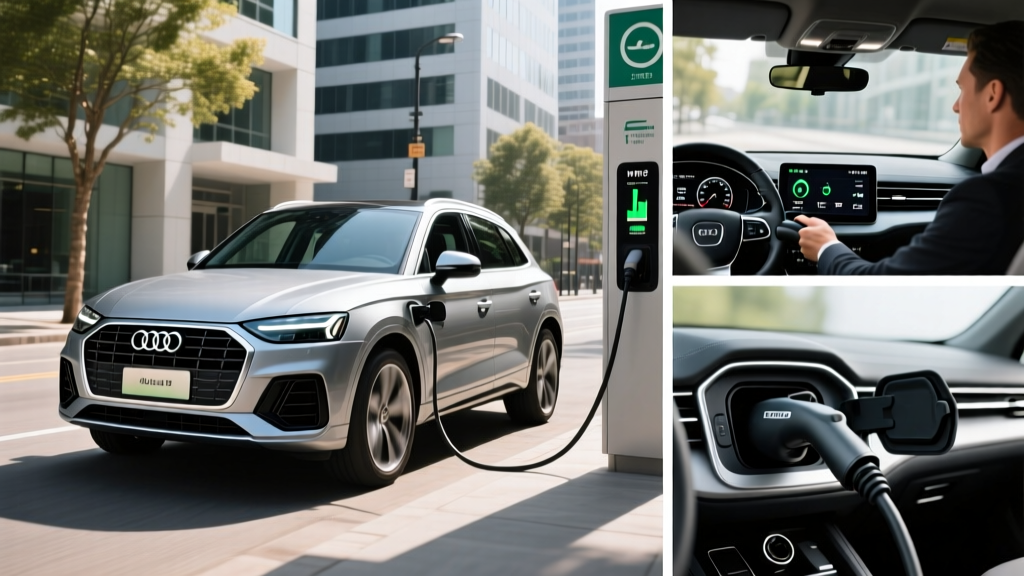
The Audi Q5 TFSI e plug-in hybrid occupies a narrow but appealing lane: luxury SUV comfort with enough electric-only range to cover most daily commutes without burning a drop of fuel. For 2026, the Q5 55 TFSI e pairs a turbocharged 2.0-liter four-cylinder with an electric motor integrated into the seven-speed S tronic transmission, delivering a combined 295 horsepower and 369 lb-ft of torque. But with a modest 17.9 kWh battery and no DC fast-charging capability, this PHEV rewards a specific type of owner — one with reliable home charging and realistic expectations about what 23 miles of EV range actually covers.
Below, we dissect every spec that matters: EPA MPG and MPGe, electric-only range, charging times, battery warranty, tax credit eligibility under current IRS §30D rules, and whether this PHEV makes more financial sense than a full EV or conventional hybrid for your driving pattern.
2026 Audi Q5 TFSI e: Key Specifications at a Glance
| Spec | Value |
|---|---|
| Powertrain | 2.0L turbo I4 + electric motor, 7-speed S tronic AWD (quattro) |
| Combined Horsepower | 295 HP |
| Combined Torque | 369 lb-ft |
| 0–60 mph | 5.0 seconds (manufacturer est.) |
| Battery Capacity (gross / usable) | 17.9 kWh / ~14.4 kWh usable |
| EPA Electric-Only Range | 23 miles |
| EPA Combined MPGe (electric + gas) | 61 MPGe |
| EPA MPG (gas-only, combined) | 25 MPG (23 city / 28 highway) |
| Total Combined Range | ~380 miles |
| Level 2 Charge Rate | 7.4 kW (AC) |
| DC Fast Charging | Not available |
| Level 2 Charge Time (0–100%) | ~2.5 hours |
| Level 1 Charge Time (120V, 0–100%) | ~8–9 hours |
| Fuel Tank Capacity | 10.6 gallons |
| Cargo Volume (behind 2nd row) | 24.7 cu ft |
| Base MSRP (Premium trim) | $58,295 |
| Battery / Powertrain Warranty | 8 years / 100,000 miles |
HEV vs. PHEV: Understanding Where the Q5 TFSI e Fits
Before evaluating the Q5 TFSI e specifically, it's worth clarifying what separates a conventional hybrid (HEV) from a plug-in hybrid (PHEV) — because the ownership experience diverges sharply.
Conventional Hybrid (HEV)
- No plug required. The battery recharges exclusively through regenerative braking and the gasoline engine.
- Small battery (typically 1–2 kWh). Electric-only driving is limited to brief low-speed assists — usually under 1 mile.
- Consistent fuel economy regardless of whether you have access to a charger.
- Example: Toyota RAV4 Hybrid (39 MPG combined, no plug).
Plug-In Hybrid (PHEV) — Like the Q5 TFSI e
- Plugs in to charge. A larger battery (17.9 kWh in the Q5) stores meaningful electric-only range.
- 23 miles of EV driving before the gas engine engages — enough for many round-trip commutes.
- MPG depends heavily on charging habits. If you never plug in, you get 25 MPG combined — respectable but unremarkable for the price. Plug in daily and short commutes can be nearly gasoline-free.
- Functions as a conventional hybrid once the battery is depleted — no range anxiety.
The Q5 TFSI e is strictly a PHEV. Audi does not sell a conventional HEV version of the Q5 in the US market. If you lack access to a home or workplace charger, the value proposition of this vehicle erodes considerably — you'd be paying a premium for battery capacity you never use.
Fuel Economy: EPA Numbers vs. Real-World MPG
| Mode | City | Highway | Combined |
|---|---|---|---|
| Electric + Gas (MPGe) | — | — | 61 MPGe |
| Gas Only (MPG) | 23 | 28 | 25 |
The 61 MPGe figure applies only when you're driving within the electric-only window — essentially, the first 23 miles after a full charge. Once the battery depletes, the turbocharged 2.0L and electric motor operate as a conventional hybrid system, returning 25 MPG combined.
Real-world expectations: In mixed suburban driving with daily charging, owners typically report 30–45 MPG effective averages over a month, depending on commute length. If your daily drive is under 23 miles and you charge every night, you may go weeks between fill-ups. Conversely, on a long highway road trip with no charging stops, expect 25–27 MPG — the electric motor provides modest assist, but the Q5's 4,500+ lb curb weight works against efficiency at sustained speeds.
Cold weather reduces the electric-only range by roughly 15–25%. In freezing temperatures, expect 17–19 miles of EV range instead of 23, as battery chemistry becomes less efficient and cabin heating draws from the pack. The Q5 TFSI e uses a resistive heater rather than a heat pump, which further erodes winter EV range.
Electric-Only Range and Charging: What to Expect
The 2026 Q5 55 TFSI e carries a 17.9 kWh gross battery (approximately 14.4 kWh usable, as the system reserves a buffer to protect battery health and maintain hybrid operation). That translates to an EPA-rated 23 miles of electric-only driving.
Charging specifics:
- Level 2 (240V AC): The onboard charger accepts up to 7.4 kW. A full 0–100% charge takes approximately 2.5 hours on a Level 2 home charger or public AC station.
- Level 1 (120V AC): Using the included cordset on a standard household outlet, a full charge takes 8–9 hours — adequate for overnight replenishment if your daily EV use is within the 23-mile window.
- DC Fast Charging: Not supported. The Q5 TFSI e lacks a CCS or NACS DC charging port. This is standard for most PHEVs — the battery is too small to justify the cost and weight of DC fast-charging hardware — but it means public fast-charging networks (Electrify America, Tesla Supercharger) are irrelevant to this vehicle.
For most PHEV owners, Level 2 home charging is the primary refueling method. A 240V Level 2 installation typically costs $500–$2,000 depending on panel capacity and wiring distance, and it ensures the battery is fully replenished each morning in roughly 2.5 hours. Consult a licensed electrician to confirm your panel can support a dedicated 40A circuit.
Performance and Powertrain
The Q5 55 TFSI e's powertrain combines a 261-hp turbocharged 2.0-liter inline-four with a 141-hp electric motor embedded in the S tronic dual-clutch transmission. Combined system output is 295 horsepower and 369 lb-ft of torque, routed through Audi's quattro all-wheel-drive system.
The result is a 0–60 mph time of approximately 5.0 seconds — meaningfully quicker than the gas-only Q5 45 TFSI (which runs around 6.1 seconds). The electric motor provides instant torque fill at low RPMs, eliminating turbo lag and giving the Q5 TFSI e a responsive, effortless feel in city driving. The transition between electric-only and hybrid modes is generally seamless, though you'll notice the engine fire up under hard acceleration or when the battery depletes.
Drive modes include EV (electric-only), Hybrid (automatic blending), Battery Hold (reserves charge for later), and Battery Charge (uses the engine to replenish the pack — useful before entering an urban zone but fuel-inefficient). The EV mode is the default when the battery has sufficient charge.
Pricing, Trims, and Tax Credit Eligibility
The 2026 Audi Q5 55 TFSI e is offered in three trims:
- Premium: $58,295 MSRP
- Premium Plus: $62,195 MSRP
- Prestige: $66,595 MSRP
All trims include the 17.9 kWh battery, quattro AWD, leather upholstery, a 10.1-inch MMI touchscreen, and Audi's Virtual Cockit digital instrument cluster. Premium Plus adds features like a panoramic sunroof and navigation; Prestige adds head-up display and advanced driver-assistance packages.
Federal Tax Credit: §30D Eligibility
Under current IRS §30D rules, the Audi Q5 TFSI e may qualify for a partial or full federal clean vehicle credit of up to $7,500, but eligibility depends on several conditions that change frequently and are subject to battery-sourcing and critical-minerals requirements:
- MSRP cap: The vehicle must have an MSRP at or below $80,000 for SUVs — all Q5 TFSI e trims qualify.
- Buyer income cap: Modified adjusted gross income must not exceed $150,000 (single), $225,000 (head of household), or $300,000 (joint filers).
- Battery sourcing requirements: A percentage of critical minerals and battery components must be sourced from the US or free-trade-agreement countries. This requirement tightens annually and can disqualify vehicles mid-year. Check the current status on fueleconomy.gov before purchasing.
- Point-of-sale transfer: As of 2024, the credit can be transferred to the dealer at the point of sale, reducing your purchase price directly rather than waiting for a tax refund.
Important caveat: Battery sourcing compliance is the variable most likely to affect Q5 TFSI e eligibility, as Audi sources cells from suppliers whose compliance status can shift. Always verify current eligibility on fueleconomy.gov and consult a tax professional before relying on the credit in your purchase decision.
Reliability, Battery Warranty, and Replacement Cost
PHEV battery degradation is generally less severe than full-EV degradation because the system uses a smaller portion of total capacity — the buffer prevents deep discharge and overcharge cycles that accelerate wear. Based on industry data from similar PHEV platforms, expect the Q5 TFSI e battery to retain 85–92% of original capacity after 8 years of typical use. Premature failures are uncommon but not unheard of, which is what the warranty protects against.
Battery replacement cost: If the battery requires replacement outside of warranty, expect a cost between $8,000 and $12,000 including parts and labor. This figure has trended downward as cell costs decline, but PHEV batteries are niche components without the aftermarket availability of popular full-EV packs. For most owners who plan to keep the vehicle within the warranty period, this is a low-probability concern.
Audi's overall reliability ratings have been middling in recent years according to J.D. Power and Consumer Reports, with PHEV-specific complaints typically centering on software glitches in the hybrid management system rather than hardware failures. The seven-speed S tronic transmission has a mixed historical reputation, though the current-generation unit has improved significantly.
Who Should Buy the Q5 TFSI e — And Who Shouldn't
Choose the Audi Q5 TFSI e if:
- Your daily commute is under 25 miles round-trip and you have reliable home Level 2 charging.
- You want luxury SUV refinement (quiet cabin, premium materials, quattro AWD) without committing to full EV ownership.
- You regularly take longer road trips where charging infrastructure is sparse or unreliable.
- You want to reduce gasoline consumption and emissions without any range anxiety.
Consider a full EV (like the Audi Q8 e-tron) instead if:
- Your daily driving exceeds 30 miles and you'd rarely use the gasoline engine.
- You want access to DC fast charging for road trips.
- You want to eliminate gasoline costs and maintenance (oil changes, spark plugs) entirely.
- Your state offers additional EV-only rebates that don't apply to PHEVs.
Consider a conventional hybrid (like the Lexus RX 350h) instead if:
- You lack access to a home or workplace charger.
- You want simpler ownership with no plug-in routine.
- You're more budget-conscious — the RAV4 Hybrid and RX 350h cost significantly less.
Ownership Costs: 5-Year Estimate
To understand whether the Q5 TFSI e saves money versus a gas-only Q5, consider this simplified 5-year comparison assuming 12,000 miles/year, $3.50/gallon gasoline, and $0.14/kWh home electricity:
| Category | Q5 TFSI e (PHEV) | Q5 45 TFSI (Gas) |
|---|---|---|
| Annual miles | 12,000 | 12,000 |
| Miles on electricity (est.) | 5,500 (daily commute) | 0 |
| Miles on gasoline | 6,500 | 12,000 |
| Annual gasoline cost | ~$910 | ~$1,680 |
| Annual electricity cost | ~$225 | $0 |
| Total 5-year fuel cost | ~$5,675 | ~$8,400 |
| 5-year fuel savings (PHEV) | ~$2,725 | |
The PHEV saves approximately $2,725 in fuel over five years under these assumptions. However, the Q5 TFSI e carries a roughly $7,000–$9,000 MSRP premium over the equivalent gas-only Q5 45 TFSI. The math works if you qualify for the full $7,500 federal tax credit — essentially neutralizing the upfront premium. Without the credit, the payback period extends well beyond typical ownership.
Insurance costs for the PHEV variant tend to run 5–10% higher than the gas Q5 due to the higher replacement value and hybrid-system complexity. Factor in standard maintenance (oil changes still apply for the gas engine) and the total-cost-of-ownership advantage is narrow but real for the right buyer.
Pros and Cons
Pros
- Smooth, quiet electric-only driving for daily commutes
- 295 HP provides effortless acceleration (5.0s 0–60)
- No range anxiety — gas engine covers long trips seamlessly
- Premium interior with Audi Virtual Cockpit and quattro AWD
- Potential $7,500 federal tax credit offsets MSRP premium
- 8-year / 100,000-mile battery warranty
Cons
- 23-mile EV range is modest — many competitors now offer 30–40 miles
- No DC fast charging — public charging limited to slow AC
- 25 MPG gas-only is unremarkable for a $58K+ vehicle
- Cargo space slightly reduced vs. gas Q5 due to battery placement
- No heat pump — winter EV range drops noticeably
- Tax credit eligibility uncertain due to battery-sourcing rules
Frequently Asked Questions
How many MPG does the Audi Q5 TFSI e get?
The EPA rates the Q5 55 TFSI e at 25 MPG combined (23 city / 28 highway) when operating on gasoline alone. When factoring in electric-only driving, the combined rating is 61 MPGe — but this only applies within the first 23 miles after a full charge. Real-world monthly averages for daily-charging owners typically fall between 30 and 45 MPG effective.
How far can the Q5 TFSI e go on electric only?
The EPA rates it at 23 miles of electric-only range. In warm, moderate driving, expect 18–22 miles. In cold weather or aggressive highway driving, expect 15–18 miles. The electric top speed is 84 mph.
Hybrid vs. PHEV vs. full EV — which is right for me?
A conventional hybrid (HEV) suits drivers without charging access who want better MPG with no behavioral change. A PHEV like the Q5 TFSI e fits drivers with home charging and sub-25-mile commutes who also take regular long trips. A full EV (like the Audi Q8 e-tron) makes sense if you want zero gasoline use, have reliable charging, and your trips fit within 250+ miles of range or you're willing to use DC fast chargers on road trips.
Is the Q5 TFSI e reliable, and what does battery replacement cost?
Audi's PHEV powertrains have been generally reliable, with most issues related to software rather than hardware. The battery is warranted for 8 years / 100,000 miles against defects and excessive degradation. Out-of-warranty battery replacement runs approximately $8,000–$12,000, though this is a low-probability event within normal ownership timelines.
Does the Audi Q5 TFSI e qualify for a tax credit?
It may qualify for up to $7,500 under the IRS §30D federal clean vehicle credit, subject to buyer income limits ($150K single / $300K joint), the $80K SUV MSRP cap (all trims qualify), and battery-sourcing/critical-minerals requirements that change periodically. Always verify current eligibility on fueleconomy.gov before purchase and consult a tax professional. The credit can be transferred to the dealer at point of sale.
Can the Q5 TFSI e use DC fast chargers like Electrify America or Tesla Superchargers?
No. The Q5 TFSI e only supports AC charging — Level 1 (120V) and Level 2 (240V, up to 7.4 kW). It does not have a CCS or NACS DC fast-charging port. This is typical for PHEVs, whose smaller batteries don't warrant DC charging hardware.
How long does it take to charge at home?
On a 240V Level 2 charger (7.4 kW), a full charge takes approximately 2.5 hours. On a standard 120V Level 1 outlet, expect 8–9 hours for a full charge. Most owners plug in overnight and wake to a full battery every morning.