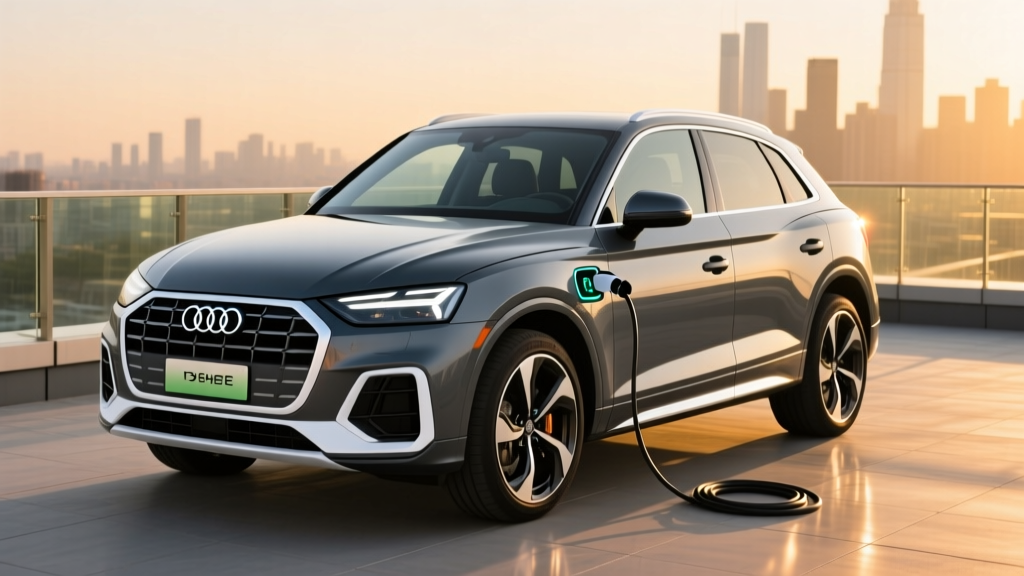
If you've been searching for a hybrid Audi SUV, the 2026 Audi Q5 TFSI e sits at the center of the lineup as a plug-in hybrid (PHEV) that bridges the gap between conventional gas driving and full electric ownership. It pairs Audi's turbocharged 2.0-liter four-cylinder with a rear-mounted electric motor and a 17.9 kWh lithium-ion battery pack to deliver 362 combined horsepower and an EPA-estimated 23 miles of electric-only driving. This guide breaks down every number buyers need — from real-world MPG and charging logistics to §30D tax credit eligibility — so you can decide whether the Q5 TFSI e fits your commute or whether a full BEV makes more sense.
2026 Audi Q5 TFSI e: Quick Spec Snapshot
| Specification | 2026 Audi Q5 55 TFSI e |
|---|---|
| Powertrain Type | Plug-in Hybrid (PHEV) |
| Engine | 2.0L Turbocharged I4 + Electric Motor |
| Combined Horsepower | 362 hp |
| Combined Torque | 369 lb-ft |
| Battery Capacity | 17.9 kWh (gross) / ~14.4 kWh usable |
| EPA Electric-Only Range | 23 miles |
| EPA Combined MPGe | 64 MPGe |
| EPA MPG (Gas-Only Combined) | 26 MPG |
| 0–60 mph | 5.0 seconds |
| Level 2 Charge Time (0–100%) | ~2.5 hours at 7.2 kW |
| DC Fast Charging | Not supported |
| Starting MSRP | $60,495 (Premium Plus) |
| Federal §30D Tax Credit | Not eligible (battery sourcing) |
| Powertrain Warranty | 4 yr / 50,000 mi |
| Hybrid Battery Warranty | 8 yr / 100,000 mi |
Understanding Audi's Hybrid SUV Strategy: HEV vs PHEV
Conventional Hybrid (HEV) vs Plug-In Hybrid (PHEV)
Conventional Hybrid (HEV): A small battery recharges via regenerative braking and the gas engine. You never plug it in. Electric-only driving is minimal (typically under 1 mile at low speeds). The Toyota RAV4 Hybrid is a classic example — expect 39–41 MPG combined without any lifestyle change.
Plug-In Hybrid (PHEV): A larger battery (here, 17.9 kWh) that you do plug in, giving you meaningful electric-only range for daily commutes before the gas engine kicks in. The Audi Q5 TFSI e is a PHEV, offering 23 EPA miles on battery alone. Once depleted, it operates as a conventional hybrid at roughly 26 MPG combined.
As of the 2026 model year, Audi does not sell a conventional (non-plug-in) hybrid SUV in the United States. Every electrified Audi SUV stateside is a PHEV. If you want a no-plug hybrid experience in a luxury SUV, you'll need to look at competitors like the Lexus RX 350h or the Volvo XC60 Recharge's hybrid mode with a depleted battery.
Electric-Only Range and Total Driving Range
The EPA rates the 2026 Q5 55 TFSI e at 23 miles of electric-only range. In real-world mixed driving — city streets with regen braking, moderate temperatures — many owners report 20–25 miles before the 2.0L engine awakens. Highway driving at 70+ mph or cold-weather operation (below 40°F) can drop that figure to 16–18 miles as cabin heating and aerodynamic drag consume more energy.
Once the battery depletes, the Q5 TFSI e reverts to hybrid mode. With its 18.5-gallon fuel tank and EPA-rated 26 MPG combined, you can expect a total combined range of approximately 500 miles (electric + gas). That's enough for a Washington, D.C.–to–Boston drive without a fuel stop.
- EPA electric-only: 23 mi | Real-world typical: 20–25 mi
- Cold weather (below 40°F): 16–18 mi electric-only
- Gas-only range (depleted battery): ~480 mi
- Total combined range: ~500 mi
Fuel Economy: EPA MPG and Real-World Results
| Driving Mode | City | Highway | Combined |
|---|---|---|---|
| Electric + Gas (MPGe) | — | — | 64 MPGe |
| Gas-Only (Battery Depleted) | 25 MPG | 27 MPG | 26 MPG |
Source: EPA Fuel Economy
The 64 MPGe figure only applies when you're driving with a charged battery over short distances. The more useful number for daily ownership is the gas-only combined rating of 26 MPG. In real-world city driving with frequent stops and regenerative braking recapturing energy, some owners see 27–28 MPG. Highway cruising at 75 mph tends to land around 25–26 MPG — slightly below the EPA estimate due to the Q5's weight (roughly 4,800 lbs with battery and motor).
If your commute falls within the 23-mile electric window and you charge nightly, your effective fuel consumption can approach zero gasoline for daily driving. The engine only fires on longer trips or when you floor the accelerator for a merge.
Charging the Q5 TFSI e: What You Need at Home
The Q5 TFSI e uses a standard J1772 connector for AC charging and comes with a portable Level 1 charging cord. Here's what charging looks like across levels:
| Charging Level | Power (kW) | 0–100% Time | Practical Use |
|---|---|---|---|
| Level 1 (120V household) | ~1.4 kW | ~10–11 hours | Overnight top-off |
| Level 2 (240V home/public) | 7.2 kW | ~2.5 hours | Recommended daily charge |
| DC Fast Charging | N/A | N/A | Not supported |
A critical point for PHEV shoppers: the Q5 TFSI e does not support DC fast charging. This is standard across nearly all PHEVs — the battery is too small to justify the hardware cost and weight. All charging is AC via Level 1 or Level 2.
A Level 2 home charger (240V, 32A) is the practical sweet spot. Expect to pay $500–$1,200 for the charger hardware and $800–$2,500 for electrician installation depending on whether your panel needs an upgrade. A 2.5-hour full charge means you can plug in when you get home at 6 PM and be fully topped off by 8:30 PM — well before your morning commute.
Powertrain and Performance
The Q5 55 TFSI e pairs a 261-hp turbocharged 2.0-liter inline-four with a 141-hp electric motor integrated into the seven-speed S tronic dual-clutch transmission. Combined system output is 362 hp and 369 lb-ft of torque, routed through Audi's quattro all-wheel drive system.
The result is a 0–60 mph time of 5.0 seconds — noticeably quicker than the gas-only Q5 45 TFSI (which runs about 5.7 seconds). The electric motor fills in torque at low RPM before the turbo spools, giving the PHEV a responsive, effortless feel in city acceleration. At higher speeds (above 80 mph), the advantage narrows as the engine does most of the work.
Three driving modes govern the powertrain:
- EV Mode: Pure electric driving up to ~84 mph (engine stays off unless you floor it)
- Hybrid Mode: The car decides when to blend electric and gas for optimal efficiency
- Battery Hold/Charge: Preserves or replenishes battery for later electric use (useful before entering city centers or for highway-then-city trip planning)
Pricing, Trims, and Tax Credit Eligibility
The 2026 Audi Q5 55 TFSI e starts at $60,495 for the Premium Plus trim. The Prestige trim adds roughly $5,500, pushing into the mid-$65,000 range before options. Audi's destination charge adds approximately $1,195.
Federal §30D Tax Credit: Not Eligible
As of 2026, the Q5 TFSI e does not qualify for the $7,500 federal §30D clean vehicle tax credit. Under current IRS rules, the vehicle's battery components and critical minerals must meet North American sourcing thresholds that the Q5's supply chain does not satisfy. The IRS maintains a list of eligible vehicles, and Audi's PHEV lineup is absent.
- Vehicle must be on the IRS eligible list (Q5 TFSI e is not)
- MSRP cap: $80,000 for SUVs (Q5 qualifies on price)
- Buyer income cap: $150K single / $300K joint (AGI)
- Battery components must meet North American manufacturing thresholds
- Critical minerals must meet sourcing thresholds
- Point-of-sale transfer available for eligible vehicles
Consult a tax professional for your specific eligibility. State incentives may still apply — check your state energy office for local rebates.
Some states offer their own PHEV incentives. California's CVRP program, for example, has historically offered rebates for qualifying PHEVs, though funding and eligibility change frequently. Check your state's energy or environmental agency for current programs.
Reliability, Battery Warranty, and Replacement Costs
PHEV battery degradation is a top buyer concern, and the data is reassuring. Lithium-ion packs in modern PHEVs are engineered with conservative buffers — the Q5's 17.9 kWh gross capacity yields roughly 14.4 kWh usable, meaning about 3.5 kWh is held in reserve to protect longevity. Based on industry data from similar VAG-group PHEVs, expect 8–12% degradation over the first 8 years under normal use.
If the battery does require out-of-warranty replacement, expect a cost range of $8,000–$14,000 including parts and labor at an Audi dealer. Independent hybrid battery specialists may offer refurbished packs for less. However, PHEV battery failures before 150,000 miles remain uncommon based on owner-reported data from similar platforms (A3 e-tron, older Q5 TFSI e generations).
Audi's overall reliability ratings are middle-of-the-pack among luxury brands. The Q5 platform is mature (this generation debuted for 2018, refreshed for 2025), and the PHEV powertrain has been in European markets since 2019. The most commonly reported issues are software-related (infotainment glitches, charging timer bugs) rather than powertrain failures.
Hybrid vs PHEV vs Full EV: Which Audi SUV Fits You?
Decision Framework
Choose the Q5 TFSI e PHEV if:
- Your daily commute is under 25 miles round-trip and you can charge at home
- You take regular road trips (300+ miles) and don't want to plan around charging stops
- You live in an apartment or area with limited public charging infrastructure
- You want electric daily driving with a gas safety net for longer trips
Choose a full EV (like the Audi Q4 e-tron or Q8 e-tron) if:
- You have reliable Level 2 home charging and your daily driving is under 200 miles
- You want zero tailpipe emissions and lower per-mile fuel costs
- You want DC fast charging for road trips (Q4 e-tron charges 10–80% in ~28 min at 175 kW)
- You want to qualify for the §30D tax credit (Q4 e-tron may be eligible depending on build date)
Choose a conventional hybrid (non-Audi) if:
- You cannot install any home charging and want maximum simplicity
- You want the lowest purchase price with no plug-in logistics
- Consider the Lexus RX 350h (36 MPG combined, ~$52K) or Toyota Highlander Hybrid
Pros and Cons: 2026 Audi Q5 TFSI e
✅ Pros
- 362 hp makes it the quickest Q5 variant
- 23 mi electric range covers most daily commutes
- ~500 mi total range eliminates road-trip range anxiety
- Premium interior, ride quality, and quattro AWD
- No DC fast charging needed — simple Level 2 overnight charge
- 8 yr / 100K mi battery warranty
❌ Cons
- $60K+ starting price with no federal tax credit
- 23 mi electric range is modest vs newer PHEVs (RAV4 Prime: 42 mi)
- No DC fast charging (common PHEV limitation)
- 26 MPG gas-only is unremarkable for a hybrid SUV
- Cargo space slightly reduced vs gas Q5 due to battery placement
- Competitors offer more electric range at lower prices
Frequently Asked Questions
How many MPG does the Audi Q5 hybrid get?
The 2026 Q5 TFSI e gets 64 MPGe when combining electric and gas driving. Once the battery is depleted, it operates as a conventional hybrid at 25 city / 27 highway / 26 combined MPG. Real-world city driving with regen braking can yield 27–28 MPG.
How far can the Audi Q5 PHEV go on electric only?
The EPA rates it at 23 miles of electric-only range. Real-world results typically fall between 20–25 miles in moderate weather, dropping to 16–18 miles in cold conditions or sustained highway driving above 70 mph.
Does the Audi Q5 hybrid qualify for a tax credit?
No. As of 2026, the Q5 TFSI e does not qualify for the federal §30D clean vehicle tax credit due to battery component and critical mineral sourcing requirements it does not meet. Some state incentives may still apply — check your state energy office.
Is the Audi Q5 hybrid reliable? What does battery replacement cost?
The Q5 PHEV powertrain has been in production since 2019 (European market) and reliability data is generally positive, with most issues being software-related rather than mechanical. The hybrid battery is warrantied for 8 years/100,000 miles. Out-of-warranty replacement costs approximately $8,000–$14,000 at a dealer.
Can I charge the Q5 TFSI e at a DC fast charger?
No. Like nearly all PHEVs, the Q5 TFSI e only supports AC charging (Level 1 at 120V or Level 2 at 240V). A full Level 2 charge takes about 2.5 hours. DC fast charging is not available — the battery is too small to justify the hardware.
Do I have to plug in a hybrid Audi SUV?
Yes — the Q5 TFSI e is a plug-in hybrid, meaning you should plug it in nightly to take advantage of its 23-mile electric range. If you never plug it in, it will still drive as a conventional hybrid at ~26 MPG, but you'll miss the efficiency and cost benefits of electric driving. Audi does not currently sell a non-plug-in (conventional HEV) SUV in the US market.
How does the Q5 TFSI e compare to the Toyota RAV4 Prime?
The RAV4 Prime offers 42 miles of electric range (vs 23 for the Q5), a lower starting price (~$44K vs $60K), and similar total horsepower (302 hp). However, the Q5 delivers a premium interior, quattro AWD, superior ride refinement, and a more polished driving experience. The RAV4 Prime is the efficiency-and-value play; the Q5 TFSI e is the luxury-and-performance play.
Editor's note: Specifications reflect 2026 model year data as published by Audi USA and the EPA. Tax credit eligibility rules under IRS §30D are subject to change. Always verify current eligibility at irs.gov and confirm MSRP with your local dealer before purchasing.