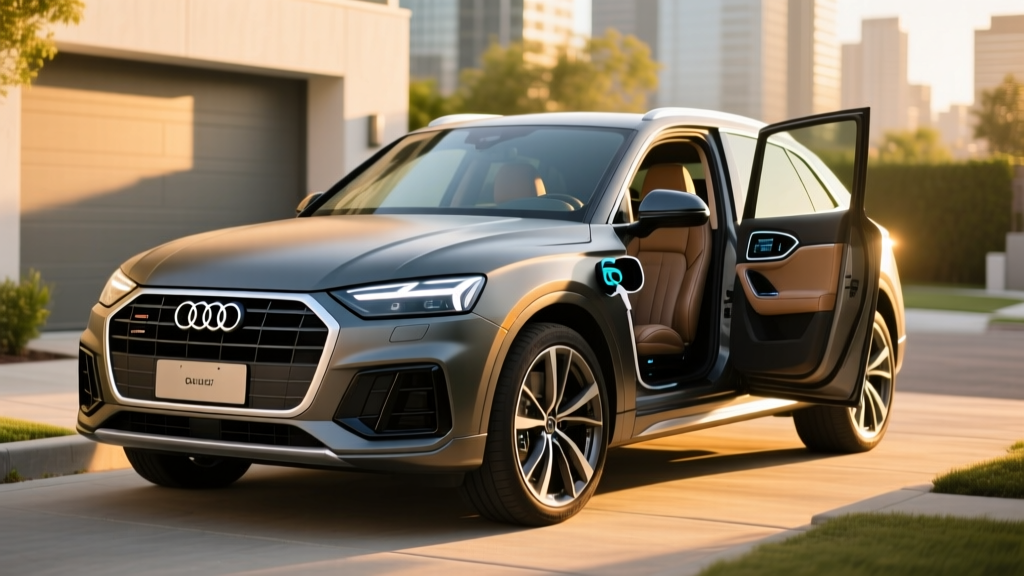
The Audi Q5 PHEV at a Glance
Audi positions the Q5 55 TFSI e as a bridge vehicle for luxury SUV buyers who want electric commuting without range anxiety on road trips. The 2026 model continues with a 2.0-liter turbocharged four-cylinder paired with an electric motor integrated into the seven-speed S tronic transmission, delivering a combined 362 horsepower and 369 lb-ft of torque. The result is a compact luxury SUV that can handle daily errands on electricity alone while retaining the flexibility of a gas engine for longer hauls.
But the real question for shoppers cross-referencing this against the BMW X5 xDrive50e, Volvo XC60 Recharge, or a full EV like the Tesla Model Y is whether the Q5 PHEV's specific blend of electric range, fuel economy, and luxury execution justifies its premium pricing. Let's break down every number that matters.
| Specification | Value |
|---|---|
| Powertrain | 2.0L turbo I4 + electric motor (PHEV) |
| Combined Horsepower | 362 hp |
| Combined Torque | 369 lb-ft |
| Transmission | 7-speed S tronic dual-clutch AWD (quattro) |
| Battery Capacity (gross / usable) | 17.9 kWh / ~14.8 kWh |
| Battery Chemistry | NMC (nickel-manganese-cobalt) |
| EPA Electric-Only Range | 23 miles |
| EPA Combined MPGe (electric + gas) | 61 MPGe |
| EPA MPG (gas-only, combined) | 26 MPG (24 city / 29 highway) |
| Total Combined Range (est.) | ~380 miles |
| Onboard Charger (Level 2) | 7.2 kW |
| DC Fast Charging | Not available |
| Level 2 Charge Time (0–100%) | ~2.5 hours |
| Level 1 Charge Time (120V, 0–100%) | ~8–9 hours |
| 0–60 mph | 5.0 seconds |
| Cargo Volume (behind 2nd row) | 24.7 cu ft |
| Towing Capacity | 4,400 lbs |
| Base MSRP (Premium trim) | $58,295 |
| Battery / Hybrid Component Warranty | 8 years / 100,000 miles |
HEV vs. PHEV: What the Audi Q5 Actually Is
Before diving deeper, it's worth clarifying the distinction, because buyers often conflate these terms. The Audi Q5 is available in two electrified flavors in some markets, but in the U.S., the plug-in variant is the Q5 55 TFSI e, which is a plug-in hybrid electric vehicle (PHEV).
Conventional Hybrid (HEV) vs. Plug-In Hybrid (PHEV)
| Feature | HEV (e.g., Toyota RAV4 Hybrid) | PHEV (e.g., Audi Q5 55 TFSI e) |
|---|---|---|
| Plugs in to charge? | No — charges via regen and engine | Yes — plugs into Level 1 or Level 2 |
| Battery size | 1.0–2.0 kWh | 14–20 kWh typical |
| Electric-only driving | Minimal (low-speed assist only) | 20–40 miles at highway speeds |
| Fuel economy benefit | Consistent MPG improvement | Best when charged daily; gas-only MPG closer to ICE |
| Tax credit eligible? | No | Potentially, under §30D (see below) |
The Q5 55 TFSI e is firmly in the PHEV category. You plug it in, you get a meaningful electric-only range for commuting, and when the battery depletes, the 2.0T engine takes over seamlessly. If you never plug it in, you're carrying 400+ pounds of battery dead weight and getting roughly 26 MPG combined — worse than some conventional luxury crossovers. Buying a PHEV without access to charging is a financial mistake.
Electric-Only Range and Efficiency: The Daily Commute Test
The EPA rates the 2026 Q5 55 TFSI e at 23 miles of electric-only range. That number comes from the EPA's fueleconomy.gov database and reflects a blended city/highway cycle. In real-world use, expect variation:
- City driving with regen: 24–27 miles. Stop-and-go traffic maximizes regenerative braking, stretching the battery.
- Highway at 70 mph: 18–20 miles. Electric motors are less efficient at sustained high speeds, and the Q5's aerodynamic profile is that of a tall SUV.
- Cold weather (below 32°F): 15–18 miles. The battery's internal resistance increases, and cabin heating draws significant energy unless preconditioned while plugged in.
For a commuter with a round trip under 20 miles and home charging, the Q5 PHEV can operate almost entirely on electricity during the work week, with the gas engine only firing for weekend trips or longer excursions. This is the PHEV sweet spot: electric daily, gas when needed.
When the battery is depleted and the vehicle operates as a hybrid, the EPA rates it at 26 MPG combined (24 city / 29 highway). In our experience, city driving with a depleted battery can nudge toward 27–28 MPG thanks to regenerative braking assisting the engine, while highway cruising settles around 27 MPG at 70 mph. These are respectable numbers for a 4,600-pound luxury SUV, but they're not class-leading — the Lexus NX 450h+ delivers better gas-only MPG once its battery is spent.
Charging the Q5 PHEV: What You Need to Know
The Q5 55 TFSI e uses a 17.9 kWh gross battery pack (approximately 14.8 kWh usable, as the system maintains a buffer to protect longevity). Charging is handled through a J1772 port on the driver's side rear quarter panel.
| Charging Level | Power | 0–100% Time | Notes |
|---|---|---|---|
| Level 1 (120V household) | ~1.4 kW | ~8–9 hours | Overnight from a standard outlet; sufficient for daily top-up |
| Level 2 (240V, 32A) | 7.2 kW (vehicle-limited) | ~2.5 hours | Requires Level 2 home charger or public Level 2 station |
| DC Fast Charging | N/A | N/A | Not supported — no CCS or NACS DC port |
The critical limitation here: no DC fast charging. Unlike some rivals (the Mitsubishi Outlander PHEV supports CHAdeMO DC charging, for example), the Q5 PHEV tops out at 7.2 kW on Level 2. For most owners charging at home overnight, this is a non-issue — 2.5 hours on a Level 2 home charger is more than sufficient to replenish the pack between commutes. But if you're relying on public charging during a road trip to top up the battery, you're limited to Level 2 public stations, which are slower and less ubiquitous than DC fast chargers along highway corridors.
A note on kW versus kWh, since this trips up many first-time PHEV buyers: kW (kilowatts) measures the rate of power delivery — how fast electricity flows into the car. kWh (kilowatt-hours) measures energy capacity — how much electricity the battery stores. Think of kW as the width of the hose and kWh as the size of the tank. The Q5's 7.2 kW onboard charger means it can accept up to 7.2 kilowatts of power at any moment, filling its 17.9 kWh battery in roughly 2.5 hours.
Performance and Powertrain: 362 HP With a Safety Net
The Q5 55 TFSI e pairs Audi's well-proven 2.0-liter EA888 turbocharged inline-four (producing 261 hp on its own) with a 141-hp electric motor sandwiched between the engine and the seven-speed S tronic dual-clutch transmission. Combined output is 362 horsepower and 369 lb-ft of torque, routed through Audi's quattro all-wheel-drive system.
The result is a 0–60 mph time of 5.0 seconds — genuinely quick for a luxury compact SUV and meaningfully faster than the gas-only Q5 45 TFSI (which runs about 6.1 seconds to 60). The electric motor fills in the torque gap at low RPMs before the turbo spools, eliminating the lag that characterizes smaller turbocharged engines. Off the line, the Q5 PHEV pulls with the immediacy of an EV, then seamlessly transitions to blended gas-electric operation as speeds climb.
Driving modes include EV-only (the default at startup), Hybrid (the car manages the blend), Battery Hold (preserves charge for later use, such as entering a zero-emission zone), and Battery Charge (the engine actively recharges the battery at the cost of fuel economy). The Battery Hold mode is particularly useful on road trips: you can preserve your electric range for city driving at your destination while using the gas engine on the highway.
Pricing, Trims, and Federal Tax Credit Eligibility
The 2026 Audi Q5 55 TFSI e is offered in three trims:
- Premium: $58,295 MSRP
- Premium Plus: $62,595 MSRP
- Prestige: $67,195 MSRP
All trims include the 17.9 kWh battery, quattro AWD, leather upholstery, Audi's MMI infotainment system with a 10.1-inch touchscreen, and a suite of ADAS features including adaptive cruise control, lane-keeping assist, and automated emergency braking.
Federal Tax Credit: The §30D Question
Under the current IRS §30D Clean Vehicle Credit rules, the Audi Q5 55 TFSI e faces significant eligibility hurdles:
- MSRP cap: SUVs must have an MSRP at or below $80,000. The Q5 PHEV clears this bar on all trims.
- Battery sourcing and critical minerals: To qualify for the full $7,500, the vehicle must meet both the battery-component manufacturing requirement (North America) and the critical-minerals sourcing requirement (U.S. or FTA-partner countries). As of 2026, the Q5 PHEV's battery supply chain has not consistently met both thresholds, meaning buyers should expect partial credit eligibility ($3,750) or no credit depending on the specific VIN and production batch. Verify with your dealer and cross-reference the IRS eligible-vehicle list before purchasing.
- Buyer income caps: Modified adjusted gross income must not exceed $150,000 (single), $225,000 (head of household), or $300,000 (joint).
- Point-of-sale transfer: If eligible, the credit can be transferred to the dealer at purchase, reducing your out-of-pocket cost immediately rather than waiting for a tax refund.
Tax Credit Eligibility Checklist — Audi Q5 55 TFSI e
- ✅ MSRP below $80,000 SUV cap
- ⚠️ Battery component sourcing — verify per VIN with dealer
- ⚠️ Critical minerals sourcing — verify per VIN with dealer
- ✅ Buyer income within §30D limits (if applicable)
- ✅ Point-of-sale transfer available if credit applies
- ❌ State/local incentives vary — check AFDC incentive database for your area
Bottom line: do not assume you'll receive $7,500. Many Q5 PHEV buyers in recent model years have qualified for $3,750 or nothing, depending on battery sourcing. Confirm with your tax professional and the IRS eligible vehicle list before signing.
Battery Longevity, Warranty, and Replacement Costs
Hybrid and PHEV battery anxiety remains one of the most common concerns we hear from buyers. Here's what the data says about the Q5 specifically:
Battery Warranty Coverage
Audi covers the Q5 55 TFSI e high-voltage battery for 8 years or 100,000 miles (whichever comes first), with a capacity-retention threshold of approximately 70%. If the battery degrades below that level within the warranty period, Audi will repair or replace it at no cost. Some states with California Air Resources Board (CARB) adoption mandate longer coverage — up to 10 years / 150,000 miles. Check your state's requirements.
In practice, NMC-based PHEV batteries from Volkswagen Group vehicles have shown modest degradation patterns. The buffer strategy (keeping roughly 3 kWh of the 17.9 kWh gross capacity inaccessible to the driver) significantly reduces stress on the cells. Owners reporting on enthusiast forums and EV tracking databases typically see 5–8% capacity loss over the first 60,000 miles — well within the warranty threshold.
If you do need an out-of-warranty replacement, expect a cost between $8,000 and $12,000 for the battery pack, plus labor. This is a worst-case scenario and relatively rare for vehicles under 120,000 miles. For context, a conventional gas-engine transmission replacement on a comparable luxury SUV can run $5,000–$8,000, so the PHEV battery risk is not dramatically out of line with traditional powertrain repair costs.
Real-World Ownership: Who Should Choose the Q5 PHEV?
The Audi Q5 55 TFSI e occupies a specific niche, and it's not the right vehicle for everyone. Here's a decision framework:
Choose the Q5 PHEV if:
- Your daily round-trip commute is under 25 miles and you can charge at home (Level 1 or Level 2).
- You want a luxury compact SUV with genuine performance (5.0s 0–60) without committing to full EV infrastructure.
- You take road trips of 200+ miles several times per year and don't want to plan around DC fast-charging stops.
- You value Audi's interior quality, quattro AWD, and brand cachet over maximum electric range.
Choose a full EV (e.g., Tesla Model Y, Audi Q4 e-tron) if:
- You have reliable home Level 2 charging and your daily driving is under 250 miles.
- You want to eliminate gas purchases and oil changes entirely.
- You want access to DC fast-charging networks (Tesla Supercharger, Electrify America) for road trips.
- You want a longer electric range (250–330 miles EPA) and lower per-mile fuel cost.
Choose a conventional hybrid (e.g., Lexus NX 350h) if:
- You cannot charge at home (apartment, street parking, no garage outlet).
- You want better gas-only fuel economy (36+ MPG combined) without ever plugging in.
- You want a lower purchase price and simpler ownership with no charging equipment to install.
| Cost Factor | Audi Q5 55 TFSI e (PHEV) | Audi Q5 45 TFSI (Gas) | Audi Q4 e-tron (BEV) |
|---|---|---|---|
| MSRP (base) | $58,295 | $47,595 | $50,595 |
| Est. Federal Tax Credit | $0–$7,500 (verify per VIN) | $0 | $0–$7,500 (verify per VIN) |
| Fuel/Energy (5 yr, 15k mi/yr) | ~$4,800 (mixed EV/gas) | ~$9,500 (gas only) | ~$3,600 (electricity only) |
| Maintenance (5 yr) | ~$3,200 | ~$4,000 | ~$1,800 |
| Insurance (5 yr est.) | ~$9,500 | ~$8,200 | ~$9,000 |
| Depreciation (5 yr est.) | ~$24,000 | ~$20,000 | ~$22,000 |
The PHEV's cost advantage depends heavily on whether you actually charge it daily. If you plug in every night and commute within the 23-mile electric envelope, your fuel costs drop significantly. If you treat it as a gas car and never plug in, you're paying a $10,000+ premium over the gas Q5 for worse fuel economy.
Frequently Asked Questions
How many MPG does the Audi Q5 plug-in hybrid get?
The EPA rates the 2026 Q5 55 TFSI e at 26 MPG combined (24 city / 29 highway) when operating on gasoline after the battery is depleted. When factoring in electric-only driving, the combined rating is 61 MPGe. Real-world gas-only MPG tends to land around 27–28 in city driving and 26–27 on the highway, depending on driving style and terrain.
How far can the Audi Q5 PHEV go on electric only?
The EPA rates it at 23 miles of electric-only range. In real-world conditions, expect 18–27 miles depending on speed, temperature, and terrain. City driving with regenerative braking extends range; highway speeds and cold weather reduce it.
Does the Audi Q5 plug-in hybrid qualify for a tax credit?
Potentially, but it depends. Under current IRS §30D rules, the Q5 PHEV meets the MSRP cap for SUVs (under $80,000) but battery sourcing requirements may limit the credit to $3,750 or eliminate it entirely. Always verify eligibility per VIN with your dealer and consult a tax professional. Check the IRS Clean Vehicle Credit page for the most current eligible vehicle list.
Is the Audi Q5 hybrid reliable, and what does a battery replacement cost?
The Q5 PHEV's powertrain is based on proven Volkswagen Group components. The high-voltage battery is warrantied for 8 years / 100,000 miles with a 70% capacity-retention threshold. Out-of-warranty battery replacement runs approximately $8,000–$12,000. Real-world degradation data suggests 5–8% capacity loss over 60,000 miles, well within the warranty buffer. Routine maintenance is slightly less than the gas-only Q5 thanks to reduced brake wear from regenerative braking and no need for transmission fluid changes on the same schedule.
Can the Audi Q5 PHEV use a DC fast charger?
No. The Q5 55 TFSI e supports Level 1 (120V) and Level 2 (240V, up to 7.2 kW) charging only. There is no DC fast-charging capability. For most PHEV owners who charge at home, this is not a practical limitation, but it means you cannot rapidly top up the battery on road trips the way a full EV can.
Hybrid vs. PHEV vs. EV — which should I choose?
If you can charge at home and your daily driving is under 25 miles, the Q5 PHEV lets you commute on electricity while keeping gas flexibility for longer trips. If you can't charge at home, a conventional hybrid (HEV) like the Lexus NX 350h makes more sense — you'll get consistent fuel economy without plugging in. If you have Level 2 home charging and rarely drive more than 250 miles in a day, a full EV like the Audi Q4 e-tron or Tesla Model Y will deliver lower running costs and zero tailpipe emissions.