Quick Verdict: The Audi Q5 Hybrid Automatic in 2026
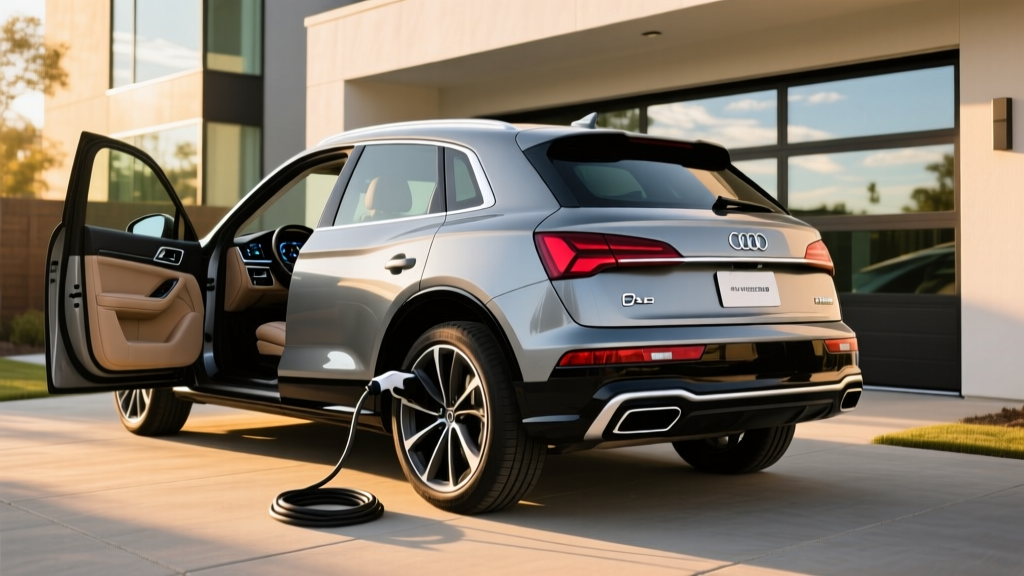
The 2026 Audi Q5 lineup offers two distinct electrified paths: the Q5 55 TFSI e plug-in hybrid (PHEV) with an estimated 23–25 miles of electric-only range, and the newly introduced Q5 mild-hybrid variants that use a 48-volt system for marginal efficiency gains. Neither is a conventional self-charging hybrid (HEV) in the Toyota RAV4 Hybrid sense. If you're searching for an Audi Q5 hybrid automatic, you're almost certainly looking at the 55 TFSI e PHEV — the only variant that meaningfully reduces fuel consumption and offers electric-only commuting.
This guide breaks down exactly what the Q5 55 TFSI e delivers in real-world driving, what it costs to buy and charge, and whether it makes more sense than a full BEV or a conventional gas SUV.
HEV vs PHEV vs Mild Hybrid: What the Q5 Actually Is
Critical distinction: Audi does not sell a conventional hybrid (HEV) Q5 in the United States. Here's how the electrified Q5 variants differ:
| Type | Q5 Variant | Plug In? | Electric-Only Range | How It Works |
|---|---|---|---|---|
| Mild Hybrid (MHEV) | Q5 45 TFSI (48V) | No | None | Small motor assists engine, enables start-stop coasting; no EV mode |
| Plug-in Hybrid (PHEV) | Q5 55 TFSI e | Yes | ~23–25 mi | Larger battery + electric motor; can drive on electricity alone or blend with gas |
| Full Hybrid (HEV) | Not offered in Q5 | No | ~1–2 mi (low speed) | Self-charging; no plug. (Think RAV4 Hybrid) |
| Battery Electric (BEV) | Q8 e-tron (different model) | Yes | 200+ mi | No gas engine at all |
If you want meaningful electric driving from your Q5, the 55 TFSI e is the trim to target. The mild-hybrid 45 TFSI saves roughly 1–2 MPG over a non-hybrid equivalent — a negligible difference for most buyers.
Fuel Economy and Electric Range: The Numbers That Matter
The EPA has not yet published finalized 2026 figures at the time of writing, but based on the carryover powertrain from the 2025 model year and Audi's published specs, here are the expected efficiency numbers for the Q5 55 TFSI e:
| Metric | EPA Estimate (Expected) | Real-World Expectation |
|---|---|---|
| Combined MPGe (electric + gas) | ~61 MPGe | 55–65 MPGe depending on charge frequency |
| Gas-only combined MPG | ~25 MPG | 22–24 MPG highway-heavy; 26–28 MPG city with regen |
| City MPG (gas-only) | ~26 MPG | Often exceeds EPA in stop-and-go thanks to regen braking |
| Highway MPG (gas-only) | ~24 MPG | 21–23 MPG at 75+ mph; aerodynamic drag dominates |
| Electric-only range | ~23–25 miles | 18–22 mi at highway speeds; 25–28 mi in mild city driving |
| Total range (full tank + full battery) | ~380–410 miles | Depends heavily on driving mix and climate |
Real-world range reality: The EPA electric-only estimate of ~23–25 miles assumes mixed driving at moderate temperatures. In practice, expect 18–20 miles of electric range during winter or sustained highway driving above 65 mph. In mild weather with city speeds under 45 mph, owners regularly report 26–28 miles before the gas engine kicks in. Always plan around the lower number for daily commute feasibility.
Powertrain and Performance Specs
The Q5 55 TFSI e pairs a turbocharged 2.0-liter inline-four with an electric motor integrated into the 7-speed S tronic dual-clutch automatic transmission. Here's the full spec breakdown:
| Specification | Q5 55 TFSI e (2026 Expected) |
|---|---|
| Gas engine | 2.0L turbocharged I4, ~261 hp / 273 lb-ft |
| Electric motor | ~141 hp / 258 lb-ft (integrated in transmission) |
| Combined system output | 362 hp / 369 lb-ft |
| Transmission | 7-speed S tronic dual-clutch automatic |
| Drivetrain | quattro all-wheel drive |
| 0–60 mph | ~5.0 seconds |
| Battery capacity (gross / usable) | ~17.9 kWh gross / ~14.4 kWh usable |
| Battery chemistry | NMC (nickel manganese cobalt) |
| Onboard charger (Level 2) | 7.2 kW |
| DC fast charging | Not available |
| Level 2 charge time (0–100%) | ~2.5 hours at 7.2 kW |
| Level 1 charge time (120V) | ~8–10 hours (overnight) |
| Fuel tank capacity | ~14.8 gallons |
| Towing capacity | ~4,400 lbs |
Charging reality check: The Q5 55 TFSI e does not support DC fast charging — a common limitation among PHEVs due to smaller battery sizes and cost trade-offs. You're limited to Level 2 (240V) at 7.2 kW or Level 1 (120V) from a standard outlet. For most PHEV owners who charge overnight at home, this is perfectly adequate. A full charge in ~2.5 hours on Level 2 means you can top up mid-day if needed. But on a road trip, you'll be running on gas — there's no pulling into an Electrify America station for a quick battery top-up.
Pricing, Trims, and Tax Credit Eligibility
The 2026 Audi Q5 55 TFSI e starts at an estimated $59,300 MSRP (including destination), with the Prestige trim pushing past $67,000. Here's the expected trim breakdown:
| Trim | Est. MSRP | Key Features |
|---|---|---|
| Premium | ~$59,300 | Leather, panoramic roof, 10.1" touchscreen, adaptive cruise |
| Premium Plus | ~$63,400 | Matrix LED headlights, Bang & Olufsen audio, 360° camera |
| Prestige | ~$67,200 | Head-up display, air suspension available, full leather dash |
Federal tax credit eligibility (§30D): The Audi Q5 55 TFSI e's eligibility for the $7,500 federal tax credit depends on several factors that change annually. Key requirements under current IRS §30D rules:
- MSRP cap: SUVs must be under $80,000 — the Q5 PHEV qualifies on price.
- Buyer income cap: AGI must not exceed $150,000 (single) / $300,000 (joint).
- Battery sourcing: Critical minerals and battery components must meet phased-in domestic/free-trade sourcing thresholds. This is where many European-built PHEVs fail.
- Point-of-sale transfer: If eligible, the credit can be applied at the dealer as an upfront discount.
Bottom line: Because the Q5 is assembled in Mexico (San José Chiapa) and uses battery cells with supply chains that may not satisfy current critical-mineral requirements, the Q5 55 TFSI e may not qualify for the full $7,500 credit — and could be ineligible entirely. Always verify current eligibility on fueleconomy.gov before purchasing. State incentives (California, Colorado, etc.) may still apply independently.
Reliability, Battery Warranty, and Long-Term Costs
Audi PHEV battery warranty: Audi covers the Q5 55 TFSI e high-voltage battery for 8 years or 100,000 miles (whichever comes first), with a capacity retention threshold of 70%. If the battery degrades below 70% of original capacity within that period, Audi will repair or replace it at no cost.
The powertrain (engine, transmission, electric motor) is covered for 4 years or 50,000 miles, matching Audi's standard new-vehicle warranty.
Battery replacement cost: Outside of warranty, a Q5 PHEV battery replacement is estimated at $8,000–$14,000 including parts and labor, based on current dealer pricing for similar Volkswagen Group PHEV packs. However, PHEV batteries are smaller and experience less stress than BEV batteries (shallower cycles, less total energy throughput), and real-world data suggests most will retain 85–90% capacity at the 100,000-mile mark.
General reliability: Audi's PHEV powertrain has been in use across the VW Group since 2019 (A6 TFSI e, A7 TFSI e, Q5 TFSI e). Common reported issues are minor — typically related to charging software glitches and onboard charger communication rather than battery degradation. The 2.0L TFSI engine is well-proven. According to IIHS, the Q5 platform earns top safety marks, though the 2026 model year has not yet been tested as of this writing.
Who Should Choose the Q5 Hybrid Automatic — and Who Shouldn't
✓ Pros
- 362 hp with quattro AWD — genuinely quick for a luxury SUV (5.0s to 60)
- 23–25 mi electric range covers most commutes under 20 miles round-trip
- No range anxiety — gas engine provides 380+ total miles
- Premium interior, strong NVH, refined ride quality
- 4,400-lb towing capacity exceeds most BEV crossovers
- Level 2 overnight charging is simple and cheap (no DCFC needed for daily use)
✗ Cons
- Only ~23–25 mi electric range — insufficient for commutes over 30 miles
- No DC fast charging — road trips run entirely on gas
- $59K+ starting price; rivals offer more electric range for less
- Federal tax credit eligibility uncertain due to sourcing rules
- Cargo space slightly reduced vs gas Q5 due to battery placement (~24.7 cu ft vs 25.8)
- Gas-only MPG (25 combined) is unremarkable for a hybrid — comparable to some non-hybrid turbo-4 SUVs
Decision Framework: Is the Q5 PHEV Right for You?
Choose the Q5 55 TFSI e if:
- Your round-trip commute is under 25 miles and you can charge at home nightly
- You want a luxury compact SUV with real performance (362 hp) and AWD
- You regularly take road trips where BEV charging infrastructure is uncertain
- You need towing capacity and don't want to compromise for electrification
Choose a full BEV (like the Q8 e-tron or BMW iX) instead if:
- Your daily driving exceeds 30 miles — you'll burn gas constantly in the Q5 PHEV
- You have reliable home charging and access to DCFC for road trips
- You want maximum fuel cost savings and zero tailpipe emissions
Choose a conventional hybrid (like the Lexus RX 350h) instead if:
- You can't install a home charger — a PHEV without home charging is just a heavy gas car
- You want simpler ownership with no plug-in routine
- Budget is under $50K and you prioritize fuel economy over performance
Charging at Home: What You'll Need
Since the Q5 55 TFSI e relies on Level 2 for practical daily charging, here's what home setup looks like:
| Charging Level | Power | Time (0–100%) | Setup Needed | Est. Cost |
|---|---|---|---|---|
| Level 1 (120V outlet) | ~1.4 kW | 8–10 hours | None — use included cable | $0 |
| Level 2 (240V, 32A) | 7.2 kW | ~2.5 hours | NEMA 14-50 outlet or hardwired EVSE | $500–$2,000 (install) |
Most Q5 PHEV owners install a Level 2 home charger (such as a ChargePoint Home Flex or Emporia Level 2) on a 240V/40A circuit. A licensed electrician will typically charge $500–$1,500 for the installation if your electrical panel has capacity. If a panel upgrade (to 200A) is needed, add $1,500–$3,000. The included Level 1 cord works for overnight top-ups but is slow — plan for Level 2 if your commute is close to the 23-mile electric range limit.
Frequently Asked Questions
How many MPG does the Audi Q5 hybrid automatic get?
The Q5 55 TFSI e PHEV is expected to return approximately 25 MPG combined (26 city / 24 highway) when running on gasoline alone, and roughly 61 MPGe combined when factoring in electric driving. Real-world gas-only MPG often hits 26–28 in city driving thanks to regenerative braking, but drops to 21–23 on sustained highway trips above 75 mph.
How far can the Q5 PHEV go on electric only?
The EPA-estimated electric-only range is approximately 23–25 miles. In real-world conditions, expect 18–20 miles at highway speeds or in cold weather, and up to 26–28 miles in mild-weather city driving under 45 mph. The gas engine seamlessly engages once the battery is depleted.
Does the Audi Q5 hybrid qualify for a tax credit?
Eligibility for the $7,500 federal §30D tax credit is uncertain for the Q5 55 TFSI e. While the MSRP is under the $80,000 SUV cap, the vehicle's Mexican assembly and battery component sourcing may not satisfy current critical-mineral and battery-component requirements. Always verify on fueleconomy.gov and consult a tax professional before relying on the credit. Some state incentives (e.g., California's CVRP, Colorado's innovative motor vehicle credit) may apply separately.
Is the Q5 hybrid reliable, and what does a battery replacement cost?
The Q5 PHEV powertrain has been in production since 2019 across multiple VW Group models, with no widespread battery failure patterns reported. The high-voltage battery is warranted for 8 years / 100,000 miles at 70% capacity retention. Out-of-warranty replacement is estimated at $8,000–$14,000. PHEV batteries generally degrade slower than BEV batteries due to smaller capacity and shallower charge cycles.
Can the Q5 PHEV charge at public DC fast chargers?
No. The Q5 55 TFSI e does not support DC fast charging. It is limited to Level 2 (7.2 kW) and Level 1 (1.4 kW) AC charging. This is standard for most PHEVs — the smaller battery doesn't justify the cost and weight of DCFC hardware. On road trips, the Q5 runs on its gasoline engine exclusively.
Hybrid vs PHEV vs EV — which should I buy?
If you can charge at home and your daily driving is under 25 miles, the Q5 PHEV lets you commute electrically while keeping gas flexibility for road trips. If you drive more than 35 miles daily and have DCFC access, a full BEV (like the Q8 e-tron) will save more on fuel. If you cannot charge at home, skip the PHEV — you'll carry dead battery weight and never use its electric advantage. A conventional hybrid (not offered in the Q5, but available in the Lexus RX 350h or Toyota Highlander Hybrid) is the better no-plug option.