Luxury compact SUVs sit at a crossroads in 2026. Full battery-electric models like the Audi Q8 e-tron offer zero tailpipe emissions but demand charging discipline, while conventional gas models leave efficiency on the table. The Audi Q5 55 TFSI e plug-in hybrid occupies the middle ground: a premium SUV that delivers short-distance electric commuting with the range and refueling convenience of a gas engine for longer trips. Whether that compromise makes sense depends entirely on your driving patterns, home charging access, and budget.
This guide dissects the 2026 Audi Q5 55 TFSI e PHEV with the data-driven approach real buyers need — EPA figures, real-world expectations, charging logistics, powertrain specs, tax-credit eligibility, and a clear decision framework to help you choose between this PHEV, a conventional hybrid, or a full BEV.
HEV vs PHEV vs BEV: Where the Q5 55 TFSI e Fits
Before evaluating specs, it's critical to distinguish between the three electrified powertrain types. Many buyers confuse them, and the ownership experience differs dramatically.
| Feature | Conventional Hybrid (HEV) | Plug-In Hybrid (PHEV) | Battery Electric (BEV) |
|---|---|---|---|
| Plugs in to charge? | No — charges via engine & regen | Yes — has a charge port | Yes — charge port required |
| Electric-only driving? | Very limited (low speed, short bursts) | Yes — typically 20–40 miles | Yes — 200–400+ miles |
| Gas engine? | Yes (always available) | Yes (always available) | No |
| Home charging needed? | No | Recommended for full benefit | Essential |
| Federal tax credit? | No | Up to $3,750–$7,500 (varies) | Up to $7,500 (varies) |
The Audi Q5 55 TFSI e is a PHEV. It has a charge port and a battery large enough to drive roughly 23 miles on electricity alone before the 2.0-liter turbocharged gas engine kicks in. If you never plug it in, it functions as a heavier, less efficient conventional hybrid — defeating the purpose of paying the PHEV premium. This vehicle rewards owners who can charge at home or work daily.
Powertrain and Performance Specs
The 2026 Q5 55 TFSI e pairs Audi's familiar 2.0L turbocharged inline-four with a permanently excited synchronous electric motor integrated into the 7-speed S tronic dual-clutch transmission. Combined output lands at 362 horsepower and 369 lb-ft of torque, routed through quattro all-wheel drive.
| Specification | Value |
|---|---|
| Combined Horsepower | 362 hp |
| Combined Torque | 369 lb-ft |
| Gas Engine | 2.0L turbocharged I4 (261 hp) |
| Electric Motor | 141 hp (integrated in transmission) |
| Transmission | 7-speed S tronic dual-clutch |
| Drivetrain | quattro AWD |
| 0–60 mph | 5.0 seconds (manufacturer est.) |
| Battery Capacity (gross) | 17.9 kWh |
| Battery Chemistry | NMC (nickel-manganese-cobalt) |
| EPA Electric-Only Range | 23 miles |
| Total Combined Range | ~440 miles (gas + electric) |
| Base MSRP (Premium trim) | $58,995 |
The 0–60 time of approximately 5.0 seconds places the 55 TFSI e in genuinely quick territory for a luxury compact SUV, with the electric motor's instant torque filling in the low-RPM gap before the turbo spools. In practice, this means confident highway merging and responsive city acceleration without the lag typical of gas-only four-cylinders.
EPA Fuel Economy and Real-World MPG
Fuel economy for a PHEV has two dimensions: efficiency when running on electricity (measured in MPGe) and efficiency once the battery is depleted and the gas engine takes over.
| Mode | City | Highway | Combined |
|---|---|---|---|
| Charge-Depleted (Gas Only) | 25 MPG | 27 MPG | 26 MPG |
| Charge-Sustaining (MPGe) | 61 MPGe combined (electric + gas blend) | ||
| Electric-Only Efficiency | 77 MPGe (36 kWh/100 mi) | ||
Real-world expectations: The EPA's 26 MPG combined in gas-only mode is achievable in mixed suburban driving. On a sustained highway trip at 70–75 mph with a depleted battery, expect closer to 24–25 MPG — the Q5's aerodynamic profile and AWD system create drag at speed. In city driving with frequent regenerative braking opportunities, you may see 27–28 MPG in charge-sustaining mode. These figures come from fueleconomy.gov data and owner reports.
Real-World Range Reality: The EPA rates the Q5 55 TFSI e at 23 miles electric-only. In mild weather (60–75°F) with conservative driving, expect 20–22 real-world electric miles. In cold weather (below 35°F), cabin heating and battery thermal losses can reduce that to 15–18 miles. Highway-speed electric driving (65+ mph) also shortens range significantly — plan on ~17 electric miles at interstate speeds.
The 23-mile electric range is the Q5 PHEV's most polarizing spec. It covers the daily commute for many drivers — the average American one-way commute is roughly 16 miles according to Census data — but falls short of PHEV leaders like the Toyota RAV4 Prime (42 miles) or the Jeep Wrangler 4xe (21 miles, but in a far less efficient vehicle). If your daily round-trip commute exceeds 25 miles, you'll be burning gas on part of your drive even with a full overnight charge.
Charging: Times, Equipment, and Logistics
The Q5 55 TFSI e uses a standard J1772 (Type 1) AC charge port. It does not support DC fast charging — a common limitation among PHEVs, which have batteries too small to justify the cost and weight of DCFC hardware.
| Charging Level | Power (kW) | Time (0–100%) | Notes |
|---|---|---|---|
| Level 1 (120V household) | ~1.4 kW | ~12–13 hours | Emergency/trickle only |
| Level 2 (240V, home/public) | 7.2 kW | ~2.5 hours | Recommended for daily use |
| DC Fast Charge | N/A | N/A | Not supported |
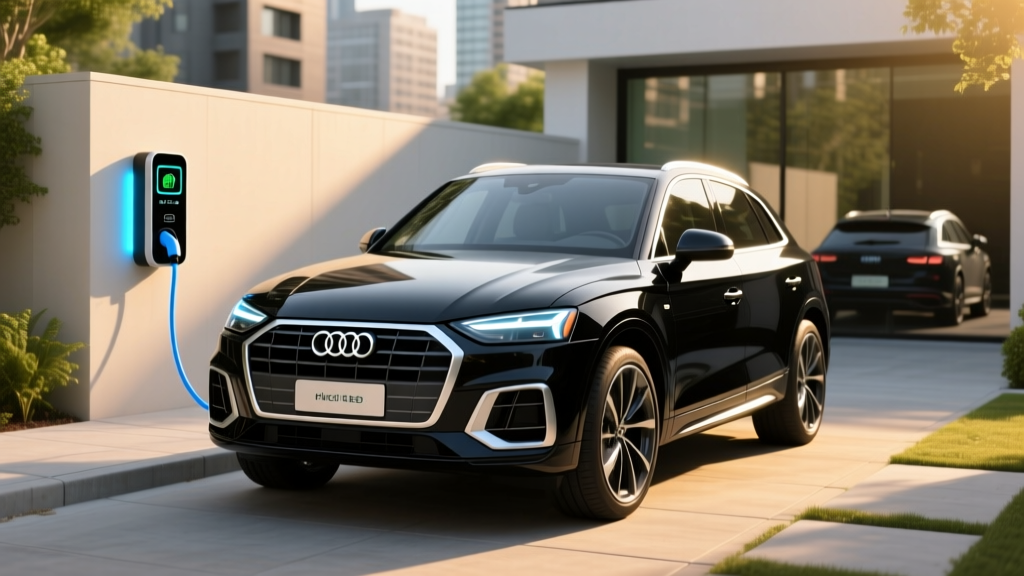
A Level 2 home charger is practically essential. At 7.2 kW, a full charge takes roughly 2.5 hours — meaning you can easily top up during the workday if you have a Level 2 outlet at your workplace, or fully recharge overnight on a standard 240V home station. On a standard 120V outlet (Level 1), a full charge takes 12+ hours, which is workable for overnight top-ups only if you start with a partially depleted battery.
For home Level 2 installation, budget $500–$1,500 for a quality charger (ChargePoint Home Flex, Emporia Vue, or Wallbox Pulsar Plus) plus $500–$2,000 for electrician labor depending on panel proximity and local permit requirements. If your home has a 200-amp electrical panel with spare capacity, installation is straightforward. Older homes with 100-amp panels may need a $2,000–$4,000 panel upgrade — a cost many PHEV buyers overlook. Always get a quote from a licensed electrician before committing.
Does the Q5 55 TFSI e Qualify for Federal Tax Credits?
This is where PHEV buyers face the most confusion. Under IRS §30D rules current for 2026, plug-in hybrids can qualify for a federal tax credit, but the amount varies based on battery capacity, critical-mineral sourcing, buyer income, and vehicle MSRP caps.
- Battery capacity requirement: Must have at least 7 kWh — the Q5's 17.9 kWh battery clears this easily.
- Critical minerals & battery component sourcing: The credit splits into two halves ($3,750 each). The Q5 55 TFSI e's battery sourcing determines whether it qualifies for one or both halves. As of 2026, many European-assembled Audi PHEVs qualify for $3,750 (one half), as battery component manufacturing may not fully meet the domestic-content threshold.
- MSRP cap: SUVs must have an MSRP at or below $80,000. The Q5 55 TFSI e (starting ~$58,995) qualifies.
- Buyer income cap: Modified adjusted gross income must not exceed $150,000 (single), $225,000 (head of household), or $300,000 (joint filers).
- Point-of-sale transfer: As of 2024+, you can transfer the credit to the dealer at purchase for an immediate price reduction rather than waiting to claim it on your tax return.
Bottom line: Expect $3,750 in federal credit for the Q5 55 TFSI e, assuming you meet income requirements. Always verify current eligibility on IRS.gov and consult a tax professional before relying on credit amounts for purchase decisions. Sourcing rules tighten annually, and a model that qualifies in early 2026 may see changes by year-end.
Additionally, check your state's incentive programs. States like California, Colorado, and New York offer supplemental PHEV rebates ($1,000–$3,000) that stack with federal credits. These vary by jurisdiction and income — consult your state energy office or AFDC's state law database for current programs.
Battery Warranty, Reliability, and Replacement Costs
Hybrid and PHEV battery longevity remains a top buyer concern. The Q5 55 TFSI e's 17.9 kWh NMC battery is liquid-cooled and managed by Audi's thermal system, which helps mitigate degradation from extreme temperatures and repeated charge cycles.
Audi PHEV Battery Warranty:
- High-voltage battery: 8 years / 100,000 miles (whichever comes first)
- Capacity retention threshold: Warranty covers replacement if battery falls below 70% of original capacity
- Powertrain warranty: 4 years / 50,000 miles
- Basic vehicle warranty: 4 years / 50,000 miles
Reliability context: Audi's PHEV powertrains share architecture with other Volkswagen Group vehicles (Porsche Cayenne E-Hybrid, VW Tiguan eHybrid). The 2.0L TFSI engine is well-proven across millions of units. The primary reliability concerns with PHEVs are not battery failure (rare under warranty) but rather the complexity of managing two powertrains — dual cooling circuits, additional power electronics, and the integrated motor-transmission assembly. Third-party reliability data from Consumer Reports and J.D. Power places Audi in the mid-pack among luxury brands, with PHEV variants generally tracking close to their gas-only counterparts.
Battery replacement cost: Out of warranty, a replacement high-voltage battery for the Q5 PHEV is estimated at $8,000–$14,000 including labor, based on current VW Group PHEV battery pricing. This is a significant sum, but battery failures within the first 10 years are uncommon in liquid-cooled systems. Most PHEV batteries lose 10–15% capacity over 8–10 years of normal use — meaning your 23-mile electric range might become 19–20 miles by year eight, not a catastrophic loss.
Pricing, Trims, and Total Cost of Ownership
The 2026 Q5 55 TFSI e is offered in three trims, all with the same powertrain:
| Trim | MSRP | Est. After $3,750 Credit |
|---|---|---|
| Premium | $58,995 | ~$55,245 |
| Premium Plus | $63,495 | ~$59,745 |
| Prestige | $68,495 | ~$64,745 |
The ~$7,000 premium over a gas-only Q5 45 TFSI (starting ~$51,995) buys you the electric motor, larger battery, and PHEV powertrain electronics. Whether that premium pays back depends on your electricity cost, gas price, and how many miles you drive within electric range.
Five-year cost-of-ownership sketch (15,000 miles/year, 70% electric commuting):
- Electricity for 10,500 miles/year at 36 kWh/100 mi × $0.16/kWh avg = ~$605/year
- Gasoline for 4,500 miles/year at 26 MPG × $3.60/gal avg = ~$623/year
- Combined annual fuel cost: ~$1,228
- Gas-only Q5 45 TFSI (28 MPG combined): 15,000 mi ÷ 28 × $3.60 = ~$1,929/year
- Annual fuel savings vs gas Q5: ~$700
- Five-year fuel savings: ~$3,500 (plus $3,750 tax credit = $7,250 total benefit)
This rough math suggests the PHEV premium is recoverable within five years for buyers who can charge daily and keep most miles on electricity. Insurance premiums for the PHEV variant typically run 5–10% higher than the gas Q5 due to the higher replacement cost of the hybrid powertrain.
Who Should Buy the Q5 55 TFSI e — And Who Shouldn't
Choose the Audi Q5 55 TFSI e PHEV if:
- Your daily round-trip commute is under 25 miles and you can charge at home nightly
- You want a luxury compact SUV with instant electric torque but need gas-engine range for road trips
- You're not ready to commit to a full BEV due to apartment living, unreliable public charging, or frequent long-distance travel
- You value Audi's interior quality, quattro AWD, and dealership network
Choose a full BEV (like the Audi Q8 e-tron or BMW iX) if:
- You have reliable Level 2 home charging and your daily driving rarely exceeds 200 miles
- You want to eliminate oil changes, spark plugs, and gas-engine maintenance entirely
- You want access to the full $7,500 federal tax credit (many BEVs qualify for both halves)
Choose the gas-only Q5 45 TFSI if:
- You cannot install a Level 2 charger at home or work
- Your daily commute regularly exceeds 40 miles (you'd spend most miles in gas mode anyway)
- The $7,000 PHEV premium doesn't pencil out given your annual mileage and fuel costs
Pros
- 362 hp with instant electric torque — genuinely quick for the segment
- 23-mile electric range covers most short commutes
- Premium interior, strong build quality, excellent NVH
- quattro AWD standard; confident in snow and rain
- No range anxiety — gas engine provides 440+ total miles
- Eligible for partial federal tax credit ($3,750)
Cons
- 23-mile electric range trails rivals (RAV4 Prime: 42 mi, Tucson PHEV: 33 mi)
- No DC fast charging — Level 2 only
- $58,995 starting price is steep vs non-luxury PHEVs
- Only partial §30D credit (not full $7,500)
- Cargo volume reduced by battery placement vs gas Q5
- Complex dual-powertrain maintenance long-term
Frequently Asked Questions
How many MPG does the Audi Q5 55 TFSI e get?
The EPA rates it at 25 city / 27 highway / 26 combined MPG when running on gasoline alone (battery depleted). When using its electric range and gas engine in combination, it achieves 61 MPGe. Real-world gas-only MPG typically falls between 24–28 depending on driving conditions.
How far can the Q5 55 TFSI e go on electric only?
The EPA rates it at 23 miles of electric-only range. In real-world conditions, expect 20–22 miles in mild weather and 15–18 miles in cold weather or at sustained highway speeds.
Does the Q5 PHEV need to be plugged in?
It doesn't need to be plugged in to operate — the gas engine and regenerative braking will keep the battery minimally charged. However, without regular plug-in charging, you lose the electric-range benefit and effectively drive a heavier, less efficient hybrid. Plugging in nightly is strongly recommended to get value from the PHEV premium.
Is the Q5 55 TFSI e reliable, and what does battery replacement cost?
Audi's PHEV powertrain is mechanically proven, with the 2.0L TFSI engine used across millions of VW Group vehicles. The high-voltage battery is warranted for 8 years/100,000 miles at 70% capacity retention. Out-of-warranty replacement is estimated at $8,000–$14,000. Battery failures within the warranty period are uncommon in liquid-cooled systems.
Does the 2026 Q5 55 TFSI e qualify for a tax credit?
It qualifies for a partial federal tax credit — estimated at $3,750 (one half of the maximum $7,500) under current IRS §30D rules, due to battery sourcing requirements. Buyer income caps ($150K single / $300K joint) and the $80K MSRP cap for SUVs apply. Verify current eligibility at IRS.gov before purchasing.
Hybrid vs PHEV vs EV — which should I choose?
If you can charge at home and your daily driving is under 25 miles, the PHEV gives you electric commuting with gas-engine backup. If you can always charge and rarely drive over 250 miles between stops, a BEV eliminates gas-engine maintenance and offers lower running costs. If you can't charge at home at all, a conventional HEV (like the Lexus NX 350h) requires no plug-in but offers lower electric-only capability. The right answer depends on your charging access, daily mileage, and road-trip frequency.
Can the Q5 55 TFSI e DC fast charge?
No. Like most PHEVs, the Q5 55 TFSI e supports only AC charging (Level 1 and Level 2) via a J1772 connector. Maximum charge rate is 7.2 kW on Level 2, completing a full charge in approximately 2.5 hours. DC fast charging is not available.
The 2026 Audi Q5 55 TFSI e plug-in hybrid serves a specific buyer: someone who values Audi's premium cabin, quattro capability, and strong acceleration, wants to commute on electricity, but isn't ready to abandon the gas engine entirely. Its 23-mile electric range is its weakest link in a segment where rivals push past 30. But for the right driving pattern — short commutes, home charging, occasional road trips — it delivers a compelling blend of luxury, efficiency, and flexibility that neither a pure gas SUV nor a full BEV can match for every trip.