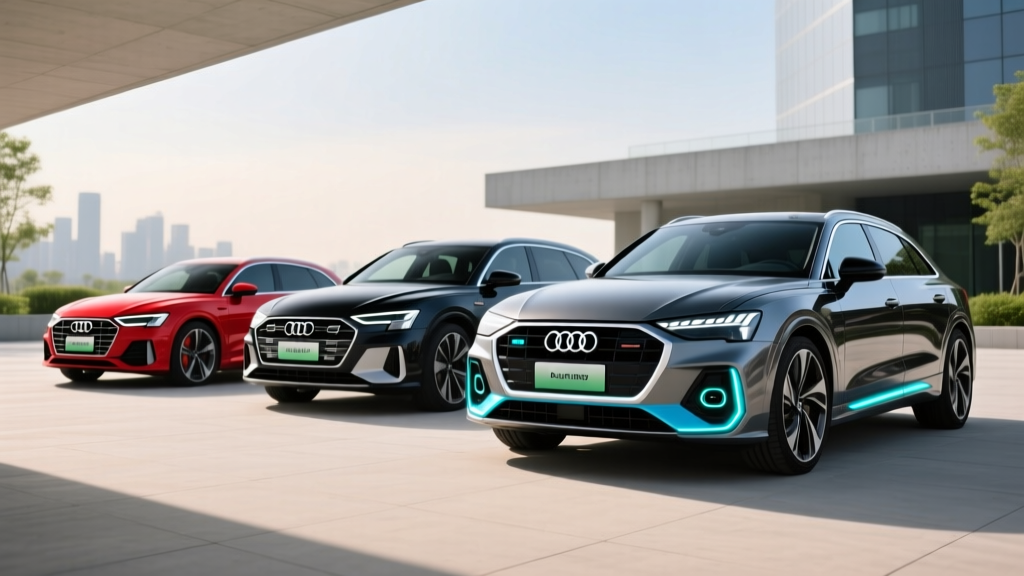
Audi's plug-in hybrid strategy in 2026 is a study in pragmatism. Rather than forcing buyers into a full battery-electric vehicle before they're ready, the German automaker offers TFSI e PHEV variants across its most popular nameplates — pairing turbocharged gasoline engines with electric motors and modest battery packs designed for 30–40 miles of electric-only commuting. For drivers who want to run errands on electrons but still have a gas tank for weekend road trips, the Audi plug-in hybrid lineup occupies a compelling middle ground.
But PHEVs are not without trade-offs. Smaller batteries mean limited electric range, slower charging than a full EV, and — as of 2026 — a more complicated federal tax credit picture than pure electric vehicles. This guide breaks down every current Audi PHEV model with exact specs, real-world efficiency expectations, ownership costs, and a clear framework for deciding whether a plug-in hybrid, a conventional hybrid, or a full EV is the right fit.
Understanding Audi's Electrified Lineup: HEV vs. PHEV vs. EV
Before examining specific models, it's essential to distinguish the three types of electrified powertrains Audi offers. Confusing them is the single most common mistake buyers make.
| Powertrain Type | Plug-In Required? | Electric-Only Range | How It Works |
|---|---|---|---|
| HEV (Conventional Hybrid) | No — charges via regenerative braking | Less than 1 mile | Small battery + motor assist the gas engine; never plugs in. Audi's "mild hybrid" (MHEV) system on models like the Q7 uses a 48-volt system for stop/start and coasting but provides no meaningful electric-only driving. |
| PHEV (Plug-In Hybrid) | Yes — plug in to maximize value | 30–40 miles (typical) | Larger battery (14–18 kWh usable) powers short commits on electricity alone; gas engine activates when battery depletes or under heavy acceleration. |
| BEV (Battery Electric) | Yes — only energy source | 200–300+ miles | No gas engine. Large battery (75–100+ kWh) powers everything. Audi e-tron GT and Q8 e-tron fall here. |
The critical takeaway: Audi's conventional "mild hybrid" models (badged MHEV) do not plug in and do not offer meaningful electric-only range. Only the TFSI e–badged models are true plug-in hybrids with usable electric commuting capability.
2026 Audi PHEV Models: Full Spec Comparison
As of the 2026 model year, Audi offers three primary PHEV nameplates in the U.S. market. The Q5 TFSI e remains the volume seller, while the A7 and A6 TFSI e variants cater to sedan and wagon buyers respectively.
| Specification | Q5 55 TFSI e | A7 55 TFSI e | A6 55 TFSI e |
|---|---|---|---|
| Body Style | Compact SUV | 5-Door Liftback | Sedan / Avant Wagon |
| Engine | 2.0L Turbo I4 | 2.0L Turbo I4 | 2.0L Turbo I4 |
| Electric Motor | Integrated in transmission | Integrated in transmission | Integrated in transmission |
| Combined HP | 362 hp / 369 lb-ft | 362 hp / 369 lb-ft | 362 hp / 369 lb-ft |
| Battery (usable) | 14.1 kWh (NMC) | 14.1 kWh (NMC) | 14.1 kWh (NMC) |
| EPA Electric Range | ~32 miles | ~33 miles | ~34 miles |
| Total Combined Range | ~420 miles | ~410 miles | ~430 miles |
| MPGe (electric+gas) | 61 MPGe | 63 MPGe | 64 MPGe |
| Gas-Only MPG (combined) | 27 MPG | 28 MPG | 29 MPG |
| 0–60 mph | 5.0 sec | 4.9 sec | 5.1 sec |
| Level 2 Charge Rate | 7.4 kW (onboard) | 7.4 kW (onboard) | 7.4 kW (onboard) |
| Full Charge Time (L2) | ~2.5 hours | ~2.5 hours | ~2.5 hours |
| DC Fast Charging | No | No | No |
| Drivetrain | quattro AWD | quattro AWD | quattro AWD |
| Starting MSRP | $58,200 | $79,900 | $68,400 |
Sources: fueleconomy.gov (EPA estimates), Audi USA press specifications. Real-world results will vary based on driving style, temperature, and terrain.
Electric-Only Range and Real-World Efficiency
The EPA-rated electric range of 32–34 miles across the Audi PHEV lineup is enough to cover the average American's one-way commute — the U.S. Census Bureau puts the mean commute at roughly 26 miles. But EPA stickers assume moderate temperatures, mixed driving, and a fully charged battery. Here's what to actually expect:
EPA Electric Range: 32–34 miles (depending on model)
Real-World Expectation:
- Summer, city/suburban driving (under 45 mph): 30–34 miles — close to or matching EPA
- Highway driving (70+ mph): 22–26 miles — electric motors are less efficient at sustained high speed
- Cold weather (below 32°F): 18–24 miles — battery chemistry slows and cabin heating draws significant energy. Audi PHEVs use resistive heating rather than a heat pump, which amplifies cold-weather range loss.
- Hilly terrain with full load: 20–25 miles — elevation gain and weight reduce range proportionally
Once the battery depletes, the 2.0-liter turbocharged engine takes over seamlessly. Gas-only combined MPG of 27–29 is respectable for vehicles producing 362 horsepower with all-wheel drive, though it's worth noting that a non-hybrid Q5 45 TFSI achieves 25 MPG combined — so the PHEV advantage is modest once the battery is empty. The real efficiency gain comes from those first 30 electric miles.
Real-World MPG vs. EPA: What Owners Report
PHEV fuel economy is uniquely dependent on how often you charge. If you plug in nightly and commute 25 miles each way, you might burn gasoline only on weekend trips — achieving an effective 80+ MPGe over a month. If you never plug in, you're simply carrying 400+ pounds of dead battery and motor, and your gas-only MPG will hover around 26–28 combined. The EPA's combined MPGe figure assumes a specific blend of electric and gas driving; your actual result depends entirely on your charging habits.
Owner forums and fueleconomy.gov's "My MPG" tracker show that diligent Q5 TFSI e owners who charge daily average between 55–70 MPGe over a full year, while those who rarely charge average 24–27 MPG. The PHEV math only works if you plug in.
Charging: What You Need to Know
Every 2026 Audi PHEV uses a 7.4 kW onboard charger for Level 2 AC charging and does not support DC fast charging. This is a deliberate engineering decision — the 14.1 kWh battery is small enough that DC fast charging infrastructure isn't necessary, and adding it would increase cost and weight.
| Charging Level | Power | Time to Full (14.1 kWh) | Practical Use |
|---|---|---|---|
| Level 1 (120V household outlet) | ~1.4 kW | ~10 hours | Overnight top-up; sufficient if you drive less than 30 miles daily and plug in for 8+ hours |
| Level 2 (240V home/public) | 7.4 kW (max) | ~2.5 hours | Ideal daily charging; a home Level 2 station fully replenishes the battery during the workday or overnight |
| DC Fast Charge | Not supported | N/A | Audi PHEVs cannot use CCS or NACS DC fast chargers |
Home charging setup: Most Audi PHEV owners install a 240V Level 2 wallbox (such as a ChargePoint Home Flex or Emporia Level 2) on a 40-amp circuit. Expect $500–$800 for the charger hardware and $800–$2,000 for professional electrician installation, depending on whether your electrical panel needs an upgrade. Total home charging setup typically runs $1,300–$2,800.
On public Level 2 chargers (commonly found at grocery stores, workplaces, and parking garages), the 7.4 kW rate means you'll add roughly 20–25 miles of electric range per hour of charging — enough to replenish the battery during a long shopping trip or work shift.
Pricing, Trims, and Federal Tax Credit Eligibility
Audi's PHEV models command a premium over their gas-only counterparts, but the value proposition depends heavily on whether you qualify for federal incentives.
| Model | Base MSRP | Gas-Only Equivalent | PHEV Premium |
|---|---|---|---|
| Q5 55 TFSI e Premium | $58,200 | Q5 45 TFSI Premium: $46,400 | +$11,800 |
| A6 55 TFSI e Premium | $68,400 | A6 45 TFSI Premium: $58,100 | +$10,300 |
| A7 55 TFSI e Premium | $79,900 | A7 45 TFSI Premium: $70,600 | +$9,300 |
Federal Tax Credit (§30D) Status for 2026
Under the IRS §30D Clean Vehicle Credit, plug-in hybrids with at least 4 kWh of battery capacity can qualify — but the rules are strict and have narrowed significantly since the Inflation Reduction Act took effect. Key requirements for 2026:
- Battery component sourcing: A percentage of battery components must be manufactured or assembled in North America (threshold increases annually)
- Critical minerals: A percentage of critical minerals must be sourced from the U.S. or free-trade-agreement partners
- MSRP cap: SUVs (Q5) capped at $80,000; sedans/liftbacks (A6, A7) capped at $55,000 — the A6 and A7 TFSI e exceed the sedan cap and do not qualify
- Buyer income limits: AGI ≤ $150,000 (single), ≤ $300,000 (joint filing)
- Point-of-sale transfer: Eligible buyers can transfer the credit to the dealer for an immediate price reduction at purchase
Bottom line: The Q5 55 TFSI e may qualify for a partial or full credit (up to $7,500) if it meets the sourcing requirements and you fall within income limits. The A6 and A7 TFSI e, as sedans/liftbacks priced above $55,000, do not qualify for the federal credit under current MSRP caps. Always verify eligibility with a tax professional and check the latest fueleconomy.gov tax credit listings before purchasing.
Some states offer additional rebates for PHEVs — California's CVRP, for example, has historically offered up to $1,000–$1,500 for qualifying plug-in hybrids, though funding varies. Check your state energy office for current programs.
Battery Warranty, Longevity, and Replacement Cost
PHEV battery longevity is one of the most common buyer concerns, and Audi addresses it with warranty coverage that matches industry standards.
Audi PHEV High-Voltage Battery Warranty:
- Coverage: 8 years or 100,000 miles (whichever comes first)
- Capacity threshold: Warranty covers defects and capacity loss below 70% of original capacity
- What's covered: Battery cell defects, battery management system failures, thermal management issues
- What's not covered: Normal degradation above 70% capacity, damage from accidents or improper charging
Estimated out-of-warranty replacement cost: $8,000–$12,000 for the high-voltage battery pack, plus $1,500–$2,500 in labor. However, PHEV batteries are smaller and less complex than full EV packs, and most owners report minimal degradation over the first 5–7 years of ownership.
Audi's 14.1 kWh NMC (nickel-manganese-cobalt) battery pack is thermally managed via a liquid cooling system, which significantly reduces degradation compared to passively cooled packs. Real-world data from European-market Audi PHEVs (sold since 2019) suggests typical capacity retention of 90–94% after five years and 60,000 miles — well above the 70% warranty threshold.
The 12-volt auxiliary battery (which powers electronics and starts the system) is a separate component with a typical lifespan of 4–6 years and replacement cost of $250–$400.
Driving Dynamics and Powertrain Character
All three Audi PHEVs share the same powertrain architecture: a 2.0-liter turbocharged inline-four paired with an electric motor integrated into the seven-speed S tronic dual-clutch transmission. Combined output of 362 horsepower and 369 lb-ft of torque makes these notably quicker than their gas-only siblings — the Q5 TFSI e hits 60 mph in 5.0 seconds, compared to 5.7 seconds for the Q5 45 TFSI.
The electric motor provides instant torque from a stop, which makes PHEVs feel particularly responsive in city driving. Audi's drive mode selector includes an "EV" mode that forces electric-only operation (up to roughly 84 mph), a "Hybrid" mode that blends both power sources automatically, and a "Battery Hold" mode that preserves the battery charge for later use — useful if you're driving on the highway and want to save electric range for city driving at your destination.
Regenerative braking is moderate by EV standards. Audi PHEVs offer adjustable regen via steering-wheel paddles, but they do not provide true one-pedal driving — you'll still use the brake pedal for complete stops. This is a deliberate choice that makes the transition from a gas car feel familiar.
Who Should Buy an Audi Plug-In Hybrid?
The PHEV value equation depends on your specific driving patterns, home charging access, and willingness to plug in regularly.
Choose an Audi PHEV if:
- Your daily commute (round trip) is under 35 miles and you can charge at home or work
- You regularly take longer road trips where EV charging infrastructure is sparse or time-consuming
- You live in a cold climate where EV range loss is a concern
- You want quattro all-wheel drive and Audi's premium interior without committing to a full EV
- Your household has one vehicle that needs to serve both commuting and road-trip duty
Choose a full EV (like the Audi Q8 e-tron) instead if:
- You can charge at home and your daily driving rarely exceeds 200 miles
- You want to eliminate gasoline costs and maintenance entirely
- You qualify for the full $7,500 federal tax credit (easier with many full EVs under the MSRP cap)
- You want DC fast charging capability for road trips
Choose a conventional gas or mild-hybrid Audi if:
- You cannot install a home charger (apartment, street parking)
- Your daily commute exceeds 50 miles and you won't recoup the PHEV premium through fuel savings
- You prefer the lowest upfront purchase price
Pros
- 30+ miles of electric commuting eliminates most daily fuel consumption
- 362 hp with quattro AWD — no performance compromise vs. gas models
- No range anxiety — gas engine provides 400+ total miles
- Home Level 2 charging fully replenishes in ~2.5 hours
- Premium interior, strong build quality, excellent NVH in EV mode
- 8-year/100,000-mile battery warranty
Cons
- $9,000–$12,000 premium over equivalent gas-only models
- No DC fast charging — limited to 7.4 kW AC
- A6 and A7 TFSI e exceed $55K sedan MSRP cap — no federal tax credit
- Cold-weather electric range drops to 18–24 miles
- No heat pump — cabin heating relies on resistive elements, draining the battery faster in winter
- PHEV only pays off if you consistently plug in
Frequently Asked Questions
How many MPG does an Audi plug-in hybrid get?
When the battery is charged, Audi PHEVs achieve 61–64 MPGe (combined electric and gasoline operation). Once the battery is depleted, they return 27–29 MPG combined on gasoline alone — comparable to a non-hybrid luxury vehicle of similar power and weight. Your real-world result depends entirely on how often you charge.
How far can an Audi PHEV go on electric only?
The EPA rates the Q5, A6, and A7 TFSI e at 32–34 miles of electric-only range. In real-world driving, expect 22–26 miles at highway speeds and 18–24 miles in cold weather (below 32°F). City driving in mild conditions can match or slightly exceed the EPA figure.
Does the Audi Q5 TFSI e qualify for the federal tax credit?
The Q5 55 TFSI e may qualify for up to $7,500 under the IRS §30D Clean Vehicle Credit, provided it meets battery sourcing requirements and the buyer's AGI is within limits ($150K single / $300K joint). The A6 and A7 TFSI e exceed the $55,000 MSRP cap for sedans and do not qualify. Always verify current eligibility on irs.gov and consult a tax professional.
Is the Audi PHEV battery reliable, and what does replacement cost?
Audi covers the high-voltage battery for 8 years or 100,000 miles against defects and capacity loss below 70%. European-market data shows typical capacity retention of 90–94% after five years. Out-of-warranty replacement runs approximately $8,000–$12,000 for the battery pack plus labor, though full replacements remain rare within the first decade of ownership.
Can I charge an Audi PHEV at a Tesla Supercharger or DC fast charger?
No. Audi plug-in hybrids do not support DC fast charging of any kind — including CCS, NACS, or CHAdeMO connectors. They are limited to Level 1 (120V) and Level 2 (240V) AC charging, with a maximum onboard charger rate of 7.4 kW. This is intentional — the small 14.1 kWh battery charges fully in about 2.5 hours on Level 2, making DC fast charging unnecessary for the battery size.
Hybrid vs. PHEV vs. EV — which Audi should I choose?
If you can charge at home and commute under 35 miles daily, the PHEV gives you electric commuting with gas-engine flexibility for road trips. If you can charge at home and rarely drive more than 200 miles in a day, a full EV like the Q8 e-tron eliminates gasoline entirely and may offer better tax credit eligibility. If you cannot charge at home, skip the PHEV — you'll pay a premium without capturing the electric efficiency benefit, and a conventional Audi mild hybrid or gas model is the more practical choice.
Does the Audi PHEV require premium gasoline?
Yes. Audi recommends premium unleaded (91 AKI or higher) for all TFSI e models to achieve rated performance and efficiency. Using regular fuel may reduce power output and slightly decrease fuel economy.
Final Assessment
The 2026 Audi plug-in hybrid lineup serves a specific and shrinking niche: luxury buyers who want electric commuting without committing to a full EV. The Q5 TFSI e is the strongest value proposition, particularly if it qualifies for the federal tax credit under your circumstances. The A6 and A7 variants offer the same powertrain in more distinctive body styles, but their pricing above the §30D sedan MSRP cap removes one of the PHEV's key financial incentives.
If your lifestyle supports daily charging and your commute falls within the 30-mile electric envelope, an Audi PHEV can reduce your annual fuel consumption by 60–80% while eliminating range anxiety entirely. If your commute is longer, your charging access is unreliable, or you're ready for full electrification, the math shifts — and a full EV or a conventional gas model may serve you better. The PHEV is a bridge technology, and its value depends entirely on which side of the bridge you're standing on.