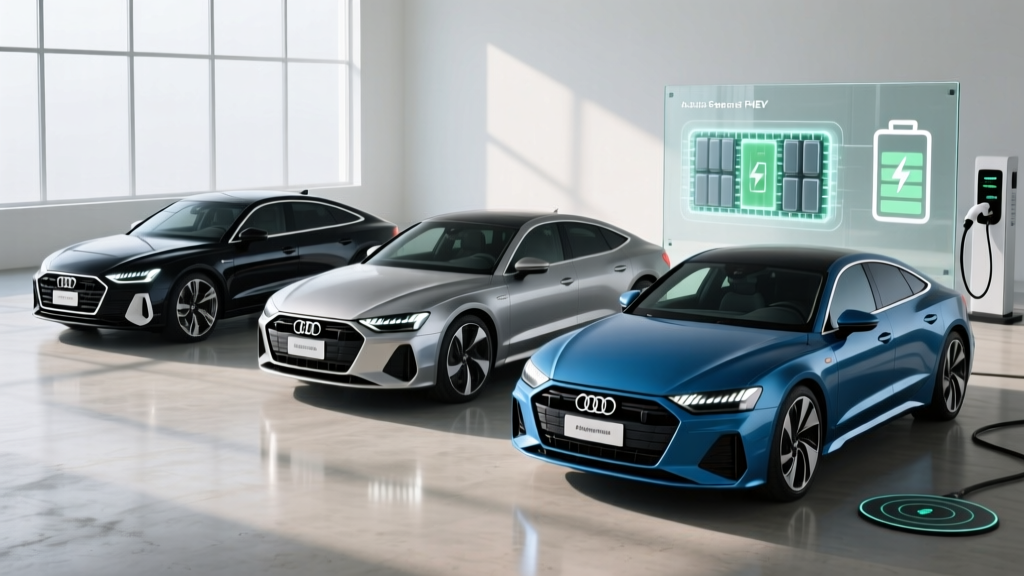
Audi's U.S. electrified strategy in 2026 centers on plug-in hybrid electric vehicles (PHEVs) — models that pair a turbocharged gasoline engine with a larger battery and electric motor you can recharge from a wall outlet. Unlike the all-electric Q8 e-tron or Q6 e-tron, Audi's hybrid offerings give buyers a bridge: genuine electric-only commuting during the week with gas-powered range for weekend road trips. But the lineup is narrow, the pricing is premium, and the tax-credit picture is complicated. Here's every Audi hybrid you can buy in 2026, with exact specs and ownership math.
HEV vs PHEV: What Audi Actually Sells in 2026
Audi does not currently offer a conventional hybrid (HEV) in the United States — the kind that recharges its small battery through regenerative braking and never plugs in. Every electrified Audi on U.S. dealer lots is either a PHEV (plug-in hybrid) or a BEV (battery electric vehicle). This matters because the ownership experience is fundamentally different.
Conventional Hybrid (HEV) — Not Available from Audi
- How it works: Small battery (~1-2 kWh) recharged by regen braking and engine; no plug.
- Electric-only range: Less than 1 mile at very low speeds.
- Example: Toyota RAV4 Hybrid, Honda CR-V Hybrid.
Plug-in Hybrid (PHEV) — Audi's Hybrid Path
- How it works: Larger battery (~17-25 kWh usable) you charge via a plug; drives on electricity alone until depleted, then operates as a conventional hybrid.
- Electric-only range: Typically 20-40 miles EPA.
- Audi examples: Q5 TFSI e, A7 TFSI e, S7 TFSI e.
If you're searching for an Audi hybrid and hoping for a simple HEV that never needs charging, you won't find one. Audi's 48-volt mild-hybrid (MHEV) system is standard on many gas models — it smooths stop/start and provides micro-boosts, but it doesn't deliver meaningful electric-only driving or fuel-economy gains. The real hybrid story is the TFSI e PHEV lineup.
The 2026 Audi PHEV Lineup: Specs at a Glance
| Specification | Q5 55 TFSI e | A7 55 TFSI e | S7 Sportback TFSI e |
|---|---|---|---|
| Body Style | Compact SUV | Luxury Sedan | Performance Sportback |
| Engine | 2.0L Turbo I4 | 2.0L Turbo I4 | 2.9L Twin-Turbo V6 |
| Combined System HP | 362 hp | 362 hp | 503 hp |
| Combined Torque | 369 lb-ft | 369 lb-ft | 516 lb-ft |
| Battery (usable) | ~17.9 kWh | ~17.9 kWh | ~25.9 kWh |
| EPA Electric Range | ~23 mi | ~24 mi | ~33 mi (est.) |
| EPA Combined MPG (gas) | ~26 MPG | ~27 MPG | ~24 MPG |
| EPA Combined MPGe | ~58 MPGe | ~60 MPGe | ~50 MPGe (est.) |
| Total Combined Range | ~400 mi | ~430 mi | ~410 mi (est.) |
| 0-60 mph | 5.0 sec | 4.9 sec | 3.9 sec |
| Level 2 Charge Time (0-100%) | ~2.5 hr @ 7.2 kW | ~2.5 hr @ 7.2 kW | ~3.5 hr @ 7.2 kW |
| DC Fast Charging | No | No | No |
| Starting MSRP | ~$60,300 | ~$76,900 | ~$96,500 |
| Drivetrain | quattro AWD | quattro AWD | quattro AWD |
Sources: EPA / fueleconomy.gov for official range and MPG figures; Audi USA for MSRP and powertrain specs. Figures reflect 2025-2026 model-year data. The S7 TFSI e specs are preliminary pending final EPA certification.
How Many MPG Do Audi Hybrids Actually Get?
The EPA publishes two numbers for PHEVs: MPGe (which includes the electric-only portion) and MPG (gasoline-only operation after the battery depletes). Both matter, but in different driving scenarios.
| Model | MPGe (combined) | MPG city (gas) | MPG hwy (gas) | MPG combined (gas) |
|---|---|---|---|---|
| Q5 55 TFSI e | ~58 MPGe | ~25 | ~28 | ~26 |
| A7 55 TFSI e | ~60 MPGe | ~26 | ~29 | ~27 |
| S7 Sportback TFSI e | ~50 MPGe | ~22 | ~26 | ~24 |
Real-world MPG vs. EPA: PHEVs are highly sensitive to how often you charge. If you plug in nightly and your commute is under 23 miles (Q5) or 33 miles (S7), you may burn almost no gasoline during the week. On a long highway road trip with a depleted battery, expect fuel economy to land within 1-2 MPG of the EPA gas-only combined number. City driving with frequent regenerative braking can push gas-only MPG slightly above EPA estimates, especially in stop-and-go traffic where the electric motor handles low-speed propulsion.
The cold-weather caveat: In sub-freezing temperatures, electric-only range drops 20-30%. A Q5 rated for 23 electric miles may deliver only 16-18 in January in Chicago. The gasoline engine will also engage more readily to provide cabin heat unless you precondition while plugged in.
Electric-Only Range: How Far Can You Commute Gasoline-Free?
For PHEV buyers, electric-only range is the number that determines whether the car fits your daily routine. Here's what Audi's 2026 PHEVs deliver:
- Q5 55 TFSI e: ~23 miles EPA electric-only. Sufficient for short suburban commutes and school runs, but a 40-mile round-trip commute will require gas.
- A7 55 TFSI e: ~24 miles EPA electric-only. Similar to the Q5 — works for tight urban loops.
- S7 Sportback TFSI e: ~33 miles EPA electric-only (estimated). The larger ~25.9 kWh battery gives meaningfully more range, covering most one-way commutes under 30 miles.
Real-world expectation: Electric range on PHEVs is tested on a mixed cycle. Sustained highway driving at 70+ mph will consume the battery faster than the EPA estimate suggests. Expect 18-20 highway electric miles from the Q5 and 26-28 from the S7 before the engine fires up.
Charging logistics: None of Audi's PHEVs support DC fast charging. This is standard for most PHEVs — the batteries are small enough that Level 2 charging (240V) fills them in 2.5-3.5 hours using the onboard 7.2 kW charger. On a standard 120V household outlet (Level 1, ~1.2 kW), expect 12-15 hours for a full charge. If you can install a Level 2 charger at home, overnight charging easily tops up the battery every night.
Powertrain Deep Dive: What's Under the Hood
Audi's PHEV architecture places an electric motor between the engine and the transmission (a P2 hybrid layout), allowing it to drive the wheels independently or assist the gas engine. The 7-speed S tronic dual-clutch transmission routes power to all four wheels via quattro all-wheel drive.
Q5 and A7 (55 TFSI e): The 2.0-liter turbocharged inline-four produces roughly 261 hp on its own. The electric motor adds approximately 141 hp, for a combined system output of 362 hp and 369 lb-ft of torque. The result is a 0-60 mph sprint in about 5.0 seconds — genuinely quick for a luxury compact SUV or midsize sedan.
S7 Sportback TFSI e: The 2.9-liter twin-turbo V6 is a different animal entirely, producing around 444 hp before the electric motor contributes. Combined output reaches 503 hp and 516 lb-ft, launching the S7 to 60 mph in approximately 3.9 seconds. This is performance-car territory with the practical fallback of a gas engine for long trips.
All three models use Audi's predictive efficiency assist, which uses navigation data to manage battery deployment — saving electric range for city driving at your destination and using the engine on highway stretches where electric efficiency is lowest.
Pricing, Tax Credits, and Total Cost
Audi PHEVs carry a premium over their gas-only siblings. Here's the pricing landscape for 2026:
- Q5 55 TFSI e: Starting ~$60,300 (Premium trim). The gas-only Q5 45 TFSI starts around $46,600 — a roughly $13,700 PHEV premium.
- A7 55 TFSI e: Starting ~$76,900. The gas-only A7 55 TFSI begins around $68,000.
- S7 Sportback TFSI e: Starting ~$96,500.
Federal Tax Credit Eligibility (§30D)
Under current IRS rules for the §30D Clean Vehicle Credit, qualifying PHEVs can receive up to $7,500. However, eligibility depends on multiple requirements that shift frequently:
- Battery sourcing: A percentage of critical minerals and battery components must be sourced from the U.S. or free-trade-agreement countries. Audi's supply chain has faced challenges meeting these thresholds.
- MSRP caps: SUVs (Q5) must be under $80,000 MSRP; sedans (A7, S7) must be under $55,000. The A7 and S7 exceed the sedan cap, likely disqualifying them.
- Buyer income limits: AGI must not exceed $150,000 (single), $225,000 (head of household), or $300,000 (joint).
- Final assembly: Must occur in North America. Audi's PHEVs are assembled in Europe, which is a significant disqualifier for most models.
Bottom line: As of early 2026, most Audi PHEVs do not qualify for the full $7,500 federal credit due to final-assembly and battery-sourcing requirements. The Q5 TFSI e, built in Mexico for some model years, may partially qualify depending on the specific VIN and current sourcing rules. Always verify your exact vehicle's eligibility at fueleconomy.gov and consult a tax professional before relying on the credit.
State incentives: Some states offer additional rebates for PHEVs. California's CVRP, for instance, has historically offered up to $1,000-$2,000 for qualifying PHEVs, though programs change. Check your state's energy office for current offers.
Battery Warranty, Reliability, and Replacement Cost
Audi PHEV Battery Warranty
Audi covers the high-voltage battery in its PHEVs for 8 years or 100,000 miles (whichever comes first), with a capacity-retention threshold of approximately 70%. If the battery degrades below this level within the warranty period, Audi will repair or replace it at no cost.
The powertrain (engine, transmission, electric motor) is covered for 5 years or 60,000 miles under Audi's standard new-vehicle limited warranty.
Reliability: Audi's PHEV powertrains have been in production since 2019 (globally), and the 2.0L TFSI engine is one of the Volkswagen Group's most widely used. The P2 hybrid architecture is proven across Audi, Porsche, and Volkswagen models. The main reliability concern is the added complexity: you have a turbocharged engine, a high-voltage battery, an electric motor, and a dual-clutch transmission — all of which are potential failure points after the warranty expires.
Battery replacement cost: Out of warranty, a PHEV battery replacement for the Q5 or A7 is estimated at $8,000-$12,000 including labor. The larger S7 battery may cost $12,000-$16,000. These are estimates based on current parts pricing and dealer labor rates; costs may decline as the PHEV parts supply matures.
Degradation reality: PHEV batteries are smaller than BEV batteries and cycle more frequently (daily full discharge/recharge), which can accelerate degradation. However, Audi's thermal management system and the battery's buffer (the usable capacity is less than the gross capacity) help mitigate this. Most owners report minimal range loss in the first 3-5 years.
Who Should Buy an Audi Hybrid — and Who Shouldn't
Reasons to Choose an Audi PHEV
- You want luxury, performance, and AWD with the ability to commute short distances on electricity
- You can charge at home (Level 2) and your daily driving is under 25-35 miles
- You take regular road trips where EV charging infrastructure is sparse or unreliable
- You want the Audi interior, tech, and design without committing to a full EV
- You live in a cold climate where EV range loss is a concern
Reasons to Look Elsewhere
- You can't charge at home — without plugging in, a PHEV is just a heavy, less-efficient gas car
- You want maximum fuel savings — a Toyota RAV4 Prime (42 mi electric, 94 MPGe) or a full EV like the Q8 e-tron will save more
- The PHEV premium ($10,000-$15,000 over gas models) isn't justified by your fuel savings
- You need DC fast charging for road-trip convenience
- You want the federal tax credit — most Audi PHEVs don't qualify
Decision Framework: Audi PHEV vs. Full EV vs. Gas
Choose the Audi PHEV if: Your commute is under 30 miles, you charge at home, you take 4+ road trips per year, and you value the Audi badge and interior.
Choose a full EV (Q8 e-tron, Q6 e-tron) if: You charge at home, your daily driving is under 250 miles, you want lower running costs, and you don't need gas-engine backup.
Choose a gas-only Audi if: You can't charge at home, your mileage is low enough that fuel cost is negligible, or the PHEV premium doesn't pencil out over your ownership period.
Frequently Asked Questions About Audi Hybrids
How many MPG does the Audi Q5 hybrid get?
The 2026 Audi Q5 55 TFSI e returns approximately 26 MPG combined in gas-only mode (25 city / 28 highway) and 58 MPGe when including electric-only driving. Real-world results vary based on charging frequency — if you plug in daily and drive less than 23 miles, your gasoline consumption may approach zero on weekdays.
How far can the Audi S7 PHEV go on electric only?
The S7 Sportback TFSI e is estimated to deliver approximately 33 miles of EPA electric-only range thanks to its larger ~25.9 kWh battery. Real-world highway driving at 70+ mph will yield closer to 26-28 miles. In cold weather, expect a 20-30% reduction.
Do Audi hybrids need to be plugged in?
Yes — Audi's current U.S. hybrids are all plug-in hybrids (PHEVs). You don't have to plug them in to drive (the gas engine will operate normally if the battery is depleted), but you'll miss the entire point of the PHEV if you never charge. Without regular charging, you're carrying extra battery weight with no efficiency benefit.
Can Audi PHEVs use DC fast chargers?
No. None of Audi's current PHEVs support DC fast charging. They use a 7.2 kW onboard charger for Level 2 (240V) charging, which fully replenishes the battery in 2.5-3.5 hours depending on the model. This is typical for PHEVs — the batteries are small enough that overnight Level 2 charging is sufficient.
Is the Audi PHEV battery reliable and what does replacement cost?
Audi's PHEV battery is warranted for 8 years / 100,000 miles against degradation below ~70% capacity. Out-of-warranty replacement is estimated at $8,000-$16,000 depending on the model. The P2 hybrid architecture has been in production since 2019 and is considered proven, though the added complexity (turbo engine + electric motor + dual-clutch transmission) means more potential repair points post-warranty compared to a simple gas car or a full EV.
Does any Audi hybrid qualify for the $7,500 federal tax credit?
Under current IRS §30D rules, most Audi PHEVs face challenges qualifying due to final-assembly location (Europe/Mexico) and battery-sourcing requirements. The sedan MSRP cap ($55,000) also disqualifies the A7 and S7. Always check fueleconomy.gov for your specific VIN's eligibility and consult a tax professional. State-level incentives may still apply.
Hybrid vs PHEV vs EV — which Audi should I buy?
Audi doesn't sell a conventional hybrid (HEV) in the U.S. Your choice is between a PHEV (Q5/A7/S7 TFSI e) and a full EV (Q8 e-tron, Q6 e-tron). If you can charge at home and rarely exceed 200 miles in a day, a full EV offers lower running costs and less maintenance. If you regularly drive 300+ miles in a day or live somewhere with unreliable charging infrastructure, the PHEV provides flexibility. If you can't charge at home at all, a gas-only Audi is the more honest choice.