Quick Verdict: Audi's Hybrid SUV Lineup for 2026
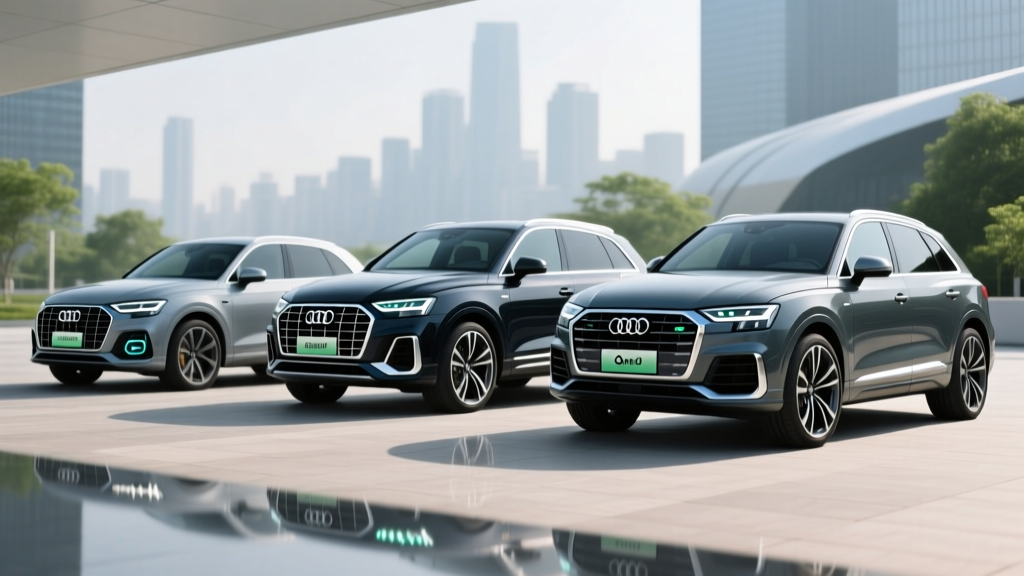
Audi's hybrid SUV strategy in 2026 splits into two camps: the Q5 55 TFSI e plug-in hybrid (PHEV) for buyers who want genuine electric-only commuting, and the Q7 and Q8 with 48-volt mild-hybrid (MHEV) systems that smooth out stop-start driving and marginally improve fuel economy but cannot drive on electric power alone. If you're searching for Audi hybrid SUVs expecting a Prius-like experience in a three-row luxury package, you'll need to adjust expectations — Audi's larger SUVs use electrification for refinement, not radical MPG gains.
The Q5 PHEV is the standout. With an EPA-estimated 23 miles of electric-only range and a combined 261 horsepower, it covers most daily commutes without burning a drop of fuel, then functions as a conventional hybrid for longer trips. The Q7 and Q8 mild-hybrids deliver modest efficiency assists but remain fundamentally gas-powered vehicles.
HEV vs PHEV vs MHEV: What Audi Actually Offers
| Type | Plug In? | Electric-Only Driving? | Audi Models (2026) |
|---|---|---|---|
| Mild Hybrid (MHEV) | No | No — assists gas engine only | Q7, Q8 |
| Plug-in Hybrid (PHEV) | Yes | Yes — limited range | Q5 55 TFSI e |
| Full Hybrid (HEV) | No | Very limited / low-speed only | None currently in US SUV lineup |
This distinction matters enormously. A mild-hybrid (MHEV) system like Audi's 48-volt setup uses a small belt-driven motor-generator to recover energy during braking and assist the engine during acceleration. It cannot propel the vehicle on electric power alone. You never plug it in. Think of it as a more sophisticated alternator.
A plug-in hybrid (PHEV) like the Q5 55 TFSI e has a substantially larger battery pack (17.9 kWh usable) and a more powerful electric motor integrated into the transmission. It can drive on electricity alone for a meaningful distance, then seamlessly switches to hybrid operation once the battery depletes. You plug it in to recharge — ideally overnight at home on Level 2 power.
Audi does not currently sell a conventional full hybrid (HEV) SUV in the US market — the type that recharges itself through regenerative braking and offers significant MPG gains without plugging in, like a Toyota RAV4 Hybrid. If you want plug-free hybrid efficiency from Audi, you're out of luck in the SUV segment.
2026 Audi Q5 55 TFSI e: The PHEV Worth Considering
| Specification | 2026 Audi Q5 55 TFSI e |
|---|---|
| Powertrain | 2.0L turbo I4 + electric motor (PHEV) |
| Combined Horsepower | 261 hp (engine 201 hp + motor 141 hp) |
| Combined Torque | 273 lb-ft |
| Battery (usable) | 17.9 kWh lithium-ion |
| EPA Electric-Only Range | 23 miles |
| EPA Combined Range (gas + electric) | ~380 miles |
| EPA MPGe (electric + gas) | 61 MPGe |
| EPA MPG (hybrid mode, battery depleted) | 25 city / 27 hwy / 26 combined |
| Level 2 Charging (240V) | ~2.5 hours (7.2 kW onboard charger) |
| DC Fast Charging | Not supported |
| 0-60 mph | 5.8 seconds |
| Drivetrain | quattro AWD |
| Base MSRP | ~$58,200 |
Electric-Only Range: What 23 Miles Actually Means
The EPA rates the Q5 55 TFSI e at 23 miles of electric-only range. In real-world driving, expect that figure to hold fairly steady in mild weather around town — the PHEV's strength is low-speed urban efficiency where regenerative braking recaptures energy constantly. On a 70-mph highway run in cold weather, that 23-mile figure can shrink to roughly 16-18 miles as the cabin heater draws from the battery and aerodynamic drag increases energy consumption.
For context, the average American one-way commute is roughly 16 miles according to the Bureau of Transportation Statistics. If you can charge at home overnight, the Q5 PHEV covers most daily driving on electricity alone, reserving the gas engine for weekend trips and longer commutes.
Charging the Q5 PHEV: Level 2 Only, No DC Fast Charging
The Q5 55 TFSI e uses a standard J1772 connector for AC charging. Here's what charging looks like in practice:
| Charging Level | Power | Time (0-100%) | Practical Use |
|---|---|---|---|
| Level 1 (120V household) | ~1.4 kW | ~13 hours | Emergency / overnight top-up |
| Level 2 (240V home charger) | 7.2 kW | ~2.5 hours | Primary daily charging |
| DC Fast Charging | N/A | N/A | Not supported on this model |
The lack of DC fast charging is standard for PHEVs — the battery is small enough that Level 2 replenishes it fully in a couple of hours. Most PHEV owners charge overnight at home and rarely use public charging infrastructure. If you don't have access to home or workplace Level 2 charging, a PHEV loses much of its advantage over a conventional hybrid.
2026 Audi Q7 and Q8: Mild-Hybrid, Not Plug-In
The Q7 and Q8 use Audi's 48-volt mild-hybrid system (branded MHEV). This is fundamentally different from the Q5's plug-in setup. Here's how each model breaks down:
| Specification | 2026 Audi Q7 45 TFSI | 2026 Audi Q8 55 TFSI |
|---|---|---|
| Hybrid Type | 48V Mild Hybrid (MHEV) | 48V Mild Hybrid (MHEV) |
| Engine | 2.0L turbo I4 | 3.0L turbo V6 |
| Horsepower | 261 hp | 335 hp |
| Torque | 273 lb-ft | 369 lb-ft |
| EPA MPG (city/hwy/combined) | 20/26/22 | 18/23/20 |
| Electric-Only Driving | No | No |
| Plug-In Required | No | No |
| 0-60 mph | 6.5 seconds | 5.5 seconds |
| Base MSRP | ~$63,500 | ~$76,300 |
What the 48V Mild-Hybrid System Actually Does
Audi's MHEV system recovers up to 12 kW of energy during deceleration and stores it in a small 48-volt lithium-ion battery. This stored energy powers the vehicle's electrical systems and provides a brief torque assist during acceleration, reducing the load on the gas engine. The system also enables extended engine-off coasting on the highway — the engine shuts down completely at cruising speeds when you lift off the throttle, reducing fuel consumption.
The real-world benefit? Roughly 1-2 MPG improvement over an equivalent non-hybrid powertrain, plus noticeably smoother stop-start operation in traffic. The engine restarts almost imperceptibly thanks to the belt-driven starter-generator. It's a refinement upgrade more than an efficiency revolution.
Real-World MPG: What to Actually Expect
| Model | EPA Combined | Real-World Expectation | Notes |
|---|---|---|---|
| Q5 55 TFSI e (hybrid mode) | 26 MPG | 24-28 MPG | Varies with regen usage, terrain |
| Q7 45 TFSI (MHEV) | 22 MPG | 20-24 MPG | Better in city with coasting feature |
| Q8 55 TFSI (MHEV) | 20 MPG | 18-22 MPG | Heavy vehicle, V6 thirsty under load |
Hybrid and mild-hybrid vehicles tend to perform better in city driving than highway driving because regenerative braking recaptures energy during stop-and-go traffic. The Q5 PHEV in hybrid mode (battery depleted) can actually exceed its EPA city rating in heavy urban traffic where regen is constantly active. Highway MPG tends to run slightly below EPA estimates at sustained 75-80 mph speeds.
Pricing, Tax Credits, and Total Cost
Federal Tax Credit Eligibility
Key eligibility requirements for the Q5 PHEV credit:
- MSRP cap: Vehicle must be under $80,000 (SUV classification) — the Q5 PHEV qualifies at ~$58,200 base
- Buyer income cap: Modified AGI must not exceed $150,000 (single) / $300,000 (married filing jointly)
- Battery sourcing: Partial credit ($3,750) due to critical mineral and component sourcing rules — check current IRS guidance as these thresholds tighten annually
- Point-of-sale transfer: You can transfer the credit to the dealer at purchase for an immediate price reduction, or claim it on your tax return
Always verify current eligibility with a tax professional and the IRS clean vehicle credits page before purchasing, as sourcing requirements change.
Total Cost of Ownership Snapshot
The Q5 PHEV's economics work best when you charge regularly. If you drive 30 miles daily and charge nightly, you'll burn almost no gasoline on weekdays — only on longer weekend trips. At current electricity rates (~$0.15/kWh nationally), fully charging the 17.9 kWh battery costs roughly $2.70, giving you 23 miles of electric driving at about $0.12 per mile. Compare that to the Q7 MHEV at 22 MPG and $3.50/gallon gas, which costs about $0.16 per mile. The savings compound over years of commuting.
However, the Q5 PHEV carries a ~$5,000 premium over the gas-only Q5 45 TFSI. If you can't charge at home and always drive in hybrid mode, the fuel savings narrow dramatically and the payback period extends to 7+ years — at which point you might question whether the PHEV was worth it.
Battery Warranty, Reliability, and Replacement Costs
PHEV Battery Degradation: What the Data Shows
The Q5's 17.9 kWh battery is relatively small and operates within a conservative state-of-charge window — Audi's software maintains a buffer at the top and bottom of the pack to prevent extreme charge states that accelerate degradation. In practice, PHEV batteries from European manufacturers have shown modest degradation over time. Expect roughly 5-10% capacity loss over the first 5 years / 60,000 miles based on industry data from similar powertrains. That translates to losing 1-2 miles of electric range over that period — barely noticeable in daily use.
Battery Replacement Cost
Out-of-warranty PHEV battery replacement for the Q5 currently runs between $8,000 and $12,000 including parts and labor at an Audi dealer. This is a significant expense, but it's important to note that most PHEV batteries outlast their warranty periods by a substantial margin. The 48V mild-hybrid batteries in the Q7 and Q8 are much smaller and cheaper to replace — typically $1,500 to $3,000 — and experience far less stress since they don't undergo deep charge-discharge cycles.
Overall Reliability
Audi's hybrid powertrains have proven reasonably reliable, though the brand as a whole scores below Toyota and Lexus in long-term dependability surveys from J.D. Power and Consumer Reports. The hybrid-specific components (battery, electric motor, power electronics) have not been a major failure point — most Audi reliability concerns center on infotainment, electrical gremlins, and turbocharged engine maintenance. The Q5 PHEV adds complexity (two power sources, more cooling circuits, high-voltage cabling) but nothing that has shown systemic failure patterns in the field.
Pros
- Genuine 23-mile EV range covers most commutes
- Seamless transition between electric and gas power
- 261 hp combined — quicker than gas-only Q5
- Eligible for partial $3,750 federal tax credit
- No range anxiety — gas engine for long trips
- quattro AWD standard
Cons
- No DC fast charging
- ~$5,000 premium over gas Q5
- Cargo space reduced vs gas Q5 (battery under floor)
- Q7/Q8 MHEV offers negligible MPG improvement
- Requires home charging access to maximize value
- Complex powertrain = higher long-term maintenance risk
Who Should Buy an Audi Hybrid SUV — And Who Shouldn't
Choose the Q5 55 TFSI e PHEV if:
- Your daily commute is under 25 miles round-trip and you can charge at home
- You want electric commuting but need a gas engine for road trips
- You value the Audi brand and interior quality but want to reduce fuel costs
- You don't want to commit to a full EV due to apartment living or unreliable charging access
Choose the Q7/Q8 mild-hybrid if:
- You need three rows (Q7) or coupe-SUV styling (Q8) and accept gas-car fuel economy
- You want the smoothest possible stop-start behavior in traffic
- Hybrid efficiency isn't your primary purchase motivation
Choose a full EV (Audi Q4 e-tron or Q8 e-tron) instead if:
- You have reliable home Level 2 charging and your daily driving is under 200 miles
- You want maximum fuel cost savings and minimal maintenance
- You want to qualify for the full $7,500 federal tax credit (check current eligibility on IRS.gov)
The honest assessment: Audi's hybrid SUV lineup is narrow. The Q5 PHEV is a competent luxury plug-in hybrid that works well for the right buyer — someone with home charging and a short commute who still wants gas-engine flexibility. The Q7 and Q8 mild-hybrids are excellent luxury SUVs, but their hybrid systems are a footnote, not a reason to buy. If efficiency is your top priority, Audi's full EV models (Q4 e-tron, Q8 e-tron) deliver dramatically lower operating costs — but they require a commitment to charging infrastructure that not every buyer is ready to make.
Frequently Asked Questions
How many MPG does the Audi Q5 hybrid get?
The 2026 Audi Q5 55 TFSI e PHEV achieves an EPA-estimated 25 city / 27 highway / 26 combined MPG when operating in hybrid mode (battery depleted). Its combined MPGe rating — which accounts for electric-only driving — is 61 MPGe. Real-world hybrid-mode MPG typically ranges from 24-28 depending on driving style, terrain, and how much regenerative braking is active.
How far can the Audi Q5 PHEV go on electric only?
The EPA rates the Q5 55 TFSI e at 23 miles of electric-only range. In real-world conditions, expect 20-23 miles in mild city driving and 16-18 miles during cold-weather highway use. Once the battery depletes, the 2.0L turbo gas engine takes over seamlessly — total combined range is approximately 380 miles.
Do the Audi Q7 and Q8 hybrids need to be plugged in?
No. The Q7 and Q8 use 48-volt mild-hybrid (MHEV) systems that recharge through regenerative braking and engine power. They cannot be plugged in and cannot drive on electric power alone. The hybrid assist is entirely automatic and requires no driver action.
Does the Audi Q5 PHEV qualify for a federal tax credit?
The Q5 55 TFSI e qualifies for a partial federal tax credit of up to $3,750 under current IRS §30D rules, subject to buyer income limits ($150K single / $300K joint) and battery sourcing requirements. The Q7 and Q8 mild-hybrids do not qualify for any federal clean vehicle credit. Verify current eligibility at fueleconomy.gov and consult a tax professional before purchasing.
Is the Audi Q5 hybrid reliable, and what does a battery replacement cost?
Audi's PHEV powertrain has not shown systemic reliability issues, though the brand scores below Japanese competitors in overall dependability surveys. The hybrid battery is warrantied for 8 years / 100,000 miles. Out-of-warranty battery replacement runs $8,000-$12,000, though most PHEV batteries outlast their warranty periods. The 48V batteries in the Q7/Q8 are cheaper to replace at $1,500-$3,000.
Can the Audi Q5 PHEV DC fast charge?
No. The Q5 55 TFSI e supports only AC charging — Level 1 (120V, ~13 hours for a full charge) and Level 2 (240V, ~2.5 hours via its 7.2 kW onboard charger). This is standard for PHEVs, as the small battery doesn't require DC fast charging to recharge quickly enough for daily use.
Hybrid vs PHEV vs EV — which Audi SUV should I choose?
If you have home charging and a sub-25-mile commute, the Q5 PHEV gives you the best of both worlds: electric daily driving with gas-engine backup. If you need three rows or can't charge at home, the Q7 MHEV is a fine luxury SUV — just don't expect hybrid-level MPG. If you're ready to go fully electric, the Audi Q4 e-tron (265-mile EPA range, ~$50,000) or Q8 e-tron (285-mile range, ~$75,000) offer zero tailpipe emissions and dramatically lower fueling costs, provided your lifestyle supports EV charging.