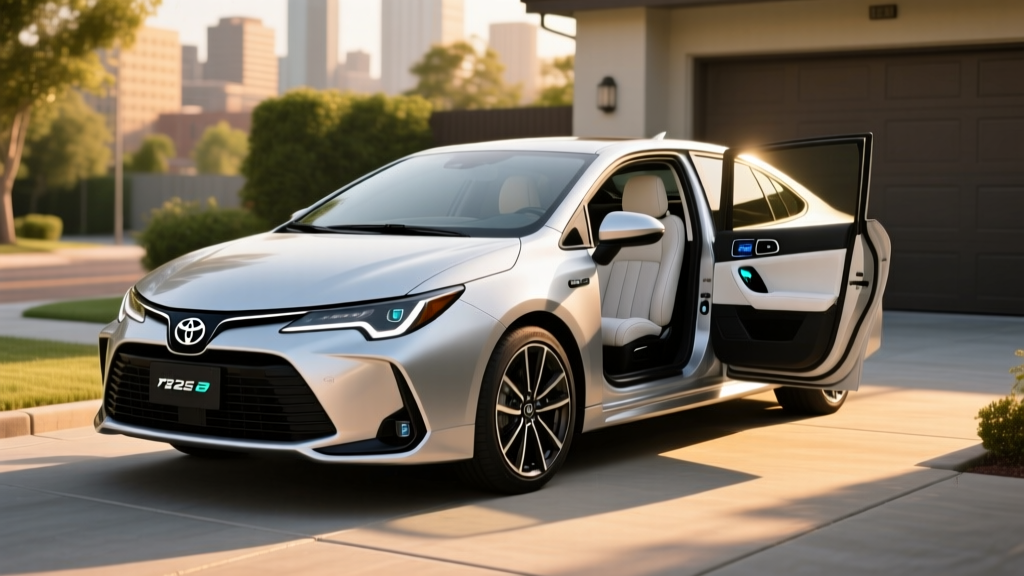
The 2025 Toyota Corolla LE Hybrid occupies a specific niche that full EVs and plug-in hybrids can't easily fill: a compact sedan that delivers 50+ MPG without requiring a plug, a charging routine, or a change in driving habits. For buyers who lack home charging access or simply want to minimize fuel costs with zero lifestyle adjustment, the Corolla Hybrid remains one of the most practical electrified vehicles on the market.
This guide breaks down the 2025 Toyota Corolla LE Hybrid's powertrain, real-world fuel economy, battery longevity, ownership costs, and how it stacks up against PHEVs and full EVs. If you're researching whether this is the right electrified car for your commute, we'll give you the exact numbers to decide.
2025 Toyota Corolla LE Hybrid: Key Specifications at a Glance
| Specification | Detail |
|---|---|
| Powertrain | 1.8L 4-cyl Atkinson-cycle + 2 electric motors (HEV) |
| Combined Horsepower | 138 hp |
| Drivetrain | Front-wheel drive (AWD-e available on SE/XSE trims) |
| EPA Fuel Economy | 53 city / 46 highway / 50 combined MPG |
| Fuel Tank Capacity | 11.4 gallons |
| Total Range | ~570 miles per tank (EPA combined) |
| Hybrid Battery | ~1.3 kWh lithium-ion (sealed, not plug-in) |
| 0–60 mph | ~9.2 seconds (estimated) |
| Starting MSRP (LE trim) | $23,500 (excludes destination) |
| Federal Tax Credit | Not eligible (§30D applies to PHEVs/BEVs only) |
| Hybrid Battery Warranty | 10 years / 150,000 miles |
Fuel Economy: EPA Numbers vs. Real-World MPG
The EPA rates the 2025 Corolla Hybrid LE at 53 MPG city, 46 MPG highway, and 50 MPG combined per fueleconomy.gov. These figures are among the best in the compact sedan segment and are achievable under normal driving conditions.
| Driving Scenario | EPA Rating | Real-World Expectation |
|---|---|---|
| City / Stop-and-Go | 53 MPG | 52–58 MPG (hybrids often exceed EPA in city) |
| Highway (70+ mph) | 46 MPG | 42–46 MPG (less regen benefit at sustained speed) |
| Combined Mixed | 50 MPG | 47–52 MPG |
| Cold Weather (below 30°F) | — | 43–48 MPG (engine runs more for cabin heat) |
Toyota's hybrid system excels in city driving because regenerative braking recaptures energy at every stop, and the electric motor handles low-speed acceleration where gas engines are least efficient. On the highway, the advantage narrows — the 1.8L Atkinson-cycle engine is efficient but can't leverage regen the same way. In cold weather, expect a 5–10% drop in MPG because the gasoline engine must run longer to provide cabin heating and maintain battery temperature.
HEV vs. PHEV vs. EV: Which Powertrain Fits Your Life?
The Corolla Hybrid LE is a conventional hybrid electric vehicle (HEV). It charges its small battery entirely through regenerative braking and the gasoline engine. There is no plug, no electric-only driving range to manage, and no charging infrastructure required.
| Factor | HEV (Corolla Hybrid) | PHEV (e.g., Prius Prime) | Full EV (e.g., Tesla Model 3) |
|---|---|---|---|
| Plug Required? | No | Yes (for EV range) | Yes |
| Electric-Only Range | None (EV assist only) | 25–44 miles typical | 250–360 miles |
| Home Charging Needed? | No | Recommended (120V or 240V) | Required |
| Fuel Cost per Mile | ~$0.06 (at $3.00/gal) | ~$0.03–0.06 (varies) | ~$0.03–0.05 (home charging) |
| Federal Tax Credit (§30D) | Not eligible | Up to $7,500 (if sourcing rules met) | Up to $7,500 (if sourcing rules met) |
| Maintenance | Oil changes, standard | Oil changes + EV systems | Minimal (no oil, fewer fluids) |
| Best For | No home charging, long highway drives | Short commute + home charging | Home charging + mostly under 300 mi/day |
The Corolla Hybrid LE makes the most sense if you live in an apartment without charging access, drive long highway routes where EV charging infrastructure is sparse, or simply don't want to think about plugging in. A PHEV like the Toyota Prius Prime (44 miles of electric-only range) is a better fit if you have a garage outlet and a short commute — you'd drive most days on electricity alone. A full EV wins on per-mile cost and maintenance but demands reliable charging access.
Powertrain and Driving Experience
The 2025 Corolla Hybrid LE uses Toyota's fifth-generation hybrid system, pairing a 1.8-liter four-cylinder Atkinson-cycle engine with two motor-generators and a planetary gearset (e-CVT). Combined output is 138 horsepower. The LE trim is front-wheel drive only; all-wheel drive (AWD-e, which adds a rear electric motor) is reserved for the SE and XSE hybrid trims.
Acceleration is adequate for merging and city driving — expect a 0–60 mph time around 9.2 seconds. The e-CVT is smooth and avoids the rubber-band feel of some competitors' transmissions. Regenerative braking is progressive and can be modulated through the gear selector's "B" mode for stronger deceleration, though it does not offer true one-pedal driving like a full EV.
The hybrid battery is a compact lithium-ion pack (~1.3 kWh usable capacity) mounted under the rear seats. It's small by design — it buffers energy from braking and assists during acceleration, but never propels the car on electricity alone for meaningful distances.
Pricing, Trims, and Tax Credit Eligibility
The 2025 Corolla Hybrid is offered in three trims. Here's the pricing breakdown:
- LE: $23,500 MSRP (+ ~$1,095 destination) — the volume seller
- SE: $26,040 MSRP — adds sport-tuned suspension, AWD-e option
- XSE: $28,190 MSRP — premium interior, standard AWD-e
For buyers specifically seeking a tax credit, the Toyota Prius Prime (PHEV) may qualify for partial or full §30D credit depending on battery sourcing and your income level — but the Corolla Hybrid's lower base price often narrows the effective cost gap when you factor in the PHEV's higher MSRP.
Battery Longevity, Warranty, and Replacement Cost
Toyota's hybrid battery track record is among the best in the industry. The Prius, which uses a similar system, has demonstrated hybrid battery longevity exceeding 200,000 miles in numerous owner reports and fleet data. The Corolla Hybrid's lithium-ion pack is smaller and less stressed than a full EV battery, contributing to its durability.
If replacement is eventually needed out of warranty, a new OEM hybrid battery for the Corolla Hybrid typically costs between $2,000 and $3,500 including labor. Refurbished or reconditioned packs are available from third-party suppliers for $1,000–$2,000. For context, a full EV battery replacement can cost $10,000–$20,000+, making the HEV's smaller battery a significantly lower long-term risk.
Degradation in Toyota's conventional hybrid batteries is minimal in practice because the system never fully charges or fully depletes the pack — it operates in a narrow state-of-charge window (roughly 40–80%), which is ideal for lithium-ion longevity.
Reliability and Safety Ratings
The 2025 Corolla Hybrid benefits from Toyota's reputation for long-term reliability, and the hybrid powertrain has been refined across multiple generations. The conventional hybrid system has fewer high-stress components than a PHEV or EV — no large battery thermal management system, no DC fast-charging hardware, and no high-voltage contactors cycling frequently.
The Corolla sedan platform earned a TOP SAFETY PICK+ rating from the IIHS when equipped with specific headlights, and Toyota Safety Sense 3.0 is standard on all trims. This includes:
- Pre-Collision System with Pedestrian Detection
- Lane Departure Alert with Steering Assist
- Full-Speed Range Dynamic Radar Cruise Control
- Lane Tracing Assist
- Road Sign Assist
- Automatic High Beams
These are SAE Level 1–2 driver-assistance features. The driver must remain engaged and hands-on at all times — this is not autonomous driving.
Pros, Cons, and the Ownership Verdict
Pros
- 50 MPG combined EPA — top-tier for a non-plug-in sedan
- No charging required — works with any gas station
- 10-year / 150,000-mile hybrid battery warranty
- Low starting MSRP ($23,500 before destination)
- Standard Toyota Safety Sense 3.0 across all trims
- Strong resale value and proven reliability
- 570-mile total range eliminates range anxiety
Cons
- No federal tax credit (HEV, not PHEV/BEV)
- Modest 138 hp — not a performance-oriented sedan
- AWD-e not available on the LE trim
- Highway MPG drops below city rating (46 vs 53)
- No electric-only driving capability
- Rear seat and cargo space unchanged from gas Corolla (no packaging advantage)
Who Should Buy the 2025 Toyota Corolla LE Hybrid?
Choose the Corolla Hybrid LE if:
- You lack access to home or workplace charging (apartment, street parking)
- Your commute is long and highway-heavy, where EV charging stops would add time
- You want maximum MPG with minimum behavioral change
- Budget is a priority — $23,500 base is thousands less than most PHEVs and EVs
- You plan to own the car 8–10+ years and value Toyota's reliability record
Look at a PHEV or full EV instead if:
- You have home charging and a short daily commute (PHEV covers it on electricity)
- You want the federal $7,500 tax credit to offset a higher purchase price
- You want zero tailpipe emissions for daily driving (full EV or PHEV in EV mode)
- Performance matters — EVs deliver instant torque the Corolla Hybrid can't match
Frequently Asked Questions
How many MPG does the 2025 Toyota Corolla LE Hybrid get?
The EPA rates it at 53 MPG city, 46 MPG highway, and 50 MPG combined. In real-world city driving, many owners report 52–58 MPG thanks to regenerative braking. Highway-only driving at 75+ mph may yield 42–46 MPG.
Does the Corolla Hybrid need to be plugged in?
No. The Corolla Hybrid LE is a conventional hybrid (HEV). Its small battery is charged entirely by the gasoline engine and regenerative braking. There is no plug and no electric-only range.
Does the 2025 Corolla Hybrid qualify for a federal tax credit?
No. The IRS §30D Clean Vehicle Credit applies only to plug-in electric vehicles (PHEVs and BEVs) with sufficient battery capacity and compliant sourcing. The Corolla Hybrid is an HEV and is ineligible. Some state or utility incentives may still apply — check local programs.
How long will the hybrid battery last, and what does replacement cost?
Toyota covers the hybrid battery for 10 years or 150,000 miles. In practice, Toyota hybrid batteries frequently last 200,000+ miles. If replacement is needed out of warranty, expect $2,000–$3,500 for an OEM pack including labor — far less than an EV battery replacement.
Is the Corolla Hybrid LE available with all-wheel drive?
No. The LE trim is front-wheel drive only. AWD-e (a rear electric motor providing on-demand all-wheel drive) is available on the SE and XSE hybrid trims at a higher MSRP.
How does the Corolla Hybrid compare to the Prius?
The 2025 Prius (also 50+ MPG combined in LE trim) offers a slightly more modern interior, more cargo versatility as a liftback, and an available PHEV variant (Prius Prime with 44 miles of EV range). The Corolla Hybrid is a traditional sedan with a lower base price and a more conventional trunk. Both use similar hybrid powertrains with comparable efficiency.
What's the difference between the Corolla Hybrid and a PHEV?
A PHEV (plug-in hybrid) has a larger battery (typically 8–18 kWh) that can be charged from an outlet and provides 25–44 miles of electric-only driving before the gas engine engages. The Corolla Hybrid's ~1.3 kWh battery cannot be plugged in and provides no meaningful electric-only range — it only assists the gas engine for better MPG.