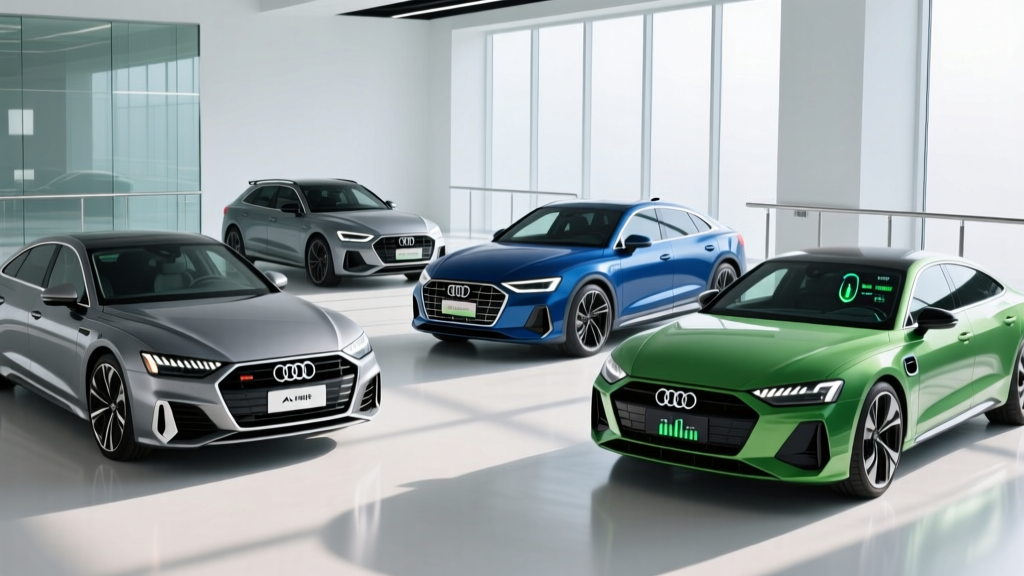
If you're researching Audi hybrid models in 2026, you're looking at a lineup built almost entirely around plug-in hybrid electric vehicles (PHEVs). Audi has largely moved past conventional hybrids (HEVs) in the U.S. market, instead offering PHEV variants of its most popular nameplates — the Q5, A6, A7, and Q8 — that pair turbocharged engines with electric motors and modest battery packs. The result: 20–40 miles of electric-only driving for daily commutes, plus a gasoline engine for weekend road trips with zero range anxiety.
This guide breaks down every current Audi PHEV, explains the HEV vs. PHEV distinction, and gives you the exact numbers — EPA MPG, electric-only range, battery kWh, charging times, and tax-credit eligibility — you need to decide which model fits your driving pattern.
Audi's Hybrid Strategy: PHEV-First in the U.S.
Unlike Toyota or Honda, which sell millions of conventional hybrids (HEVs) that never plug in, Audi's U.S. hybrid strategy centers on plug-in hybrids (PHEVs). The difference is fundamental:
HEV vs. PHEV — What's the Difference?
| Feature | Conventional Hybrid (HEV) | Plug-in Hybrid (PHEV) |
|---|---|---|
| Plugs in to charge? | No — charges via regenerative braking and engine | Yes — Level 1/Level 2 AC charging |
| Battery size | 1–2 kWh (small buffer) | 14–26 kWh (usable) |
| Electric-only range | 0–1 miles at low speed | 20–40+ miles at highway speeds |
| Fuel economy (gas mode) | 40–55 MPG combined typical | 25–30 MPG combined (gas only) |
| Tax credit eligible? | No | Up to $3,750–$7,500 (varies by model/year) |
| Best for | Drivers who can't plug in at all | Drivers with home/work charging and commutes under 40 mi |
Audi does not currently sell a conventional HEV in the United States. Every Audi hybrid you can buy is a PHEV. If you see references to "Audi hybrids" that describe HEV-style fuel economy (50+ MPG without plugging in), those are typically mild-hybrid (MHEV) systems — 48-volt setups that provide marginal efficiency gains (1–2 MPG) but no electric-only driving. Audi's 55 TFSI and 45 TFSI mild-hybrid badges can be confusing; they are not full hybrids.
2026 Audi PHEV Lineup: Specs at a Glance
Here's the current Audi PHEV lineup available or announced for the U.S. market. Specs reflect 2025–2026 model-year data from fueleconomy.gov and Audi's official U.S. press materials.
| Model | Powertrain | Combined HP | Battery (kWh usable) | EV Range (EPA) | MPG (gas only) | MPGe (combined) | Max AC Charge | Base MSRP |
|---|---|---|---|---|---|---|---|---|
| 2026 Audi Q5 55 TFSI e | 2.0L turbo I4 + electric motor | 362 hp | ~17.9 kWh | 23 mi | 25 city / 26 hwy / 25 combined | 61 MPGe | 7.2 kW (Level 2) | $60,995 |
| 2026 Audi A6 55 TFSI e | 2.0L turbo I4 + electric motor | 362 hp | ~17.9 kWh | 25 mi | 26 city / 28 hwy / 27 combined | 63 MPGe | 7.2 kW (Level 2) | $68,495 |
| 2026 Audi A7 55 TFSI e | 2.0L turbo I4 + electric motor | 362 hp | ~17.9 kWh | 24 mi | 26 city / 27 hwy / 26 combined | 62 MPGe | 7.2 kW (Level 2) | $73,495 |
| 2026 Audi Q8 55 TFSI e | 3.0L turbo V6 + electric motor | 455 hp | ~17.9 kWh | 22 mi | 20 city / 22 hwy / 21 combined | 50 MPGe | 7.2 kW (Level 2) | $82,995 |
Key takeaway: Audi's PHEVs all use roughly the same 17.9 kWh (usable) lithium-ion battery and 7.2 kW onboard charger. None support DC fast charging — you're limited to Level 2 AC charging, which means a full 0–100% charge takes approximately 2.5 hours on a 240V home charger, or about 8–10 hours on a standard 120V outlet (Level 1).
Electric-Only Range: What the EPA Says vs. Reality
The EPA electric-only range for Audi's PHEVs falls between 22 and 25 miles depending on the model. But real-world results vary significantly based on temperature, terrain, and driving style.
Real-World EV Range Expectations
EPA sticker: 22–25 miles electric-only
Mild weather, city driving (under 45 mph): 24–28 miles — regenerative braking extends range
Highway (70+ mph sustained): 16–20 miles — aerodynamic drag and sustained power draw reduce range
Cold weather (below 32°F): 14–18 miles — battery chemistry loses efficiency, cabin heating draws power
Mountainous terrain: 12–18 miles uphill; regen recovers some energy on descent
For a commuter with a 20-mile round trip and home charging, an Audi PHEV can handle most weekday driving on electricity alone. But if your one-way commute exceeds 25 miles, you'll burn gasoline on a meaningful portion of your drive — at which point the gas-only MPG (21–27 combined depending on model) becomes your actual fuel economy.
Charging Your Audi PHEV: Times, Costs, and Limitations
Audi PHEVs use a standard J1772 connector for AC charging. Here's what charging looks like in practice:
| Charging Level | Power (kW) | Voltage | 0–100% Time | Miles of EV Range per Hour |
|---|---|---|---|---|
| Level 1 (standard outlet) | ~1.4 kW | 120V | ~12–14 hours | ~2 mi/hr |
| Level 2 (home/public AC) | 7.2 kW (max) | 240V | ~2.5 hours | ~9–10 mi/hr |
| DC Fast Charging | Not supported | N/A | N/A | N/A |
The no-DCFC limitation matters. Competitors like the Toyota RAV4 Prime (which also lacks DCFC) and the Jeep Wrangler 4xe (which offers optional DCFC on newer trims) face the same constraint. But if you expected to top up at a highway DC fast charger during road trips, that's not an option with any current Audi PHEV. On road trips, the gasoline engine handles all propulsion once the battery depletes.
Cost to charge at home: At the U.S. average residential electricity rate of ~$0.17/kWh (EIA, 2025 data), a full 17.9 kWh charge costs roughly $3.04. That buys you ~22–25 miles of electric driving — approximately $0.12–$0.14 per mile. Compare that to premium unleaded at $4.00/gallon and 25 MPG gas-only, which costs about $0.16 per mile. The savings are modest on a per-mile basis but compound over hundreds of commute miles.
Federal Tax Credits for Audi PHEVs: §30D Eligibility
Under IRS §30D clean vehicle credit rules, qualifying PHEVs can receive up to $7,500 in federal tax credits — but eligibility is complex and model-dependent. Here's what determines whether a specific Audi PHEV qualifies:
- MSRP cap: SUVs (Q5, Q8) must be under $80,000; sedans (A6, A7) must be under $55,000. The Q5 55 TFSI e at $60,995 clears the SUV cap. The A6 and A7 sedans at $68,495 and $73,495 exceed the $55,000 sedan cap and are not eligible.
- Battery capacity: Must be at least 7 kWh — all Audi PHEVs meet this requirement at ~17.9 kWh.
- Buyer income limits: Modified AGI must not exceed $300,000 (joint), $225,000 (head of household), or $150,000 (single).
- Critical minerals & battery component sourcing: Phased-in percentages increase annually. For 2026, at least 70% of critical minerals and 85% of battery components must meet North American sourcing requirements to receive the full $7,500. Partial sourcing may yield $3,750.
- Point-of-sale transfer: Buyers can transfer the credit to the dealer at purchase, reducing the purchase price upfront rather than waiting for a tax refund.
Bottom line for 2026: The Q5 55 TFSI e is the most likely Audi PHEV to qualify for at least a partial credit ($3,750), depending on final battery-sourcing certification. The A6, A7, and Q8 sedans/SUV pricing exceeds MSRP caps or sits at the edge of eligibility. Always verify current eligibility on the fueleconomy.gov tax credit lookup tool before purchasing, as manufacturer sourcing certifications update throughout the year.
Powertrain Deep Dive: How Audi's PHEV System Works
Audi's PHEV architecture places an electric motor between the engine and the transmission (a P2 hybrid layout), integrated into the housing of the 7-speed S tronic dual-clutch gearbox. This means the electric motor can drive the wheels independently (EV mode), assist the gasoline engine under acceleration (hybrid mode), or regenerate energy during braking and deceleration.
Driving modes:
- EV mode: Pure electric up to ~84 mph. The engine stays off unless you floor the throttle.
- Hybrid mode: The car's ECU blends engine and motor for optimal efficiency. Best for mixed driving.
- Battery Hold: Preserves current battery charge for later use (useful before entering a city or zero-emission zone).
- Battery Charge: Uses the engine to recharge the battery while driving — sacrifices MPG to build electric range.
The Q5 55 TFSI e's combined 362 hp and 369 lb-ft of torque deliver a 0–60 mph time of approximately 5.0 seconds — noticeably quicker than the non-hybrid Q5 45 TFSI (5.8 seconds). The electric motor's instant torque fills in the turbo lag, making the PHEV the quickest Q5 variant short of the SQ5.
Battery Warranty, Degradation, and Replacement Costs
Audi PHEV Battery Warranty
Coverage: 8 years / 100,000 miles (whichever comes first)
Capacity retention threshold: Battery must retain at least 70% of original capacity during the warranty period
What's covered: Defects, excessive degradation below the 70% threshold
What's not covered: Damage from accidents, improper charging, or modifications
Real-world degradation: Audi PHEV batteries are relatively small (~17.9 kWh usable) and are typically cycled more deeply than full EV batteries (drivers use 80–100% of the pack daily rather than staying in the 20–80% sweet spot). Based on owner reports from 2019–2023 model-year Audi PHEVs in Europe and the U.S., typical degradation after 5 years and 60,000 miles is 8–14%, meaning most owners retain 86–92% of original capacity. This is within normal expectations for NMC (nickel manganese cobalt) chemistry under moderate cycling.
Replacement cost: If the battery fails out of warranty, a replacement pack for an Audi Q5 PHEV currently runs $8,000–$12,000 including parts and labor at a dealership. This is a significant expense, though it's comparable to other luxury-brand PHEV battery replacements. Independent EV shops may offer refurbished packs at 30–40% less.
Who Should Buy an Audi PHEV — and Who Shouldn't
Choose an Audi PHEV If:
- Your daily commute is under 25 miles round-trip and you can charge at home overnight
- You want electric commuting but take regular road trips beyond 250 miles
- You want Audi's build quality, Quattro AWD, and interior refinement without going full EV
- You're not ready to deal with public charging infrastructure on long trips
- You want to reduce fuel consumption without sacrificing performance (362+ hp)
Choose a Full EV (BEV) Instead If:
- You can install a Level 2 home charger and your daily driving stays under 250 miles
- You want to eliminate gasoline costs and oil changes entirely
- You want access to DC fast charging for road trips (Audi's Q8 e-tron offers up to 170 kW DCFC)
- You want the full $7,500 federal tax credit with more certainty (many BEVs qualify more clearly)
Stick With a Gas Car If:
- You have no access to any charging — not at home, work, or elsewhere
- Your daily commute regularly exceeds 50+ miles (the PHEV advantage disappears)
- You want the lowest possible purchase price and simplest maintenance
Audi PHEV Pros
- 22–25 miles electric-only covers most commutes
- 362–455 hp — quickest variants in their model lines
- Quattro AWD standard on all PHEV trims
- No range anxiety on road trips — gasoline engine takes over seamlessly
- Level 2 home charging is simple and relatively inexpensive to install
- Premium interior, technology, and ride quality
Audi PHEV Cons
- No DC fast charging — road-trip charging impractical
- Gas-only MPG is unremarkable (21–27 combined) once battery depletes
- Small 17.9 kWh battery limits electric range vs. competitors (RAV4 Prime: 42 mi)
- Sedan PHEVs (A6, A7) likely ineligible for federal tax credit due to $55K MSRP cap
- Higher maintenance complexity — engine + electric motor + dual-clutch transmission
- 8-year battery warranty is standard but replacement cost is steep out of warranty
Frequently Asked Questions
How many MPG does an Audi hybrid get?
It depends on whether you're driving on electricity or gasoline. In gas-only mode (after the battery depletes), the 2026 Audi Q5 55 TFSI e returns an EPA-estimated 25 MPG combined (25 city / 26 highway). The A6 55 TFSI e achieves 27 MPG combined. In practice, if you charge nightly and commute under 25 miles, you may use very little gasoline at all — some owners report going weeks between fill-ups. But on a long road trip with a depleted battery, expect fuel economy similar to a conventional luxury SUV or sedan in that class.
How far can an Audi PHEV go on electric only?
The EPA rates Audi's current PHEVs at 22–25 miles of electric-only range. In real-world mild-weather city driving, you may stretch that to 26–28 miles thanks to regenerative braking. On the highway at 70+ mph, expect 16–20 miles. In freezing temperatures, plan for 14–18 miles. This range is adequate for short commutes but falls short of the Toyota RAV4 Prime's 42-mile EPA rating or the upcoming generation of PHEVs with 50+ mile electric ranges.
Does the Audi Q5 hybrid qualify for a tax credit?
The Q5 55 TFSI e, priced at $60,995, falls under the $80,000 MSRP cap for SUVs and has a battery exceeding the 7 kWh minimum. Whether it receives the full $7,500, a partial $3,750, or nothing depends on the current critical-minerals and battery-component sourcing certifications filed with the IRS. Check fueleconomy.gov for the most up-to-date eligibility status before purchasing. The A6 and A7 sedan PHEVs exceed the $55,000 sedan MSRP cap and are not eligible regardless of sourcing.
Is the Audi PHEV battery reliable, and what does replacement cost?
Audi's PHEV batteries are covered for 8 years / 100,000 miles with a 70% capacity-retention guarantee. Real-world data from 2019–2023 models shows typical degradation of 8–14% over 5 years, which is within normal parameters for NMC chemistry. Out-of-warranty replacement costs $8,000–$12,000 at a dealership. The battery is not a routine maintenance item — most will outlast the vehicle's typical ownership period, but the replacement cost is a legitimate long-term consideration for second owners.
Can I charge an Audi PHEV at a DC fast charger?
No. None of Audi's current PHEVs support DC fast charging. You're limited to AC Level 2 charging at up to 7.2 kW, which takes about 2.5 hours for a full charge. On road trips, the gasoline engine handles propulsion once the battery is depleted — you don't need to stop to charge. This is a deliberate trade-off: PHEV batteries are small enough that DC fast charging adds cost and complexity without much practical benefit for the target use case (home charging overnight, gasoline for long trips).
Hybrid vs PHEV vs EV — which Audi should I choose?
Audi doesn't sell conventional hybrids (HEVs) in the U.S., so the real choice is between an Audi PHEV (Q5, A6, A7, Q8 55 TFSI e) and a full Audi EV (Q8 e-tron, Q6 e-tron, e-tron GT). If you can charge at home, drive under 250 miles daily, and want to eliminate gasoline entirely, the Q8 e-tron or Q6 e-tron is the stronger long-term play with DC fast charging for road trips. If your routine includes frequent 300+ mile trips, you live in an area with sparse charging infrastructure, or you simply want the flexibility of a gas engine, the Q5 55 TFSI e PHEV is the practical middle ground.