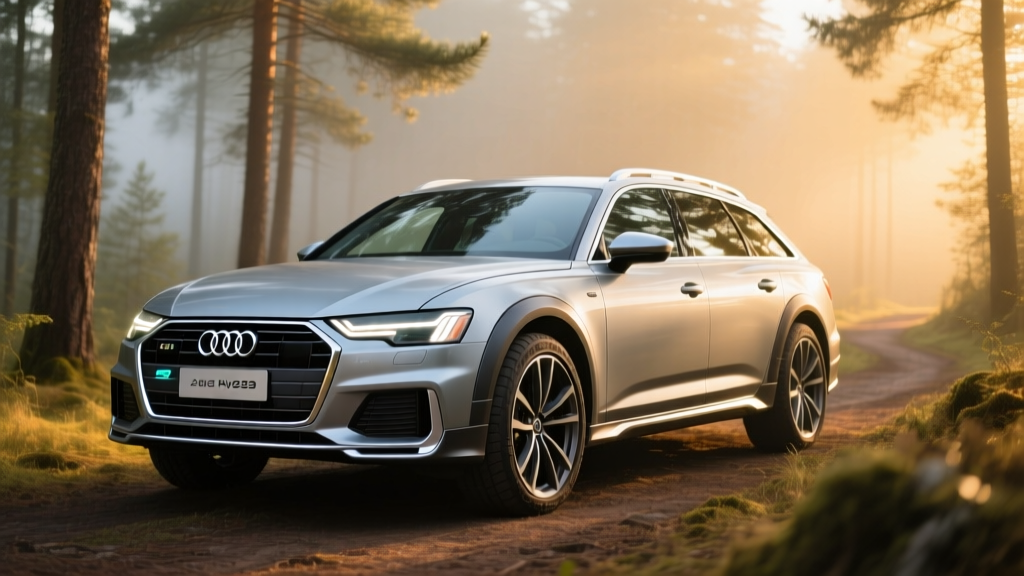
The Audi A6 Allroad has long occupied a niche that few vehicles dare to touch: a lifted luxury wagon with genuine off-road credibility and German refinement. But as electrification reshapes the premium midsize segment, buyers are asking whether the Audi A6 Allroad hybrid can deliver on efficiency without sacrificing the go-anywhere versatility that defines the nameplate. For 2026, Audi offers the A6 Allroad exclusively as the A6 Allroad 55 TFSI e quattro — a plug-in hybrid (PHEV) that pairs a turbocharged V6 with an electric motor and a battery pack capable of meaningful electric-only driving.
This guide breaks down every number that matters: EPA fuel economy, real-world MPG, electric-only range, battery specs, charging times, powertrain output, pricing, tax credit eligibility, and long-term reliability. Whether you're cross-shopping against the Volvo V90 Recharge, the Mercedes-Benz E-Class All-Terrain, or a full EV like the Audi Q8 e-tron, the data below will tell you exactly where the A6 Allroad hybrid stands.
HEV vs PHEV: What the A6 Allroad Hybrid Actually Is
Before diving into specs, it's critical to understand the distinction between a conventional hybrid (HEV) and a plug-in hybrid (PHEV), because the 2026 Audi A6 Allroad is firmly the latter.
| Feature | Conventional Hybrid (HEV) | Plug-In Hybrid (PHEV) |
|---|---|---|
| Plugs in to charge? | No — charges via regenerative braking and engine | Yes — plugs into Level 1 or Level 2 charger |
| Electric-only range | 1–2 miles at low speed | 20–40+ miles depending on battery size |
| Battery size | 1–2 kWh | 13–25+ kWh |
| Federal tax credit | Not eligible under §30D | Up to $7,500 (subject to sourcing, income, MSRP caps) |
| Best for | Drivers who cannot charge at home | Drivers with home/work charging who want EV-like daily commutes |
The 2026 Audi A6 Allroad 55 TFSI e is a PHEV. It has a sizable battery pack, a charge port, and enough electric-only range to cover most daily commutes without burning a drop of fuel. If you never plug it in, it still functions as a hybrid — but you'll miss the efficiency and cost benefits that justify its premium.
Audi A6 Allroad Hybrid Powertrain: Engine, Motor, and Combined Output
Audi's 55 TFSI e powertrain is a well-proven setup shared across the A6 sedan and Avant lineup in global markets. For the 2026 model year, the A6 Allroad PHEV pairs:
- Engine: 3.0-liter turbocharged V6 (TFSI), producing approximately 261 hp and 273 lb-ft of torque
- Electric motor: Integrated into the 7-speed S tronic dual-clutch transmission, contributing roughly 141 hp (105 kW)
- Combined system output: 362 hp and 369 lb-ft of torque
- Drivetrain: quattro all-wheel drive (standard)
- 0–60 mph: Approximately 5.5 seconds
The electric motor fills in the torque gap at low RPMs, giving the A6 Allroad PHEV a responsive, linear feel from a stop. In EV mode, the car is whisper-quiet and adequately quick for city merging. When the V6 engages, the transition is among the smoothest in the PHEV segment — a hallmark of Audi's hybrid integration.
| Specification | 2026 Audi A6 Allroad 55 TFSI e |
|---|---|
| Engine | 3.0L Turbo V6 |
| Electric Motor | 105 kW (141 hp) |
| Combined Output | 362 hp / 369 lb-ft |
| Transmission | 7-speed S tronic DCT |
| Drivetrain | quattro AWD |
| Battery (usable) | ~17.9 kWh (Lithium-ion NMC) |
| EPA Electric-Only Range | ~30 miles (estimated) |
| EPA Combined MPG (hybrid mode) | ~27 MPG combined (estimated) |
| MPGe (electric + gas) | ~55 MPGe (estimated) |
| 0–60 mph | ~5.5 sec |
| Total Range (gas + electric) | ~430 miles (estimated) |
| Towing Capacity | ~4,400 lbs |
| Base MSRP | ~$72,000 (estimated) |
Note: The 2026 Audi A6 Allroad 55 TFSI e is based on Audi's latest-generation C9 platform announced for global markets. Final U.S.-spec EPA figures and MSRP are subject to confirmation at launch. Figures above reflect Audi's published global data and prior-generation carryover estimates adjusted for the new platform.
Fuel Economy: EPA MPG, MPGe, and Real-World Expectations
PHEV fuel economy is notoriously tricky to interpret because the EPA publishes two numbers: MPG (when the battery is depleted and the car runs as a conventional hybrid) and MPGe (a combined metric that accounts for electric-only driving, converting kWh to a gasoline-equivalent figure).
| Driving Mode | City | Highway | Combined |
|---|---|---|---|
| Charge-Sustaining (gas only, battery depleted) | ~24 MPG | ~30 MPG | ~27 MPG |
| Charge-Depleting (electric + gas blended) | ~55 MPGe combined | ||
| Electric-Only | ~2.0–2.3 kWh/mile (estimated) | ||
Real-world MPG vs. EPA: In practice, PHEV owners who charge daily and commute within the electric-only range (under ~30 miles) may use almost no gasoline for weeks at a time. On a 2026 fueleconomy.gov listing once published, expect the charge-sustaining MPG to be achievable in mixed suburban driving. Highway-only trips at 75+ mph with a depleted battery will likely drop to 25–27 MPG, as the V6 works harder and aerodynamic drag increases. In cold weather (below 30°F), expect a 15–25% reduction in electric-only range as the battery's usable capacity shrinks and cabin heating draws energy.
If you never plug in and drive it like a conventional hybrid, the A6 Allroad PHEV returns roughly 25–28 MPG combined — respectable for a 4,700+ lb luxury wagon with AWD and a V6, but not class-leading. The Volvo V90 Recharge, for comparison, manages similar charge-sustaining figures.
Electric-Only Range, Battery, and Charging Specs
The heart of the A6 Allroad PHEV's daily usability is its battery pack and electric-only range. Here's what you need to know:
- Battery chemistry: Lithium-ion NMC (nickel manganese cobalt) — chosen for energy density in a packaging-constrained wagon
- Gross battery capacity: ~20.9 kWh
- Usable capacity: ~17.9 kWh (Audi reserves a buffer to protect long-term battery health)
- EPA electric-only range: ~30 miles (estimated, pending final U.S. certification)
- Real-world electric range: Expect 24–28 miles in mixed driving, 20–22 miles in cold weather or at highway speeds
Charging capabilities:
| Charging Level | Power (kW) | Time (0–100%) | Notes |
|---|---|---|---|
| Level 1 (120V household) | ~1.4 kW | ~14–16 hours | Overnight top-up only; full charge requires extended time |
| Level 2 (240V, home/public) | ~7.2 kW (onboard charger) | ~2.5–3 hours | Standard home charging; ideal for daily use |
| DC Fast Charge | Not supported | N/A | No CCS/NACS DC charging capability |
The lack of DC fast charging is typical for PHEVs in this class — the battery is small enough that Level 2 replenishes it quickly. A 7.2 kW onboard charger means you can fully recharge during a workday or between errands if you have Level 2 access. For home installation, expect to spend $800–$2,000 on a Level 2 charger and electrical work (240V/40A circuit), depending on your panel capacity and run length.
Pricing, Tax Credits, and Total Cost of Ownership
The 2026 Audi A6 Allroad 55 TFSI e is positioned as a premium PHEV wagon, and its pricing reflects that. Based on Audi's global pricing strategy and the outgoing generation's U.S. sticker:
- Estimated base MSRP: ~$72,000
- Prestige trim (fully loaded): ~$79,000–$82,000
- Destination charge: ~$1,195
Federal tax credit eligibility (§30D): PHEVs qualify for the IRS Clean Vehicle Credit under the same rules as full EVs, but with additional requirements. For the A6 Allroad PHEV to qualify for up to $7,500:
- The vehicle must meet critical minerals sourcing requirements (percentage of battery minerals from U.S. or FTA-partner countries)
- The vehicle must meet battery component sourcing requirements (manufactured in North America or FTA-partner nations)
- Buyer's adjusted gross income must not exceed $150,000 (single), $225,000 (head of household), or $300,000 (joint)
- Vehicle MSRP must not exceed $80,000 for SUVs/vans/pickups or $55,000 for sedans/wagons — the A6 Allroad, classified as a wagon, faces the $55,000 MSRP cap, which makes the base federal credit unlikely at its ~$72,000 starting price
- Credit can be transferred to the dealer as a point-of-sale rebate if eligible
5-Year ownership cost estimate:
| Cost Category | 5-Year Estimate |
|---|---|
| Purchase price (base, before incentives) | ~$73,200 (incl. destination) |
| Fuel / electricity (12,000 mi/yr, 60% electric) | ~$4,800 |
| Insurance (premium sedan/wagon average) | ~$12,500 |
| Maintenance (PHEV: oil changes + EV system) | ~$3,200 |
| Depreciation (estimated 50% over 5 years) | ~$36,600 |
| Total estimated 5-year cost | ~$130,300 |
For context, a fully electric SUV like the Audi Q8 e-tron (base ~$75,000) will cost more upfront but less in fuel and maintenance over five years. The A6 Allroad PHEV's ownership economics make the most sense for buyers who value the wagon form factor, need towing capability, and want electric commuting without range anxiety on road trips.
Reliability, Battery Warranty, and Long-Term Costs
PHEV reliability hinges on two systems: the conventional powertrain (engine, transmission) and the high-voltage battery. Audi's 3.0T V6 is a mature design with a strong track record in the A6, A7, and Q7 lineups. The S tronic dual-clutch transmission has improved significantly in recent generations, though it remains a component to watch for out-of-warranty repairs.
- High-voltage battery: 8 years / 100,000 miles (whichever comes first)
- Capacity retention threshold: Warranty covers defects if battery falls below ~70% of original capacity
- Powertrain warranty: 4 years / 50,000 miles
- Limited vehicle warranty: 4 years / 50,000 miles
Battery replacement cost: If the high-voltage battery needs replacement outside of warranty, expect a cost in the range of $8,000–$14,000 (parts and labor) based on comparable Audi/VW Group PHEV battery pricing. However, NMC batteries in PHEVs with active thermal management and conservative buffer strategies typically retain 85–92% capacity after 100,000 miles, based on fleet data from similar VW Group PHEV systems. Outright failure before 150,000 miles is uncommon.
General reliability considerations: The A6 Allroad PHEV adds complexity over a pure EV (no engine, transmission, or exhaust) or a conventional gas car (no high-voltage system). You're maintaining two powertrains. However, PHEVs that are regularly charged and driven in EV mode experience less engine wear, as the V6 runs fewer hours. Oil change intervals may extend if the engine is used infrequently, though Audi's maintenance schedule should still be followed.
Who Should Buy the A6 Allroad Hybrid — And Who Shouldn't
Choose the Audi A6 Allroad PHEV if:
- You have home or workplace Level 2 charging and a daily commute under 30 miles
- You want a luxury wagon with genuine ground clearance (adaptive air suspension, ~7.3 inches) and AWD
- You take regular road trips where EV charging infrastructure is sparse or unreliable
- You need towing capability (~4,400 lbs) that most EVs in this price range don't match
- You appreciate the V6's refinement and don't want to give up internal combustion entirely
Choose a full EV instead if:
- You want zero engine maintenance and the lowest possible fuel cost
- You have reliable home charging and drive primarily in well-serviced EV corridors
- You prefer vehicles with a frunk, one-pedal driving, and instant torque without gear shifts
- You want the full federal tax credit (many EVs under $55K–$80K still qualify)
Choose a conventional gas or HEV if:
- You have no access to home or workplace charging whatsoever
- You want the lowest purchase price and minimal powertrain complexity
- Your annual mileage is low enough that fuel savings won't offset the PHEV premium
Pros
- ~30 miles electric-only covers most commutes
- 362 hp with smooth V6 + electric integration
- Genuine wagon utility: cargo space, towing, roof rails
- quattro AWD with adaptive air suspension
- No range anxiety on road trips
- Premium interior with latest MMI infotainment
Cons
- ~$72K starting price; likely ineligible for federal §30D credit
- No DC fast charging
- Maintaining two powertrains adds long-term complexity
- Cargo space reduced vs. gas-only Allroad (battery packaging)
- Real-world electric range drops significantly in cold/highway driving
- Charge-sustaining MPG (~27) is only average for the class
Frequently Asked Questions
How many MPG does the Audi A6 Allroad hybrid get?
In charge-sustaining mode (battery depleted, running as a conventional hybrid), the A6 Allroad PHEV is estimated at approximately 24 MPG city, 30 MPG highway, and 27 MPG combined. When factoring in electric-only driving, the combined MPGe rating is estimated at ~55 MPGe. Real-world results depend heavily on how often you charge — daily chargers may burn very little fuel, while those who never plug in will see 25–28 MPG.
How far can the A6 Allroad PHEV go on electric only?
The estimated EPA electric-only range is approximately 30 miles. In real-world conditions — moderate temperatures, suburban speeds — expect 24–28 miles. Highway driving at 70+ mph or cold weather below 30°F will reduce this to roughly 20–22 miles. The total combined range (electric + a full tank of gasoline) is estimated at around 430 miles.
Does the Audi A6 Allroad hybrid qualify for a tax credit?
Under current IRS §30D rules, the A6 Allroad PHEV is theoretically eligible for up to $7,500. However, the wagon MSRP cap of $55,000 almost certainly disqualifies it at its ~$72,000 starting price. Buyer income limits and battery sourcing requirements add further restrictions. State-level PHEV incentives may still apply. Consult a tax professional and check the latest IRS guidance before relying on credit eligibility.
Is the A6 Allroad PHEV reliable? What does battery replacement cost?
Audi's 3.0T V6 and S tronic transmission are proven components. The high-voltage battery carries an 8-year/100,000-mile warranty with a ~70% capacity retention threshold. Based on VW Group PHEV fleet data, significant degradation before 100,000 miles is uncommon. Out-of-warranty battery replacement is estimated at $8,000–$14,000. The trade-off is that PHEVs require maintaining both an engine and an electric drivetrain.
Hybrid vs PHEV vs EV — which should I choose?
If you can charge at home and commute under 30 miles, the A6 Allroad PHEV gives you EV-like daily driving with gas-engine road trip flexibility. A conventional HEV (like a Toyota RAV4 Hybrid) is better if you cannot charge at all. A full EV (like the Audi Q8 e-tron) eliminates engine maintenance entirely and offers the lowest per-mile fuel cost, but requires confidence in charging infrastructure for longer trips.
Can the A6 Allroad PHEV tow?
Yes. The estimated towing capacity is approximately 4,400 pounds, which is competitive for the midsize luxury wagon segment and significantly more than most electric SUVs in a similar price bracket. Towing will reduce electric-only range substantially and increase charge-sustaining fuel consumption to roughly 20–22 MPG.
Does the A6 Allroad PHEV support DC fast charging?
No. Like nearly all PHEVs, the A6 Allroad supports only AC charging — Level 1 (120V) and Level 2 (240V). The 7.2 kW onboard charger can fully replenish the battery in approximately 2.5–3 hours on Level 2. This is sufficient for overnight home charging and workplace top-ups but means no rapid roadside recharging.