The Short Answer: Yes, Every 2025 Camry Is a Hybrid
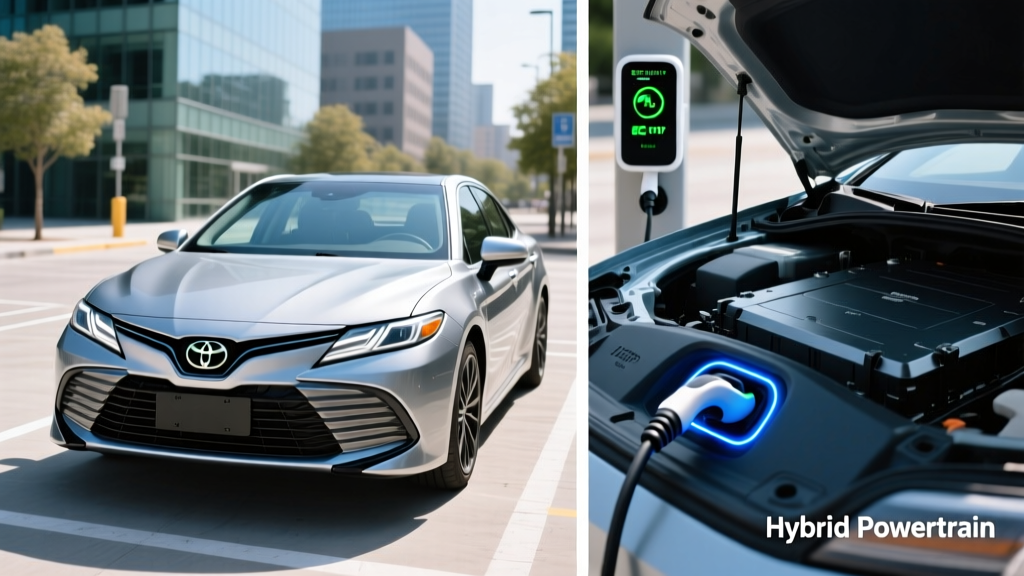
Starting with the ninth generation's mid-cycle refresh for the 2025 model year, Toyota eliminated the conventional gasoline-only four-cylinder Camry entirely. Every 2025 Toyota Camry sold in the United States is now a hybrid electric vehicle (HEV) — specifically, a self-charging conventional hybrid that requires no plug and no behavioral change from drivers accustomed to gas cars. Toyota's fifth-generation Hybrid System (THS 5) powers the entire lineup, paired with a 2.5-liter four-cylinder engine and one or two electric motors depending on drivetrain.
This is a significant shift. The previous-generation Camry offered both a 2.5L gas model and a hybrid variant. For 2025, the hybrid is the Camry. If you've been searching "are all 2025 Camrys hybrids," the answer is unambiguous: Toyota made the HEV powertrain standard and sole across every trim from LE to XSE.
Notably, the 2025 Camry is not a plug-in hybrid (PHEV). It has no charge port, no electric-only driving mode of meaningful distance, and no eligibility for the federal §30D new EV tax credit. It operates exactly like the Camry Hybrid has for years — the gasoline engine and regenerative braking charge a small traction battery, which assists acceleration and enables brief low-speed electric-only creeping. If you want plug-in capability in a Toyota sedan, you'd look at the Prius Prime.
2025 Camry Hybrid Powertrain: Engine, Motors, and Horsepower
The 2025 Camry uses Toyota's fifth-generation hybrid architecture, which is lighter, more compact, and more powerful than the outgoing THS 4 system. Here's how the powertrain breaks down by drivetrain configuration:
| Specification | FWD Models (LE, SE, XLE, XSE) | AWD Models (SE, XLE, XSE) |
|---|---|---|
| Engine | 2.5L DOHC 4-cylinder (A25A-FXS) | 2.5L DOHC 4-cylinder (A25A-FXS) |
| Engine Output | 184 hp / 163 lb-ft | 184 hp / 163 lb-ft |
| Front Electric Motor | 100 kW (134 hp) | 100 kW (134 hp) |
| Rear Electric Motor | None | 30 kW (40 hp) |
| Net Combined Horsepower | 225 hp | 232 hp |
| Transmission | eCVT (planetary gearset) | eCVT (planetary gearset) |
| 0–60 mph (est.) | ~7.2 sec | ~6.9 sec |
| Drivetrain | Front-wheel drive | Electronic on-demand AWD |
The AWD system doesn't use a mechanical driveshaft. Instead, the rear electric motor engages independently when the system detects slip or when additional traction is needed, operating at speeds up to about 43 mph before disengaging to prioritize efficiency. This is the same electronic AWD logic Toyota uses in the RAV4 Hybrid and Venza — proven and low-maintenance since there's no center differential or driveshaft to service.
The eCVT is not a belt-driven continuously variable transmission like those found in some competitors. It's a planetary gearset that blends engine and motor power with no belts, no cones, and no slippage. This is one reason Toyota hybrids have earned a reputation for powertrain longevity.
Fuel Economy: EPA MPG by Trim and Drivetrain
How many MPG does the 2025 Camry Hybrid get? The EPA rates the Camry Hybrid across a spread depending on trim, wheel size, and drivetrain. Here are the official figures from fueleconomy.gov:
| Trim / Drivetrain | City MPG | Highway MPG | Combined MPG |
|---|---|---|---|
| LE FWD | 53 | 50 | 51 |
| SE FWD | 48 | 47 | 47 |
| XLE FWD | 48 | 47 | 47 |
| XSE FWD | 48 | 47 | 47 |
| SE AWD | 46 | 46 | 46 |
| XLE AWD | 46 | 46 | 46 |
| XSE AWD | 44 | 43 | 44 |
The LE trim achieves its class-leading 53/50/51 MPG thanks to lighter weight, smaller 16-inch wheels with low-rolling-resistance tires, and the absence of sport-tuned suspension components that add mass and drag. Moving up to SE, XLE, or XSE with 18- or 19-inch wheels costs you roughly 4–7 MPG combined — still exceptional, but worth knowing if maximum efficiency is your priority.
Real-World MPG vs. EPA Sticker
Toyota hybrids consistently perform close to or slightly above their EPA city ratings in real-world driving, because stop-and-go traffic maximizes regenerative braking and electric-motor assist. On the highway, where the gasoline engine does most of the work, expect figures closer to the EPA highway number or slightly below at sustained 75–80 mph speeds.
In mixed suburban and city driving, owners of the current-generation Camry Hybrid LE frequently report 50–55 MPG on the trip computer over a tank. Cold weather (below 40°F) reduces efficiency by roughly 5–10% due to increased engine runtime for cabin heat and reduced battery efficiency. If you live in a northern climate, plan for winter combined MPG in the mid-to-upper 40s for the LE, and low-to-mid 40s for AWD trims.
With a 13.2-gallon fuel tank, the LE FWD delivers a theoretical range of roughly 670 miles per tank at combined EPA — one of the longest ranges of any non-diesel sedan on the market.
Hybrid Battery: Size, Chemistry, Warranty, and Replacement Cost
The 2025 Camry Hybrid uses a lithium-ion (Li-ion) traction battery pack, a change from the nickel-metal hydride (NiMH) batteries used in earlier Camry Hybrid generations. The Li-ion pack is smaller, lighter, and more energy-dense, contributing to the improved power output and fuel economy of the THS 5 system.
Toyota covers the hybrid battery and all hybrid system components (inverter, control module, electric motors) for 10 years or 150,000 miles, whichever comes first, on all 2020 and newer models. This applies to the original owner and is transferable to subsequent owners. Prior to 2020, the warranty was 8 years/100,000 miles in most states and 10 years/150,000 miles in CARB states.
Hybrid battery replacement cost for the Camry has historically ranged from $2,000 to $4,000 at a Toyota dealer depending on labor rates, with refurbished packs available for less. However, real-world data from fleet operators and long-term owners indicates that Toyota hybrid batteries routinely last well beyond 150,000 miles and often exceed 200,000 miles before significant capacity loss. The battery in a conventional hybrid like the Camry is relatively small (roughly 1.1–1.6 kWh usable) and operates within a narrow state-of-charge window — typically between 40% and 80% — which dramatically reduces degradation compared to a full EV battery that cycles through deeper discharge ranges.
The hybrid system's battery management computer is specifically designed to prevent the deep cycling that degrades lithium-ion cells. You'll never see the Camry Hybrid's battery indicator hit "empty" or "full" — those buffer zones are intentional and protective.
Does the 2025 Camry Hybrid Need to Be Plugged In?
No. The 2025 Camry Hybrid is a conventional HEV, not a plug-in hybrid. It has no charge port and no capability to accept external charging. The battery is charged exclusively through regenerative braking and the gasoline engine. You fuel it at a gas station exactly like any conventional car. This is a deliberate design: Toyota positions the Camry Hybrid for buyers who want hybrid efficiency without any charging infrastructure dependency.
HEV vs. PHEV vs. Full EV: Which Powertrain Fits You?
The 2025 Camry is only available as an HEV, but understanding where it sits in the electrification spectrum helps clarify whether it's the right choice for your situation:
| Factor | HEV (2025 Camry Hybrid) | PHEV (e.g., Prius Prime) | BEV (e.g., Tesla Model 3, Hyundai Ioniq 6) |
|---|---|---|---|
| Plug-in Required? | No | Yes (Level 1 or 2) | Yes (Level 2 or DCFC) |
| Electric-Only Range | ~1 mi at low speed | 32–44 mi (typical) | 250–360+ mi |
| Gasoline Required? | Yes (always) | Yes (after EV range) | No |
| Home Charging Needed? | No | Recommended | Essential |
| Federal Tax Credit (§30D) | Not eligible | Up to $3,750* | Up to $7,500* |
| Maintenance | Oil changes + standard | Oil changes + standard | Minimal (no oil, fewer fluids) |
| Best For | No home charging access, road-trip heavy | Home charging + short commute | Home charging + mostly electric |
*Federal §30D tax credit eligibility depends on buyer income caps, vehicle MSRP caps, battery component sourcing, and critical mineral requirements per IRS guidelines. Consult a tax professional for your specific situation. Conventional HEVs like the Camry Hybrid do not qualify for §30D.
- You lack access to home or workplace charging
- You regularly take long road trips and don't want to plan around chargers
- You want maximum fuel efficiency with zero lifestyle change
- You live in an apartment or condo where installing a Level 2 charger is impractical
- You have reliable home Level 2 charging and a commute under 40 miles
- You want to drive primarily on electricity and reduce gasoline consumption further
- You want to access HOV lane privileges or federal/state EV incentives
2025 Camry Hybrid Pricing by Trim
Toyota prices the 2025 Camry Hybrid starting at roughly $28,700 for the LE FWD, with the range-topping XSE AWD reaching approximately $36,500 before options and destination charges (destination fee is approximately $1,135). Here's the approximate MSRP breakdown by trim:
- LE FWD: ~$28,700
- LE AWD: ~$30,200
- SE FWD: ~$30,900
- SE AWD: ~$32,400
- XLE FWD: ~$33,200
- XLE AWD: ~$34,700
- XSE FWD: ~$34,500
- XSE AWD: ~$36,000
These are starting MSRPs. Packages such as the available panoramic roof, JBL audio, and advanced navigation can add $1,500–$3,500. Check with your local dealer for actual transaction prices, which may vary based on regional demand and incentives.
Does the 2025 Camry Hybrid Qualify for Any Tax Credit?
The 2025 Camry Hybrid does not qualify for the federal §30D Clean Vehicle Credit, which applies only to plug-in electric vehicles (PHEVs and BEVs) with a minimum battery capacity of 7 kWh and external charging capability. The Camry Hybrid's battery is well below that threshold, and it cannot be plugged in.
Some states and local utilities offer rebates or incentives for conventional hybrids, but these vary widely by jurisdiction and are often modest ($250–$500) compared to EV incentives. Check your state's energy office or your utility provider's website for current programs.
Pros and Cons of the All-Hybrid 2025 Camry Lineup
Pros
- Class-leading 51 MPG combined (LE FWD) — among the most efficient non-plug-in sedans available
- No charging infrastructure required — fuel at any gas station
- 10-year/150,000-mile hybrid battery warranty
- Proven THS reliability with decades of real-world data
- Standard Toyota Safety Sense 3.0 (adaptive cruise, lane-keeping, AEB)
- AWD availability across sport and luxury trims
- 670+ mile total range per tank (LE)
- Strong resale value — Camry Hybrid historically retains value well
Cons
- No plug-in hybrid variant — cannot drive meaningful distances on electricity alone
- No federal tax credit eligibility
- AWD trims lose 5–7 MPG combined versus LE FWD
- eCVT drone under hard acceleration (inherent to planetary gearset under load)
- Sport trims (SE/XSE) sacrifice efficiency for styling and larger wheels
- Rear seat space slightly reduced vs. some midsize competitors
- No manual or traditional automatic transmission option
Reliability and Long-Term Ownership Outlook
Toyota's hybrid system is one of the most thoroughly validated powertrains in automotive history. The Prius, which shares core THS architecture with the Camry Hybrid, has been in global production since 1997, with well over 20 million Toyota hybrids sold worldwide. Taxi fleets using Toyota hybrids have logged individual vehicles past 300,000 miles on the original hybrid battery.
The 2025 Camry Hybrid's A25A-FXS engine uses the Atkinson cycle, which reduces thermal stress and contributes to longevity. There's no turbocharger, no high-pressure fuel system, and no conventional automatic transmission — all common failure points in non-hybrid vehicles. The eCVT planetary gearset has no wearable friction components like clutch packs or bands.
According to IIHS, the Camry continues to earn top safety ratings, and Toyota Safety Sense 3.0 is standard on every trim — including pre-collision braking with pedestrian detection, full-speed adaptive cruise control, lane departure alert with steering assist, and automatic high beams. These are Level 1 driver-assistance features per SAE classification and require full driver engagement at all times.
For buyers weighing long-term cost of ownership, the Camry Hybrid's fuel savings over a comparable non-hybrid midsize sedan are substantial. At $3.50/gallon and 15,000 miles per year, a 51 MPG Camry Hybrid LE uses roughly $1,029 in fuel annually, compared to approximately $1,750 for a 30 MPG gas-only midsize sedan — a savings of about $720 per year, or $3,600 over five years.
Frequently Asked Questions
Are all 2025 Camrys hybrids?
Yes. Toyota discontinued the gasoline-only Camry for the 2025 model year. Every 2025 Camry uses the fifth-generation Toyota Hybrid System with a 2.5-liter four-cylinder engine and electric motor(s). The conventional gas Camry is no longer available.
Can I plug in the 2025 Camry Hybrid to charge it?
No. The 2025 Camry Hybrid is a conventional hybrid (HEV), not a plug-in hybrid (PHEV). It has no charge port. The battery charges itself through regenerative braking and the gasoline engine. You refuel it at a gas station like any conventional car.
How far can the 2025 Camry Hybrid go on electric only?
Effectively zero meaningful distance. The Camry Hybrid can creep at very low speeds (under ~25 mph) on electric power for roughly one mile or less, but the gasoline engine starts frequently. This is normal for conventional hybrids — the electric motor assists the engine rather than replacing it. If you need true electric-only driving, consider a PHEV like the Prius Prime (up to 44 miles EV range) or a full BEV.
Is the hybrid battery expensive to replace?
A new OEM hybrid battery for the Camry typically costs $2,000–$4,000 installed at a dealer. However, Toyota hybrid batteries routinely last 150,000–200,000+ miles thanks to the system's conservative charge-window management. The 10-year/150,000-mile warranty provides substantial coverage. Refurbished and aftermarket replacement batteries are also available for less.
Does the 2025 Camry Hybrid qualify for a federal tax credit?
No. The federal §30D Clean Vehicle Credit requires plug-in capability and a minimum battery capacity of 7 kWh. The Camry Hybrid meets neither requirement. Only PHEVs and BEVs qualify. Some states or utilities may offer small hybrid incentives — check your local programs.
Is AWD worth the MPG trade-off on the Camry Hybrid?
The AWD Camry Hybrid loses about 5–7 MPG combined compared to the FWD LE. If you live in a region with frequent snow, ice, or rain, the electronic on-demand AWD provides meaningful traction benefits for a modest efficiency cost. The AWD system adds a 40 hp rear electric motor with no mechanical driveshaft, so there's no additional drivetrain maintenance. For dry-climate drivers, FWD offers the best fuel economy.
How does the 2025 Camry Hybrid compare to the Honda Accord Hybrid?
The 2025 Accord Hybrid is rated at 48 MPG combined (Sport/LX trims) to the Camry Hybrid LE's 51 MPG combined. Both are excellent, but the Camry LE edges out the Accord by 3 MPG on the combined cycle. The Accord Hybrid offers a slightly more powerful system (204 hp combined) and a more traditional driving feel, while the Camry Hybrid prioritizes maximum efficiency in the LE trim. Both carry strong reliability reputations and similar hybrid battery warranties.