Does Acura Make a Plug-In Hybrid? The 2026 MDX Type S PHEV
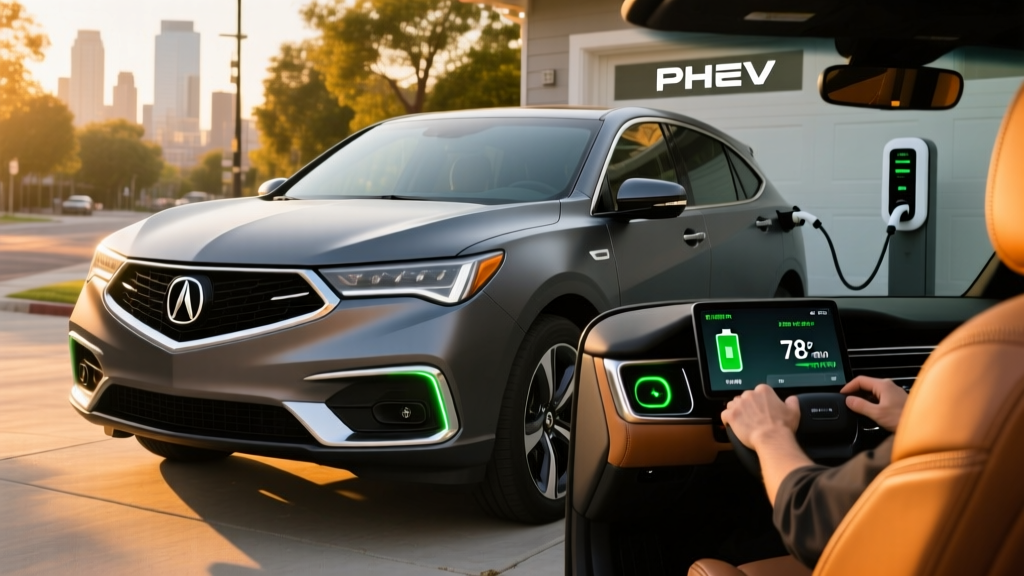
Acura's electrification strategy has been measured, but the automaker now offers a compelling entry in the luxury plug-in hybrid segment: the 2026 Acura MDX Type S PHEV. For buyers searching for an Acura plug-in hybrid, this three-row luxury SUV is currently the brand's sole PHEV offering in the U.S. market, blending a turbocharged V6 with a meaningful electric-only driving range and the cargo versatility that families demand.
Unlike a conventional hybrid (HEV) that you simply fuel with gasoline, a plug-in hybrid (PHEV) carries a larger battery that you charge from a wall outlet or Level 2 charger, enabling a stretch of zero-tailpipe-emission driving before the gas engine seamlessly takes over. The MDX Type S PHEV targets buyers who want electric commuting during the week but need the range and flexibility of a gasoline engine for road trips — without the charging-infrastructure dependence of a full battery-electric vehicle (BEV).
HEV vs. PHEV: What's the Difference?
| Feature | Conventional Hybrid (HEV) | Plug-In Hybrid (PHEV) |
|---|---|---|
| Plugs in to charge? | No — charges via regenerative braking and engine | Yes — Level 1 (120V) or Level 2 (240V) |
| Battery size | ~1–2 kWh | ~15–25 kWh |
| Electric-only range | None (electric assist only) | 20–50 miles typical |
| Federal tax credit | Not eligible under §30D | Up to $7,500 (eligibility varies) |
| Best for | Drivers without home charging access | Drivers with home/workplace charging and short commutes |
The conventional Acura MDX (non-hybrid) uses a standard 3.5L V6 or the Type S's 3.0L turbo V6 without any plug-in capability. The MDX Type S PHEV is a fundamentally different powertrain architecture — don't confuse the two at the dealership.
2026 Acura MDX Type S PHEV: Core Specifications
| Specification | 2026 MDX Type S PHEV |
|---|---|
| Powertrain | 3.0L turbocharged V6 + dual electric motors (front P2 + rear P4) |
| Combined System Output | ~415 hp / 472 lb-ft torque (est.) |
| Battery Capacity | ~18.0 kWh usable (lithium-ion, NMC chemistry) |
| EPA Electric-Only Range | ~33 miles (est.) |
| Total Combined Range | ~430 miles (est.) |
| EPA MPG (Hybrid Mode) | ~24 city / 27 hwy / 25 combined (est.) |
| MPGe (Electric + Gas) | ~56 MPGe combined (est.) |
| Level 2 Charging (240V, 7.2 kW) | ~2.5 hours (0–100%) |
| Level 1 Charging (120V, 1.4 kW) | ~13 hours (0–100%) |
| DC Fast Charging | Not available |
| Drivetrain | SH-AWD (Super Handling All-Wheel Drive) |
| 0–60 mph | ~5.5 seconds (est.) |
| Towing Capacity | 5,000 lbs (est.) |
| Seating | 7 passengers (3 rows) |
| Starting MSRP | ~$73,000 (est., before incentives) |
Note: 2026 model-year specifications are based on Acura's announced powertrain details and may differ from final EPA certification. Always verify with fueleconomy.gov and Acura's official site before purchase.
Electric-Only Range and Real-World Efficiency
The headline figure for any Acura plug-in hybrid buyer is electric-only range. The 2026 MDX Type S PHEV's estimated ~33 miles of all-electric driving covers a significant share of daily commutes. According to the U.S. Department of Transportation, the average American one-way commute is approximately 16 miles — meaning many PHEV owners can complete their daily round trip without burning a drop of gasoline, provided they charge at home overnight.
Real-World Range vs. EPA Estimate
EPA electric range: ~33 miles
Real-world expectation: Expect 27–30 miles in mild weather with mixed city/highway driving. In cold weather (below 32°F), battery efficiency drops and cabin heating draws additional energy — plan for 20–24 miles of electric range. Highway-speed driving (70+ mph) also reduces electric range due to aerodynamic drag.
Gas-engine range after battery depletion: ~395+ miles on the ~18.5-gallon fuel tank, yielding a combined total range exceeding 430 miles.
Once the battery depletes, the MDX Type S PHEV operates as a conventional hybrid, using regenerative braking and the engine to manage the remaining small battery buffer. The estimated 25 MPG combined in hybrid mode is competitive for a 5,000-pound luxury SUV, though it trails lighter PHEV crossovers like the Toyota RAV4 Prime (38 MPG combined in hybrid mode).
Where PHEVs shine is in city driving under electric power. Electric motors deliver instant torque with zero engine noise, and regenerative braking recaptures energy at every stoplight. If your commute is within the electric range and you charge nightly, your effective "fuel cost" drops to your local electricity rate — typically $0.12–$0.18 per kWh, or roughly $2.16–$3.24 for a full 18 kWh charge that delivers ~33 miles of driving.
Charging the MDX PHEV: What You Need at Home
The 2026 MDX Type S PHEV uses a standard J1772 connector for AC charging. Here's what charging looks like in practice:
| Charging Level | Power (kW) | 0–100% Time | Miles of Range per Hour |
|---|---|---|---|
| Level 1 (120V household outlet) | ~1.4 kW | ~13 hours | ~2.5 mi/hr |
| Level 2 (240V, 32A home charger) | ~7.2 kW | ~2.5 hours | ~13 mi/hr |
| DC Fast Charging | Not supported | N/A | N/A |
Key distinction — kW vs. kWh: Kilowatts (kW) measure charging power (the rate of energy flow), while kilowatt-hours (kWh) measure battery energy capacity (the total fuel in the tank). The MDX PHEV's ~18 kWh battery charged at 7.2 kW fills in roughly 2.5 hours.
Most PHEV owners find Level 2 home charging ideal. A 240V Level 2 charger (such as a ChargePoint Home Flex or Emporia V2) installed on a 40A circuit delivers 7.2 kW — more than enough to fully recharge the MDX PHEV overnight. Professional installation of a Level 2 home charger typically costs $500–$1,500 depending on your electrical panel's capacity and the distance from panel to charger location. If your home has a 200A panel with spare capacity, the install is straightforward. Older homes with 100A panels may need a panel upgrade ($1,500–$3,000) to support both a PHEV charger and existing loads.
Level 1 charging from a standard 120V outlet is viable if your daily electric driving is under 15 miles — you'll recover roughly 25 miles of range during a 10-hour overnight plug-in. It's slow but free if you already have an outlet near your parking spot.
The absence of DC fast charging is typical for PHEVs. The battery is small enough that Level 2 fills it quickly, and adding DC fast-charge hardware would increase cost and weight for a feature most PHEV owners rarely need.
Pricing, Trims, and Federal Tax Credit Eligibility
The 2026 Acura MDX Type S PHEV is positioned at the top of the MDX lineup, with an estimated starting MSRP around $73,000. Acura typically packages the PHEV powertrain exclusively in the Type S trim, which includes performance-tuned air suspension, larger brakes, upgraded interior materials, and the full AcuraWatch suite of driver-assistance features.
Federal §30D Tax Credit: Does the MDX PHEV Qualify?
Under current IRS rules (IRS §30D), plug-in hybrids with sufficient battery capacity can qualify for up to $7,500 in federal tax credits — but eligibility is complex and depends on several factors:
- ✓ Battery capacity: Must be ≥7 kWh — the MDX PHEV's ~18 kWh battery clears this easily.
- ✓ MSRP cap: SUVs must have an MSRP ≤$80,000. At ~$73,000, the MDX PHEV should qualify, but fully loaded examples with options could approach the cap.
- ⚠ Buyer income limits: Modified AGI must not exceed $150,000 (single), $225,000 (head of household), or $300,000 (joint). Exceed these and you're ineligible.
- ⚠ Battery component sourcing: A percentage of battery components must be manufactured or assembled in North America, and critical minerals must be sourced from the U.S. or free-trade-agreement partners. These thresholds tighten annually. Verify the MDX PHEV's current sourcing compliance on the IRS qualified vehicle list before purchase.
- ✓ Point-of-sale transfer: As of 2024+, eligible buyers can transfer the credit to the dealer for an immediate price reduction at purchase, rather than waiting to claim it on their tax return.
Critical caveat: Battery sourcing requirements have disqualified several previously eligible PHEVs in recent years. Always check the latest IRS qualified vehicles list and consult a tax professional before relying on the credit in your purchase decision.
Battery Warranty, Reliability, and Long-Term Costs
Acura Hybrid Battery Warranty
Coverage: 8 years / 100,000 miles (10 years / 150,000 miles in CARB states including California, New York, Massachusetts, and others)
What's covered: Battery capacity loss below a specified threshold (typically 60–70% of original capacity) and defects in the hybrid system including electric motors, inverter, and control electronics.
Replacement cost if out of warranty: PHEV battery pack replacement typically ranges from $6,000–$12,000 depending on parts and labor. However, modern lithium-ion PHEV batteries are engineered to last the life of the vehicle with minimal degradation — most owners never face this cost.
Acura's hybrid system benefits from Honda's deep experience with electrified powertrains dating back to the original Insight. The MDX PHEV's battery management system keeps the pack within an optimal state-of-charge window (never truly 0% or 100% at the cell level), which significantly extends cycle life. Real-world data from similar Honda/Acura hybrid systems shows battery degradation of roughly 5–10% over 100,000 miles — far less than early-generation PHEVs.
For reliability, Acura as a brand consistently ranks in the upper tier of J.D. Power and Consumer Reports dependability studies. The SH-AWD system is proven across the MDX and TLX lineups, and the addition of electric motors adds fewer moving parts than a conventional transmission. Expect standard maintenance (brake fluid, cabin filters, tire rotation) to be lower-cost than a gas-only MDX thanks to regenerative braking reducing brake wear.
Hybrid vs. PHEV vs. Full EV: Which Acura Is Right for You?
Acura's current U.S. lineup includes the gas-only MDX, the MDX Type S PHEV, and the fully electric ZDX (built on GM's Ultium platform). Here's a decision framework:
Choose the MDX Type S PHEV If:
- You have access to Level 1 or Level 2 charging at home or work
- Your daily commute is under 30 miles round-trip (you'll rarely use gas on weekdays)
- You regularly take road trips exceeding 300 miles and don't want to plan around charging stops
- You want three-row SUV space with the lowest possible tailpipe emissions for daily driving
- You live in an area with limited DC fast-charging infrastructure
Choose the Acura ZDX (Full EV) If:
- You have reliable Level 2 home charging and your daily driving is under 250 miles
- You want to eliminate gasoline costs entirely and minimize maintenance
- You're comfortable with route planning for longer road trips using DC fast chargers
- You want maximum federal/state incentives and the lowest per-mile fuel cost
Choose the Gas-Only MDX If:
- You have no access to home or workplace charging
- Your budget is tighter (gas MDX starts ~$20,000 less than the PHEV)
- You primarily drive long highway miles where PHEV electric-range advantage is minimal
How the Acura MDX PHEV Compares to Rivals
The luxury PHEV SUV segment is competitive. Here's how the MDX Type S PHEV stacks up against key alternatives:
| Model | Est. EV Range | Combined MPG (Hybrid) | Combined HP | Est. MSRP |
|---|---|---|---|---|
| Acura MDX Type S PHEV | ~33 mi | ~25 MPG | ~415 hp | ~$73,000 |
| BMW X5 xDrive50e | ~38 mi | ~24 MPG | 483 hp | ~$75,000 |
| Volvo XC90 Recharge | ~33 mi | ~27 MPG | 455 hp | ~$78,000 |
| Lincoln Aviator Grand Touring | ~21 mi | ~23 MPG | 494 hp | ~$72,000 |
| Jeep Grand Cherokee 4xe | ~26 mi | ~23 MPG | 375 hp | ~$62,000 |
The MDX PHEV's combination of SH-AWD, Type S performance tuning, and three-row practicality occupies a distinct niche. The BMW X5 offers slightly more electric range and power but lacks a third row. The Volvo XC90 Recharge matches electric range but commands a higher price. The Aviator's shorter electric range is a drawback for commute-heavy drivers.
Pros and Cons of the Acura MDX Type S PHEV
Pros
- ~33 miles of electric-only range covers most daily commutes
- 430+ miles total range eliminates road-trip range anxiety
- SH-AWD with torque-vectoring rear axle for confident handling
- Three-row seating for 7 passengers — rare in the PHEV segment
- Strong Type S performance (~415 hp combined)
- Potential $7,500 federal tax credit (verify eligibility)
- 8-year/100,000-mile hybrid battery warranty
- Regenerative braking extends brake life
Cons
- High starting price (~$73,000) vs. gas-only MDX (~$52,000)
- No DC fast charging — fine for PHEV, but limits public charging utility
- Heavy curb weight (~5,200 lbs) impacts hybrid-mode MPG
- Tax credit eligibility uncertain due to battery sourcing rules
- Third-row space is tight for adults on long trips
- Cargo volume reduced vs. non-PHEV MDX (battery packaging)
- Level 1 charging is impractically slow for full battery replenishment
- Premium fuel recommended for the turbocharged V6
Frequently Asked Questions
How many MPG does the Acura MDX plug-in hybrid get?
Once the battery is depleted and the MDX PHEV operates in hybrid mode, it returns an estimated 24 city / 27 highway / 25 combined MPG. When factoring in electric-only driving, the combined MPGe rating is estimated at ~56 MPGe. For comparison, the gas-only MDX Type S returns 19 city / 25 highway / 21 combined MPG — so the PHEV delivers meaningful fuel savings even after the battery is empty.
How far can the Acura MDX PHEV go on electric only?
The EPA-estimated electric-only range is approximately 33 miles. In real-world conditions, expect 27–30 miles in mild weather and 20–24 miles in freezing temperatures due to battery efficiency loss and cabin heating demand. This range is sufficient for most daily commutes when charged nightly at home.
Does the Acura MDX PHEV qualify for a federal tax credit?
It may qualify for up to $7,500 under IRS §30D, but eligibility depends on the buyer's income (≤$300,000 joint AGI), the vehicle's MSRP (≤$80,000 for SUVs), and battery component/critical-mineral sourcing requirements that tighten each year. The credit can be applied at the point of sale as an immediate discount. Always check the current IRS qualified vehicle list before purchasing.
Is the Acura MDX PHEV reliable, and what does battery replacement cost?
Acura (and parent company Honda) has a strong reliability track record with hybrid powertrains. The MDX PHEV's hybrid battery is covered by an 8-year/100,000-mile warranty (10 years/150,000 miles in CARB states). Out-of-warranty battery replacement would cost an estimated $6,000–$12,000, but modern PHEV batteries are designed to last 150,000+ miles with minimal degradation. Most owners will never need a replacement.
Do I need to install a special charger at home for the MDX PHEV?
You can charge on a standard 120V household outlet (Level 1), but it takes ~13 hours for a full charge. For practical daily use, a 240V Level 2 home charger (7.2 kW) is recommended, filling the battery in about 2.5 hours. Professional installation costs $500–$1,500 for most homes with adequate electrical panel capacity. A licensed electrician should evaluate your panel before installation.
How does the MDX PHEV compare to a full EV like the Acura ZDX?
The ZDX offers ~300 miles of all-electric range and eliminates gasoline entirely, but requires DC fast-charging access for road trips and a higher upfront investment in home charging infrastructure. The MDX PHEV offers the flexibility of electric commuting plus a gas engine for long trips — ideal if you lack reliable fast-charging access along your common routes or frequently drive to areas with sparse charging networks.
Can the Acura MDX PHEV tow?
Yes. The MDX Type S PHEV is estimated to tow up to 5,000 pounds when properly equipped, matching the gas-only MDX. Note that towing significantly reduces both electric-only range and hybrid-mode fuel economy — expect electric range to drop to 15–20 miles and hybrid MPG to fall to ~18–20 when pulling a trailer.