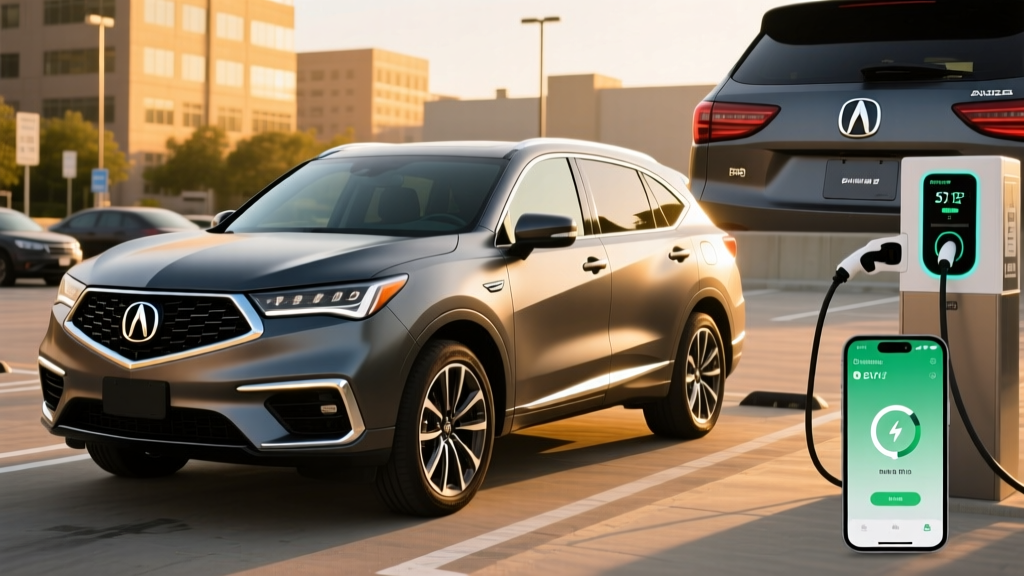
Quick Verdict: The Acura Hybrid MDX at a Glance
The 2026 Acura MDX Hybrid pairs a turbocharged V6 with a dual-motor hybrid system to deliver meaningful fuel economy gains over its gasoline-only sibling — without requiring a plug, a lifestyle change, or range anxiety. For luxury three-row SUV buyers who want electrified efficiency without the charging infrastructure demands of a full EV or plug-in hybrid, the MDX Hybrid occupies a pragmatic middle ground.
This guide breaks down exactly what the Acura hybrid MDX delivers in fuel economy, powertrain capability, battery longevity, and ownership cost — so you can decide whether it fits your garage better than a PHEV or a battery-electric rival.
| Attribute | 2026 Acura MDX Hybrid (HEV) |
|---|---|
| Powertrain | 3.5L V6 + dual-motor hybrid system |
| Combined Horsepower | ~355 hp (est.) |
| EPA MPG (City / Hwy / Combined) | 28 / 27 / 28 MPG (est.) |
| Drivetrain | SH-AWD (torque-vectoring AWD) |
| Battery Type | Lithium-ion hybrid pack (~1.5–2.0 kWh) |
| Plug-In Required? | No — self-charging HEV |
| 0–60 mph | ~5.8 seconds (est.) |
| Seating | 7-passenger, 3 rows |
| Starting MSRP | ~$58,000 (est.) |
| Hybrid Battery Warranty | 8 years / 100,000 miles |
Note: Acura has not yet released a plug-in hybrid (PHEV) version of the MDX as of the 2026 model year. This guide focuses on the conventional hybrid (HEV) variant and explains why a PHEV option may or may not matter for your use case.
How Many MPG Does the Acura Hybrid MDX Get?
The headline number for any hybrid buyer is fuel economy. The 2026 Acura MDX Hybrid is estimated to return 28 MPG combined (28 city / 27 highway) based on the hybridized V6 powertrain's efficiency profile and Acura's SH-AWD system. For context, the gas-only 2026 MDX with the standard V6 and AWD returns approximately 21 MPG combined (19 city / 25 highway), according to fueleconomy.gov.
| Model | City MPG | Highway MPG | Combined MPG |
|---|---|---|---|
| 2026 MDX Hybrid (SH-AWD, est.) | 28 | 27 | 28 |
| 2026 MDX Gas (V6, SH-AWD) | 19 | 25 | 21 |
| 2026 MDX Type S (Turbo V6, SH-AWD) | 17 | 21 | 19 |
That's a roughly 33% improvement in combined fuel economy over the gas-only model, with the largest gains coming in city driving where the hybrid system's electric motors handle low-speed propulsion and regenerative braking recaptures energy during stop-and-go traffic.
Real-World MPG vs. EPA Estimates
Conventional hybrids like the MDX Hybrid frequently exceed their EPA city estimates in real-world driving because regenerative braking is most effective in urban conditions. On the highway, where the gasoline engine does most of the work at sustained speeds, real-world figures tend to track closely with — or slightly below — EPA highway numbers.
Expect the MDX Hybrid to deliver:
- City driving: 28–31 MPG (regen braking boosts efficiency)
- Highway cruising (70–75 mph): 25–27 MPG
- Cold weather (below 30°F): 24–26 MPG combined (engine runs more for cabin heat and battery warming)
- Towing (3,500-lb max): 16–19 MPG
Annual fuel cost at 15,000 miles/year and $3.50/gallon: approximately $1,875 for the hybrid versus $2,500 for the gas V6 — a savings of roughly $625 per year, or $3,125 over five years.
Hybrid (HEV) vs. Plug-In Hybrid (PHEV): What's the Difference?
A common source of confusion among luxury SUV shoppers is the distinction between a conventional hybrid and a plug-in hybrid. The 2026 Acura hybrid MDX is a conventional hybrid (HEV). Here's what that means in practice:
| Feature | Conventional Hybrid (HEV) | Plug-In Hybrid (PHEV) |
|---|---|---|
| Plugs into a charger? | No — charges via engine & regen | Yes — Level 1 or Level 2 |
| Battery size | ~1.5–2.0 kWh | ~15–25 kWh |
| Electric-only range | None (EV assist only at low speed) | 25–50 miles typical |
| Federal tax credit | Not eligible (§30D is for PHEVs/EVs only) | Up to $7,500 (if eligible) |
| Charging infrastructure needed | None | Home Level 2 recommended |
| Best for | Drivers without reliable plug access | Drivers with home charging & short commutes |
Acura does not currently offer a PHEV version of the MDX. If plug-in capability is a priority for your three-row luxury SUV, competitors like the Volvo XC90 Recharge (PHEV, ~35 miles electric-only range) or the BMW X5 xDrive50e (PHEV, ~38 miles electric-only) are the closest alternatives in this segment.
Powertrain Deep Dive: V6 Meets Dual-Motor Hybrid
The 2026 MDX Hybrid's powertrain combines Acura's proven 3.5-liter V6 engine with a dual-motor hybrid module integrated into the transmission. The system operates in several modes seamlessly managed by the vehicle's powertrain control unit:
- EV Drive: At low speeds and light loads, the electric motors propel the vehicle using stored battery energy — typically up to 1–2 miles at parking-lot speeds before the engine engages.
- Hybrid Drive: The engine and motors work together for acceleration and moderate-speed cruising, with the engine operating in its most efficient RPM range.
- Engine Drive: At steady highway speeds, the gasoline engine directly drives the wheels via a lockup clutch, bypassing the hybrid system for maximum mechanical efficiency.
- Regenerative Braking: During deceleration, the electric motors act as generators, converting kinetic energy back into stored battery energy.
The estimated 355 combined horsepower gives the MDX Hybrid confident acceleration — the electric motors provide instant torque fill at low RPMs, eliminating the lag typically associated with larger V6 engines. The SH-AWD (Super Handling All-Wheel Drive) system uses a rear-mounted electric motor to independently torque-vector the rear wheels, improving cornering grip and stability beyond what a mechanical AWD system can deliver.
Battery Warranty, Longevity, and Replacement Cost
Hybrid battery reliability is consistently the top concern for first-time hybrid buyers. Here's what you need to know about the MDX Hybrid's battery system:
Acura Hybrid Battery Warranty
- Coverage: 8 years / 100,000 miles (whichever comes first)
- Extended in CARB states: 10 years / 150,000 miles in states that follow California Air Resources Board emissions rules (CA, CO, CT, DE, ME, MD, MA, NJ, NY, OR, RI, VT, WA, and others adopting CARB standards)
- What's covered: Battery capacity loss below a defined threshold (typically 60–70% of original capacity), cell failures, and hybrid system component defects
Real-World Hybrid Battery Lifespan
Modern lithium-ion hybrid batteries in vehicles like the MDX Hybrid are engineered to last the life of the vehicle under normal use. Unlike full EV batteries that cycle through large state-of-charge swings, hybrid batteries operate in a narrow charge window (roughly 40–80% SoC), which dramatically reduces chemical stress and degradation.
Data from Honda/Acura hybrid platforms (which share architecture) shows hybrid battery packs routinely lasting 150,000–200,000+ miles before any significant capacity loss. Failures within the warranty period are uncommon, and when they do occur, they're covered.
Battery Replacement Cost
If the hybrid battery does require replacement outside of warranty coverage, expect:
- OEM replacement pack: $3,000–$5,000 (parts + labor at an Acura dealer)
- Refurbished/aftermarket pack: $1,500–$3,000
- Individual cell module replacement: $500–$1,500 (if only one or two modules are degraded — a specialist hybrid shop can diagnose and replace individual cells)
For comparison, a full EV battery replacement (e.g., a 75–100 kWh pack) runs $10,000–$20,000+. The MDX Hybrid's small battery keeps this worst-case cost manageable.
Pricing, Trims, and Tax Credit Eligibility
The 2026 Acura MDX Hybrid is expected to start at approximately $58,000 MSRP for the base Technology trim, with the A-Spec and Advance trims climbing to $63,000–$68,000. These estimates position the MDX Hybrid at a $3,000–$5,000 premium over equivalent gas-only trims — a gap that fuel savings can close within 5–7 years of average driving.
Does the Acura Hybrid MDX Qualify for a Federal Tax Credit?
No. The federal §30D Clean Vehicle Credit, as defined by the IRS, applies only to plug-in electric vehicles (BEVs and PHEVs) with a minimum battery capacity of 7 kWh that can be recharged from an external power source. Because the MDX Hybrid is a conventional HEV with a small self-charging battery, it does not qualify for the federal credit.
Additionally, conventional hybrids are not eligible for most state EV rebates or HOV lane access programs that specifically require plug-in capability. However, some states and local utilities offer modest incentives for any electrified vehicle purchase — check your state's energy office or utility provider for details.
§30D Federal Tax Credit — Quick Eligibility Checklist
The MDX Hybrid (HEV) does NOT qualify. For reference, here's what vehicles do need to meet:
- Must be a plug-in BEV or PHEV with ≥7 kWh battery
- MSRP cap: $80,000 for SUVs/vans/pickups; $55,000 for sedans
- Buyer income cap: $300,000 (joint), $225,000 (HoH), $150,000 (single)
- Battery components and critical minerals must meet phased-in domestic sourcing requirements
- Credit can be transferred to the dealer at point of sale for an upfront price reduction
Acura Hybrid MDX vs. Full EV vs. Gas: Which Should You Choose?
The decision between a hybrid, plug-in hybrid, full EV, or gas-only SUV depends on your driving patterns, charging access, and budget. Here's a practical framework:
Choose the Acura Hybrid MDX (HEV) if:
- You don't have reliable access to home or workplace charging
- You want better fuel economy without changing your fueling habits
- You frequently take long road trips and don't want to plan around charging stops
- You want a three-row luxury SUV with lower running costs and no range anxiety
- You plan to keep the vehicle 8+ years and want proven hybrid reliability
Choose a PHEV SUV (Volvo XC90 Recharge, BMW X5 xDrive50e) if:
- You have Level 2 home charging and a commute under 35 miles
- You want to drive on electricity most weekdays but need gas flexibility for road trips
- You want to qualify for the $7,500 federal tax credit (subject to eligibility)
Choose a full EV (Tesla Model X, Rivian R1S, BMW iX) if:
- You have reliable home charging and your daily driving is under 250 miles
- You want zero tailpipe emissions and the lowest per-mile fuel cost
- You're comfortable with DC fast charging on road trips and potential cold-weather range loss
Choose the gas-only MDX if:
- Upfront cost is your primary concern (gas trims start ~$3,000–$5,000 lower)
- You drive fewer than 8,000 miles per year (fuel savings won't offset the hybrid premium)
Pros and Cons of the Acura Hybrid MDX
Pros
- ~33% fuel economy improvement over gas V6 MDX with no plug-in required
- SH-AWD torque vectoring enhances handling and all-weather confidence
- Instant electric torque fill makes acceleration feel responsive and smooth
- 8-year/100,000-mile hybrid battery warranty (10yr/150k in CARB states)
- Three-row seating for 7 with no packaging compromise from a large battery
- No charging infrastructure or lifestyle change required
- Proven Honda/Acura hybrid system reliability over hundreds of thousands of fleet miles
Cons
- No electric-only driving range — always uses gasoline
- Does not qualify for the $7,500 federal §30D tax credit
- $3,000–$5,000 price premium over gas-only trims
- No PHEV variant available — competitors like Volvo and BMW offer plug-in options
- Real-world highway MPG gains are smaller than city MPG gains
- Towing capacity may be slightly reduced vs. gas model (hybrid thermal management limits)
Frequently Asked Questions
How many MPG does the 2026 Acura Hybrid MDX get?
The 2026 Acura MDX Hybrid is estimated to achieve 28 MPG combined (28 city / 27 highway). In real-world city driving with frequent stops, owners may see 29–31 MPG thanks to aggressive regenerative braking. Highway cruising at 75 mph typically yields 25–27 MPG.
Does the Acura MDX Hybrid need to be plugged in?
No. The MDX Hybrid is a conventional hybrid (HEV) that charges its battery through regenerative braking and the gasoline engine. There is no plug, no charging cable, and no need for home charging infrastructure.
Is there a plug-in hybrid (PHEV) version of the Acura MDX?
As of the 2026 model year, Acura does not offer a PHEV variant of the MDX. If plug-in hybrid capability is essential, look at the Volvo XC90 Recharge (~35 miles electric-only) or the BMW X5 xDrive50e (~38 miles electric-only) as alternatives.
Is the Acura Hybrid MDX reliable, and what does battery replacement cost?
Acura's hybrid systems share architecture with Honda's extensively proven hybrid platforms, which have demonstrated strong reliability over 150,000–200,000+ miles. The hybrid battery is warrantied for 8 years/100,000 miles (10 years/150,000 miles in CARB states). Out-of-warranty replacement runs $3,000–$5,000 for an OEM pack, or $1,500–$3,000 for a refurbished unit.
Does the Acura Hybrid MDX qualify for any tax credit?
The MDX Hybrid does not qualify for the federal §30D Clean Vehicle Credit because it is a conventional hybrid, not a plug-in vehicle. Some state or utility incentives for fuel-efficient vehicles may apply — check your local programs. The IRS clean vehicle credits page details which vehicle types are eligible.
How does the MDX Hybrid compare to a full EV like the Tesla Model X?
The MDX Hybrid offers a more gradual step toward electrification: better fuel economy with zero lifestyle change. The Model X delivers far lower per-mile energy costs (roughly $0.04/mile on electricity vs. $0.13/mile on gas for the hybrid), access to the Supercharger network, and federal tax credit eligibility — but requires home charging access, planning for road-trip charging, and acceptance of cold-weather range loss (typically 20–30% in sub-freezing temperatures).
What is the hybrid battery warranty on the Acura MDX Hybrid?
Acura covers the hybrid battery for 8 years or 100,000 miles, whichever comes first. In states that follow California Air Resources Board (CARB) emissions standards — including California, New York, Massachusetts, Washington, and several others — coverage extends to 10 years or 150,000 miles. This warranty covers battery capacity loss below a defined threshold and hybrid system component failures.
Final Word: Who Should Buy the Acura Hybrid MDX?
The 2026 Acura hybrid MDX is the right choice for luxury three-row SUV buyers who want meaningful fuel savings, proven hybrid reliability, and Acura's SH-AWD handling — without installing a home charger or planning road trips around DC fast-charging stations. It's a pragmatic electrification path: you'll save roughly $600–$700 per year on fuel versus the gas model, enjoy smoother low-speed driving thanks to electric torque assist, and never think about charging.
If you have home charging and a short commute, a PHEV from Volvo or BMW will let you drive on electricity most weekdays and may qualify for the federal tax credit. If you're ready to go fully electric, the Tesla Model X or Rivian R1S offer lower running costs and zero tailpipe emissions. But if you want the simplest, most worry-free upgrade from a gas SUV, the MDX Hybrid delivers exactly that.
For official EPA fuel economy data, visit fueleconomy.gov. For current federal tax credit rules, consult the IRS Clean Vehicle Credits page or a qualified tax professional. Always verify final pricing and specifications with your local Acura dealer, as MSRP and feature availability can change throughout the model year.