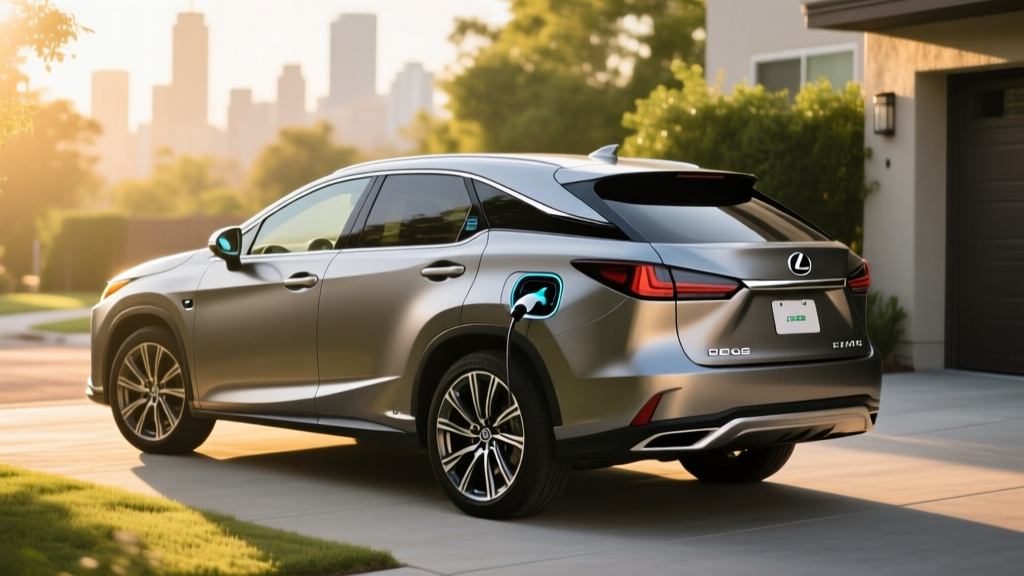
The midsize luxury SUV segment has no shortage of electrified options, but the Lexus RX 350h hybrid SUV occupies a specific niche: buyers who want premium comfort and dramatically better fuel economy without ever plugging in. For the 2026 model year, the RX 350h continues as the conventional hybrid (HEV) variant of Lexus's best-selling nameplate, sitting between the turbocharged RX 350 and the plug-in hybrid RX 500h in the lineup.
If you've been cross-shopping luxury hybrids and wondering whether the RX 350h's 36 MPG EPA combined rating holds up in real-world driving — or whether you'd be better served by the plug-in RX 500h or a full battery-electric SUV — this guide breaks down every number that matters.
Lexus RX 350h vs. RX 500h: HEV vs. PHEV Explained
Before diving into specs, it's essential to understand the fundamental difference between the two electrified RX variants, because confusing them is one of the most common buyer mistakes.
| Attribute | RX 350h (HEV) | RX 500h (PHEV) |
|---|---|---|
| Type | Conventional Hybrid | Plug-in Hybrid |
| Needs to plug in? | No — self-charging via regenerative braking and engine | Yes — plugs into Level 1 or Level 2 charger |
| Electric-only range | None (EV mode limited to ~1 mile at low speed) | ~37 miles EPA electric-only |
| Battery size | ~1.6 kWh (small, nickel-metal hydride or lithium-ion) | ~18.1 kWh usable (lithium-ion) |
| DC fast charging | Not applicable | No — AC Level 2 only |
| Combined output | 246 hp | 366 hp (turbo hybrid) |
| Federal tax credit | Not eligible (§30D requires plug-in) | Eligibility depends on sourcing & income caps |
The bottom line: The RX 350h is a self-charging hybrid. You fuel it with gasoline and the hybrid system recovers energy during braking and deceleration to assist the engine. The RX 500h (and its sibling, the RX 450h+) is a plug-in hybrid that can drive on electricity alone for roughly 37 miles before the gasoline engine kicks in. If your daily commute is under 35 miles and you have home charging, the PHEV variant may eliminate most of your gasoline use. If you don't have reliable charging access or want simplicity, the RX 350h is the pragmatic choice.
Fuel Economy: EPA Ratings and Real-World MPG
According to fueleconomy.gov, the 2026 Lexus RX 350h achieves the following EPA estimates with all-wheel drive (the only drivetrain offered on the 350h):
| Driving Cycle | EPA Estimate | Real-World Expectation |
|---|---|---|
| City | 37 MPG | 35–40 MPG (hybrids often beat EPA in city due to regenerative braking) |
| Highway | 34 MPG | 30–33 MPG (sustained 75+ MPH reduces hybrid advantage) |
| Combined | 36 MPG | 33–37 MPG depending on driving mix |
Why real-world MPG varies: Hybrid systems shine in stop-and-go city driving, where the electric motor handles low-speed propulsion and regenerative braking recaptures energy that would otherwise be lost as heat. On long highway cruises at 75-80 MPH, the gasoline engine does most of the work, and aerodynamic drag dominates. Expect to see 38-40 MPG on suburban errands with frequent stops, but closer to 30-32 MPG on a flat interstate at 80 MPH. In cold weather (below 30°F), expect a 5-10% reduction as the engine runs more frequently to provide cabin heat and maintain battery temperature.
Compared to the non-hybrid RX 350 AWD (24 MPG combined), the 350h delivers a 50% improvement in fuel economy. Over 15,000 miles per year at $3.50/gallon, that translates to roughly $875 in annual fuel savings — or about $4,375 over five years.
Powertrain and Performance Specs
| Specification | 2026 Lexus RX 350h AWD |
|---|---|
| Engine | 2.5L inline-4 Atkinson-cycle |
| Electric motors | Front + rear (e-AWD) |
| Combined system output | 246 hp |
| 0–60 MPH | 7.4 seconds |
| Transmission | eCVT (electronically controlled) |
| Drivetrain | AWD (standard, electric rear motor) |
| Towing capacity | 3,500 lbs |
| Cargo volume (behind 2nd row) | 29.6 cu ft |
| Cargo volume (seats folded) | 46.2 cu ft |
The 246-horsepower output won't thrill enthusiasts — that's the RX 500h's job with its 366-hp turbocharged hybrid setup. But the 350h's electric motors provide immediate low-end torque, making it feel responsive around town despite the modest peak number. The eCVT is smooth and drone-free under normal acceleration, a hallmark of Toyota/Lexus hybrid synergy drive. The electric rear axle provides all-wheel-drive traction without a mechanical driveshaft, improving efficiency and packaging.
Pricing, Trims, and Tax Credit Eligibility
The 2026 Lexus RX 350h starts at approximately $52,710 (including destination) for the base Premium trim and climbs to around $62,000 for the fully loaded Luxury trim. Here's how the trims break down:
- Premium: ~$52,710 — heated/ventilated front seats, 9.8-inch touchscreen, wireless CarPlay/Android Auto
- Premium+: ~$55,210 — panoramic roof, larger 14-inch display, power-folding rear seats
- Luxury: ~$59,710 — semi-aniline leather, 21-inch wheels, adaptive suspension
- F SPORT Handling: ~$57,500 — sport-tuned suspension, F SPORT seats, unique styling
Federal Tax Credit: Not Eligible
The Lexus RX 350h is a conventional hybrid (HEV), not a plug-in vehicle. Under IRS §30D rules, only plug-in electric vehicles (PHEVs and BEVs) with a battery capacity of at least 7 kWh qualify for the federal clean vehicle credit. The RX 350h's ~1.6 kWh battery falls well below this threshold. If the $7,500 federal tax credit is a priority, you'll need to look at the RX 450h+/500h PHEV (if eligible under current critical-mineral and battery-sourcing rules) or a fully electric alternative. Always verify current eligibility on irs.gov, as sourcing requirements and MSRP/income caps change.
Some states offer their own hybrid incentives — for example, certain utility companies provide rebates for purchasing any electrified vehicle, including HEVs. Check your state energy office or local utility for programs, but don't count on significant incentives for a conventional hybrid at the federal level.
Battery Warranty, Reliability, and Replacement Cost
Hybrid battery longevity is consistently the top concern for first-time hybrid buyers. Here's what Lexus provides:
- Hybrid battery warranty: 10 years / 150,000 miles (whichever comes first), transferable to subsequent owners
- Hybrid system components warranty: 8 years / 100,000 miles (covers inverter, electric motors, control module)
- New vehicle limited warranty: 4 years / 50,000 miles
- Powertrain warranty: 6 years / 70,000 miles
Real-world reliability: Lexus and Toyota have built millions of hybrids since the 2001 Prius, and their hybrid systems are among the most proven in the industry. The RX 350h uses a relatively small battery that is never fully depleted or fully charged — the system maintains a state-of-charge window (roughly 40-80%) to minimize degradation. Based on data from previous-generation RX 450h models, hybrid battery failure before 150,000 miles is rare. Consumer Reports and J.D. Power consistently rank Lexus at or near the top for long-term reliability.
Battery replacement cost: If the hybrid battery does need replacement out of warranty, expect $3,000–$5,000 for a refurbished or new unit including labor at a Lexus dealer. Independent hybrid specialists often offer replacements for $2,000–$3,500. Some shops offer individual cell module replacement for $500–$1,500 if only a portion of the pack has degraded. Given the 10-year/150,000-mile warranty, most original owners will never face this cost.
Who Should Choose the RX 350h Over an EV or Gas SUV?
Choose the Lexus RX 350h if:
- You don't have access to home or workplace charging (apartment, street parking)
- You want luxury SUV comfort with 35+ MPG without changing your fueling habits
- You regularly take long road trips and don't want to plan around charging stops
- You value Lexus's proven hybrid reliability and strong resale value
- Your daily driving is a mix of city and highway, not a short fixed commute
Choose a PHEV (RX 450h+/500h) instead if:
- You have Level 2 home charging and a commute under 37 miles
- You want electric-only driving for daily errands with gas-engine flexibility for road trips
- You want to qualify for potential federal tax credits (subject to §30D sourcing rules)
Choose a full EV (e.g., Genesis Electrified GV70, BMW iX) instead if:
- You have reliable home Level 2 charging
- You want zero tailpipe emissions and minimal drivetrain maintenance
- Your daily driving is under 250 miles and you're comfortable with DC fast charging on road trips
Pros and Cons at a Glance
Pros
- 36 MPG combined — exceptional for a luxury midsize SUV
- No plug-in charging required; fuel it like any gas car
- Smooth, quiet powertrain with seamless electric assist
- 10-year/150,000-mile hybrid battery warranty
- Strong Lexus reliability record and resale value
- Standard AWD with electric rear axle
Cons
- 246 hp feels merely adequate — not sporty
- No federal tax credit eligibility
- Premium starting price ($52,710) is steep vs. non-hybrid RX 350
- eCVT can drone under hard acceleration
- Hybrid battery reduces cargo space slightly vs. non-hybrid (minimal)
- No DC fast charging or meaningful electric-only driving
Frequently Asked Questions
How many MPG does the Lexus RX 350h hybrid SUV get?
The EPA rates the 2026 RX 350h AWD at 37 MPG city, 34 MPG highway, and 36 MPG combined. In real-world driving, owners typically report 33–40 MPG depending on their city/highway mix. City-heavy driving often exceeds the EPA estimate thanks to regenerative braking, while sustained highway speeds above 75 MPH tend to return 30–33 MPG.
Does the Lexus RX 350h need to be plugged in?
No. The RX 350h is a conventional hybrid (HEV). Its small battery charges through regenerative braking and the gasoline engine. You never plug it in — just fill it with regular unleaded gasoline (premium is not required).
How far can the RX 350h drive on electric power alone?
Effectively less than one mile at very low speeds (under 25 MPH) in EV mode. The 350h's ~1.6 kWh battery is designed to assist the engine, not to provide standalone electric driving. If electric-only commuting is your goal, look at the RX 450h+ plug-in hybrid (~37 miles electric) or a full BEV.
Is the Lexus RX 350h hybrid reliable?
Yes. Lexus's hybrid system is one of the most proven in the automotive industry, with over two decades of iterative refinement across millions of vehicles. The hybrid battery is warranted for 10 years/150,000 miles, and real-world data from prior RX hybrid generations shows battery failures within that period are uncommon. Lexus consistently tops J.D. Power and Consumer Reports reliability rankings.
What does it cost to replace the hybrid battery?
Out-of-warranty replacement at a Lexus dealer typically runs $3,000–$5,000. Independent hybrid specialists may offer replacements for $2,000–$3,500, and individual cell module repairs can cost as little as $500–$1,500. Most owners will never need this service within the 10-year/150,000-mile warranty window.
Does the Lexus RX 350h qualify for a federal tax credit?
No. The federal §30D clean vehicle credit requires a plug-in vehicle with a battery capacity of at least 7 kWh. The RX 350h's ~1.6 kWh battery does not qualify. The plug-in RX 450h+ or RX 500h may qualify depending on current-year battery sourcing, MSRP caps, and buyer income limits — verify on irs.gov.
Hybrid vs. PHEV vs. EV — which RX is right for me?
Choose the RX 350h (HEV) if you want maximum simplicity, no charging infrastructure, and 36 MPG everywhere. Choose the RX 450h+/500h (PHEV) if you can charge at home and want ~37 miles of electric-only commuting with gas backup. Choose a full EV (outside the RX lineup) if you want zero tailpipe emissions, the lowest per-mile fuel cost, and have reliable home charging. The right answer depends entirely on your charging access and daily mileage pattern.
The 2026 Lexus RX 350h hybrid SUV isn't trying to be revolutionary. It's a refinement play — taking one of the most popular luxury SUVs in America and making it significantly more efficient without asking the buyer to change a single habit. If your priority is fuel savings, proven reliability, and zero charging hassle, the 350h delivers exactly what it promises, mile after unremarkable mile. And in the luxury hybrid segment, unremarkable reliability is exactly what you're paying for.