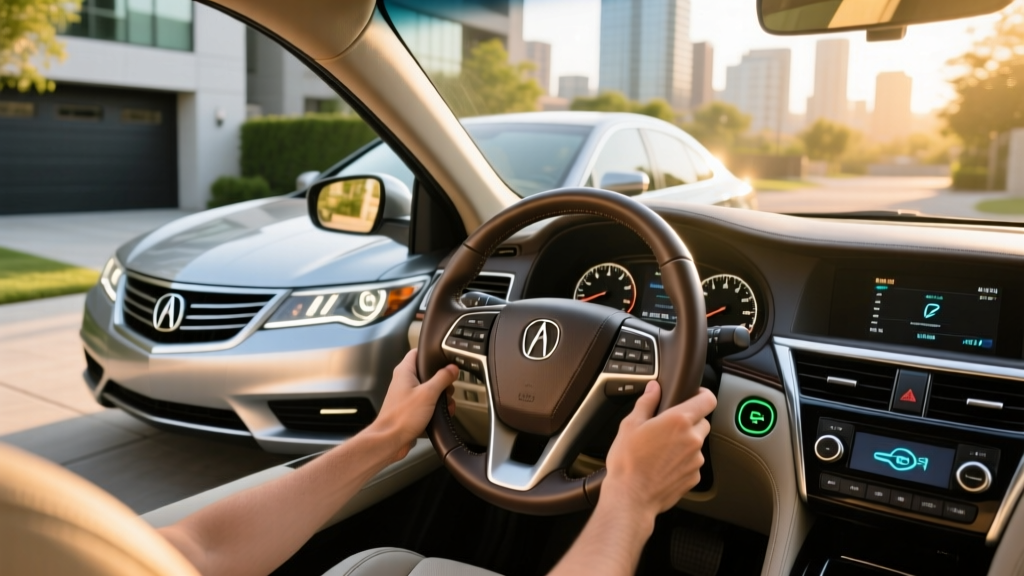
The 2014 Acura RLX Sport Hybrid SH-AWD was a flagship experiment: a full-size luxury sedan packing three electric motors, a 3.5-liter V6, and a seven-speed dual-clutch transmission into a package that returned an EPA-estimated 29 MPG combined. A decade later, it remains a fascinating used-car proposition for buyers who want luxury, all-wheel drive, and hybrid efficiency without plugging in. But is the complex powertrain reliable? What does battery replacement cost? And how does it stack up against modern hybrids and EVs?
This guide covers every number a used RLX Hybrid buyer needs — from real-world fuel economy to hybrid battery warranty status in 2026 — and helps you decide whether this discontinued Acura flagship still earns a spot in your driveway.
2014 Acura RLX Hybrid: Powertrain and Performance Specs
The 2014 RLX Sport Hybrid pairs a 310-horsepower 3.5-liter V6 with three electric motors — one integrated between the engine and transmission to assist the front wheels, and two independent motors powering each rear wheel. The result is Acura's Sport Hybrid SH-AWD (Super Handling All-Wheel Drive), which can vector torque across the rear axle for sharper cornering.
| Spec | Value |
|---|---|
| Combined System Output | 377 hp |
| Gas Engine | 3.5L V6, 310 hp / 272 lb-ft |
| Electric Motors | 3 total (1 front, 2 rear) |
| Transmission | 7-speed dual-clutch automatic |
| Drivetrain | SH-AWD (torque-vectoring AWD) |
| 0–60 mph | ~5.2 seconds |
| Battery Type | Lithium-ion, ~1.3 kWh (not plug-in) |
| EPA Fuel Economy | 29 city / 31 hwy / 29 combined MPG |
| Fuel Tank | 15.8 gallons |
| Total Range | ~458 miles |
| Original MSRP (2014) | ~$65,950 (Sport Hybrid Tech); ~$70,950 (Advance) |
| Avg. Used Price (2026 est.) | $12,000–$18,000 depending on mileage/condition |
Important distinction: the 2014 RLX Sport Hybrid is a conventional hybrid (HEV), not a plug-in hybrid (PHEV). It has no charge port, no electric-only range to speak of (the small battery assists during acceleration and enables brief low-speed electric creep), and it never needs to be plugged in. You refuel it exactly like a gas car — the hybrid system recovers energy through regenerative braking and engine-driven generation.
Fuel Economy: EPA vs. Real-World MPG
The EPA rated the 2014 RLX Sport Hybrid at 29 city / 31 highway / 29 combined MPG. That highway-biased rating is unusual for a hybrid — most hybrids earn higher city numbers thanks to regenerative braking and electric assist at low speeds. The RLX's relatively low city figure reflects the sedan's substantial weight (~4,400 lbs) and the complexity of its dual-clutch transmission, which doesn't always seamlessly integrate the electric motor at stop-and-go speeds.
| Cycle | EPA Rating | Real-World Expectation |
|---|---|---|
| City | 29 MPG | 26–30 MPG |
| Highway | 31 MPG | 28–33 MPG |
| Combined | 29 MPG | 27–31 MPG |
Real-world note: Owner forums and fueleconomy.gov user reports suggest most RLX Hybrid owners average between 25 and 30 MPG in mixed driving. Highway cruising at 70–75 mph with light loads can push toward 32–33 MPG. Cold weather and aggressive driving can drop city numbers into the low-to-mid 20s. The RLX Hybrid's efficiency advantage over the non-hybrid RLX (20/31/24 MPG for the FWD V6) is most pronounced in mixed and city driving, where the electric motors reduce engine load.
HEV vs. PHEV vs. EV: Where Does the RLX Hybrid Fit?
If you're cross-shopping the used RLX Hybrid against newer electrified vehicles, understanding the fundamental architecture differences is essential:
HEV vs. PHEV vs. BEV — Quick Comparison
| Feature | HEV (RLX Hybrid) | PHEV (e.g., Toyota RAV4 Prime) | BEV (e.g., Tesla Model S) |
|---|---|---|---|
| Plug-in required? | No | Yes (optional) | Yes (mandatory) |
| Electric-only range | ~0 miles (assist only) | 25–42 miles typical | 250–400+ miles |
| Gas engine? | Yes (primary) | Yes (backup) | No |
| Fuel/energy cost per mile | ~$0.12–$0.15 | ~$0.04–$0.12 | ~$0.03–$0.08 |
| Home charging needed? | No | Recommended | Yes |
| Federal tax credit (new) | None | Up to $7,500 (§30D) | Up to $7,500 (§30D) |
The RLX Hybrid makes sense for drivers who want lower fuel consumption than a comparable gas luxury sedan but have no access to home or workplace charging. If you do have charging access, a modern PHEV or BEV will deliver dramatically lower per-mile energy costs and a smoother, quieter driving experience.
Battery Health, Warranty, and Replacement Cost
The 2014 RLX Hybrid's lithium-ion battery pack is small (~1.3 kWh) and operates within a narrow state-of-charge window — Acura's hybrid management system rarely lets it fully charge or fully deplete, which reduces degradation. This is a key longevity advantage over early PHEVs and BEVs that cycled their larger batteries more aggressively.
Battery Warranty Callout
Original warranty: Acura covered the RLX Hybrid's IMA (Integrated Motor Assist) battery and hybrid system components for 8 years / 100,000 miles (extended to 10 years / 150,000 miles in California Air Resources Board states).
2026 status: A 2014 model's factory hybrid battery warranty has expired as of 2022 at the latest (8 years from the model year). Buyers are purchasing the battery "as-is" unless a previous owner purchased an extended warranty or the battery was already replaced.
Replacement cost: A new OEM hybrid battery pack for the RLX Sport Hybrid runs approximately $2,500–$4,000 including labor at an Acura dealer. Independent hybrid specialists may offer refurbished packs for $1,500–$2,500. Given the small battery size and conservative charge management, outright battery failure is uncommon — more likely is gradual capacity loss that reduces the electric motor's assist contribution, resulting in slightly lower MPG over time rather than a vehicle-stopping fault.
Before buying, request a hybrid system diagnostic from an Acura dealer or qualified independent shop. They can read the battery's state-of-health (SoH) data and check for stored fault codes related to the IMA system, DC-DC converter, or rear electric motors.
Ownership Costs: Insurance, Maintenance, and Depreciation
The RLX Hybrid has already absorbed most of its depreciation. Original MSRPs of $65,000–$71,000 have collapsed to the $12,000–$18,000 range for examples with 80,000–130,000 miles. That's a steep value proposition for a 377-hp luxury AWD sedan. But ongoing costs deserve scrutiny:
- Insurance: Expect $1,400–$2,000 annually depending on your profile — roughly comparable to a non-hybrid RLX, though some insurers charge a small premium for the hybrid powertrain's repair complexity.
- Maintenance: The 3.5L V6 is a well-known Honda/Acura engine (shared with the Accord and MDX) with straightforward service intervals. The 7-speed dual-clutch transmission, however, is unique to the RLX Hybrid and can be costly to service if issues arise. Transmission fluid changes are critical — follow Acura's schedule strictly.
- Tires: The SH-AWD system and ~4,400-lb curb weight accelerate tire wear. Budget for premium all-season or touring tires ($800–$1,200 per set) every 30,000–40,000 miles.
- Fuel: At 29 MPG combined and $3.50/gallon premium (required), annual fuel cost for 12,000 miles is approximately $1,450 — roughly $500–$700 less per year than the non-hybrid V6 RLX.
Does the 2014 RLX Hybrid Qualify for Any Tax Credit?
No. The 2014 Acura RLX Sport Hybrid does not qualify for the federal §30D Clean Vehicle Credit, for two reasons:
- It is a conventional hybrid (HEV), not a plug-in electric vehicle. The §30D credit applies only to PHEVs and BEVs with sufficient battery capacity (at least 7 kWh for new vehicles, 4 kWh for the older credit structure that applied in 2014).
- Even as a used vehicle, the Used Clean Vehicle Credit (up to $4,000 or 30% of sale price, whichever is less) applies only to plug-in EVs and fuel-cell vehicles — not conventional hybrids.
Some states offer modest incentives for used hybrid purchases, but these vary widely. Check your state's energy or environmental agency website for current programs. For federal rules, the IRS Clean Vehicle Credits page provides the definitive eligibility criteria.
Who Should Buy the 2014 RLX Hybrid — and Who Shouldn't
Pros
- 377 hp with AWD and ~29 MPG — rare combination
- SH-AWD torque vectoring is genuinely engaging
- No charging infrastructure needed
- Deep depreciation means strong value at $12K–$18K
- Spacious, well-insulated cabin with premium materials
- Proven 3.5L V6 engine (widely serviced)
Cons
- Complex 7-speed DCT and 3-motor hybrid system — expensive to repair
- Factory battery warranty expired; replacement is $2,500–$4,000
- Infotainment and safety tech are a decade behind modern cars
- No plug-in capability; can't access HOV lanes or EV incentives
- Higher weight hurts city MPG vs. lighter hybrids
- Limited dealer familiarity with the Sport Hybrid system in 2026
Decision Framework
Choose the RLX Hybrid if: You want a comfortable, powerful AWD luxury sedan for under $20,000, you lack home charging access, and you're comfortable budgeting for potential hybrid-system repairs out of warranty.
Skip it and consider a PHEV/BEV if: You have Level 2 charging at home, want the lowest possible per-mile energy cost, value modern ADAS and infotainment, or want to qualify for federal/state EV incentives on a newer vehicle.
Consider a non-hybrid RLX or TLX if: You prioritize lower repair complexity and can accept 24 MPG combined — the non-hybrid powertrain is simpler and cheaper to maintain long-term.
Frequently Asked Questions
How many MPG does the 2014 Acura RLX Hybrid get?
The EPA rates it at 29 city / 31 highway / 29 combined MPG. Real-world owners typically report 25–30 MPG in mixed driving, with highway cruising sometimes reaching 32–33 MPG. See fueleconomy.gov for the official data.
Can the 2014 RLX Hybrid drive on electric power only?
Not in any meaningful way. The RLX Sport Hybrid is a conventional HEV with a ~1.3 kWh battery. The electric motors assist the gas engine during acceleration and can power the car at very low speeds for brief moments, but there is no usable electric-only range. This is fundamentally different from a PHEV, which can travel 25–42 miles on electricity alone.
Is the 2014 RLX Hybrid reliable?
The 3.5L V6 engine is one of Honda/Acura's most proven powerplants. The main reliability concern is the 7-speed dual-clutch transmission and the three-motor SH-AWD system, both of which are complex and expensive to repair. The hybrid battery itself is generally durable thanks to conservative charge management, but at 10+ years old, some capacity loss is expected. Budget $2,000–$4,000 for a potential battery replacement during ownership.
What does a replacement hybrid battery cost for the RLX?
An OEM replacement lithium-ion pack runs approximately $2,500–$4,000 at an Acura dealer including labor. Refurbished or aftermarket packs from hybrid specialists may cost $1,500–$2,500. The original 8-year/100,000-mile hybrid warranty has expired for all 2014 models.
Does the 2014 RLX Hybrid qualify for any tax credit in 2026?
No. Federal tax credits under §30D apply only to plug-in vehicles (PHEVs and BEVs). The RLX Hybrid is a conventional HEV and does not qualify for new or used clean vehicle credits. Check your state's environmental or energy agency for any local hybrid incentives, though most have shifted focus to plug-in vehicles.
Should I buy the RLX Hybrid or a modern PHEV like the Toyota Camry Hybrid?
It depends on budget and priorities. A used 2014 RLX Hybrid ($12K–$18K) offers more power, luxury, and AWD for the money than a new Camry Hybrid (~$30K+), but the Toyota will deliver 44–52 MPG, a full factory warranty, modern safety tech, and far lower repair risk. If reliability and efficiency are paramount, the newer Camry Hybrid wins. If you want luxury AWD performance on a tight budget, the RLX Hybrid is compelling — with a repair-fund caveat.
Sources: U.S. EPA / fueleconomy.gov, IRS Clean Vehicle Credits, Acura Newsroom (2014 RLX press kit).