The three-row luxury SUV segment rarely rewards fuel efficiency, but the Lexus TX lineup tries to change that equation. If you're researching Lexus TX hybrid MPG numbers, you're likely cross-shopping this midsize hauler against rivals like the BMW X5, Volvo XC90, or the fully electric Rivian R1S. The TX offers two electrified paths: the conventional hybrid TX 500h and the plug-in hybrid TX 550h+. Both deliver meaningfully better fuel economy than a gas-only three-row SUV, but the numbers, ownership experience, and tax-credit eligibility diverge sharply between them.
Below is a data-driven breakdown of what the EPA says, what real-world driving actually yields, and which TX powertrain fits your commute.
2026 Lexus TX Hybrid MPG: EPA Ratings at a Glance
| Model | Powertrain | City MPG | Highway MPG | Combined MPG | Combined MPGe (PHEV) |
|---|---|---|---|---|---|
| TX 500h | HEV (2.4L turbo + hybrid) | 27 | 28 | 27 | N/A |
| TX 550h+ | PHEV (3.5L V6 + plug-in hybrid) | 64 MPGe | 65 MPGe | 64 MPGe | 64 MPGe |
| TX 550h+ (charge-sustaining) | PHEV — gas-only mode | 26 | 27 | 26 | N/A |
| TX 350 (gas baseline) | 2.4L turbo gas | 20 | 26 | 22 | N/A |
The TX 500h hybrid delivers a combined 27 MPG — a 23% improvement over the gas-only TX 350. The TX 550h+ plug-in hybrid achieves 64 MPGe when operating on its combined electric-and-gas cycle, though that number only applies while the battery has charge. Once depleted, the TX 550h+ reverts to approximately 26 MPG combined as a conventional hybrid.
Source: fueleconomy.gov — U.S. EPA official ratings.
TX 500h vs TX 550h+: HEV and PHEV Explained
Conventional Hybrid (HEV) — TX 500h: The TX 500h pairs a 2.4-liter turbocharged four-cylinder engine with a hybrid electric motor system and a small 1.8 kWh nickel-metal hydride (NiMH) battery pack. It recovers energy through regenerative braking and engine assist — you never plug it in. The battery is charged entirely by the powertrain. Think of it as a more efficient gas car that happens to use electric assist.
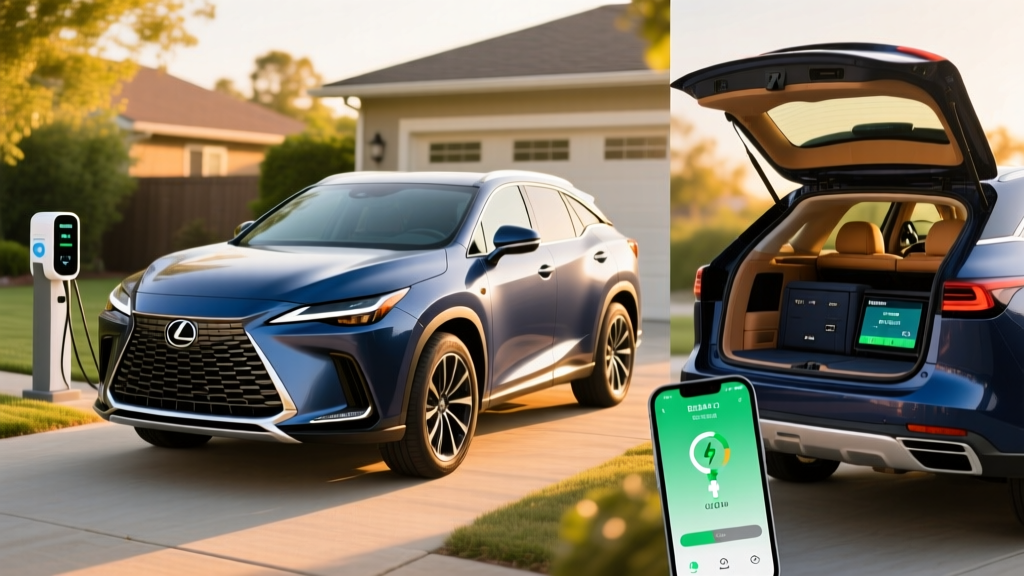
Plug-In Hybrid (PHEV) — TX 550h+: The TX 550h+ pairs a 3.5-liter V6 with a larger 20.5 kWh (gross) lithium-ion battery and a more powerful electric drive system. You can and should plug it in to unlock its full efficiency potential. When charged, it can drive on electricity alone before the gas engine engages.
The critical distinction: the TX 500h never requires plugging in and is ideal for drivers without reliable home or workplace charging access. The TX 550h+ rewards daily plugging with dramatically lower fuel consumption on shorter commutes, but if you never charge it, you're carrying 300+ extra pounds of battery for no benefit — effectively getting similar MPG to the TX 500h at a higher purchase price.
PHEV Electric-Only Range and Total Range
The TX 550h+ delivers an EPA-estimated 33 miles of electric-only range. That's enough to cover the average American one-way commute (roughly 16 miles each way per BTS data) entirely on electricity, with the gas engine only engaging for longer trips or hard acceleration.
- EPA sticker: 33 miles EV-only
- Mild weather, city driving: 30–35 miles (regenerative braking extends range)
- Highway at 70+ mph: 22–26 miles (aerodynamic drag and no regen benefit)
- Cold weather (below 30°F): 20–25 miles (battery chemistry slows, cabin heating draws power)
With a full tank of gas and a depleted battery, total combined range is approximately 420–440 miles.
Charging the TX 550h+
| Battery capacity (gross / usable) | 20.5 kWh / ~17.5 kWh |
| Level 1 (120V household outlet) | ~1.4 kW — 0 to full in ~12 hours |
| Level 2 (240V home charger) | ~6.6 kW — 0 to full in ~2.5 hours |
| DC fast charging | Not supported |
| Charge connector | J1772 (Level 1/2) |
The TX 550h+ does not support DC fast charging — a common limitation among PHEVs. With a Level 2 home charger (the 240V setup most EV owners install), a full charge takes roughly 2.5 hours, meaning you can easily recharge overnight or top up during a workday. On a standard 120V outlet, plan for 12+ hours, which works for overnight charging but won't fully replenish if you drain the battery mid-day.
Powertrain Specs: Horsepower and Performance
| Specification | TX 500h (HEV) | TX 550h+ (PHEV) | TX 350 (Gas) |
|---|---|---|---|
| Engine | 2.4L turbo I-4 + hybrid motor | 3.5L V6 + plug-in hybrid motors | 2.4L turbo I-4 |
| Combined horsepower | 366 hp | 406 hp | 275 hp |
| Combined torque | 406 lb-ft | 400+ lb-ft | 317 lb-ft |
| 0–60 mph | ~5.9 sec | ~5.6 sec | ~7.1 sec |
| Drivetrain | AWD (DIRECT4) | AWD (E-Four) | FWD or AWD |
| Transmission | 6-speed automatic | e-CVT | 8-speed automatic |
| Towing capacity | 5,000 lbs | 5,000 lbs | 5,000 lbs |
Both hybrid variants substantially outperform the base gas TX 350 in acceleration, thanks to the instant torque from their electric motors. The TX 500h's DIRECT4 all-wheel-drive system can shift torque between front and rear axles in milliseconds, providing confident grip in rain or light snow without the efficiency penalty of traditional mechanical AWD.
Real-World MPG: What Owners Actually See
EPA estimates are standardized test cycles, but real-world driving introduces variables like terrain, temperature, driving style, and trip length. Here's what to expect from the TX hybrid lineup based on typical owner driving patterns:
TX 500h (HEV) real-world MPG:
- City driving: 28–30 MPG — hybrids often exceed EPA city estimates because stop-and-go traffic maximizes regenerative braking and electric-motor usage.
- Highway (65–75 mph): 25–27 MPG — the turbo engine works harder at sustained speeds, and there's less regen opportunity.
- Cold weather (below 25°F): 23–25 MPG combined — the engine runs more frequently to generate cabin heat and maintain battery temperature.
- Mountainous terrain: 22–24 MPG uphill; regen recovers some energy on descents.
TX 550h+ (PHEV) real-world efficiency:
- Daily commute under 33 miles + nightly charging: Near-zero gasoline consumption on most days. Owners report using 1–2 tanks per month in this pattern.
- Road trips (battery depleted): 24–27 MPG — essentially TX 500h efficiency with extra battery weight.
- Neglected charging (never plugging in): 24–26 MPG combined — you're paying the PHEV premium without the benefit.
The TX 500h's real-world advantage over its EPA rating in city driving is a well-documented hybrid trait. Toyota/Lexus hybrid systems are optimized for low-speed electric assist, making them particularly efficient in urban congestion where gas-only vehicles are at their worst.
Pricing, Trims, and Tax Credit Eligibility
| Model & Trim | Base MSRP | Est. After Federal Credit |
|---|---|---|
| TX 500h Premium | $64,500 | $64,500 (no credit) |
| TX 500h Luxury | $69,500 | $69,500 (no credit) |
| TX 550h+ Luxury | $74,500 | ~$67,000 (if eligible*) |
| TX 550h+ Executive | $79,000 | ~$71,500 (if eligible*) |
* Federal tax credit eligibility is not guaranteed and depends on multiple IRS §30D requirements.
- Maximum credit: Up to $7,500 — split into $3,750 for critical-mineral sourcing and $3,750 for battery-component sourcing. As of 2026, many PHEVs qualify for $3,750 (one of two requirements met).
- Buyer income caps: AGI ≤ $150,000 (single) / $300,000 (joint) / $225,000 (head of household).
- MSRP cap: SUVs/vans ≤ $80,000. All TX 550h+ trims currently fall under this cap.
- Battery sourcing rules: Critical minerals and battery components must meet escalating domestic/F.T.A.-partner sourcing thresholds. Verify current-year compliance at irs.gov.
- Point-of-sale transfer: Eligible buyers can transfer the credit to the dealer at purchase, reducing the out-of-pocket price immediately rather than waiting for tax filing.
- TX 500h (HEV): Conventional hybrids do not qualify for the §30D new clean vehicle credit — this credit applies only to plug-in vehicles (BEVs and PHEVs with ≥7 kWh battery).
Always confirm eligibility with a tax professional and check the latest IRS guidance before purchasing. Credit rules and sourcing requirements have changed annually since 2023.
Battery Warranty, Reliability, and Replacement Costs
- TX 500h (HEV): 10 years / 150,000 miles hybrid battery warranty (whichever comes first)
- TX 550h+ (PHEV): 10 years / 150,000 miles plug-in hybrid battery warranty
- Hybrid system components: 8 years / 100,000 miles (inverters, control modules)
- Capacity retention: Lexus warrants that the PHEV battery will retain sufficient capacity to deliver meaningful EV range during the warranty period, though an exact percentage threshold is not published.
How Reliable Are Lexus Hybrids?
Lexus (and parent company Toyota) has the deepest track record in hybrid powertrains of any automaker, with over 25 years of hybrid production since the original Prius. The TX 500h's hybrid system uses a proven architecture shared across the Toyota/Lexus lineup, and the brand consistently tops J.D. Power dependability studies.
For the TX 550h+, the plug-in hybrid system is newer to the TX nameplate but uses components derived from the NX 450h+ and RAV4 Prime — both of which have shown strong reliability in early owner surveys.
Battery Replacement Cost
This is the number-one concern for hybrid buyers, and it deserves a direct answer:
- TX 500h (HEV) battery replacement: Approximately $3,000–$5,000 out of warranty. The NiMH pack is smaller and less expensive than a full EV battery.
- TX 550h+ (PHEV) battery replacement: Approximately $8,000–$12,000 out of warranty. The larger lithium-ion pack carries higher material costs.
- Reality check: Toyota/Lexus hybrid batteries routinely last 150,000–200,000+ miles before significant degradation. Many first-generation Prius packs are still operating at 200,000+ miles. Out-of-warranty failure is uncommon in the vehicle's first 10–12 years.
The 10-year/150,000-mile warranty provides substantial protection, and most owners will sell or trade the vehicle before battery replacement becomes a concern. If you plan to keep the TX past 150,000 miles, budgeting for a potential replacement in years 12–15 is prudent but statistically unlikely to be needed immediately.
Hybrid vs PHEV vs Full EV: Which TX Fits You?
- You don't have access to home or workplace Level 2 charging.
- You want better fuel economy without changing your habits — no plugging in, no range planning.
- Your typical drives are a mix of city and highway with no single dominant pattern.
- You want a lower purchase price and don't qualify for the PHEV tax credit.
- You can install a Level 2 charger at home and will plug in nightly.
- Your daily round-trip commute is under 35 miles — you'll rarely use gas on weekdays.
- You qualify for the federal tax credit (income and sourcing requirements met).
- You want EV-like daily driving with the security of a gas engine for road trips.
- You have reliable home charging and access to DC fast-charging networks for road trips.
- Your daily driving is predictable and within the EV's range.
- You want the lowest per-mile fuel cost (~$0.04–0.06/mile on home electricity vs $0.12–0.18/mile for the TX hybrids on gas).
- You're ready to commit to the EV charging ecosystem.
5-Year Cost of Ownership Snapshot
| Cost Factor | TX 350 (Gas) | TX 500h (HEV) | TX 550h+ (PHEV) |
|---|---|---|---|
| Purchase price (base MSRP) | $56,000 | $64,500 | $74,500 |
| Federal tax credit | $0 | $0 | ~$3,750–$7,500* |
| Fuel / electricity (5 yr) | ~$11,250 | ~$8,900 | ~$4,500–$6,500** |
| Estimated maintenance | ~$3,500 | ~$3,000 | ~$3,000 |
| Insurance (avg) | ~$9,000 | ~$9,500 | ~$10,000 |
| Net 5-year cost (est.) | ~$79,750 | ~$85,900 | ~$78,250–$83,250 |
* Credit amount depends on sourcing compliance and buyer income. ** PHEV fuel cost assumes daily charging + occasional gas; without charging, costs approach the TX 500h.
The TX 500h costs more upfront than the gas TX 350 but saves roughly $2,350 in fuel over 5 years — not enough to fully offset the $8,500 price premium. The financial case for the TX 500h is strongest when you value the performance upgrade (366 hp vs 275 hp) and plan to keep the vehicle long-term, where fuel savings compound and maintenance stays lower.
The TX 550h+ makes the strongest economic case if you qualify for the full $7,500 credit and charge daily. In that scenario, the effective purchase price drops to ~$67,000, and the dramatically lower fuel cost narrows the gap with the gas model substantially over 5 years.
Frequently Asked Questions
How many MPG does the Lexus TX Hybrid get?
The TX 500h conventional hybrid gets an EPA-estimated 27 MPG combined (27 city / 28 highway). The TX 550h+ plug-in hybrid achieves 64 MPGe combined when using its electric range, and approximately 26 MPG combined once the battery is depleted and it operates as a conventional hybrid.
How far can the TX 550h+ drive on electric only?
The EPA rates the TX 550h+ at 33 miles of electric-only range. In real-world conditions, expect 30–35 miles in mild city driving, 22–26 miles at highway speeds, and 20–25 miles in cold weather below 30°F.
Does the Lexus TX Hybrid qualify for a tax credit?
The TX 550h+ plug-in hybrid may qualify for up to $7,500 in federal §30D tax credits, depending on battery-sourcing compliance, your income level, and current-year IRS rules. The TX 500h conventional hybrid does not qualify for the federal new clean vehicle credit, as it is not a plug-in vehicle. Check irs.gov for current eligibility details.
Is the Lexus TX Hybrid reliable?
Lexus has one of the strongest reliability records in the industry, and its hybrid powertrains have been refined over 25+ years of production. Both the TX 500h and TX 550h+ use proven hybrid architectures shared with other Toyota/Lexus models. The hybrid battery is covered by a 10-year / 150,000-mile warranty, and real-world data shows Toyota/Lexus hybrid batteries regularly lasting 150,000–200,000+ miles.
What does it cost to replace the hybrid battery?
Out-of-warranty replacement runs approximately $3,000–$5,000 for the TX 500h (NiMH pack) and $8,000–$12,000 for the TX 550h+ (lithium-ion pack). However, Lexus hybrid batteries are designed for the life of the vehicle and rarely fail before 150,000+ miles. The 10-year/150,000-mile warranty covers premature degradation or failure.
Do I need to plug in the TX 500h?
No. The TX 500h is a conventional hybrid (HEV) and charges its small battery entirely through regenerative braking and the gas engine. You fuel it like any other gas car. Only the TX 550h+ (PHEV) benefits from plugging in.
Can the TX 550h+ DC fast charge?
No. Like most plug-in hybrids, the TX 550h+ supports Level 1 (120V) and Level 2 (240V) AC charging only, via a J1772 connector. A full Level 2 charge takes approximately 2.5 hours. DC fast charging is not available — a trade-off for the smaller battery size.
Hybrid vs PHEV vs EV — which is right for me?
Choose the TX 500h (HEV) if you want better MPG without changing habits or needing a charger. Choose the TX 550h+ (PHEV) if you can charge at home and have a sub-35-mile daily commute. Choose a full EV if you have charging access, predictable driving patterns, and want the lowest per-mile energy cost. The PHEV is the bridge option — electric daily, gas for road trips.